
Concrete Restoration: Causes, Process, Repair Methods, Contractors and Cost
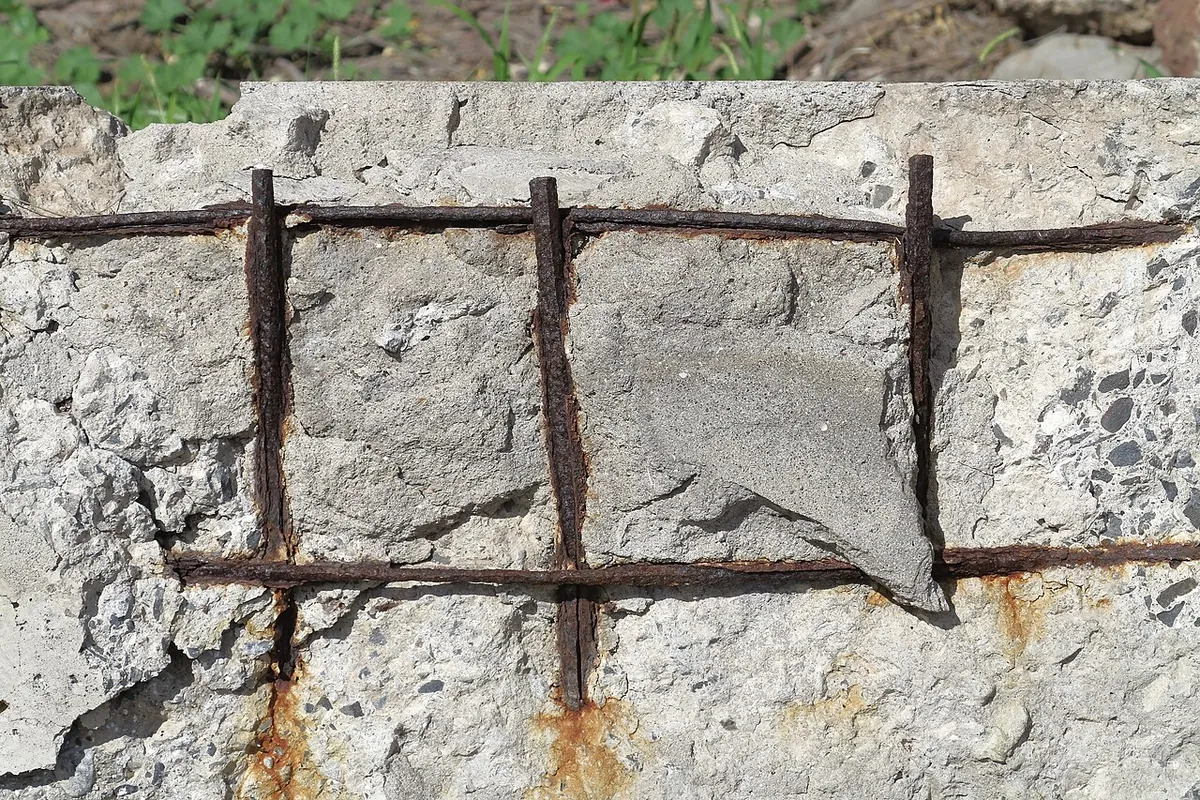
Photo: TeWeBs, Wikimedia Commons, CC BY-SA 4.0
Quick Answer
Concrete restoration is the process of repairing and protecting damaged or deteriorated concrete so it can serve safely for many more years, instead of being demolished and replaced. It usually follows six steps: assess the damage and its cause, remove unsound concrete, clean and treat the reinforcing steel, prepare the surface, rebuild with concrete repair mortar, new concrete or shotcrete, and protect it with sealers, coatings or membranes. The most common cause of damage is corrosion of the rebar, which cracks and spalls the concrete above it. Small residential concrete restoration jobs cost a few hundred to a few thousand dollars; structural concrete restoration of parking garages, balconies, bridges and buildings typically runs $30 to $150+ per square foot of repair area.
Concrete is durable, but it is not permanent, which is why concrete restoration is a large industry. Over decades, water, salt, freezing, carbon dioxide from the air and heavy use wear it down. The damage often starts hidden inside: reinforcing steel slowly rusts, the rust takes up more space than the steel, and the concrete covering it cracks and breaks away, exactly as in the photo above, where corroded bars are fully exposed on a wall. Concrete restoration stops that process, rebuilds what has been lost, and protects the structure so the problem does not come back.
This guide explains what concrete restoration covers, the main causes of concrete damage, how concrete restoration projects are assessed and carried out, the repair methods used, residential and commercial applications, how to choose a contractor, and what concrete restoration costs.
What Is Concrete Restoration?
Concrete restoration is a broad term for work that returns existing concrete to good condition. It includes structural concrete repair of beams, columns, slabs and walls; surface concrete repair of spalls, scaling and cracks; strengthening of members that have lost capacity; resurfacing and overlays that renew worn surfaces; and protective systems that slow future damage. It differs from simple patching in its focus on finding and treating the cause of the damage, not just filling the hole, and in following engineered procedures and industry standards such as the International Concrete Repair Institute (ICRI) guidelines and ACI 562, the code for evaluation, repair and rehabilitation of existing concrete structures.
The term also covers the concrete restoration of historic and architectural concrete, where the goal is to repair damage while preserving the original appearance, color and texture of an older building or monument. And on the residential side, many contractors use concrete restoration to describe repair and resurfacing of driveways, patios, pool decks, steps and foundations. See concrete repair cost and how to resurface concrete.
Common Causes of Concrete Damage
Corrosion of reinforcing steel. The number one cause of structural concrete deterioration. Concrete normally protects steel with its high alkalinity, but chlorides from deicing salt or seawater, or carbonation of the concrete over time, destroy that protection. The steel rusts, expands, and cracks and spalls the concrete. Balconies, parking garages, bridges and coastal structures are especially affected. See concrete spalling and does salt damage concrete.
Carbonation. Carbon dioxide from the air slowly reacts with the cement paste, lowering its pH from about 12.5 to around 9 and moving inward over decades. When the carbonated layer reaches the steel, corrosion can begin. Thin cover over the rebar speeds the process. The wall in the photo at the top of this page shows corrosion caused by carbonation.
Freeze-thaw damage. Water in the pores of concrete expands as it freezes. Repeated cycles break down concrete that is not air-entrained or is saturated, causing scaling, flaking and crumbling. See concrete pitting and flaking.
Cracking. Shrinkage, settlement, overloading, thermal movement and structural movement cause cracks that let in water and chlorides. See why does concrete crack.
Chemical attack. Sulfates in soil and water, acids, and some industrial chemicals react with cement paste and weaken it. Alkali-silica reaction, a reaction between certain aggregates and alkalis in cement, causes internal expansion and map cracking.
Wear and impact. Traffic, abrasion, and impact wear down floors, ramps and industrial slabs.
Poor original construction. Inadequate cover, poor consolidation, honeycombing, cold joints and too much water in the mix make concrete vulnerable to all of the above. See honeycombing in concrete and cold joints in concrete.
The Concrete Restoration Process
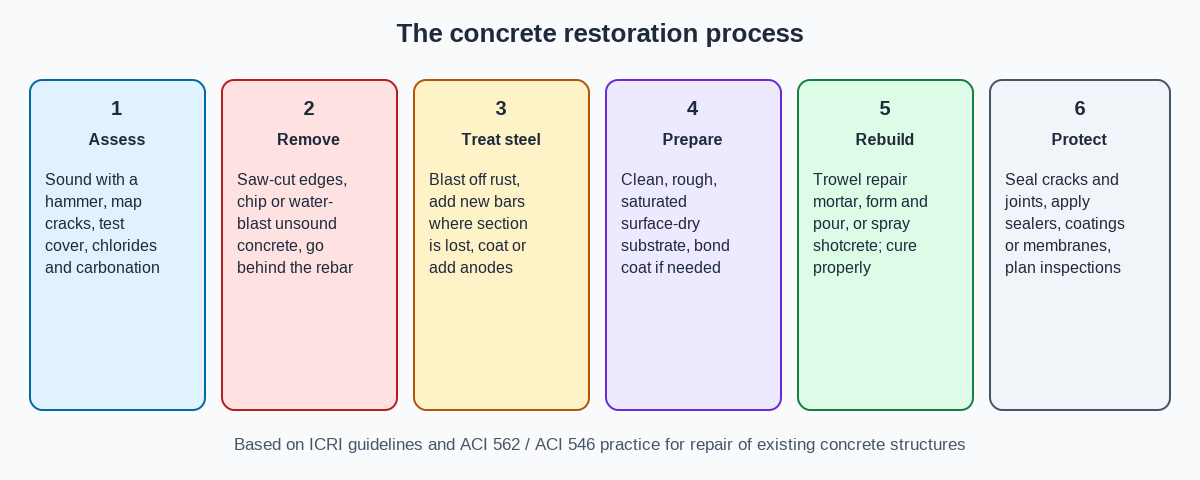
1. Assessment and testing
Every concrete restoration project starts with a condition survey, and good concrete repair depends on it. An engineer or experienced contractor inspects the concrete, maps cracks, spalls and stains, and sounds the surface with a hammer or chain drag to find hollow areas where concrete has delaminated over corroding steel. Testing may include cover meters to find rebar depth, half-cell potential surveys to identify active corrosion, chloride testing of concrete samples, carbonation depth testing with phenolphthalein, cores for strength and petrographic examination, and ground-penetrating radar to locate steel and voids. The goal is to understand what is damaged, why, and how much, and to design a repair that addresses the cause. See concrete core drilling and concrete cylinder test.
2. Removal of damaged concrete
Unsound, delaminated and chloride-contaminated concrete is removed. The perimeter of each repair is saw cut to a depth of at least 1/2 inch to avoid thin, feathered edges that break off. Concrete is removed with chipping hammers, or on large jobs with hydrodemolition, which uses very high-pressure water jets to remove damaged concrete while leaving sound concrete and steel intact. Where reinforcing steel is corroded, concrete is removed all around the bar, typically at least 3/4 inch behind it, so the full circumference of the steel can be cleaned and the repair material can lock around it. Shoring may be needed to support the structure while concrete is removed. See how to remove concrete.
3. Treating the reinforcing steel
Exposed steel is cleaned of rust and scale, usually by abrasive blasting or wire brushing. Bars that have lost significant cross section, often more than 20 to 25 percent, are supplemented or replaced with new bars lapped or mechanically spliced to the existing steel. The steel may be coated with a corrosion-inhibiting primer, and galvanic anodes, small sacrificial zinc units tied to the steel, may be installed at the edges of repairs to prevent new corrosion starting next to the patch, known as the halo or ring-anode effect. On large structures, impressed current cathodic protection systems can protect all the steel electrically. See rebar in concrete.
4. Surface preparation
The exposed concrete is cleaned and roughened so the repair material bonds well, typically to a concrete surface profile defined by ICRI. Dust and debris are removed. Most cement-based concrete repair materials need the surface to be saturated surface dry, damp but with no standing water, at the time of placement. Some systems use a bonding agent or a scrub coat of the repair mortar. See concrete adhesive.
5. Rebuilding
The removed concrete is replaced with a material chosen for the depth, orientation and exposure of the repair. Shallow and overhead concrete repairs often use polymer-modified, low-shrinkage repair mortars applied by trowel. Larger and deeper concrete repairs are formed and filled with flowable repair concrete or grout. Large areas, walls and overhead surfaces may be rebuilt with shotcrete, sprayed concrete applied at high velocity. The repair is finished to match the surrounding surface and cured properly, which is critical for preventing shrinkage cracks. See concrete patching compound and shotcrete vs gunite.
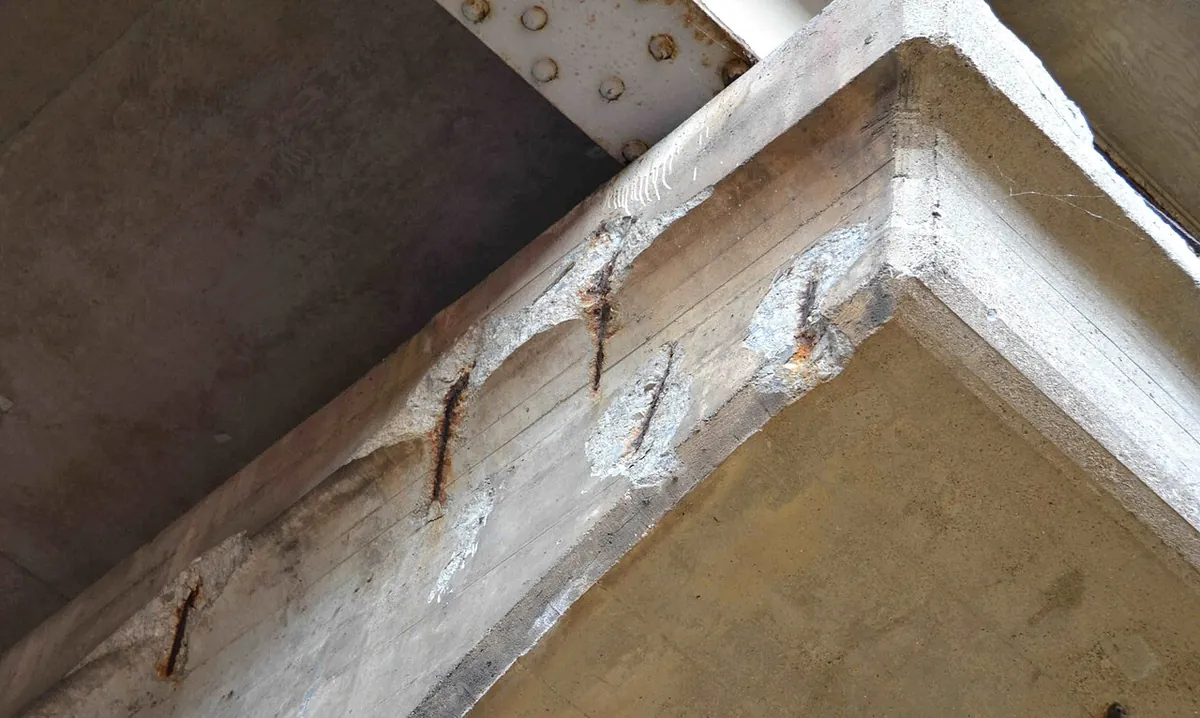
Photo: Achim Hering, Wikimedia Commons, CC BY 3.0
The bridge beam above shows why proper removal and steel treatment matter: earlier patches (the lighter areas) have been applied over spalls, but rust stains and exposed bars show that corrosion has continued around and behind them. Patching the surface without removing contaminated concrete behind the steel or protecting the surrounding bars rarely lasts.
6. Protection
The final step of concrete restoration protects the restored concrete and the rest of the structure from future damage. Options include penetrating sealers such as silanes and siloxanes that reduce water and chloride penetration; elastomeric coatings that bridge small cracks on walls; traffic-bearing membranes on parking decks and balconies; crack and joint sealants; corrosion-inhibiting treatments applied to the surface; and improved drainage to keep water off the concrete. A maintenance plan with periodic inspections helps catch new problems early. See concrete sealer and concrete expansion joints.
Concrete Restoration Methods
Crack injection. Epoxy injection bonds structural cracks back together and restores strength; polyurethane injection seals leaking cracks in basements, tunnels and tanks. See epoxy concrete crack repair.
Partial-depth and full-depth patching. Removing and replacing damaged concrete in slabs, beams, columns and walls, as described above.
Resurfacing and overlays. Thin cement-based or polymer overlays renew worn, scaled or stained surfaces on driveways, patios, pool decks and floors. Bonded concrete overlays restore bridge decks and industrial floors. See concrete driveway resurfacing and concrete overlay cost.
Strengthening. Fiber-reinforced polymer (FRP) wraps and strips bonded to beams, columns and slabs add strength; steel jackets, external post-tensioning and enlarged sections are other options.
Slab lifting and leveling. Sunken slabs are raised by injecting foam or grout underneath. See concrete leveling cost.
Joint and sealant replacement. Failed joint sealants and expansion joints are replaced to keep water out.
Cleaning and historic concrete restoration. Gentle cleaning, matching of color and texture, and careful concrete repair of architectural concrete on historic buildings, often using custom-matched mortars.
Residential Concrete Restoration
For homeowners, concrete restoration usually means bringing a tired driveway, patio, walkway, pool deck, steps or garage floor back to life instead of tearing it out. Typical work includes cleaning and pressure washing, crack repair, patching spalls and pop-outs, leveling sunken sections, resurfacing with a thin overlay, and sealing. A restored driveway or patio can look nearly new and last many more years for a fraction of the cost of replacement, as long as the slab underneath is structurally sound. Restoration is not a good fit when slabs are badly broken, heaved by roots, or settling continuously; then replacement is usually better. Foundation walls and basement concrete may need crack injection, waterproofing and, if there is structural movement, an engineer's assessment. See how to fix cracks in concrete driveway, concrete pool deck repair and how to fix concrete steps.
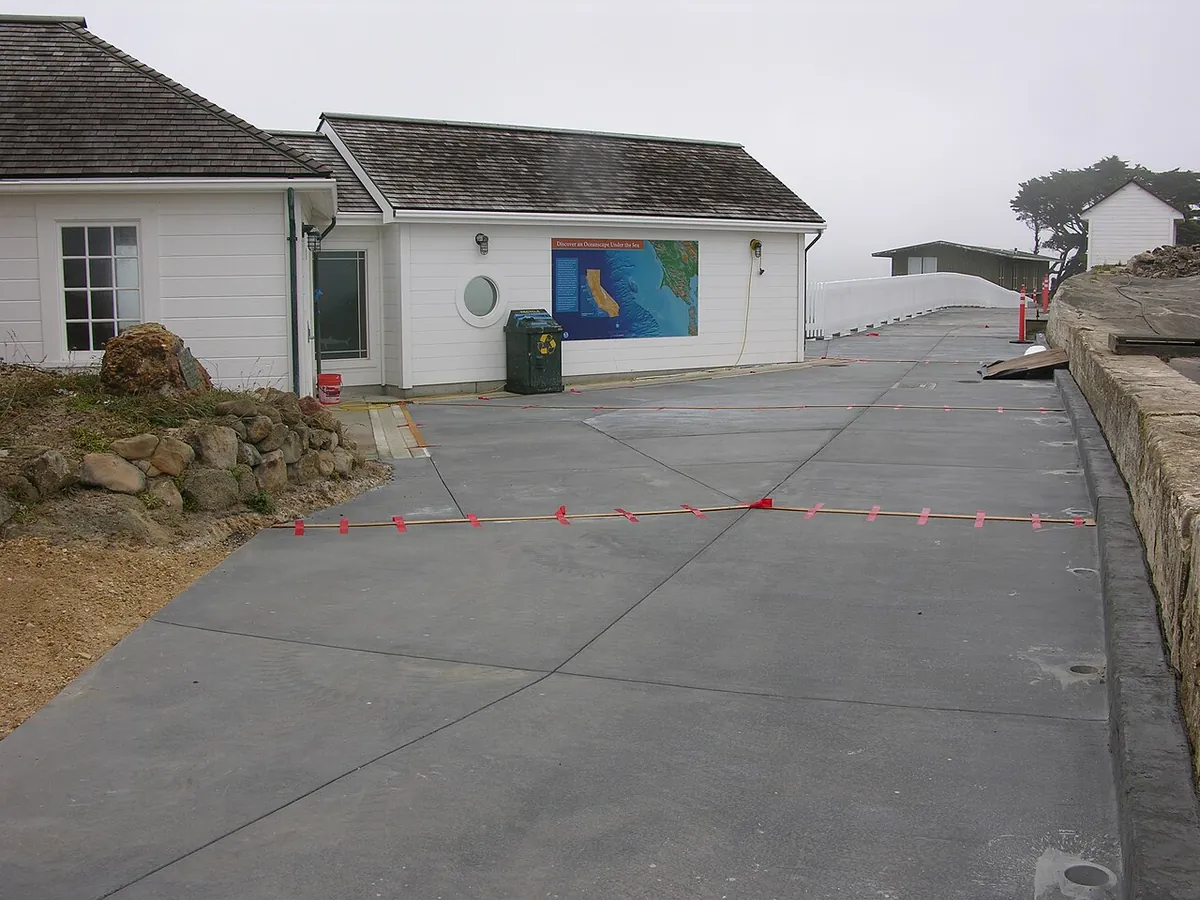
Photo: National Park Service (public domain), Wikimedia Commons
The pathway above was renewed as part of a larger concrete restoration project: damaged sections were removed and replaced with new concrete panels, with joints laid out in a neat pattern so the new work fits the site.
Commercial and Structural Concrete Restoration
Commercial concrete restoration covers parking garages, high-rise balconies and facades, bridges, dams, water and wastewater tanks, industrial floors, marine structures, stadiums and historic buildings. These projects are designed by structural engineers and carried out by specialist concrete restoration contractors, often while the structure stays in use. Parking garages are among the most common: deicing salt carried in on cars soaks into the decks, corroding the steel and causing widespread spalling and delamination. Restoration typically includes removing and replacing deteriorated deck concrete, repairing beams and columns, replacing expansion joints, and installing a traffic-bearing membrane. In many cities, building codes require periodic inspection of facades and balconies, and owners must restore concrete in hazardous conditions, which drives a large share of concrete restoration work. See post-tensioned concrete slab.
Choosing a Concrete Restoration Contractor
For structural concrete restoration, look for contractors with specific restoration experience, not just new construction. Ask about projects similar to yours and request references. Check that workers are trained and, where relevant, certified, for example through ICRI's Concrete Surface Repair Technician program or ACI certifications. For larger jobs, the owner should hire a structural engineer to assess and design the repairs, and the contractor should follow the engineer's specifications. Ask how the contractor determines the extent of removal, how they treat the steel, what concrete repair materials they use and why, how they cure repairs, and what warranty they offer. For residential work, compare written quotes that describe the scope, materials and finish, ask to see completed projects that are a few years old, and be cautious of very low bids that skip preparation.
Signs Your Concrete Needs Restoration
Knowing the early warning signs helps you plan concrete restoration before small problems become expensive ones. Rust stains running down a wall, balcony edge or beam often mean the steel inside is corroding; by the time stains appear, concrete repair is usually needed. Cracks that follow the line of the reinforcing bars, rather than random shrinkage cracks, also point to corrosion. Hollow-sounding areas when tapped with a hammer indicate delamination, where a layer of concrete has separated from the concrete below and will eventually fall off. Spalls, where pieces have already broken away, are the most obvious sign, and in overhead locations they are a safety hazard that calls for immediate attention. On flat surfaces, scaling, flaking, pop-outs, exposed aggregate and wide cracks show that the surface is breaking down. White deposits, wet patches and leaks point to water moving through the concrete. Any of these signs is a good reason to call a concrete restoration contractor or engineer for an assessment.
Concrete Restoration vs Replacement
The choice between concrete restoration and replacement depends on how much of the concrete is damaged, whether the structure is still sound, and the cost and disruption of each option. Concrete restoration makes sense when damage is limited to the surface or to localized areas, the underlying structure is strong, and the cause of the damage can be controlled. Replacement makes sense when deterioration is widespread throughout the depth of the concrete, the structure is badly cracked or moving, the original design no longer meets current needs, or repeated concrete repair has already failed. Engineers often compare the life-cycle cost of each option over 20 to 50 years. In many cases, a well-planned concrete restoration program extends the life of a parking garage, bridge deck or building facade by decades for a fraction of the cost of rebuilding, and avoids the waste and carbon emissions of demolition. For homeowners, a driveway with a few cracks and a worn surface is a good candidate to restore concrete with patching and resurfacing, while a driveway broken into many pieces and sinking is usually better replaced. See concrete driveway cost.
Repair Materials Used in Concrete Restoration
The materials used in concrete restoration are chosen to match the existing concrete and the conditions it faces. Cement-based concrete repair mortars are the most common: they are similar to concrete in stiffness, thermal expansion and appearance, and modern products contain polymers, silica fume, fibers and shrinkage-reducing admixtures to improve bond and durability. Rapid-setting concrete repair materials let traffic return within hours, which is valuable on roads, bridges and busy floors. Epoxy mortars and polymer concretes are very strong and chemically resistant but differ from concrete in stiffness and thermal movement, so they are used for specific situations such as thin, small repairs or chemical exposure. Flowable repair concretes and grouts fill formed repairs around congested reinforcement. Shotcrete is used for large vertical and overhead areas. Compatibility between the concrete repair material and the original concrete is one of the most important principles of concrete restoration, because a repair that shrinks, expands or flexes differently from the surrounding concrete will crack and debond. See concrete admixtures and high-strength concrete.
Concrete Restoration and Waterproofing
Water is behind most concrete damage, so concrete restoration is closely tied to waterproofing. Once concrete repair work is complete, keeping water and salt out is the best way to make it last. On parking decks and plaza decks, a traffic-bearing membrane or a hot-applied waterproofing membrane under topping protects the structure. On balconies, sloping the surface to drain and sealing the edges prevents water from soaking in. On walls and facades, sealers and coatings shed rain while letting vapor escape. In basements and below-grade structures, crack injection, membranes and drainage stop leaks. Good drainage design, such as cleaning drains, adding slope, and directing downspouts away, is often the cheapest and most effective concrete restoration measure of all. See is concrete waterproof and concrete trench drain.
Planning a Concrete Restoration Project
A successful concrete restoration project starts with a clear understanding of the problem and a realistic plan. For structures, the owner usually hires an engineer to perform a condition assessment and prepare concrete repair drawings and specifications, then invites qualified concrete restoration contractors to bid. Because the full extent of damage is often hidden until concrete is removed, contracts usually include unit prices for repair quantities, so the cost can be adjusted as work proceeds. Projects in occupied buildings are phased to keep parts of the structure in use, with temporary shoring, protection and traffic control. Work is scheduled around weather, since many repair materials and coatings have temperature limits. Quality control includes inspection of surface preparation, testing of repair materials and bond, and documentation of all concrete repairs. After completion, a maintenance plan with inspections every few years keeps the restored concrete in good condition and catches new issues early. Planning this way turns concrete restoration from an emergency response into routine care of a valuable asset.
Concrete Restoration Services
Concrete restoration contractors offer a wide range of services, and it helps to know what to ask for. Inspection and condition assessment services identify damage and its causes. Concrete repair services cover spall and delamination repair, crack repair and injection, joint repair and sealant replacement. Surface restoration services include cleaning, grinding, resurfacing, overlays and polishing. Structural concrete restoration services include beam, column and slab repair, strengthening with FRP or steel, and shoring. Protection services include sealers, coatings, membranes and corrosion protection systems. Many concrete restoration companies also handle waterproofing, masonry repair and facade work, because these problems often occur together on older buildings. For homeowners, concrete restoration services usually focus on driveways, patios, walkways, steps, pool decks and garage floors, with options to restore concrete color and texture as well as structure.
When comparing concrete restoration services, ask whether the company does the work with its own crews, how it warranties concrete repair work, and what it will do if more damage is found once work begins. A good concrete restoration contractor explains the cause of the damage in plain language and recommends a repair that addresses it, rather than simply covering the symptoms.
DIY Concrete Restoration for Homeowners
Some concrete restoration around the house is well within reach of a handy homeowner. You can restore concrete surfaces by pressure washing, removing stains, filling small cracks with a flexible crack filler, patching shallow spalls with a polymer-modified repair mortar, and applying a penetrating sealer. Thin resurfacers can renew a worn patio or walkway in a weekend. The keys to DIY concrete repair are the same as on large projects: remove all loose material, clean and dampen the surface, use a product suited to the depth and location, follow the mixing instructions exactly, and keep the repair damp while it cures. Leave structural concrete restoration, such as cracked foundations, balconies, beams and columns, to professionals with an engineer's guidance. See how to fix cracks in concrete.
Concrete Restoration Cost
Concrete restoration costs vary widely with the type and extent of damage, access, and the structure. Typical US ranges are:
- Residential crack repair and patching: $200 to $1,500 for typical driveway, patio or step repairs.
- Driveway or patio resurfacing: $3 to $10 per square foot.
- Slab leveling: $3 to $10 per square foot, or $500 to $2,500 per area.
- Crack injection: $300 to $1,000 per crack for foundation walls.
- Structural spall and delamination repair: $30 to $150 or more per square foot of repair area, depending on depth, orientation (overhead costs more) and access.
- Parking garage restoration: often $10 to $40 per square foot of deck overall, including membranes and joints, depending on the extent of damage.
- Engineering and testing: $1,500 to $25,000+, depending on the size of the structure.
Concrete restoration is usually much less expensive than demolition and replacement, and it avoids the disruption, waste and carbon emissions of building new. Delaying concrete repairs, however, lets corrosion spread and raises costs quickly. See concrete removal cost and concrete cost guide.
Frequently Asked Questions
What is concrete restoration?
Repairing, rebuilding and protecting damaged concrete so it serves for many more years, while addressing the cause of the damage.
Is concrete restoration cheaper than replacement?
Usually yes, often by a large margin, as long as the structure is sound enough to repair.
What causes concrete to spall?
Most often corrosion of the reinforcing steel from chlorides or carbonation, plus freeze-thaw damage and poor original construction.
How long does concrete restoration last?
Well-designed and well-executed concrete repairs with proper protection can last 15 to 30 years or more.
Do I need an engineer for concrete restoration?
For structural elements such as beams, columns, balconies and parking decks, yes. Simple residential concrete repairs usually do not need one.
Sources
- International Concrete Repair Institute: technical guidelines for concrete repair
- American Concrete Institute: ACI 562 code for repair of existing concrete structures; ACI 546 repair guide
- FHWA: bridge preservation and concrete deck repair
- Portland Cement Association: durability and corrosion of reinforced concrete
Related Guides
- Concrete lintel — precast lintels over openings
- Concrete chisel — hand and SDS chisels
- Concrete beam — beams, rebar and concrete details
- Concrete slide — hillside and playground slides, plus concrete sliders (knee boards)