
Concrete Polisher Guide: Machines, Rental and Residential Polished Concrete Floors
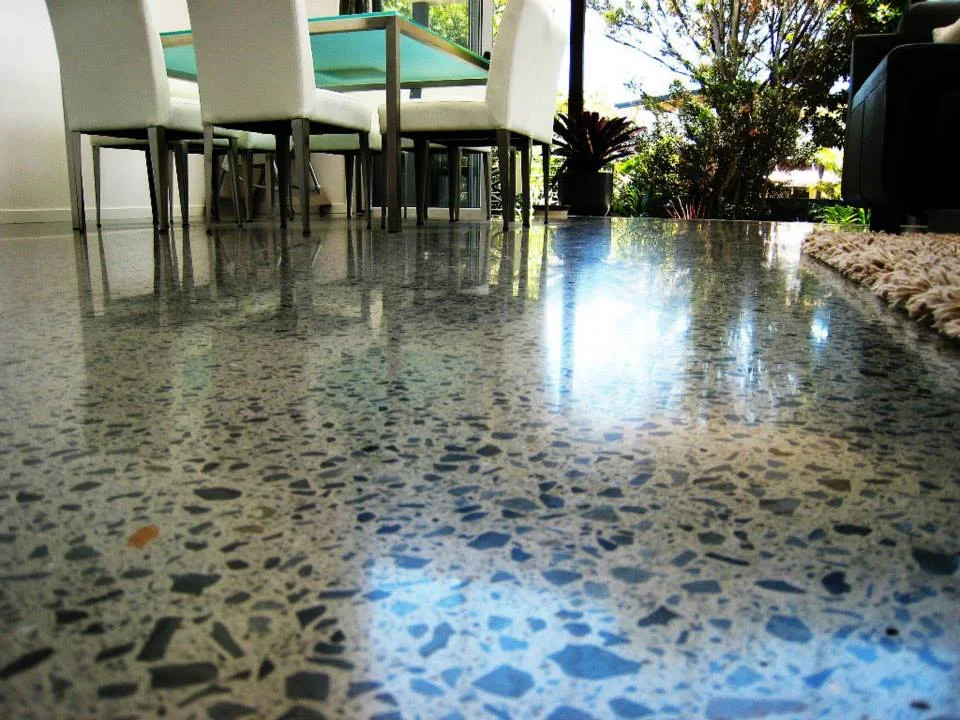
Photo: Multiblast122, Wikimedia Commons, CC BY-SA 4.0
Quick Answer
A concrete polisher is a floor machine that grinds and polishes concrete with a sequence of diamond tools, from coarse metal-bond grits to fine resin pads, to create a smooth, glossy, durable floor. Small jobs use handheld grinders; whole floors use planetary walk-behind machines with several rotating heads. Concrete grinding machine rental typically costs about $200 to $500 a day for a walk-behind grinder, plus diamond tooling. Professional residential concrete floor polishing usually costs $3 to $8 per square foot for basic to mid-level finishes and more for high-gloss or exposed-aggregate floors. Residential polished concrete floors last for decades, are easy to clean and need only periodic burnishing and guard reapplication.
Polished concrete started in warehouses and big-box stores, but residential polished concrete floors are now common in modern homes, basements, kitchens, lofts and garages. The floor in the photo above shows what a concrete polisher can do: the surface has been ground to expose decorative aggregate and polished to a reflective sheen. Unlike paint or epoxy, polished concrete is not a coating; the machine refines the concrete surface itself.
This guide explains the types of concrete polisher, how concrete grinding machine rental works, the step-by-step process of residential concrete floor polishing, sheen and aggregate choices, DIY versus hiring a contractor, costs and how to care for polished concrete floors residential owners live with every day.
What Is a Concrete Polisher?
A concrete polisher is a floor grinder designed to cut and refine concrete with diamond abrasives. Diamond segments or pads are attached to rotating plates under the machine. At first, coarse metal-bond diamonds grind off the top layer of the slab, removing coatings, stains and surface defects and flattening the floor. Then progressively finer resin-bond diamond pads remove the scratches left by each previous step until the surface is smooth enough to reflect light. Most professionals call the same machine a grinder during the early steps and a concrete polisher during the later steps; the difference is mainly the tooling.
Concrete polishing machines can work wet or dry. Wet polishing uses water to cool the diamonds and control dust, but creates slurry that must be cleaned up. Dry polishing uses a dust shroud connected to a high-efficiency vacuum and is now the more common method indoors because it is cleaner and lets the operator see the surface. See concrete grinding.
Types of Concrete Polisher
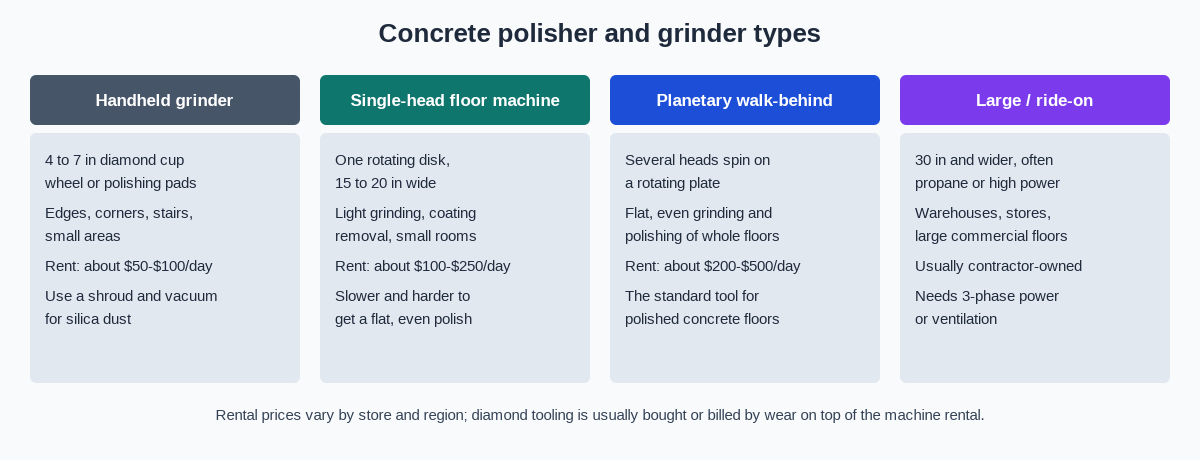
Handheld grinders. Angle grinders fitted with diamond cup wheels or polishing pads, used for edges, corners, stairs, countertops and small areas the big machine cannot reach.
Single-head floor machines. One large rotating disk. They are lighter and cheaper and good for light grinding and coating removal, but it is harder to get a perfectly flat, even polish with them.
Planetary walk-behind grinders. Several heads spin on a plate that also rotates, so the diamonds cross the floor in overlapping patterns. They grind flatter and more evenly and are the standard concrete polisher for residential polished concrete floors and most commercial work.
Large and ride-on machines. Heavy machines 30 inches wide or more, sometimes propane-powered, for warehouses and large commercial floors.
Burnishers. High-speed machines used with fine pads to bring up the shine after polishing and during maintenance.
Concrete Grinding Machine Rental
Home centers, equipment rental shops and flooring suppliers offer concrete grinding machine rental for DIY projects and small contractors. Typical 2026 rental prices are:
Handheld grinder with shroud: about $50 to $100 per day.
Single-head floor grinder: about $100 to $250 per day.
Planetary walk-behind grinder: about $200 to $500 per day, with weekly rates often equal to three or four daily rates.
HEPA dust extractor: about $75 to $150 per day, needed for dry grinding.
Diamond tooling: often sold separately or billed by wear, commonly $100 to $400 or more per job depending on how many grits you use and how hard the concrete is.
Before taking a concrete polisher home, check its power requirements: many walk-behind grinders need a 220 or 240 volt circuit, and some need three-phase power. Ask the rental shop which tooling suits your concrete's hardness, and get a demonstration of how to change diamonds and adjust the machine. See concrete mixer rental cost for how other concrete equipment rentals are priced.
How Residential Concrete Floor Polishing Works
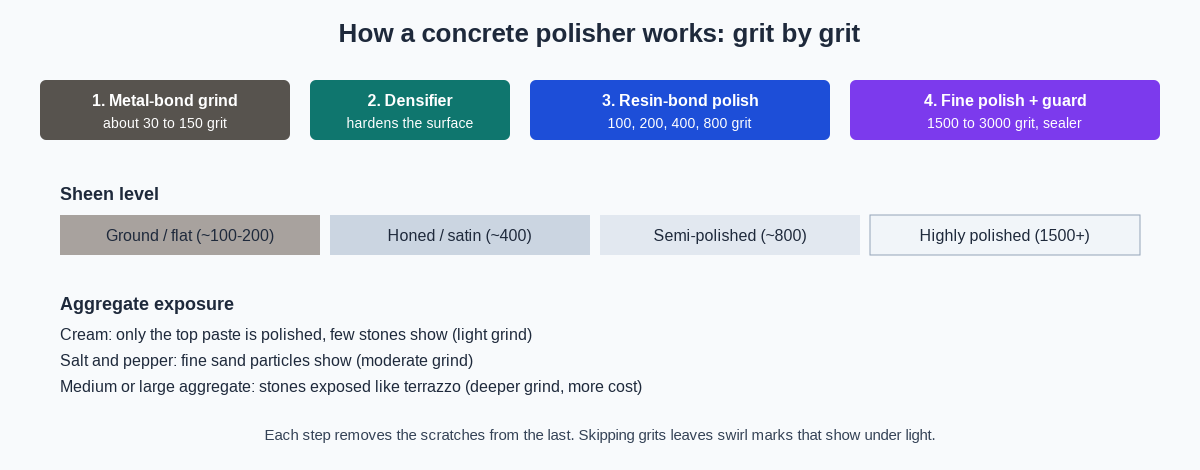
As the chart shows, residential concrete floor polishing follows a set sequence:
1. Evaluate the slab. Check for cracks, coatings, adhesives, moisture problems and how hard the concrete is. Old carpet glue, tile mortar and paint must be removed first.
2. Grind. Metal-bond diamonds, starting around 30 to 50 grit for rough or coated floors and stepping up to about 80 and 150 grit, flatten the floor and expose the level of aggregate you want.
3. Fill and repair. Fill cracks, holes and pinholes with a color-matched filler or epoxy so they do not show in the polished floor.
4. Densify. Apply a lithium, sodium or potassium silicate densifier, which reacts with the concrete to harden the surface so it takes a better polish. See concrete densifier.
5. Polish. Resin-bond pads at roughly 100, 200, 400 and 800 grit refine the surface, with each step removing the scratches of the last. Many residential polished concrete floors stop at 800 for a satin to semi-gloss finish; others go to 1500 or 3000 for high gloss.
6. Stain or dye (optional). Water-based or acetone-based dyes can add color between polishing steps. See concrete staining.
7. Guard and burnish. A penetrating stain guard or polish guard protects against stains, then a high-speed burnisher brings up the final shine.
Sheen Levels and Aggregate Exposure
Two choices define how residential polished concrete floors look. The first is sheen, from a flat ground finish through honed, semi-polished and highly polished. Higher sheen means more polishing steps and more cost. The second is aggregate exposure. A cream finish polishes only the top paste, leaving a smooth, cloudy surface with few stones showing; salt-and-pepper exposes fine sand particles; and medium or large aggregate exposure grinds deeper to reveal the stones, like the floor at the top of this page, which looks similar to terrazzo. Deeper grinding takes more time and tooling, so large aggregate exposure is the most expensive option. On existing slabs, the stones you will reveal depend on what was in the original concrete; on new slabs, you can specify decorative aggregate and seeded stones.
DIY or Hire a Pro?
A skilled DIYer can rent a concrete polisher and get a good honed or satin finish on a garage, shop or basement floor, especially when the slab is in good condition and the goal is a durable, easy-clean surface rather than a showpiece. The challenges are real, though: the machines are heavy, dust control is essential, coatings and glues are hard to remove, it is easy to leave swirl marks by skipping grits, and getting an even, high-gloss finish takes experience. For living areas, high-gloss finishes, exposed aggregate and floors with many cracks or patches, most homeowners hire a polished concrete contractor. A pro typically finishes a 500-square-foot room in two to four days with commercial machines, tooling and dust control. See concrete dust for silica safety.
Residential Polished Concrete Floors: Pros and Cons
Pros: very durable, no coating to peel or wear through, easy to clean with a dust mop and neutral cleaner, works well with radiant floor heating, light-reflective, hypoallergenic, and often cheaper than tile or hardwood over the long term because the slab is already there.
Cons: hard and cold underfoot without rugs or radiant heat, dropped dishes break, existing cracks and patches show, the result depends on the condition of the existing slab, and the work is noisy and dusty during installation. Polished concrete floors residential owners choose for basements must also be checked for moisture problems first. See concrete floors in homes and heated concrete floor.
Choosing Diamond Tooling for a Concrete Polisher
Tooling matters as much as the machine. Metal-bond diamonds come in different bond hardnesses: soft-bond diamonds wear faster and are used on hard concrete, because the bond must wear away to expose fresh diamonds; hard-bond diamonds are used on soft concrete, which would otherwise wear soft tools too quickly. Using the wrong bond either glazes the diamonds so they stop cutting, or wears expensive tooling away in minutes. Rental shops and tooling suppliers can test the concrete's hardness with a simple scratch test or a Mohs hardness kit and recommend the right bond. Transitional tools, usually ceramic or hybrid diamonds, remove the deep scratches left by metal-bond grinding before resin pads are used, saving time on the polishing steps. For edges, handheld grinders use cup wheels and flexible pads in the same grit sequence as the floor concrete polisher, so the edges match the field of the floor.
Preparing a Room for Concrete Polishing
Clear the room completely and remove baseboards and door casings where possible, since the machine and edge grinder will work right up to the walls. Cover doorways and openings with plastic to contain dust, and protect cabinets and walls in kitchens. Remove carpet, tack strip, pad, tile, vinyl and adhesive; thick black mastic and some old adhesives may contain asbestos and should be tested before grinding. Fill or mark floor drains, and locate any in-floor heating tubes, electrical conduits or post-tension cables before grinding deeply. Plan power: walk-behind concrete polisher machines often need a 240 volt outlet within reach of a heavy-duty extension cord, plus a separate circuit for the dust extractor.
Polishing New Slabs vs. Existing Floors
The easiest residential polished concrete floors are planned before the slab is poured. On new construction, you can specify a dense, well-finished slab, decorative aggregate, a hard-troweled surface and protection during construction, so the floor needs less grinding and polishes more evenly. Wait at least about 28 days before grinding so the concrete has gained strength. Existing slabs vary widely: some polish beautifully, others reveal patches, cracks, soft spots and old stains, and every house is different. A test area, often in a closet or under where an appliance will sit, shows how the floor will look before committing to a whole room.
Polished Concrete in Basements
Basements are a popular place for residential concrete floor polishing because the slab is already there and carpet or wood can be risky with moisture. Before polishing, check for moisture: tape a square of plastic sheet to the floor for 24 to 48 hours and look for condensation underneath, or have a contractor run a moisture test. Polished concrete tolerates some moisture better than coatings do, since there is no film to blister, but persistent dampness, efflorescence or water entry should be fixed first. Basement slabs are often thinner, softer and more uneven than main-floor slabs, so expect more grinding. See efflorescence on concrete.
Polished Concrete Garage Floors
Garage floors take a polish well and gain a durable, easy-clean surface without the peeling and hot-tire pickup that can affect some coatings. A honed or satin finish with a densifier and a strong stain guard is usually the practical choice, because oil, brake fluid and road salt are harder on a garage floor than anything in a house. Clean up oil drips promptly, use drip pans under vehicles and reapply the guard periodically. A rented concrete polisher is often used for garages, since a slightly imperfect finish is acceptable in a work space. See concrete garage floor repair.
Polished Concrete vs. Epoxy vs. Tile
Polished concrete refines the existing slab, has no coating to wear through, and costs least over the long term, but shows existing cracks and is only as good as the slab.
Epoxy and polyaspartic coatings cover the slab with a colored or flaked film that hides imperfections and resists chemicals well, but can scratch, peel if moisture is present, and eventually need recoating. See concrete coating cost.
Tile offers endless looks and repairs one piece at a time, but grout lines need cleaning and installation over a slab costs more than polishing.
For living areas in modern homes, many owners choose residential polished concrete floors for their durability and simplicity; for garages and workshops with heavy chemical exposure, coatings are a strong alternative.
Common Concrete Polisher Mistakes
Skipping grits. Jumping from coarse to fine leaves scratches that show as swirls under raking light.
Not grinding flat enough. If the first metal-bond steps do not reach a consistent level, high spots polish and low spots stay dull.
Using the wrong diamond bond. Glazed or rapidly worn tooling wastes time and money.
Ignoring the edges. Edges finished with a different method or fewer steps look different from the field.
Poor dust control. Dry grinding without a shroud and a HEPA extractor spreads silica dust through the house.
Applying densifier too early or too heavily. Follow the product directions; excess densifier can leave white residue.
Polishing a damp or contaminated slab. Moisture and old oil stains can show through or interfere with guards and dyes.
Concrete Polisher Safety
Concrete polishing machines are heavy and powerful. Read the operating manual, keep cords clear of the machine, and turn the machine off before changing tooling. Wear hearing protection, safety glasses, gloves and steel-toed boots. For dry grinding, use a dust shroud connected to a HEPA dust extractor that meets OSHA's silica rules, and wear a respirator rated for silica. Keep children and pets out of the work area until cleanup is finished, and ventilate well, especially when using solvent-based dyes or guards.
Buying a Concrete Polisher
Contractors who polish floors regularly buy their own machines. A quality handheld grinder with a dust shroud costs about $200 to $800, and professional handheld polishers with variable speed and water feed cost more. Small planetary walk-behind grinders suitable for residential concrete floor polishing typically start around $5,000 to $10,000, while larger professional machines run $15,000 to $40,000 or more, plus a matching HEPA dust extractor that can cost several thousand dollars. Tooling is an ongoing expense. For homeowners and remodelers who only occasionally polish a floor, concrete grinding machine rental is almost always the better choice; buying makes sense only for contractors or people who plan to polish many floors.
How Long Concrete Polishing Takes
Time depends on the floor's condition, the finish level and the size of the machine. As a rough guide, a professional crew with a planetary concrete polisher often completes about 500 to 1,000 square feet per day for a standard semi-polished finish on a slab in good condition. Coating or glue removal, deep aggregate exposure, crack repair and high-gloss finishes add days. Densifiers and dyes need time to react or dry between steps. The floor can usually be walked on as soon as it is clean, and furniture can go back the same day or the next, which is faster than coatings that need curing time.
Polishing Stairs, Countertops and Edges
Not every surface fits under a floor machine. Concrete stairs, curbs, countertops and the strip along walls are polished with handheld concrete polisher tools: angle grinders or dedicated polishers with flexible diamond pads, worked through the same grit sequence by hand. This detail work is slow and is often where DIY projects look less professional, so budget time for it. On countertops, a variable-speed wet polisher with water feed gives the best control and keeps dust down. See concrete countertops.
Color Options for Polished Concrete
Gray is the most common color, but residential polished concrete floors can be colored in several ways. Water-based and solvent-based dyes are applied during polishing and penetrate the surface for rich, translucent colors such as browns, blacks and blues. Acid stains react chemically with the concrete for mottled, earthy tones, though they can be less predictable on polished floors. Integral color added to new concrete when it is placed gives a uniform base color throughout the slab. Decorative saw cuts and borders, scored before or after polishing, can create tile or rug patterns. Test any color on a sample area first, because the same dye looks different on different slabs, and darker colors show dust and scratches more readily than mid-tone grays and browns.
Cost of Residential Concrete Floor Polishing
Basic grind and seal or honed finish: about $2 to $4 per square foot.
Standard semi-polished, cream or salt-and-pepper: about $3 to $8 per square foot.
High gloss, dyes or medium to large aggregate exposure: about $6 to $15 or more per square foot.
Coating or glue removal and crack repair: often $1 to $3 or more per square foot extra.
DIY with a rented concrete polisher: commonly $500 to $1,500 for a garage or basement, including rental, tooling and densifier, plus several days of labor.
Small rooms often have minimum charges of $1,000 to $2,000 because of setup and equipment. See polished concrete cost.
Questions to Ask a Polished Concrete Contractor
When hiring for residential concrete floor polishing, ask to see floors the contractor has polished in homes, not just warehouses, and ideally visit one in person. Ask which machines and tooling they use, how they control dust in an occupied house, which grit they finish at and what sheen to expect, and whether they use a densifier and a guard. Get the level of aggregate exposure in writing, because "polished concrete" can mean anything from a cream finish to full terrazzo-like stone exposure. Confirm who removes old flooring and adhesive, how cracks and patches will be treated, and what maintenance the contractor recommends. A good contractor will also do a small test area so you can approve the look before the whole floor is ground.
Is a Polished Floor Right for Your Home?
Residential polished concrete floors suit modern, industrial and minimalist interiors, homes with radiant heating, households with pets and allergies, and anyone who wants a floor that is easy to clean and nearly impossible to wear out. They suit less well if you want a soft, warm floor underfoot, if your slab is badly cracked or patched, or if you prefer a uniform, flawless look; in those cases, a coating, overlay or traditional flooring may be a better fit. Many homeowners combine both, using polished concrete in kitchens, entries and living areas and softer flooring in bedrooms. Area rugs add warmth and sound absorption to polished rooms without hiding the floor, and they are easy to move when the floor needs burnishing.
Caring for Polished Concrete Floors
Polished concrete floors residential owners maintain well can look good for decades. Dust mop daily or as needed, since tracked-in grit acts like sandpaper on the surface. Damp mop with a pH-neutral cleaner made for polished concrete; avoid vinegar, ammonia, bleach and citrus cleaners, which can etch the surface or strip the guard. Wipe up acidic spills such as wine, juice and tomato sauce quickly. Use felt pads under furniture and mats at entries to catch grit before it reaches the polished surface. Every year or two, or as the shine fades, burnish with a high-speed machine and reapply a guard. Heavily worn areas can be repolished with a few fine grits rather than starting over. See how to clean concrete floors.
Frequently Asked Questions
What is the best concrete polisher for a homeowner?
A rented planetary walk-behind grinder for floors, plus a handheld grinder for edges. Buying is rarely worthwhile for a single project.
How much does concrete grinding machine rental cost?
About $200 to $500 per day for a walk-behind grinder, plus diamond tooling and a dust extractor.
How much do residential polished concrete floors cost?
Usually $3 to $8 per square foot for standard finishes, more for high gloss or exposed aggregate.
Can you polish an old concrete floor?
Usually, if the slab is sound. Coatings and glues must be removed, and cracks and patches will show.
How long do residential polished concrete floors last?
Decades. The surface does not peel or wear through like a coating; it only needs periodic cleaning, burnishing and guard reapplication, and worn areas can be repolished.
Do I need a dust extractor with a rented concrete polisher?
Yes for dry grinding indoors. A shroud connected to a HEPA dust extractor controls silica dust; most rental shops rent them together.
Are polished concrete floors slippery?
Dry polished concrete has good traction; it becomes slippery when wet or dusty, like most hard floors.
Sources
- American Concrete Institute: ACI 310R, guide to decorative concrete
- Concrete Network: polished concrete process and finishes
- OSHA: silica standard, dust control for grinding
- Portland Cement Association: concrete floors
Related Guides
- Stamped concrete floors — indoor patterns, overlays vs new slabs, sealers and cost
- Concrete worker — job duties, pay, training, safety and career path
- Concrete machines — mixers, placer booms, screeds, trowels, sprayers, saws and scrubbers