
Stamped Concrete vs Pavers: Which Costs Less and Lasts Longer?
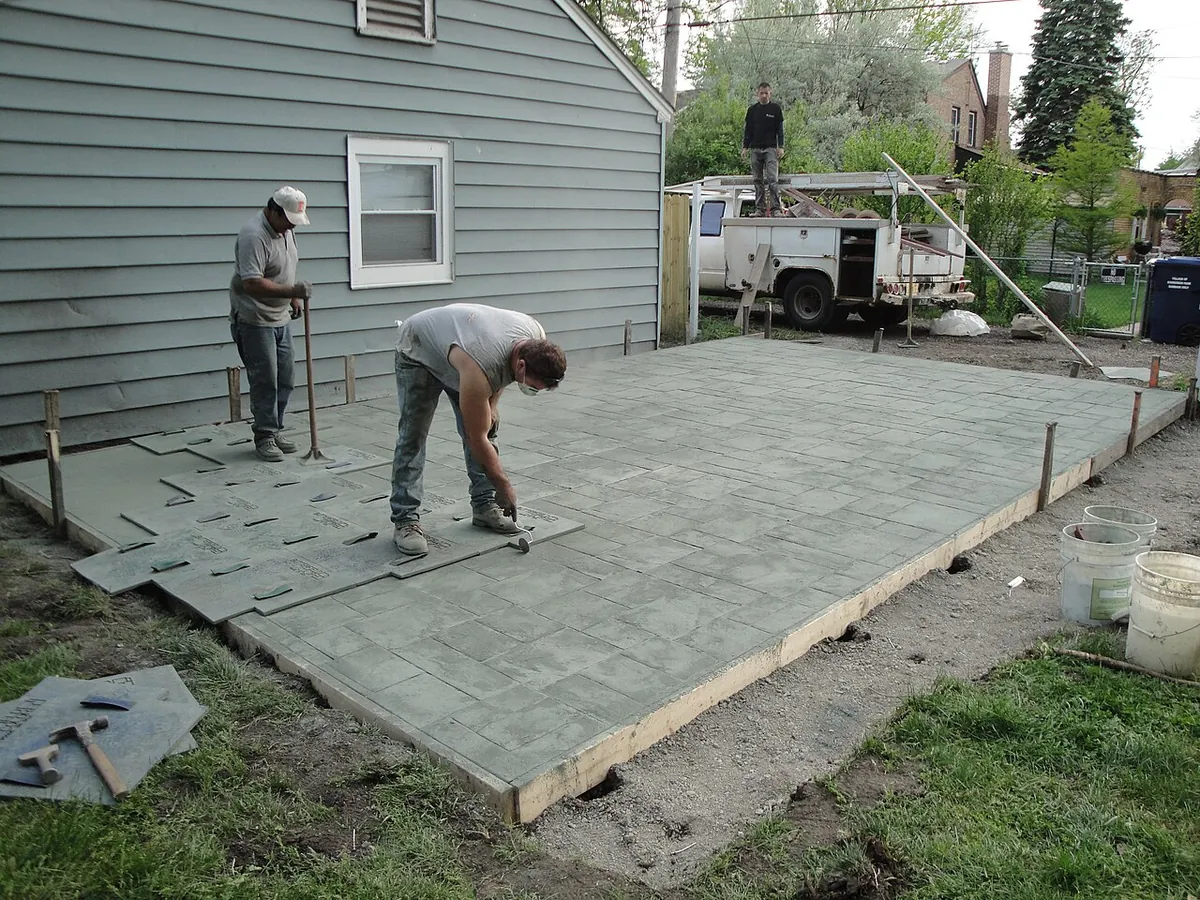
Photo: ChicagoConcrete, Wikimedia Commons, CC BY-SA 3.0
Quick Answer
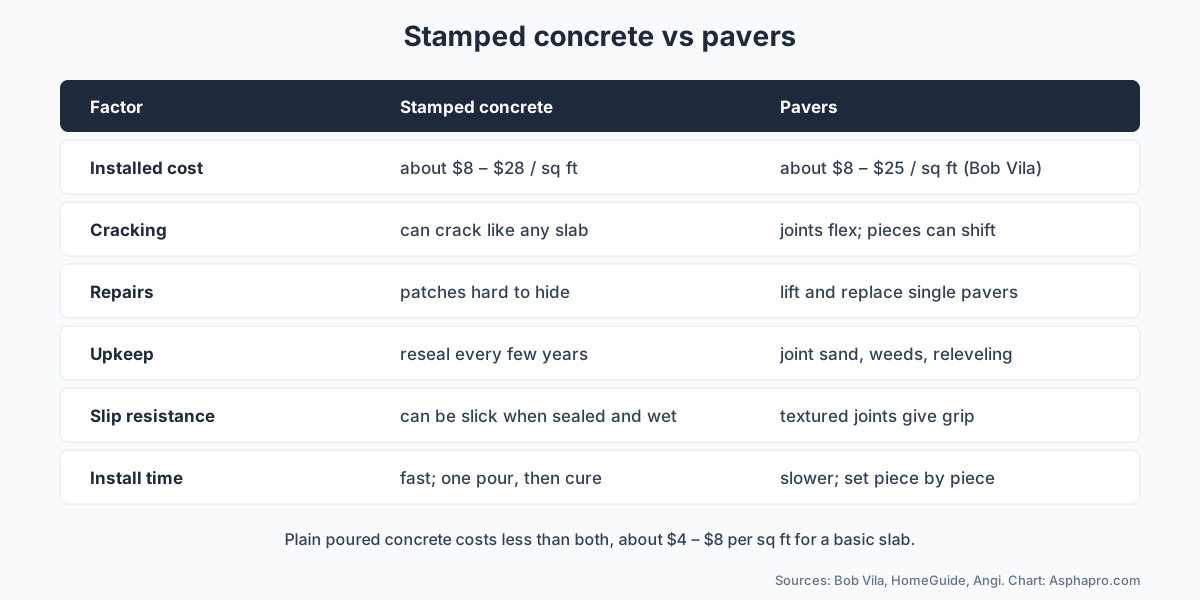
In the stamped concrete vs pavers comparison, cost is closer than most people expect. Bob Vila's cost guide puts stamped concrete at about $8 to $28 per square foot and pavers at about $8 to $25, with both averaging around $12; HomeGuide lists stamped driveways at $12 to $18 and pavers at $10 to $30. Stamped concrete installs faster as one slab but can crack and needs resealing every few years. Pavers take longer to install but flex with the ground, and single pieces can be lifted and replaced. Plain poured concrete, at about $4 to $8 per square foot, is cheaper than both.
Stamped concrete and pavers can both turn a plain patio, walkway or driveway into something that looks like stone, brick or slate. They get there in very different ways. Stamped concrete is a single slab colored and pressed with patterned mats while it is wet. Pavers are individual units, usually concrete, clay brick or natural stone, set on a compacted base and sand bed. The choice affects the upfront price, how the surface ages, and what repairs look like years later.
This guide compares stamped concrete vs pavers on cost, durability, repairs, maintenance, slip resistance and installation, and also covers concrete pavers vs brick pavers so you can choose the right surface for your project.
Stamped Concrete vs Pavers at a Glance
Stamped Concrete vs Pavers Cost
On price, pavers vs stamped concrete is closer than many people expect. Stamped concrete usually wins on up-front cost, while pavers can win over many years because single pavers can be replaced instead of patching a slab.
| Surface | Typical installed cost per sq ft | Source |
|---|---|---|
| Plain poured concrete | $4 – $8 | HomeGuide / Angi |
| Stamped concrete, basic | about $8 – $12 | Bob Vila |
| Stamped concrete, mid-range | about $12 – $18 | Bob Vila; HomeGuide driveways $12 – $18 |
| Stamped concrete, complex | about $18 – $28+ | Bob Vila |
| Pavers (overall) | about $8 – $25 | Bob Vila |
| Pavers (HomeGuide range) | $10 – $30 | HomeGuide |
So is stamped concrete cheaper than pavers? Often slightly, at the basic end, because a simple one-color stamped slab goes in quickly. Elaborate stamped work with several colors, hand-detailed edges and borders can cost as much as or more than good concrete pavers. For a 400 square foot patio, stamped concrete might run about $3,200 to $11,200 and pavers about $3,200 to $10,000 using the Bob Vila ranges, with most projects falling near the middle.
How Each Is Installed
Stamped concrete
The crew excavates, compacts a gravel base, sets forms and pours a concrete slab, usually about 4 inches thick for patios. Color is mixed into the concrete or broadcast onto the surface, a release agent is applied, and large rubber stamping mats are pressed into the surface while it is still soft. Edges are detailed by hand, joints are cut, and the slab is sealed after it cures. Most patios are poured in a single day.
Pavers
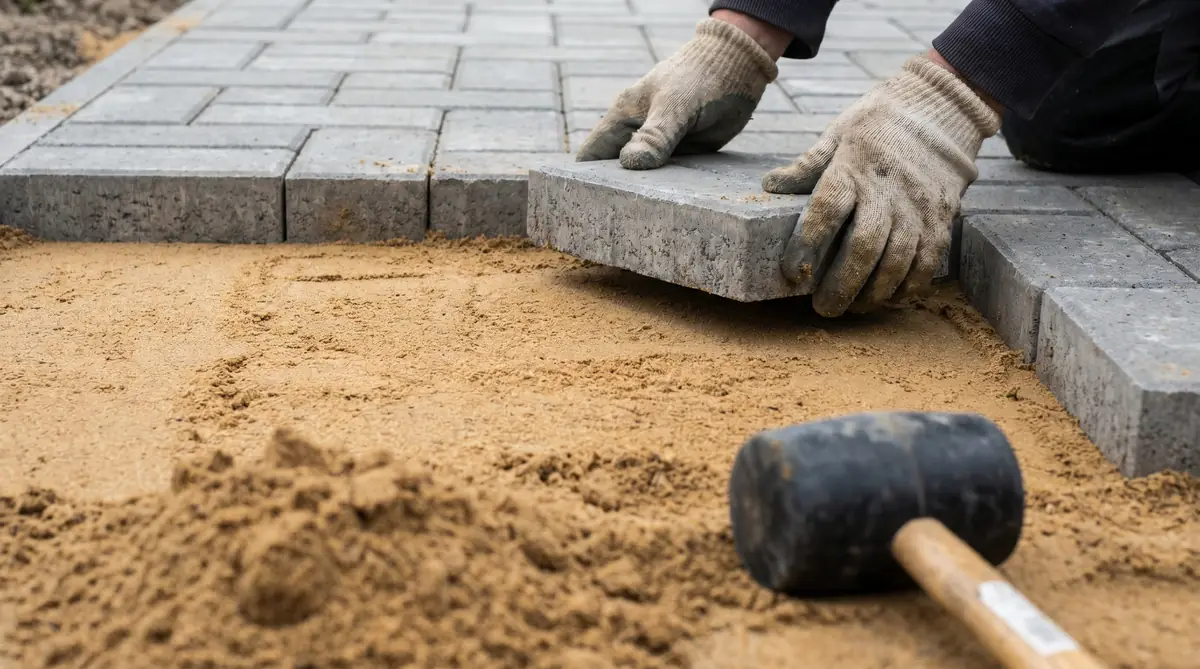
The crew excavates deeper, compacts a thicker gravel base, spreads and screeds a sand bed, lays the pavers one by one in the chosen pattern, cuts edge pieces, installs edge restraints, and sweeps joint sand or polymeric sand into the joints before compacting the surface. Installation takes longer, especially with complex patterns, but the surface can be used right away. See paving stones vs concrete for more on paver installation.
Durability and Cracking
Stamped concrete is a single slab, so like any concrete it can crack from shrinkage, settling, tree roots or freeze-thaw cycles. Control joints help cracks form in planned places, and joints can be hidden in the pattern, but random cracks still happen. Pavers are separate units with joints between them, so the surface flexes as the ground moves; instead of cracking, individual pavers may shift or settle. Quality concrete pavers are dense and strong, and the system handles freeze-thaw well when the base drains properly.
Repairs
This is where pavers have a clear edge. A cracked stamped concrete slab is hard to repair invisibly: patches rarely match the color and texture exactly. Pavers can be lifted, the base fixed, and the same pavers reset, or a cracked paver swapped for a spare. Utility work under a paver patio is also easier, since pavers can be removed and replaced. For concrete repair options, see concrete repair cost.
Maintenance
- Stamped concrete: needs resealing every few years to protect color and surface; sealers can wear in high-traffic areas.
- Pavers: need joint sand topped up, occasional weed control, and releveling of any sunken pavers; sealing is optional.
See how to seal concrete for sealing steps.
Stamped Concrete vs Non-Slip Surfaces: Slip Resistance
Stamped concrete has texture from the pattern, but a glossy sealer can make it slippery when wet, especially around pools and on steps. Contractors often add an anti-slip additive to the sealer, choose a matte sealer, or use patterns with deeper texture. Pavers usually offer good traction because of their surface texture and the joints between units, though some smooth stone pavers can be slick. For pool decks and steps, ask for slip-resistant finishes on either surface. See types of concrete finishes.
Concrete Pavers vs Brick Pavers
| Factor | Concrete pavers | Brick (clay) pavers |
|---|---|---|
| Cost | usually lower to mid range | often higher (roughly $10 – $20 per sq ft reported) |
| Shapes and colors | many shapes, colors and textures | classic rectangle, natural clay colors |
| Color over time | can fade slowly | color is fired in and lasts |
| Strength | very strong, good for driveways | strong; thinner bricks better for patios |
Which Is Better for Your Project?
Patios
Both work well. A stamped slab gives a seamless look and is often a little cheaper for simple designs; individual units make sense if you want a classic brick or stone look, plan to add plumbing or lighting later, or have soil that moves. For a patio next to the house, check drainage carefully with either choice. See the cost to pour a concrete slab for plain slab prices.
Driveways
Driveways take vehicle loads and, in cold climates, salt and snowplows. A stamped driveway must be thick enough and well reinforced, and its sealer wears faster under tires. Interlocking driveway units, set on a deep compacted base, spread loads well and can be repaired piece by piece if a section settles. Either can last for decades when built correctly; the base and drainage matter more than the surface. See concrete driveway cost and how thick a concrete driveway should be.
Walkways
For narrow paths, laying individual units can be easier to fit to curves and edges, while a stamped walk needs careful forming. Both look good next to planting beds.
Pool decks
Grip and heat matter here. Light-colored stamped surfaces with a slip-resistant sealer are common, and many people prefer textured units or natural stone for barefoot comfort. Pool decks also need good drainage away from the pool and expansion joints at the coping.
Steps
Stamped steps can be poured in place with a matching pattern. Steps built from units need a solid base or a concrete core underneath, and treads must be well bonded. See concrete steps cost.
Climate Considerations
In freeze-thaw climates, water that gets into surface pores or joints freezes and expands. Stamped slabs should be air-entrained and sealed to resist scaling, and de-icing salt should be used with care. Paver systems handle frost well when the base drains, because the joints let the surface move slightly without cracking, though frost heave on a poor base can lift sections. In hot, sunny climates, dark stamped colors and some stone units can get very hot underfoot; choose lighter colors near pools. In areas with expansive clay soils, a flexible unit surface often tolerates movement better than a rigid slab.
Design and Appearance
Stamped concrete can imitate slate, flagstone, cobblestone, brick, tile and even wood planks, with many color combinations. Because it is one piece, it has a seamless look with only control joints. Individual units come in many shapes, sizes and colors, from simple rectangles to tumbled cobbles and large-format slabs, and can be laid in herringbone, basketweave, running bond or circular patterns. The joints give a true, three-dimensional texture that stamped surfaces only imitate. Many homeowners think units look more authentic up close, while stamped surfaces look very convincing from a distance. Ask contractors to show you finished projects in person, ideally a few years old.
Lifetime Cost Over 20 Years
Upfront price is only part of the comparison. For a 400 square foot patio, suppose a mid-range stamped patio costs about $12 per square foot ($4,800) and a mid-range unit patio costs about $14 per square foot ($5,600). Over 20 years, the stamped patio might need resealing every few years, perhaps six or seven times, plus a crack repair or two. The unit patio might need joint sand top-ups, weed control, occasional resetting of a few settled pieces, and optional sealing. Depending on local costs and how much work you do yourself, the totals can end up close. The bigger difference is what repairs look like: a patched stamped slab may never match, while reset units look like new.
Base Requirements
Both surfaces depend on a good base. Stamped concrete usually needs about 4 inches of compacted gravel under a 4 inch slab for patios. Interlocking units need a thicker compacted aggregate base, often several inches more for driveways, plus a thin sand bed and solid edge restraints to keep the units from spreading. Skimping on the base is the most common reason either surface fails early. See concrete slab thickness.
Weeds, Ants and Joint Sand
Joints in a unit surface can grow weeds, host ant hills and lose sand to rain and pressure washing. Polymeric joint sand hardens after watering and reduces all three problems, but it must be installed carefully and topped up over time. Stamped concrete has no joints for weeds except at control joints and edges, which is one of its main maintenance advantages.
DIY Options
Laying units is one of the more DIY-friendly hardscape projects: with time, a plate compactor and careful base work, many homeowners build their own patios. Stamped concrete is not a good DIY project for most people, because coloring, stamping and detailing must happen in a short window while the concrete is at exactly the right stage, and mistakes are permanent. If you want to DIY, units are usually the safer choice; if you want a stamped look, hire an experienced decorative concrete contractor.
Resale and Curb Appeal
Both upgrades can improve curb appeal compared with plain gray concrete. Buyers tend to notice condition more than material: a faded, cracked stamped patio or a weedy, sunken unit patio both look tired. Whichever you choose, keep it clean, sealed or topped up, and repaired.
Stamped Concrete vs Pavers: Quick Decision Checklist
Use these questions to settle the stamped concrete vs pavers choice for your yard:
- Budget is tight and the design is simple? Basic stamped concrete is often the lower bid.
- Soil moves, or tree roots are nearby? Interlocking units tolerate movement better.
- You want easy, invisible repairs? Units win; single pieces can be replaced.
- You hate weeding joints? Stamped concrete has fewer joints.
- You want to DIY? Units are far more DIY-friendly.
- You need the area usable right away? Units can be walked on immediately; a stamped slab must cure.
- Pool deck or steps? Either works with slip-resistant finishes; plan grip carefully.
For many homeowners, the stamped concrete vs pavers decision comes down to two things: how much ground movement to expect and how much maintenance you are willing to do.
Colors and Sealers for Stamped Concrete
Stamped concrete gets its color from integral color mixed into the whole slab, color hardener broadcast onto the surface, and an antiquing release agent that settles into the texture as a darker accent. Multiple colors and hand-applied stains create more natural-looking stone. A sealer protects the color and surface, and its sheen changes the look: high-gloss sealers deepen colors but can be slick, while matte and satin sealers look more natural. Because sealers wear, the surface needs resealing every few years, and the color can fade faster in full sun.
Types of Pavers
- Concrete pavers: the most common; many shapes, colors and textures; strong enough for driveways.
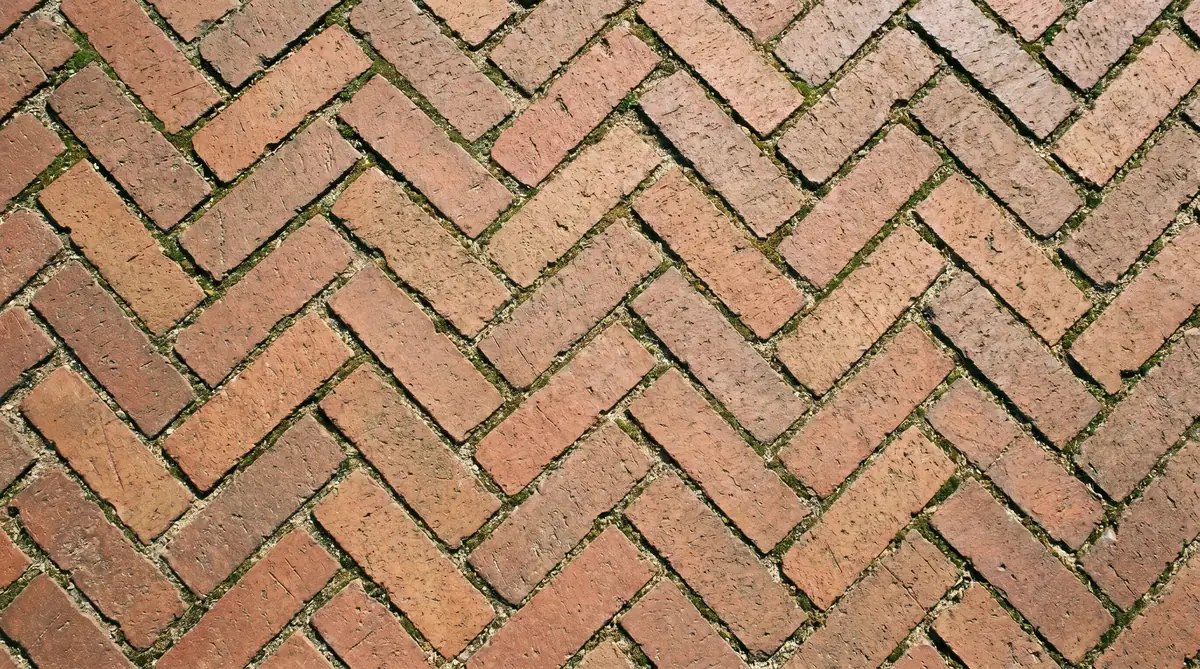
- Clay brick pavers: fired clay with long-lasting color and a classic look.
- Natural stone pavers: bluestone, travertine, granite and others; usually the most expensive.
- Permeable pavers: wider joints filled with stone let rainwater soak into a specially designed base, reducing runoff; some areas offer incentives for them.
- Large-format slabs: big, modern units with narrow joints for a clean look.
Common Problems With Each
Stamped concrete
- Cracks that cut across the pattern.
- Faded color, especially in sun, if not resealed.
- Sealer that whitens, peels or gets slippery.
- Scaling in freeze-thaw areas if the concrete was not air-entrained or was salted early.
Pavers
- Settling or rutting from a thin or poorly compacted base.
- Joint sand washing out, followed by weeds and ants.
- Edges spreading if edge restraints are missing.
- Efflorescence or staining on some concrete units.
Cost Examples by Size
Using Bob Vila's ranges of about $8 to $28 per square foot for stamped concrete and $8 to $25 for pavers, here is what common projects might cost, with most jobs landing near the middle:
- 12 × 12 ft patio (144 sq ft): stamped about $1,150 – $4,030; pavers about $1,150 – $3,600.
- 16 × 20 ft patio (320 sq ft): stamped about $2,560 – $8,960; pavers about $2,560 – $8,000.
- 20 × 24 ft driveway (480 sq ft): stamped about $3,840 – $13,440; pavers about $3,840 – $12,000.
Small projects often cost more per square foot, and removal of an old surface adds cost; see concrete removal cost.
How Repairs Work on Each Surface
Fixing a stamped slab
Hairline cracks in a stamped surface can be cleaned and filled with a tinted, flexible filler, then the area resealed. Wider cracks can be routed and filled, and some contractors re-stain the patch to blend it in. Badly cracked sections can be saw-cut out and repoured, then stamped and colored to match as closely as possible, though an exact match is rare. Faded color can often be refreshed with a tinted sealer or stain. Because repairs show, prevention through good base work, joints and sealing matters most.
Resetting units
When units sink or lift, the fix is straightforward: pull out the affected pieces, add or remove base and bedding sand, compact, and reset the same pieces, then refill the joints. A homeowner can handle small areas with a pry tool, rubber mallet and hand tamper. Broken pieces can be swapped for spares, which is why many installers recommend keeping a few extra from the original batch, since colors can vary between production runs.
Mixing Both Materials
You do not have to choose only one. Some designs use a stamped field with a border of brick or stone units, or a unit walkway leading to a stamped patio. Others pour a plain concrete driveway with a decorative band of units at the street. Mixing materials can control cost while adding interest, but each material should have its own proper base, and the transitions need careful detailing so water drains and edges stay level.
Installation Timelines
A stamped patio is typically formed one day and poured and stamped the next, then left to cure for a few days before light use and sealed later. A unit patio of the same size often takes longer to build because every piece is placed by hand and edges are cut, but it can be used as soon as the joints are filled and compacted. Weather affects both: concrete pours avoid rain and freezing, while unit installation can continue in more conditions but needs dry sand for joints.
Drainage and Runoff
Solid surfaces shed water, so both need a slope away from the house and somewhere for runoff to go. Standard units with tight joints also shed most water. Permeable systems with open joints and a deep stone base let rain soak into the ground, which can help with drainage problems and local stormwater rules. If runoff or puddling is a concern on your lot, ask about permeable options or add drains along the edge.
Cleaning and Stain Removal
Both surfaces collect dirt, leaves, oil drips and rust stains over time. On a stamped slab, use a mild cleaner and a soft brush or low-pressure rinse so you do not strip the sealer; harsh chemicals and high-pressure washing can dull the finish. Oil and rust stains should be treated quickly, before they soak in. On a unit surface, cleaning is similar, but high-pressure washing blows out joint sand, so rinse gently and refill joints afterward. Many unit installers recommend cleaning and resanding every few years, and some suggest a sealer to make cleaning easier and enhance color. See how to remove oil stains from concrete and how to clean concrete.
Snow Removal
In snowy areas, think about how you will clear the surface. Stamped slabs are smooth enough for shovels and snowblowers, but metal blades can scratch the sealer, so plastic blades or shoes are kinder. On units, shovels can catch raised edges if any pieces have settled, and plows can chip corners; keeping the surface level helps. Both should be treated with de-icers that are safe for concrete, or with sand for traction. Avoid rock salt on new installations. See does salt damage concrete.
Warranties
Many unit manufacturers offer long warranties on the units themselves against defects, while installers warrant their workmanship for a set period. Decorative concrete contractors usually warrant workmanship but rarely guarantee that concrete will never crack. Read what each warranty covers, such as settling, cracking, color and sealer, and keep your paperwork.
Choosing a Contractor
- For stamped work, choose a decorative concrete specialist and look at several of their finished jobs.
- For unit surfaces, choose a hardscape installer and ask about base depth, compaction and edge restraints.
- Ask both for a written description of base, thickness or unit type, pattern, joints and sealing.
- Ask what maintenance they recommend and what the warranty covers.
Frequently Asked Questions
Is stamped concrete cheaper than pavers?
Often slightly at the basic end, about $8 to $12 per square foot for simple stamped concrete. Complex stamped designs can cost as much as or more than pavers.
Which lasts longer, stamped concrete or pavers?
Both can last decades. Pavers are easier to repair and handle ground movement better; stamped concrete needs resealing and can crack.
What is the stamped concrete vs pavers cost for a 400 square foot patio?
Roughly $3,200 to $11,200 for stamped concrete and $3,200 to $10,000 for pavers using Bob Vila's ranges, with many projects near the middle.
Is stamped concrete slippery?
It can be when sealed and wet. Anti-slip additives in the sealer and textured patterns help.
Are concrete pavers better than brick pavers?
Concrete pavers offer more shapes and colors and usually cost less; brick pavers keep their color longer and have a classic look.
What is the stamped concrete vs pavers cost difference for a driveway?
For a 480 square foot driveway, stamped concrete might run about $3,840 to $13,440 and pavers about $3,840 to $12,000 using Bob Vila's ranges; HomeGuide lists stamped driveways at $12 to $18 per square foot.
Can stamped concrete be repaired to match?
Small cracks can be filled and tinted, but larger repairs rarely match perfectly. Resealing with a tinted sealer can help blend old and new areas.
Which is easier to maintain?
Stamped concrete has fewer joints to weed but needs resealing. Units need joint sand and occasional resetting but no sealing. Many owners find the total effort similar over the life of the surface, so choose the type of upkeep you would rather do each year.
Do pavers need to be sealed?
No, sealing is optional. It can enhance color, make cleaning easier and help lock in joint sand, but it must be reapplied over time.
Do pavers increase home value more than stamped concrete?
There is no clear winner. Either can add curb appeal compared with plain concrete; condition and design matter more than material.
Which is better in cold climates?
Well-built pavers on a draining base handle freeze-thaw well and are easy to repair. Stamped concrete works if it is air-entrained, sealed and protected from early salt use.
How often does stamped concrete need sealing?
Many contractors recommend resealing every few years, more often in sun or heavy traffic.
Can you put pavers over stamped concrete?
Sometimes, if the slab is stable, but it adds height. See can you lay pavers over concrete for details.
Sources
- Bob Vila, "Cost of pavers vs concrete." bobvila.com
- HomeGuide, "Concrete driveway cost" (stamped ranges) and pavers vs concrete. homeguide.com
- Angi, "What's the difference between stamped concrete and pavers?" angi.com
- Concrete Network, "Stamped concrete vs pavers." concretenetwork.com
- Image credits: stamping photo by ChicagoConcrete (CC BY-SA 3.0), via Wikimedia Commons. Paver images and chart by Asphapro.com.
Prices checked November 2026. They are national ranges; local prices can be higher or lower.
Related Guides
- Can you lay pavers over concrete? — sand-set vs mortar-set overlays
- How to make concrete stepping stones — molds, mix and setting a path
- Types of concrete — high performance, precast and gunite
- Types of concrete finishes — broom, trowel, stamped, polished
- How to reseal concrete — sealer types and dry times