
Types of Concrete Finishes: How They Are Made and Where to Use Them
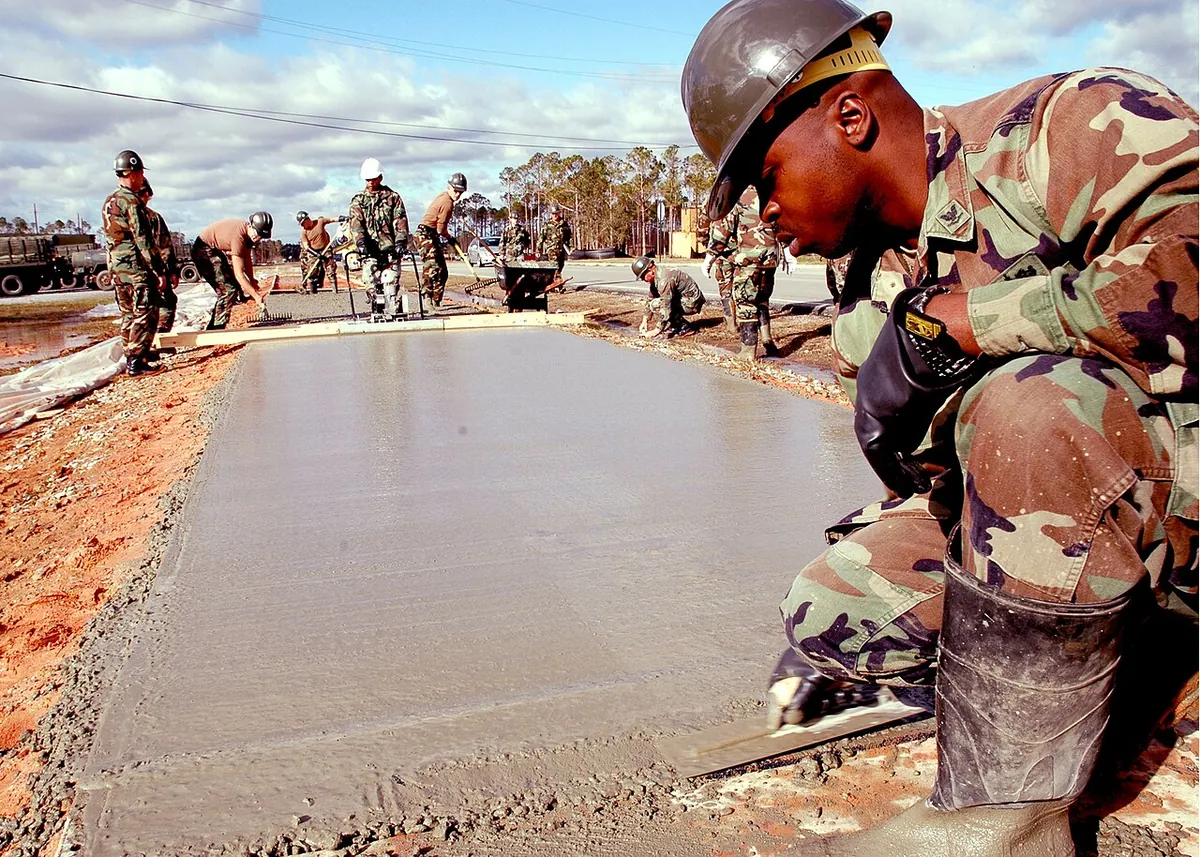
Photo: U.S. Navy, Photographer's Mate 3rd Class Ja'lon A. Rhinehart, Wikimedia Commons, public domain.
Quick Answer
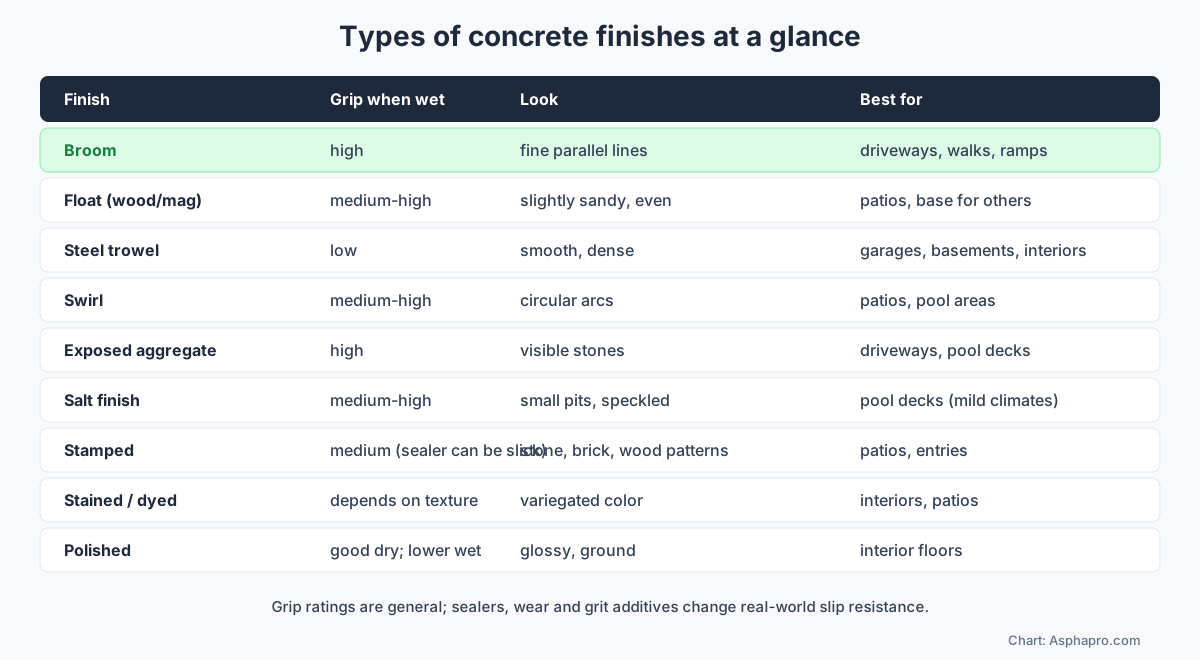
The main types of concrete finishes are broom finish (textured lines for grip, the standard for driveways and sidewalks), float finish (slightly sandy), steel trowel finish (smooth and dense, for garages and interiors), swirl finish, exposed aggregate (stones showing), salt finish (small pits), stamped concrete (patterns like stone or brick), stained or dyed concrete (color), and polished concrete (ground and glossy). Outdoors, choose finishes with grip, like broom, exposed aggregate or swirl. Indoors, smooth trowel, stained or polished finishes are common. Decorative finishes cost more and usually need sealing.
The finish is the part of a concrete slab you see and walk on every day. It affects how the surface looks, how slippery it is when wet, how easy it is to clean, how it wears, and how much it costs. Two slabs poured from the same truck can look and perform completely differently depending on how the finisher works the surface in the hours after the pour.
This guide explains the types of concrete finishes, how each is made, where it works best, and the tradeoffs in slip resistance, maintenance and cost.
How Concrete Finishing Works
There are many different types of concrete finishes, but most start the same way: the slab is leveled, floated and then given its final texture. Concrete finish types differ in what happens in that last step and whether anything is added to the surface.
Every finish starts with the same basic steps after concrete is placed in the forms:
- Screeding: a straight board or screed is dragged across the forms to strike off excess concrete and make the surface level.
- Bull floating: a wide float on a long handle smooths ridges, pushes stones just below the surface and brings up a thin layer of cement paste.
- Waiting for bleed water: water rises to the surface. Finishers wait until this bleed water evaporates before further finishing. Working water back into the surface weakens it and can cause scaling and dusting later.
- Edging: an edging tool rounds the slab edges along the forms so they resist chipping.
- Jointing: a groover cuts control joints, or joints are sawed later, to control where cracks form; see why concrete cracks.
- Final finish: float, trowel, broom, stamp or other texture.
- Curing: keeping the surface moist or sealed with a curing compound so it gains strength; see how long concrete takes to cure.
Timing is everything. Finish too early and you trap bleed water; finish too late and the surface is too hard to work. Weather changes the timing a lot, which is why experienced finishers watch the concrete, not the clock.
1. Broom Finish
The most common exterior finish. After floating, a stiff or soft broom is dragged across the surface, leaving fine parallel grooves. The grooves give traction when wet, which is why broom finish is the standard for driveways, sidewalks, ramps, steps and pool areas.
- Light broom: soft bristles, fine texture, easier to clean.
- Heavy broom: stiff bristles, deeper grooves, more grip for slopes and ramps.
- Direction: brooming across the direction of travel gives the most grip and helps drainage.
Broom finish is inexpensive because it adds only a few minutes per pass. See concrete driveway cost and concrete sidewalk cost.
2. Float Finish
A wood, magnesium or resin hand float, or a power float, is worked over the surface after bleed water is gone. It levels small bumps, embeds aggregate and leaves a slightly rough, sandy texture. Float finish is a step in most other finishes, but it can also be the final finish for patios and areas where a little grip is wanted without broom lines.
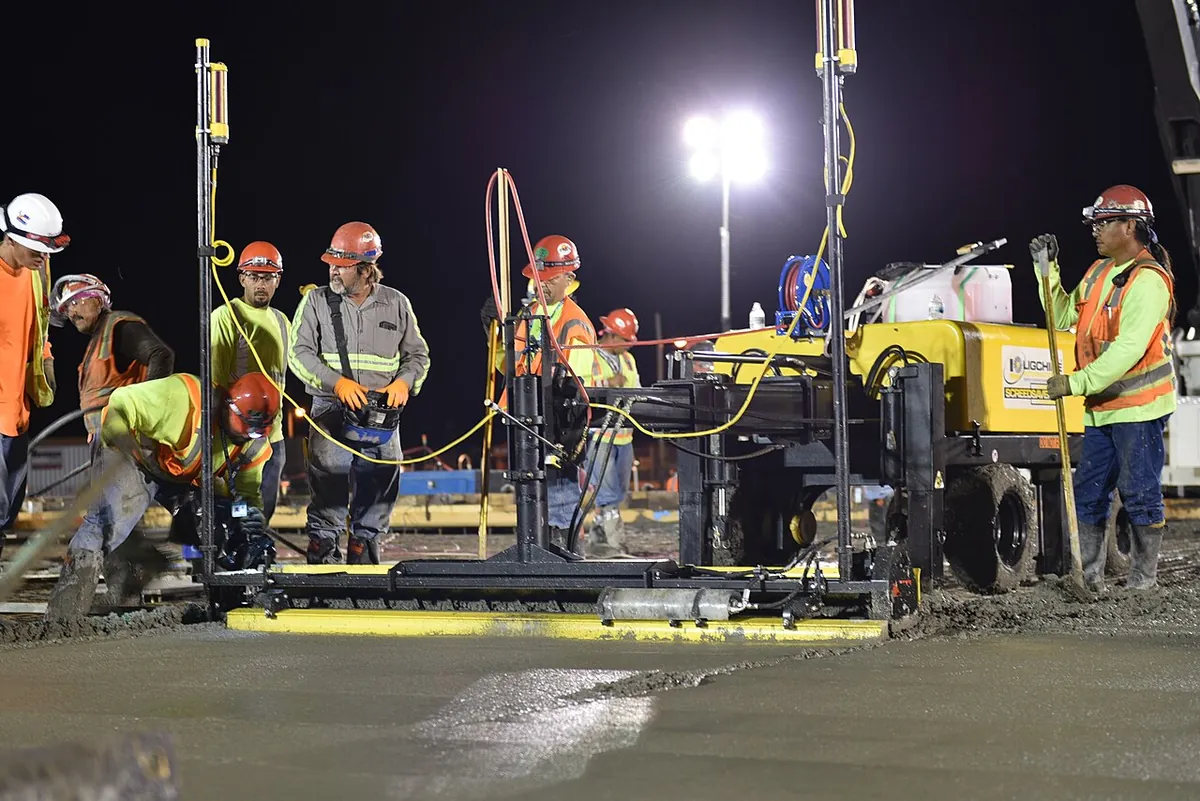
Photo: PEO ACWA, Wikimedia Commons, CC BY 2.0.
3. Steel Trowel (Smooth) Finish
After floating, a steel trowel is passed over the surface, often several times as the concrete stiffens, compacting it into a smooth, dense, slightly shiny surface. Large slabs are troweled with walk-behind or ride-on power trowels.
- Pros: smooth, easy to sweep and clean, dense surface that resists wear, good base for coatings after proper prep.
- Cons: slippery when wet; not recommended for exterior walkways, ramps or pool decks.
- Best for: garage floors, basements, warehouses, interior slabs.
Over-troweling exterior air-entrained concrete can seal the surface too early and trap air and water, leading to scaling. That is one reason exteriors usually get a float and broom instead.
4. Swirl Finish
A float or trowel is moved in overlapping circular arcs, leaving a decorative pattern of swirls. It gives moderate traction and a hand-crafted look. Swirl finishes are popular on patios and around pools in some regions.
5. Exposed Aggregate Finish
The top layer of cement paste is removed to reveal the stones underneath. Methods include:
- Washing and brushing the surface a few hours after placement.
- Spraying a surface retarder that slows the top paste, then washing it off the next day.
- Seeding decorative stones into the surface and then exposing them.
- Grinding or sandblasting hardened concrete.
Exposed aggregate is durable, hides dirt and stains, and gives excellent traction. It costs more than broom finish, especially with decorative stone, and the rough surface is harder to sweep.
6. Salt Finish
Coarse rock salt is pressed into the wet surface and later washed away, leaving small pits and a speckled texture. It is popular for pool decks in warm climates because it gives grip and stays cooler-looking. In freeze-thaw climates, the pits can hold water that freezes, so salt finishes are generally not recommended there.
7. Stamped Concrete
Textured stamps or mats are pressed into the surface while it is still plastic to imitate stone, brick, slate, tile or wood. A color hardener or integral color, and a release agent in a second color, give the look of natural materials. Stamped concrete is then sealed. It is one of the most popular decorative types of concrete finishes for patios and entries but costs more than broom finish and needs resealing every few years. A sealed stamped surface can be slippery when wet unless a grit additive is used in the sealer. See stamped concrete vs pavers.
8. Stained and Dyed Concrete
Color is applied to cured concrete:
- Acid stains: react chemically with the concrete to give mottled, variegated earth tones.
- Water-based stains and dyes: offer a wider range of colors and more even results.
Staining works on new and existing concrete, inside and out, and is usually sealed afterward. See concrete staining.
9. Polished Concrete
Hardened concrete is ground with progressively finer diamond abrasives, densified with a chemical hardener, and polished to a matte, satin or high-gloss sheen. Polished concrete is durable, easy to clean and popular in modern homes, stores and warehouses. It is mainly for interiors. See polished concrete cost.
10. Colored Concrete
Color can be built into the concrete rather than applied later:
- Integral color: pigment mixed into the whole batch at the plant, so color goes all the way through and chips do not show gray.
- Color hardener: a dry-shake powder of pigment, cement and hard aggregate broadcast onto the fresh surface and troweled in. Gives intense color and a harder wearing surface; common with stamped concrete.
Colored concrete can then receive any texture, from broom to stamp. Color varies slightly from batch to batch, so order all of it from one supplier and keep water content consistent.
11. Sandblasted and Shot-Blasted Finishes
Sandblasting hardened concrete removes the surface paste to expose fine aggregate, giving a uniform, matte, sandy texture. Light blasting gives a brush-off look; heavy blasting exposes more stone. Shot-blasting uses steel shot and is mainly used to prepare floors for coatings, but it also leaves a clean, slightly rough texture.
12. Textured Overlays and Spray (Knockdown) Finishes
Polymer-modified cement overlays are sprayed or troweled over existing concrete in a thin layer. A knockdown finish is sprayed in a splatter pattern and lightly flattened with a trowel, leaving a cool-to-the-touch, slip-resistant texture common on pool decks in hot climates. Microtoppings are very thin, smooth overlays for a modern look indoors or out. Overlays are a way to change the finish on old concrete; see concrete overlay cost.
13. Stenciled Concrete
Paper stencils are laid on fresh concrete, color hardener is broadcast and troweled in, and the stencils are removed to reveal grout-line patterns like brick or tile. It looks similar to stamped concrete but with a smoother surface.
14. Burnished Finish
A power trowel is run repeatedly at high speed as the concrete hardens, producing a very dense, glossy surface without grinding. It is used in warehouses and some modern homes. Like other smooth finishes, it can be slippery when wet.
15. Coatings
Epoxy, polyurea and polyaspartic coatings are applied over prepared concrete, mostly on garage and basement floors. They add color, chip flakes and chemical resistance. They are a covering, not a finish of the concrete itself, but they are often chosen instead of a decorative finish. See concrete coating cost.
16. Vertical and Formed Finishes
Walls and other vertical concrete get their finish from the forms and from work after stripping:
- Smooth form finish: from plywood or steel forms.
- Board-formed concrete: rough sawn boards used as forms leave a wood-grain imprint.
- Form liners: rubber or plastic liners create stone, brick or patterned textures.
- Rubbed or sacked finish: a cement slurry is rubbed into the stripped surface to fill bug holes and even the color.
Combining Finishes
Many of the best-looking slabs mix more than one of the types of concrete finishes. A common approach is a broom-finished field with smooth troweled borders, made by running an edger or a trowel along the edges and joints after brooming. This frames each panel and looks crisp for little extra cost. Other combinations include a stamped border around a broom-finished driveway, an exposed aggregate band at the street edge, stained panels separated by saw-cut grout lines, or a smooth troweled patio with a textured band where people step out of a door.
Combining finishes lets you put grip where it matters and decoration where it shows. It also helps break up large slabs visually. Plan the layout with your finisher before the pour, because each finish has its own timing and some need extra crew members on the day.
How Long Each Finish Lasts
The concrete underneath can last for decades no matter the finish. What changes is how long the surface keeps its look. Broom textures slowly wear smoother in heavy traffic areas. Exposed aggregate keeps its texture for a very long time. Stamped and stained finishes rely on sealers, which wear and need renewal every few years. Polished floors keep their shine with routine cleaning and occasional re-polishing in high-traffic paths. See how long concrete lasts.
Choosing a Finish by Location
| Location | Good finishes | Avoid |
|---|---|---|
| Driveway | Broom, exposed aggregate, stamped with grit sealer | Smooth trowel |
| Sidewalk, ramp, steps | Broom (across travel), exposed aggregate | Smooth or polished |
| Patio | Broom, swirl, stamped, stained, exposed aggregate | Unsealed smooth in wet areas |
| Pool deck | Broom, exposed aggregate, salt (warm climates), knockdown overlay | Smooth or high-gloss sealed |
| Garage floor | Steel trowel, coating, polished | Deep textures that trap oil |
| Basement and interiors | Trowel, stained, polished, burnished | Rough exterior textures |
Relative Cost of Concrete Finishes
Basic finishes are included in nearly every concrete quote. Decorative finishes add labor, materials and sealing:
- Lowest: float, broom and swirl finishes.
- Low to moderate: steel trowel, salt finish, simple exposed aggregate.
- Moderate: staining, integral color, seeded exposed aggregate, stenciled.
- Higher: stamped concrete, especially multi-color with borders.
- Highest: high-gloss polished concrete and complex overlays.
For price ranges, see concrete cost per square foot.
Maintenance by Finish
- Broom and float: sweep and wash occasionally; a penetrating sealer helps in freeze-thaw areas.
- Exposed aggregate: reseal every few years to keep stones locked in and colors rich.
- Stamped and stained: reseal every 2 to 3 years or as the sealer maker recommends; see how to reseal concrete.
- Polished: dust mop and clean with a pH-neutral cleaner; reapply guard products as needed.
- Steel trowel garage floors: clean oil spots promptly; see how to remove oil stains from concrete.
Common Finishing Problems
- Scaling: the top layer flakes off, often from finishing with bleed water on the surface, over-troweling, poor air entrainment or early deicing salt. See does salt damage concrete.
- Dusting: a soft, powdery surface from too much water, finishing bleed water in, or poor curing.
- Crazing: a network of fine surface cracks from fast surface drying or over-troweling.
- Blistering: bumps from troweling too early and sealing the surface over trapped air or water.
- Plastic shrinkage cracks: short cracks from rapid evaporation in hot, windy weather before finishing.
- Discoloration: uneven color from changing water content, curing differences or calcium chloride.
Most finishing problems come down to timing, water and curing. Hiring an experienced finisher matters as much as choosing the finish.
Changing the Finish on Existing Concrete
If you have plain gray concrete and want a different look, you have options without tearing it out:
- Stain or dye it for color.
- Grind and polish an interior slab.
- Apply a stamped or textured overlay.
- Add a coating on a garage floor.
- Lay pavers or tile over a sound slab; see can you lay pavers over concrete.
To add grip to a slippery finish, apply a sealer with anti-slip grit, have the surface lightly shot-blasted or acid-etched, or use an anti-slip coating.
Tools Used for Concrete Finishes
Each of the types of concrete finishes depends on a handful of tools, used at the right moment:
- Screed board: a straight 2x4 or aluminum straightedge to strike the concrete level with the forms.
- Bull float: a wide float on a long handle that smooths the surface right after screeding and pushes aggregate down.
- Darby: a shorter hand float used on small slabs instead of a bull float.
- Hand floats: wood floats give a rougher texture; magnesium floats slide more easily and suit air-entrained concrete.
- Edger: rounds the edges along the forms.
- Groover: cuts control joints in fresh concrete.
- Steel trowels and power trowels: for smooth, dense finishes.
- Brooms: soft or stiff finishing brooms on long handles, often with an adjustable angle.
- Stamps, texture mats and rollers: for decorative patterns.
- Knee boards: let finishers kneel on fresh concrete without sinking.
Finishing a Small Slab Yourself: The Timeline
For a DIY patio or walkway with a broom finish, the sequence usually goes like this on a mild day:
- Pour and screed (first 15 to 30 minutes): place the concrete, spread it, and strike it off level with the forms.
- Bull float immediately: one or two passes to level and close the surface. Do not overwork it.
- Wait (30 minutes to 2 hours): bleed water rises and then evaporates. The surface loses its sheen. Do nothing while water is on the surface.
- Edge and joint: run the edger along the forms and the groover at the planned joints when the surface can hold a shape.
- Hand float: float the surface to remove edger and groover marks and smooth it.
- Broom: drag the broom across the slab in straight, overlapping passes. Clean the broom often. Re-run the edger lightly if you want smooth borders.
- Cure: once the surface can be touched without marking, apply a curing compound or cover with plastic, and keep it moist for several days.
A simple way to judge readiness: press a gloved thumb on the surface. If it leaves a mark about ¼ inch deep and no water appears, the concrete is usually ready for edging and floating. For smooth troweling, wait until the thumbprint is shallower. Practice on a small slab before tackling a driveway.
How Weather Affects Concrete Finishes
Hot, dry and windy weather speeds up setting and surface drying. The window for finishing shrinks, and plastic shrinkage cracks become more likely. Finishers use evaporation retarders, sunshades, windbreaks, cooler concrete and earlier start times. Cold weather slows setting, so bleed water lingers and finishing can drag on for hours; accelerators and heated enclosures help. Rain on fresh concrete can wash out the surface and ruin a decorative finish; see can you pour concrete in the rain and pouring concrete in cold weather.
Finishing Air-Entrained Concrete
Exterior concrete in cold climates is usually air-entrained for freeze-thaw protection. Over-working or hard troweling an air-entrained surface can drive out the protective air near the top and seal the surface too early, which can lead to blistering and scaling. That is why most exterior flatwork in cold regions gets a magnesium float and a broom finish rather than a hard steel trowel finish. If a smooth exterior surface is required, the finisher and supplier should plan the mix and timing together.
Slip Resistance and Safety
Slip resistance matters most where surfaces get wet: entries, ramps, steps, pool decks and driveways that slope. Accessibility guidelines call for walking surfaces that are firm, stable and slip resistant. Textured finishes like broom and exposed aggregate give the best natural grip. Decorative sealers can make any finish slick, so ask for a sealer with an anti-slip additive on stamped and stained concrete outdoors. Test a sample area with wet shoes before sealing a large patio.
Three Real-World Examples
A driveway in a cold, snowy climate
A homeowner in a northern state wants a new two-car driveway. The contractor orders 4,000 psi air-entrained concrete, places it, bull floats it once, waits for bleed water to leave, edges and joints it, floats it with a magnesium float and gives it a medium broom finish across the slope. The slab is cured with a curing compound, and the homeowner waits until the following season, after the concrete has had time to cure and dry, before using deicers, and then avoids harsh ones. A smooth steel trowel finish or a salt finish would be a poor choice here because of slipperiness and freeze-thaw risk.
A pool deck in a hot climate
A homeowner in a warm southern state wants a pool deck that stays cool underfoot and is not slippery. Options include a light-colored broom finish, a salt finish, exposed aggregate, or a knockdown spray overlay. The finisher uses an evaporation retarder and starts early in the morning to beat the heat. Any sealer used includes anti-slip grit. The deck is sloped away from the pool, with drains where needed.
A basement floor that will be lived on
For a basement being finished as living space, a steel trowel finish gives a flat, dense surface. Later, the owner can stain and seal it, grind and polish it, or install flooring over it. If flooring will be glued down, the floor is tested for moisture first; see mold on concrete for moisture tips.
These examples show the pattern: outdoor surfaces get texture and freeze-thaw protection, wet areas get grip, and interior floors get smooth, dense finishes that can be decorated or covered later.
Questions to Ask a Concrete Finisher
- Which finish do you recommend for this location and climate, and why?
- Can I see photos or visit past jobs with this finish?
- Is the mix air-entrained, and how will that affect finishing?
- How will joints be placed and cut?
- How will the slab be cured, and for how long?
- Is sealing included, and what sealer will be used?
- What happens if the color or pattern is uneven?
Choosing among the types of concrete finishes is partly about looks, but the best result comes from matching the finish to the location, climate and how much maintenance you are willing to do.
Frequently Asked Questions
What are the main types of concrete finishes?
Broom, float, steel trowel, swirl, exposed aggregate, salt, stamped, stained and polished.
What is the best finish for a concrete driveway?
Broom finish is the standard for grip and cost. Exposed aggregate and stamped finishes are decorative options.
What is the least slippery concrete finish?
Heavy broom and exposed aggregate finishes give the most traction when wet.
Is smooth concrete good outdoors?
Usually not. A steel trowel finish can be very slippery when wet; use broom or float finishes outdoors.
What is the cheapest concrete finish?
Broom and float finishes cost the least because they add little labor.
Which concrete finish is best for a pool deck?
Textured finishes with good wet grip: broom, exposed aggregate, salt (in warm climates) or a textured overlay.
Can you broom finish concrete after it dries?
No. Broom texture must be applied while the surface is still plastic. On hardened concrete, use an overlay or grinding for texture.
How long after pouring do you broom concrete?
After bleed water evaporates and the surface is floated, usually within a couple of hours depending on weather.
Does stamped concrete need sealing?
Yes. Sealer protects color and surface. Reseal every few years and add grit for traction.
What finish is best for a garage floor?
A steel trowel finish, often followed by a coating or polishing.
What type of concrete finish is best for a driveway?
A broom finish is the most common type of concrete finish for driveways because it is cheap and gives good grip. Exposed aggregate and stamped finishes also work but cost more and need sealing.
Sources
- American Concrete Institute, guidance on finishing concrete flatwork. concrete.org
- Portland Cement Association, finishing concrete slabs and avoiding scaling. cement.org
- Image credits: trowel photo U.S. Navy (public domain); power float photo by PEO ACWA (CC BY 2.0), both Wikimedia Commons; chart by Asphapro.com.
Checked November 2026.
Related Guides
- Can you pour concrete in the rain? — risks and how to protect a pour