
Concrete Culvert Guide: Concrete Pipe, Box Culverts, Sizing, Installation and Costs
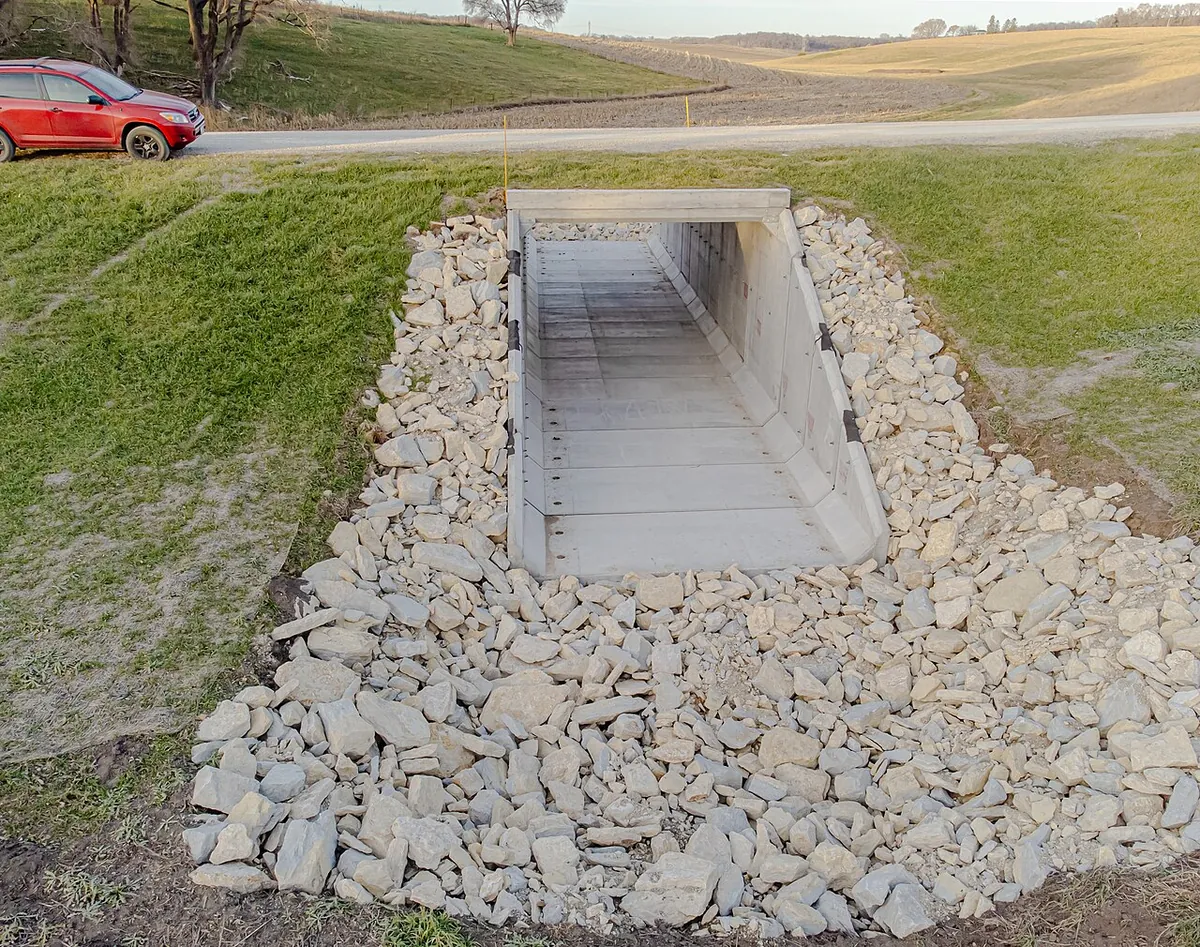
Photo: Wikideas1, Wikimedia Commons, CC0
Quick Answer
A concrete culvert is a buried concrete pipe or box that carries a stream, ditch or storm water under a road, driveway, railroad or trail. Most are made of reinforced concrete pipe (RCP), round pipe from 12 to 144 inches in diameter in strength classes I to V under ASTM C76, or precast concrete box culverts for larger flows and low headroom. A typical home driveway needs a 15 to 24 inch concrete culvert pipe 20 to 40 feet long, set on compacted bedding with at least 12 inches of cover. Concrete pipe costs roughly $20 to $150 per foot by size, and a finished driveway culvert typically costs $1,500 to $5,000. Concrete culverts last 50 to 100 years, longer than most metal or plastic pipe.
Wherever a road or driveway crosses a ditch, a creek or a low spot, water needs a way through. Concrete culverts are the oldest and most durable way to give it one. They range from small concrete pipes under farm lanes to precast concrete box culverts large enough to drive through, like the box sections in the photo above, set under a rural Iowa road with rock riprap at the outlet to stop erosion. Highway departments use concrete culverts by the thousands because they are strong, fireproof, resist abrasion and last for generations.
This guide explains the types of concrete culverts, reinforced concrete pipe classes and sizes, how to size a concrete culvert for a driveway, how to install one correctly, headwalls and end treatments, costs, lifespan and maintenance, and what to know if you find old asbestos concrete pipe on your property.
Types of Concrete Culverts
Concrete culverts fall into a few main types. The most common is the round concrete pipe culvert, made of reinforced concrete pipe in sections joined end to end. Round pipe handles loads well because the arch shape spreads pressure, and it is easy to make, ship and install. Elliptical reinforced concrete pipe, oval in shape, is used where cover is shallow and a round pipe of the same capacity would stick up too high. Concrete arch pipe has a flat bottom and arched top for similar reasons. Precast concrete box culverts are rectangular sections, often 3 to 12 feet wide, used for larger flows, wildlife and pedestrian crossings, and places where headroom is limited. Three-sided precast arches and bridges sit on footings and keep the natural stream bed, which is better for fish passage. Cast-in-place concrete culverts are formed and poured on site, usually for large or unusual structures. See precast concrete.
For homeowners and farms, the choice is usually between a round concrete culvert pipe and plastic or corrugated metal pipe. For county and state roads, engineers choose among reinforced concrete pipe, precast box culverts and other materials based on flow, cover, loads, soil, corrosion, fish passage and cost over the full life of the culvert.
Reinforced Concrete Pipe: Sizes and Classes
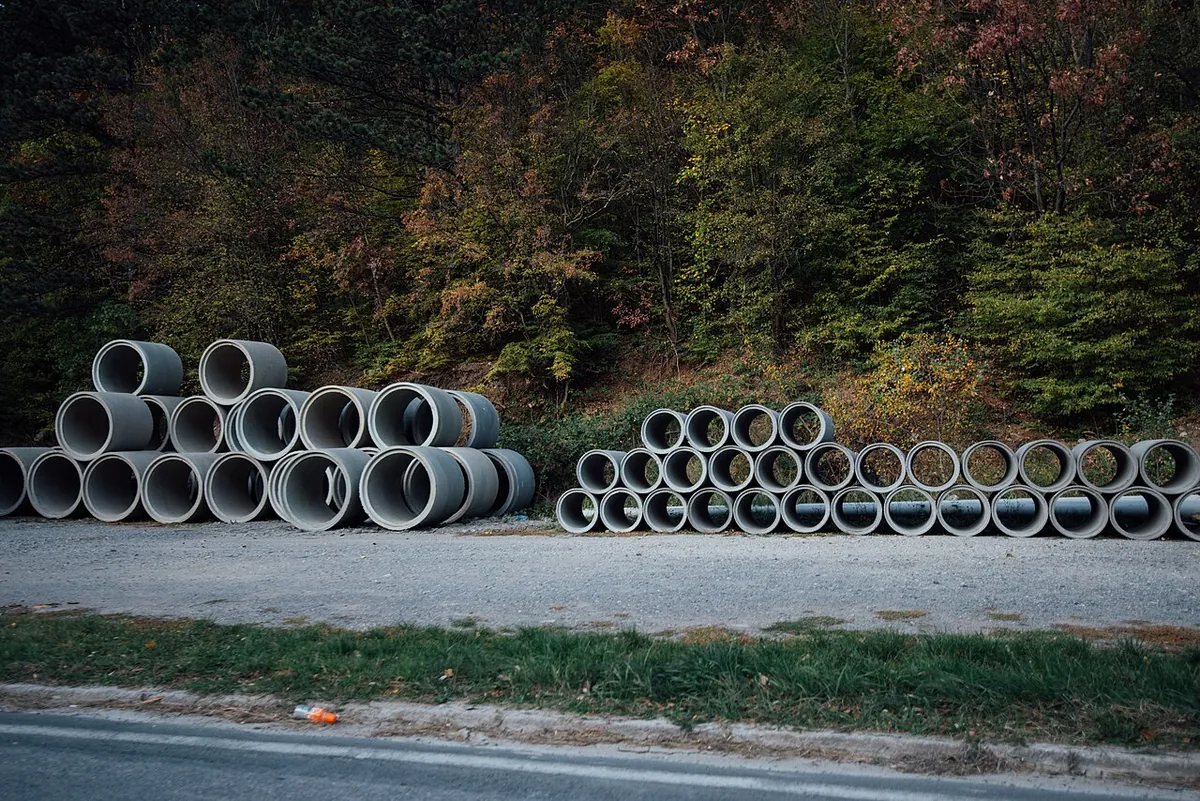
Photo: Shixart1985, Wikimedia Commons, CC BY 2.0
Reinforced concrete pipe is concrete pipe with one or more cages of steel reinforcement cast into the wall, like the stacked pipes above waiting for installation. In the United States, ASTM C76 covers round reinforced concrete pipes, with inside diameters from 12 to 144 inches and standard lengths of 4 to 8 feet; 8 foot sections are common for smaller sizes. Pipes are made in five strength classes, Class I to Class V, based on the load the pipe can carry before cracking, measured in a three-edge bearing test. Class III is the most common for culverts under roads and driveways; Class IV and V are used under deep fills or very heavy loads. Wall thickness comes in types called Wall A, B and C, with Wall B the usual choice. Joints are bell and spigot or tongue and groove, sealed with rubber gaskets, mastic or mortar. Non-reinforced concrete pipe, covered by ASTM C14, comes in small diameters for light-duty drainage.
Concrete pipe is heavy, which is part of its strength. A 12 inch Class III reinforced concrete pipe weighs about 90 to 100 pounds per foot, a 24 inch pipe about 300 pounds per foot, and a 48 inch pipe roughly 1,000 pounds per foot. An 8 foot section of 24 inch pipe weighs around 2,400 pounds, so installation needs an excavator or loader with lifting gear. Plan delivery and placement before ordering, including where the truck will park, where the pipe will be unloaded and stored, and how the excavator will reach the trench without driving over soft ground or the new pipe.
Precast Concrete Box Culverts
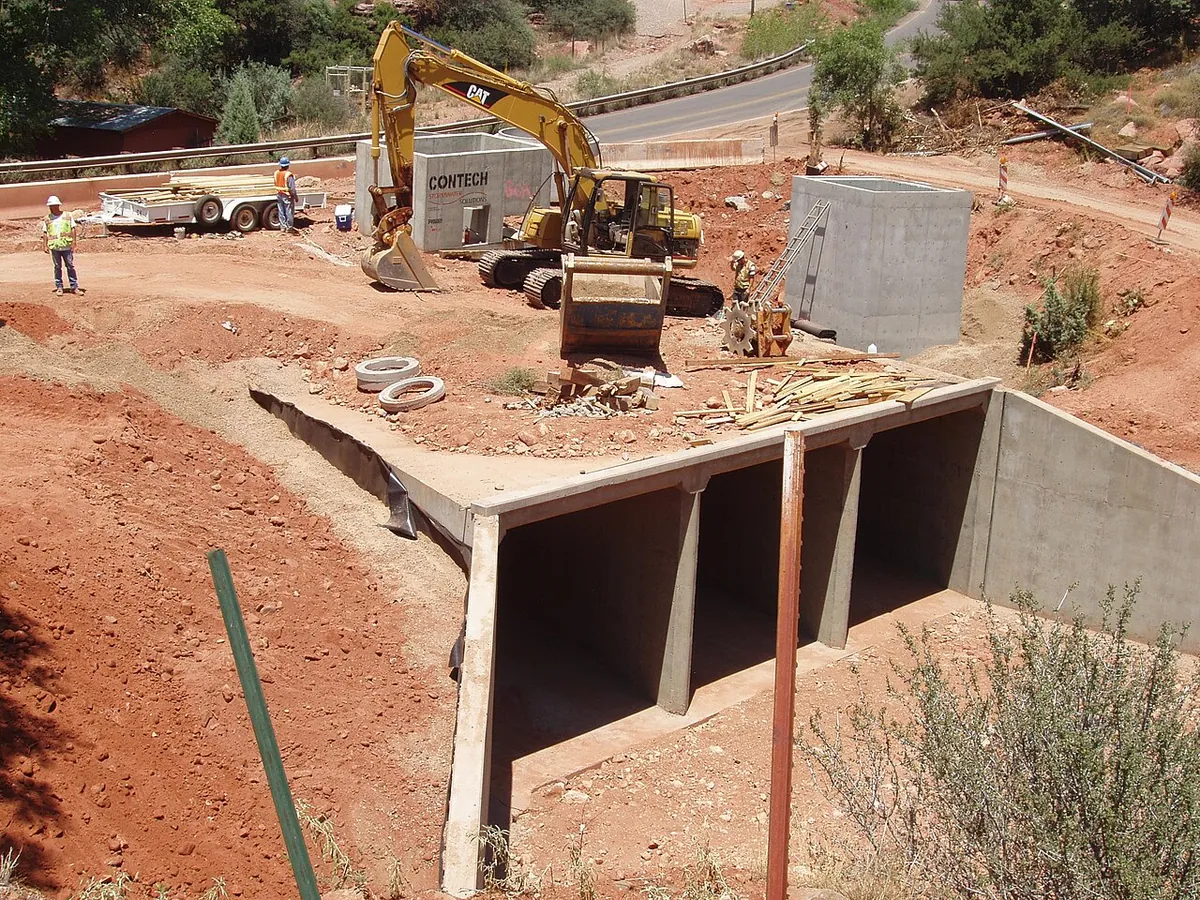
Photo: Federal Highway Administration, Wikimedia Commons, public domain
Precast concrete box culverts are rectangular sections cast in a plant, delivered by truck, and set side by side or end to end in a prepared trench. Standards such as ASTM C1577 cover their design. They are made in spans from about 3 to 12 feet or more and in many heights, and can be set as single cells or multiple cells side by side, like the three-cell installation under construction above. Box culverts carry large flows with less height than round pipe, which helps where the road cannot be raised. Their flat bottom can be buried slightly below the stream bed and covered with natural material, helping fish and wildlife pass through. Precast concrete culverts install quickly, often in a day or two, which shortens road closures. Wingwalls and headwalls, precast or cast in place, hold back soil at each end. See concrete footings and concrete retaining walls.
Sizing a Concrete Culvert for a Driveway
Sizing matters more than anything else. A culvert that is too small backs water up over the driveway, washes out the fill, and can flood neighbors upstream. A culvert that is too large costs more but rarely causes problems. Most local road departments and counties set a minimum size for driveway culverts in road ditches, often 15 or 18 inches in diameter, and many require a permit and a specific pipe material. Check with the county or state highway department before you buy anything, because a culvert in the public right of way usually has to follow their rules.
For a ditch carrying runoff from a few acres, a 15 to 18 inch concrete culvert pipe is common. Larger drainage areas, steep land and creeks need bigger pipes, sized from rainfall data and drainage area using methods such as the rational method or local design charts. A simple field check is to measure the cross-section of the ditch or stream at bank-full height and choose a culvert with at least that much open area. When in doubt, go one size up or ask the road department or an engineer. Length should be enough to span the driveway plus side slopes, usually 20 to 40 feet for a home driveway, depending on width and fill height.
How to Install a Concrete Culvert Pipe
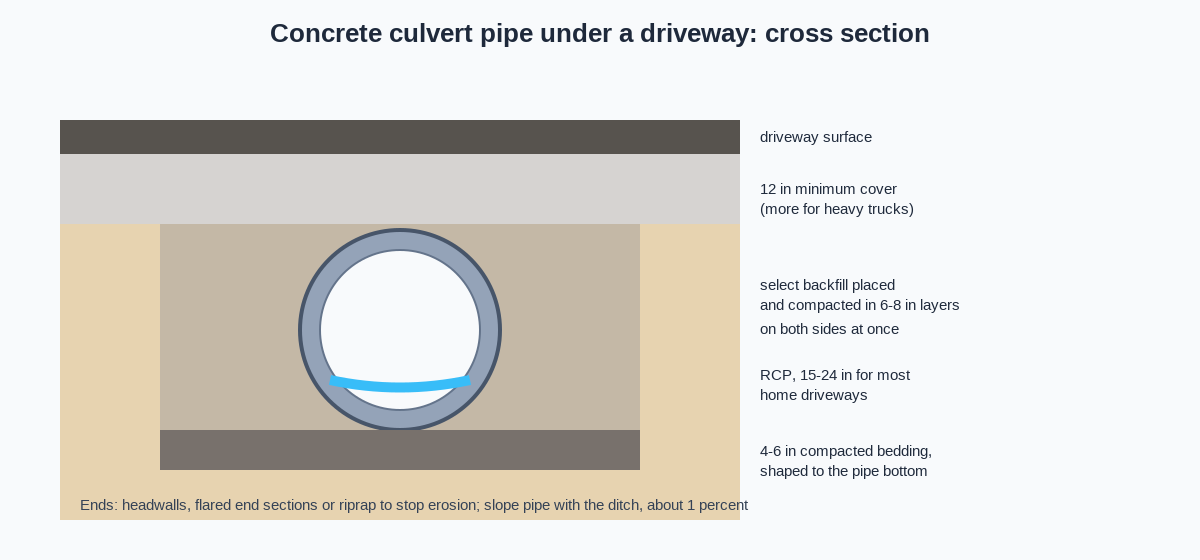
The strength of a concrete culvert depends as much on the bedding and backfill as on the pipe. The diagram above shows the basic installation for a driveway culvert. Start by calling 811 to locate utilities and getting any permit the road department requires. Excavate a trench along the ditch line, wide enough for the pipe plus about a foot on each side for compaction. The trench bottom should follow the slope of the ditch, usually about 1 percent, so water flows freely and sediment does not settle in the pipe. Set the inlet and outlet at the natural ditch grade, not above it, or water will pond upstream and erode downstream.
Place 4 to 6 inches of bedding, usually crushed stone or well-graded granular material, and compact it. Shape it slightly to fit the pipe bottom so the pipe is supported along its length, not resting on its bells or on high spots. Lower the concrete pipe sections with an excavator, using a lifting device, chain through the pipe, or lifting holes, and push each spigot fully into the previous bell, with the bells facing upstream. Seal joints with the gaskets or mastic supplied. Backfill around the pipe with granular material in layers of 6 to 8 inches, compacting each layer on both sides at the same time so the pipe does not shift. Pay special attention to the haunches, the area under the lower curve of the pipe, which must be filled and compacted by hand or with a tamper. Continue to at least 12 inches of compacted cover over the top of the pipe before driving over it with heavy equipment, or more if the manufacturer or road department requires. Finish with the driveway base and surface. See crushed concrete and gravel driveway cost.
Headwalls, End Sections and Erosion Control
The ends of a concrete culvert are where most failures begin. Water speeds up through a pipe and scours the soil at the outlet, and at the inlet it can wash around the pipe and erode the fill. Headwalls are concrete or stone walls at each end that hold the fill, protect the pipe ends and guide water in and out. Precast flared end sections fit onto the pipe ends and spread the flow. Riprap, large angular stone placed on filter fabric at the outlet and around the inlet, absorbs energy and prevents scour, like the stone apron around the box culvert at the top of this page. Many driveway culverts also have concrete or stone aprons on the driveway slopes so the fill does not wash into the ditch. A simple bag-and-mortar headwall or a cast-in-place concrete headwall is a good homeowner project once the pipe is in. See concrete bag retaining walls and concrete catch basin.
Concrete vs Plastic vs Metal Culverts
Homeowners usually choose among concrete, corrugated metal and plastic culvert pipe. Concrete pipe is the strongest and longest-lasting, often 70 to 100 years. It does not burn, resists abrasion from sand and gravel, and is rigid, so it does not rely as much on the backfill for strength. It is also the heaviest and most expensive per foot, and needs machinery to install. Corrugated steel pipe is lighter and cheaper, but rusts and wears through at the bottom, often in 20 to 40 years depending on water and soil. Aluminum pipe lasts longer than steel in many soils. High-density polyethylene (HDPE) plastic pipe is light, cheap, easy to handle and does not corrode, but depends heavily on good backfill, can deform under heavy loads with poor compaction, and can burn in brush fires. Many road departments allow all three for driveways; for long life and heavy trucks, concrete culverts are the safest choice. See asphalt vs concrete driveway cost.
Replacing an Old or Failed Culvert
Many driveways and farm lanes have old culverts that are rusted through, crushed, too small or plugged with sediment. Signs of failure include water ponding upstream after storms, a dip or sinkhole in the driveway over the pipe, rust holes in the bottom of a metal pipe, a pipe outlet hanging above the ditch with a scour hole below it, and water flowing around the outside of the pipe instead of through it. Replacing a failed culvert with a new concrete culvert is a common upgrade. The job starts the same way as a new installation: check with the road department, call 811, and plan for traffic, since the driveway will be closed for a day or more. The old pipe is dug out, the trench is cleaned of soft or wet soil, the bedding is rebuilt, and the new concrete pipe is set at the correct grade, often one size larger than the old one. Backfill and compact in layers, rebuild the driveway base and surface, and protect both ends with headwalls or riprap. If the old pipe is metal and in decent shape inside, a contractor can sometimes slip-line it with a smaller pipe and grout the gap, but that reduces capacity, so it works only if the old pipe was oversized.
Precast Concrete Culvert vs Cast in Place
For most projects, a precast concrete culvert wins over cast-in-place work. A precast concrete culvert is made in a plant under controlled conditions, with consistent concrete strength, cover over reinforcement and dimensions, and it arrives ready to set. Installation takes hours or days rather than weeks, which matters on roads that must reopen quickly and on streams where work windows are short to protect fish. Cast-in-place culverts are still used for very large or unusually shaped structures, for sites where trucks and cranes cannot reach, and for extensions or repairs of existing cast-in-place structures. Cast-in-place work needs forms, reinforcement, concrete deliveries, curing time and inspections, and it is more sensitive to weather. Many projects combine both: precast barrel sections with cast-in-place headwalls and wingwalls, or the reverse. See how to build concrete forms and how long concrete takes to cure.
Culverts, Streams and Fish Passage
A culvert in a ditch that only carries runoff is a simple drainage problem. A culvert in a stream is also an ecological one. Poorly designed stream culverts can block fish and other aquatic animals from moving upstream, either because water runs too fast through the smooth pipe, because the outlet is perched above the stream after scour, or because the pipe is too small and shallow. Many states now require stream crossings to meet stream simulation design rules, which call for a culvert wider than the bank-full channel, with a natural streambed inside it and no drop at the outlet. Precast concrete box culverts and three-sided arches with buried bottoms are common ways to meet those rules. Before replacing or installing any culvert in a creek or brook, check with the state environmental or fish and wildlife agency, since permits are usually required and the design may have to follow their guidance.
Storm Drains and Concrete Pipe in Developments
Beyond culverts, reinforced concrete pipe forms most storm sewer systems under streets and parking lots. Storm water flows from curbs into inlets and catch basins, then through concrete pipes to ponds, streams or larger trunk lines. The same pipe classes, bedding methods and joint types apply, with manholes at junctions and changes in direction. Developers and municipalities favor concrete pipe for storm drains because it handles heavy traffic loads and deep burial, resists damage during construction, and lasts for generations. Homeowners rarely deal with these systems directly, but understanding them helps when planning yard drainage that connects to a street system, which usually requires city approval. See concrete trench drain and concrete splash blocks.
Concrete Culvert Costs
Prices vary by region, size and class, but rough material costs for reinforced concrete pipe are about $20 to $40 per foot for 12 to 15 inch pipe, $35 to $70 per foot for 18 to 24 inch, $70 to $150 per foot for 30 to 36 inch, and $150 to $400 or more per foot for 48 to 72 inch. Delivery is often extra because of the weight. Precast concrete box culverts range from several hundred to several thousand dollars per foot depending on size. A complete residential driveway culvert, including a 20 to 30 foot length of 15 to 24 inch concrete pipe, excavation, bedding, backfill, compaction, end treatment and driveway repair, typically costs about $1,500 to $5,000. Larger farm or private road crossings with 36 to 48 inch pipe or box sections can cost $8,000 to $30,000 or more. Permits, engineering and erosion control add cost. See how much it costs to pave a private road and concrete driveway apron.
Lifespan and Maintenance
Concrete culverts are low-maintenance, but not no-maintenance. Inspect them at least once a year and after big storms. Clear debris, branches and sediment from the inlet and outlet, because a blocked culvert causes flooding and washouts. Look for sinkholes or depressions over the pipe, which mean soil is washing into the pipe through a joint. Check the outlet for scour and add riprap if the ground is eroding. Look inside with a flashlight for cracks, separated joints, exposed reinforcement or sediment buildup. Small joint leaks can be sealed with grout or internal joint seals; badly damaged pipes can be lined or replaced. In acidic soils or water with high sulfates, specify concrete pipe with sulfate-resistant cement or protective coatings. With basic care, a well-installed reinforced concrete culvert lasts as long as the road above it. See how long concrete lasts and concrete spalling.
Asbestos Concrete Pipe
Asbestos cement pipe, also called transite or AC pipe, was widely used from the 1930s to the 1980s for water mains, sewers, drainage and some culverts. It is made of portland cement reinforced with asbestos fibers, which made it light, strong and corrosion resistant. Many miles of asbestos concrete pipe are still in service. Intact, buried pipe is generally not considered a hazard, because the fibers are bound in cement. The danger comes when the pipe is cut, broken, drilled or crushed, which can release asbestos fibers that cause lung disease. If you find old gray cement pipe on your property, do not cut, break or grind it. Have it tested if you are unsure, and use a licensed contractor who follows asbestos rules to remove or repair it. Many utilities have programs to replace old AC water mains. See concrete dust and concrete removal cost.
Working Safely Around Concrete Pipe
Concrete pipe sections are heavy and can roll. Block stored pipe with wood chocks, never stand downhill of a pipe being moved, and use lifting equipment rated for the weight, with the pipe supplier's recommended lifting method. Trenches deeper than 5 feet need shoring, sloping or a trench box under OSHA rules, and even shallower trenches can collapse in wet or sandy soil. Keep spoil piles back from the trench edge. Never crawl into a culvert pipe to clear debris unless it is large, dry and you have a second person outside; use a hook, a hose or a jetting service instead. Cutting concrete pipe creates silica dust, so cut wet and wear a respirator.
Common Culvert Mistakes
The most common mistakes with concrete culverts are choosing a pipe that is too small for the flow, setting it above or below the ditch grade, skipping the bedding and compaction, leaving too little cover so trucks crack the pipe, and leaving the ends unprotected so they wash out. Another frequent problem is installing a driveway culvert in a public ditch without asking the road department, which may then require it to be removed and replaced. Using broken or salvaged pipe with damaged bells, failing to seal joints, and backfilling with large rocks or clumps of clay that leave voids around the pipe also cause failures. Take time with the base and backfill, protect the ends, and match the size to the flow, and a concrete culvert will outlast almost everything else on the property.
Concrete Culverts for Farms and Rural Properties
Farms, ranches and rural landowners use concrete culverts for field entrances, lane crossings, livestock crossings, and access across creeks and ditches. Heavy equipment such as combines, grain carts and loaded trucks needs culverts with enough strength and cover, so Class III or IV reinforced concrete pipe or precast concrete box culverts are common. For crossings over streams, check state rules on stream crossings and fish passage, since many states require permits for work in waterways and may require larger, buried-bottom culverts or bridges. Concrete box culverts with a natural bottom are often favored for these crossings. A low-water crossing, a reinforced concrete slab across a shallow stream, is an alternative for crossings that only flood briefly. See concrete slab thickness.
Frequently Asked Questions
What size concrete culvert do I need for my driveway?
Most local rules call for at least 15 or 18 inches, but the right size depends on the drainage area and ditch size. Check with your road department.
How much cover does a concrete culvert pipe need?
Usually at least 12 inches of compacted cover before heavy traffic, more for heavy trucks or as the manufacturer specifies.
How long do concrete culverts last?
Reinforced concrete culverts commonly last 70 to 100 years when installed and maintained properly.
Is concrete pipe better than plastic for culverts?
Concrete is stronger, more durable and fireproof, but heavier and more expensive. Plastic is cheaper and lighter but depends on good backfill.
Is old asbestos concrete pipe dangerous?
Intact buried pipe is generally low risk, but cutting or breaking it releases asbestos fibers. Leave removal to licensed professionals.
Sources
- American Concrete Pipe Association: design and installation of concrete pipe
- Federal Highway Administration: culvert hydraulics (HDS-5)
- ASTM C76: reinforced concrete culvert, storm drain and sewer pipe
- US EPA: asbestos information
Related Guides
- Concrete trench drain — channel drains, grates, install and cost
- Concrete burial vault — vaults, grave liners and cost
- Concrete catch basin — storm inlets, sizes and install
- Concrete cloth — rolled concrete for ditches and slopes