
Concrete Cloth: How Rolled Concrete Works, Uses, Installation and Cost
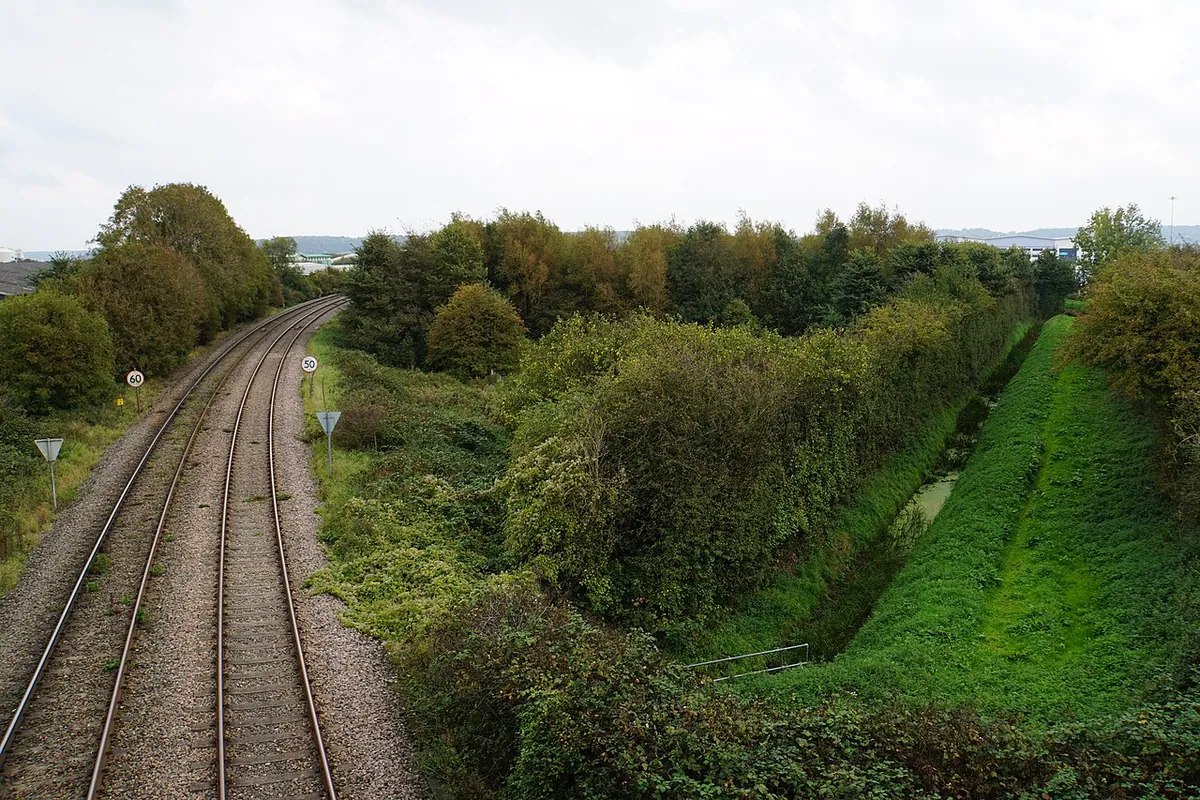
Photo: Bill Boaden, Wikimedia Commons, CC BY-SA 2.0
Quick Answer
Concrete cloth, also called rolled concrete, concrete fabric or a geosynthetic cementitious composite mat (GCCM), is a flexible fabric filled with a dry concrete mix. It is unrolled and shaped like a heavy tarp, then soaked with water, and within about 24 hours it hardens into a thin, strong, waterproof layer of concrete, typically 5 to 13 mm (about 1/4 to 1/2 inch) thick. Concrete cloth is used mainly for ditch and channel lining, slope and erosion protection, culvert repair, containment lining and weed suppression, especially where trucks and mixers cannot reach. Material typically costs about $5 to $15 per square foot depending on thickness, plus installation.
Lining a drainage ditch, protecting a steep slope or repairing a damaged culvert with conventional concrete means forms, mixers, pump trucks and skilled crews, often in places that are hard to reach. Concrete cloth offers a different approach: concrete that arrives on a roll, goes down like fabric and sets with nothing but water. Ditches like the grassy channel in the photo above, which erode, fill with weeds and need constant maintenance, are one of the most common places where concrete cloth is used to create a durable, low-maintenance lining in a day.
This guide explains what concrete cloth is, how it works, its thickness and strength, common uses, how to install it step by step, how it compares with sprayed and poured concrete, its limitations and its cost.
What Is Concrete Cloth?
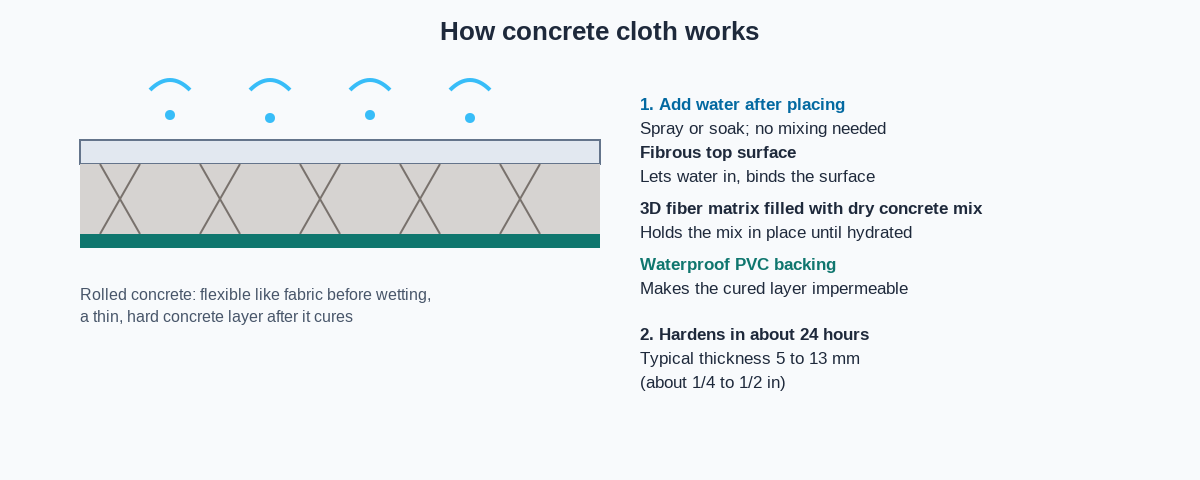
Concrete cloth is a composite material made of three main parts, as the diagram shows. On top is a fibrous surface layer that lets water in and holds the surface together. In the middle is a three-dimensional fiber matrix filled with a specially formulated dry concrete mix, usually based on fast-setting cements. On the bottom is a waterproof backing, typically PVC, that makes the cured layer impermeable to liquids. Until it is wetted, the material is flexible and can be cut, folded, draped over shapes and fitted into ditches and around obstacles. Once water is added, the cement hydrates and the fabric becomes a thin, rigid shell of fiber-reinforced concrete bonded to the backing.
The industry name for this kind of product is geosynthetic cementitious composite mat, or GCCM, and ASTM International has standards for testing and classifying these materials. Several manufacturers produce concrete cloth under different trade names, in thicknesses from about 5 mm for light-duty uses to 13 mm or more for heavy-duty channel linings. Rolled concrete is sold in large bulk rolls for big projects and smaller batch rolls that two people can handle.
How Concrete Cloth Hardens
Concrete cloth hardens by the same chemical reaction as ordinary concrete: hydration of cement. When the dry mix in the fabric is soaked with water, the cement reacts and forms crystals that bind the mix and the fibers together. Because the mix is pre-proportioned and held in a thin layer, there is no measuring or mixing, and it does not matter whether the water is clean tap water, rainwater or even seawater for some products. Most concrete cloth has a working time of one to two hours after wetting, during which it can still be shaped, and it reaches most of its strength in about 24 hours. Over-wetting is not a problem, because excess water simply runs off; under-wetting is, because dry patches will not harden properly. That is why the instructions usually call for spraying until the fabric is fully saturated and then spraying again. See how long does concrete take to cure and what is concrete made of.
Thickness and Strength
Concrete cloth is much thinner than a typical concrete slab, which is the point: it is a protective lining, not a structural slab. Thinner products around 5 mm are used for weed suppression, light erosion control and small ditches. Medium products around 8 mm are common for ditch lining and slope protection. Heavy products around 13 mm handle higher flow velocities, more abrasion, and some foot or light vehicle traffic in specific applications. The fiber reinforcement gives concrete cloth good resistance to cracking and impact for its thickness, and the PVC backing keeps it watertight even if the concrete layer develops hairline cracks. It is not designed to carry vehicle loads like a driveway or to act as a structural wall. See fiber reinforced concrete and concrete slab thickness.
Uses for Concrete Cloth
Ditch and channel lining. The most common use. Concrete cloth lines drainage ditches, swales and channels to stop erosion, control weeds, improve flow and reduce maintenance. It is widely used along roads, railways, farms, mines and industrial sites. See concrete trench drain.
Slope protection. Steep cut slopes and embankments are covered with concrete cloth to stop surface erosion, rockfall and weed growth, often in places where sprayed concrete would be difficult. See concrete retaining walls.
Culvert repair and inverts. Corroded metal culverts and worn culvert inverts can be lined with concrete cloth to extend their life. See concrete culvert.
Containment and bund lining. Secondary containment areas around tanks and bunds are lined to hold spills, using the waterproof backing.
Weed suppression. Areas around fences, signs, utility equipment and railway assets are covered to stop vegetation growth and reduce mowing and spraying.
Pipeline and cable protection. Concrete cloth wraps pipelines and protects cables in trenches and river crossings.
Emergency and remote works. Because it needs only water, concrete cloth is used for rapid repairs, flood defenses, temporary structures and projects in remote areas where concrete trucks cannot go.
Landscaping and DIY. Homeowners use smaller rolls to line garden drainage swales, protect banks, make edging and create artistic shapes and planters.
How to Install Concrete Cloth
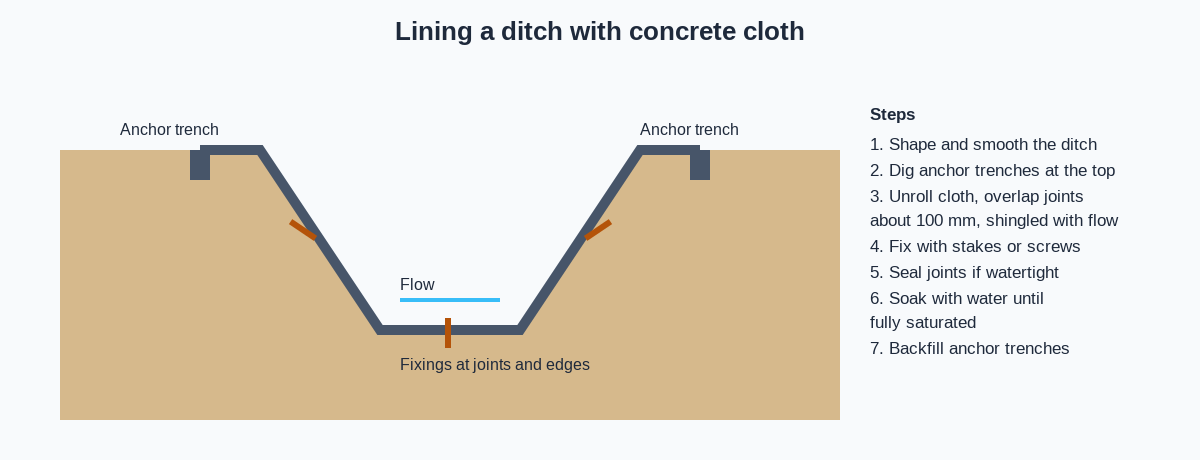
Installation is simple compared with poured concrete, but the details matter. The diagram above shows a typical ditch lining.
1. Prepare the ground. Clear vegetation, roots, sharp stones and debris. Shape the ditch or slope to a smooth, even profile, filling holes and compacting soft spots, because the concrete cloth follows the ground surface exactly. On very soft or weed-prone ground, a geotextile underlayer may be used.
2. Dig anchor trenches. Along the top edges of a ditch or slope, dig small trenches to bury the edges of the cloth, which stops water getting behind it and holds it in place.
3. Unroll and position. Unroll the concrete cloth along or across the ditch, depending on the product and site. Cut it to length with a utility knife or saw while dry. Lay sheets so that overlaps are shingled in the direction of water flow, like roof shingles, typically overlapping by about 100 mm (4 inches).
4. Fix the sheets. Fasten overlaps and edges with ground stakes, pins or screws, following the manufacturer's spacing. Joints that must be watertight can be sealed with adhesive or sealant between the layers.
5. Hydrate. Spray the concrete cloth with water until fully saturated, using a hose, pump or spray bar, starting from the top of slopes. Wait a few minutes and spray again. In hot, dry weather, rewet after an hour or so. The concrete cloth can still be adjusted during the working time.
6. Backfill and cure. Backfill the anchor trenches. Avoid walking on or loading the concrete cloth until it has hardened, typically 24 hours.
Concrete Cloth vs Sprayed and Poured Concrete
Compared with sprayed concrete (shotcrete) and poured concrete, concrete cloth is faster to install on small and medium projects, needs no mixers, pumps or forms, uses far less material, and produces very little waste and dust. It can be installed by a small crew with hand tools, in remote and confined locations, and in wet conditions. The cured layer is thin, consistent in thickness and waterproof. On the other hand, poured and sprayed concrete can be much thicker and stronger, can carry structural and traffic loads, and is cheaper per unit of material on very large projects with good access. Concrete cloth is also less forgiving of very rough or rocky ground, which must be prepared carefully. Many engineers choose concrete cloth for linings and protection where its speed and access advantages outweigh the higher material cost per square foot. See shotcrete vs gunite and concrete pump truck cost.
Limitations of Rolled Concrete
Not structural. Rolled concrete protects surfaces; it does not replace structural slabs, walls or pavements.
Ground preparation matters. Voids and sharp stones under the cloth can lead to cracking and punctures when loaded.
Hydration must be complete. Dry spots will not harden. Saturate thoroughly, especially on slopes and in hot weather.
Cold weather limits. Like all concrete, it must not freeze before it hardens; manufacturers give minimum temperatures for installation. See pouring concrete in cold weather.
Appearance. The finished surface is functional rather than decorative, usually a gray, fabric-textured finish.
Material cost. On a per-square-foot basis, the material is more expensive than poured concrete, though total installed cost may be lower on suitable projects.
A Short History of Concrete Cloth
Concrete cloth is a relatively new material. The idea of a flexible fabric impregnated with cement that hardens on contact with water was developed in the early 2000s, initially for rapidly deployable shelters that could be inflated into shape and then hydrated to form a hard, durable shell. Engineers soon realized that the same material could solve everyday civil engineering problems, especially lining ditches and protecting slopes in places that were hard for concrete trucks to reach. Since then, concrete cloth has been used on railways, highways, mines, farms, airports, military bases and flood defenses around the world, and the industry has developed standard test methods and specifications so engineers can compare products and specify them with confidence. Today, rolled concrete is an established alternative to poured concrete, sprayed concrete, stone riprap and erosion-control blankets for many lining and protection jobs.
Design Considerations for Concrete Cloth Linings
Choosing the right concrete cloth and detailing it correctly makes the difference between a lining that lasts for decades and one that fails in the first storm. Engineers consider the flow velocity and depth of water in a channel, since faster, deeper flows need thicker grades and better anchoring; the steepness and length of slopes, which affect how the cloth is anchored and how runoff is handled at the top; the soil type and groundwater, since water pressure building up behind an impermeable lining can lift it, so weep holes or drainage may be needed; any traffic from maintenance equipment, animals or people; freeze-thaw exposure; and chemical exposure in industrial or mining settings. At the top of slopes and the edges of channels, water must not be allowed to get behind the concrete cloth, which is why anchor trenches and sealed joints are so important. At the downstream end of a lined ditch, the outlet needs protection, such as stone or a concrete apron, so water leaving the lining does not erode the ground below. See concrete catch basin and concrete culvert.
Concrete Cloth vs Riprap, Erosion Blankets and Geotextiles
Concrete cloth competes with several other erosion-control and lining methods. Stone riprap, a layer of large rocks, is durable and lets water drain through, but it needs heavy equipment, a lot of material, and a stable slope, and weeds grow between the stones. Turf reinforcement mats and erosion-control blankets help vegetation take hold on slopes and in low-velocity ditches, and they are cheaper and more natural looking, but they rely on plants establishing and can fail in high flows or dry climates. Geotextiles separate and filter soils but do not resist erosion by themselves. Concrete cloth sits between these and poured concrete: it gives a hard, impermeable, low-maintenance surface like concrete, installed almost as easily as a blanket. It is especially useful where vegetation will not grow, where weeds must be controlled, where flows are fast, or where a smooth lining helps water move. See pervious concrete for a material that lets water through instead.
Working in Different Weather
Concrete cloth can be installed in a wide range of conditions, which is one of its advantages over poured concrete. It can be laid in light rain, since the concrete cloth does not need mixing and rain simply starts the hydration, though heavy rain can wash fines from freshly wetted concrete cloth on steep slopes. In hot, dry and windy weather, the main risk is that the concrete cloth dries out before hydration is complete, so it should be wetted thoroughly, sometimes several times, and covered or misted if conditions are extreme. In cold weather, the water and cloth must not freeze before the concrete has hardened; manufacturers give minimum temperatures, and installation may need to wait for a warmer day or use warm water and covers. Underwater installation is possible for some grades, which is useful for repairs in channels that cannot be fully drained.
Concrete Cloth for Gardens and DIY Projects
Smaller rolls of concrete cloth have become popular with homeowners, landscapers and artists. In gardens, it can line a drainage swale that carries water away from a house, protect a short eroding bank, make a weed-free strip along a fence, edge planting beds, or line the base of a dry creek bed before stones are added. Because it can be cut and folded while dry, rolled concrete is also used to make sculptural planters, garden art, outdoor furniture and even small shelters, by draping the fabric over a mold, a frame or a balloon and then wetting it. For DIY users, the key points are the same as on big projects: prepare a smooth, firm base, overlap and fix the sheets, wet the concrete cloth thoroughly and keep it damp for the first hours, and wear gloves, since wet cement is caustic. See how to make concrete planters and concrete raised beds.
Inspection, Maintenance and Repair
Once installed, a concrete cloth lining needs little maintenance. Inspect it after major storms and once or twice a year for damage at joints, edges and outlets, debris build-up, undermining at the downstream end, and any punctures or tears. Clear debris and silt so water flows freely. Small damaged areas can be repaired by cleaning the area, placing a patch of new concrete cloth over it with a generous overlap, fixing it in place and wetting it, or by using a cement-based repair mortar. If water is getting behind the lining at the top edge, re-dig and backfill the anchor trench or seal the edge. Well-installed concrete cloth linings are designed to last for decades, and many manufacturers state design lives of 50 years or more for appropriate applications.
Buying Concrete Cloth
Concrete cloth is sold by specialist geosynthetics distributors, civil engineering suppliers and some landscape suppliers, and increasingly online in smaller rolls. When buying, compare thickness, roll size and weight, since heavy bulk rolls may need a forklift or excavator with a spreader bar to unroll, while batch rolls can be handled by hand. Ask for technical data sheets showing compressive and flexural strength, abrasion resistance, fire performance and compliance with relevant standards. Check the shelf life and storage conditions: the dry cement in the concrete cloth slowly reacts with moisture in the air, so rolls must be kept dry and used within the stated period, typically about a year. Order a little extra to allow for overlaps, cutting waste and anchor trenches, typically 10 to 20 percent more than the area to be covered.
Safety and Environmental Notes
Like any cement product, wet concrete cloth is alkaline and can irritate or burn skin and eyes, so wear gloves, long sleeves and eye protection while handling and wetting it, and wash skin promptly. Cutting dry cloth with power tools can release cement and silica dust; use a knife where possible, or cut outdoors with dust control and a respirator. Runoff from freshly wetted rolled concrete is alkaline and should not drain directly into streams and ponds; contain or divert it where needed, as with any concrete work. Compared with poured concrete, concrete cloth uses much less cement per square foot of lining, needs fewer truck deliveries and produces little waste, which can reduce the carbon footprint of a lining project. See concrete washout and concrete dust.
Concrete Cloth on Railways, Roads and Farms
Infrastructure owners are some of the largest users of concrete cloth. Railways use it to line trackside drainage ditches and cesses, protect embankment slopes, stop vegetation around signals and equipment, and repair culvert inverts during short track possessions, because rolled concrete can be carried in by hand and installed between trains. Highway agencies use concrete cloth to line roadside ditches and median drains, protect slopes under bridges, and stop erosion at culvert outlets. On farms, concrete cloth lines irrigation channels and farm drains to reduce water loss and weed growth, protects the ground around water troughs and gateways where livestock churn up mud, and lines small ponds and slurry areas where a watertight layer is needed. Mines and quarries use concrete cloth for haul road drainage, containment bunds and slope protection. In each case, the main attraction is the same: a durable concrete lining delivered on a roll, installed quickly with a small crew and simple tools, in places where getting a concrete truck would be slow, expensive or impossible.
Is Concrete Cloth Right for Your Project?
Concrete cloth is a good choice when you need a thin, durable, low-maintenance lining or protective layer, when access is difficult, when the work must be done quickly, or when you want to avoid the mess and logistics of mixing and placing concrete. It is less suitable when you need a structural slab, a surface for regular vehicle traffic, a decorative finish, or when a very large, easily accessible area could be paved more cheaply with conventional concrete. For small garden and DIY jobs, a few rolls of concrete cloth can solve drainage and erosion problems that would otherwise need a lot of digging and mixing. For larger civil projects, ask an engineer or the manufacturer to help choose the grade of rolled concrete and detail the anchoring, joints and outlets so the lining performs as expected.
Tips for a Successful Concrete Cloth Installation
A few practical tips help concrete cloth go down smoothly. Plan the layout before unrolling, so concrete cloth joints fall where they are easy to fix and overlaps face downstream. Unroll concrete cloth close to where it will be placed, since dry rolls are heavy and the material is easier to handle before it is wet. Cut concrete cloth with a sharp utility knife from the backing side, or with a disc cutter for thick grades, wearing a dust mask. Smooth out wrinkles and air pockets so the concrete cloth sits tight against the ground. Fix every overlap before wetting, because concrete cloth becomes stiff once it starts to set. Wet the concrete cloth from the top of slopes downward, keep a hose running until the surface stays dark and wet, and come back to wet it again within the hour. Finally, protect fresh concrete cloth from foot traffic, animals and heavy rain until it has hardened.
Concrete Cloth Cost
Concrete cloth prices vary by thickness, roll size, quantity and supplier. As a rough guide, material costs about $5 to $15 per square foot, with thicker heavy-duty grades at the upper end and bulk orders cheaper per square foot. Installation is relatively quick, so labor is often a smaller share of the total than for poured concrete; a small crew can line hundreds of square feet of ditch in a day. For a typical 100 foot long drainage ditch with a 6 foot lining width (600 square feet), material might cost about $3,000 to $9,000 plus preparation and labor. Compared with forming and pouring a concrete ditch lining, which typically costs $8 to $20 per square foot installed with good access, concrete cloth is often competitive where access is difficult, the site is remote, or speed matters. See concrete cost per square foot.
Frequently Asked Questions
What is concrete cloth?
A flexible fabric filled with dry concrete mix and backed with a waterproof layer that hardens into a thin concrete lining when soaked with water.
How long does concrete cloth take to harden?
It has a working time of one to two hours after wetting and reaches most of its strength in about 24 hours.
How thick is rolled concrete?
Typically about 5 to 13 mm, roughly 1/4 to 1/2 inch, depending on the grade.
Can you drive on concrete cloth?
It is not designed for regular vehicle traffic. It is a lining and protection layer, not a pavement.
Is concrete cloth waterproof?
Yes. The PVC backing makes the cured layer impermeable, and joints can be sealed for watertight linings.
Sources
- ASTM D8364: specification for geosynthetic cementitious composite mats (GCCM)
- ASTM D8058: test methods for GCCM
- FHWA: design of roadside channels with flexible and rigid linings
- US EPA: erosion and sediment control