
Concrete Catch Basin Guide: How It Works, Sizes, Installation and Cost
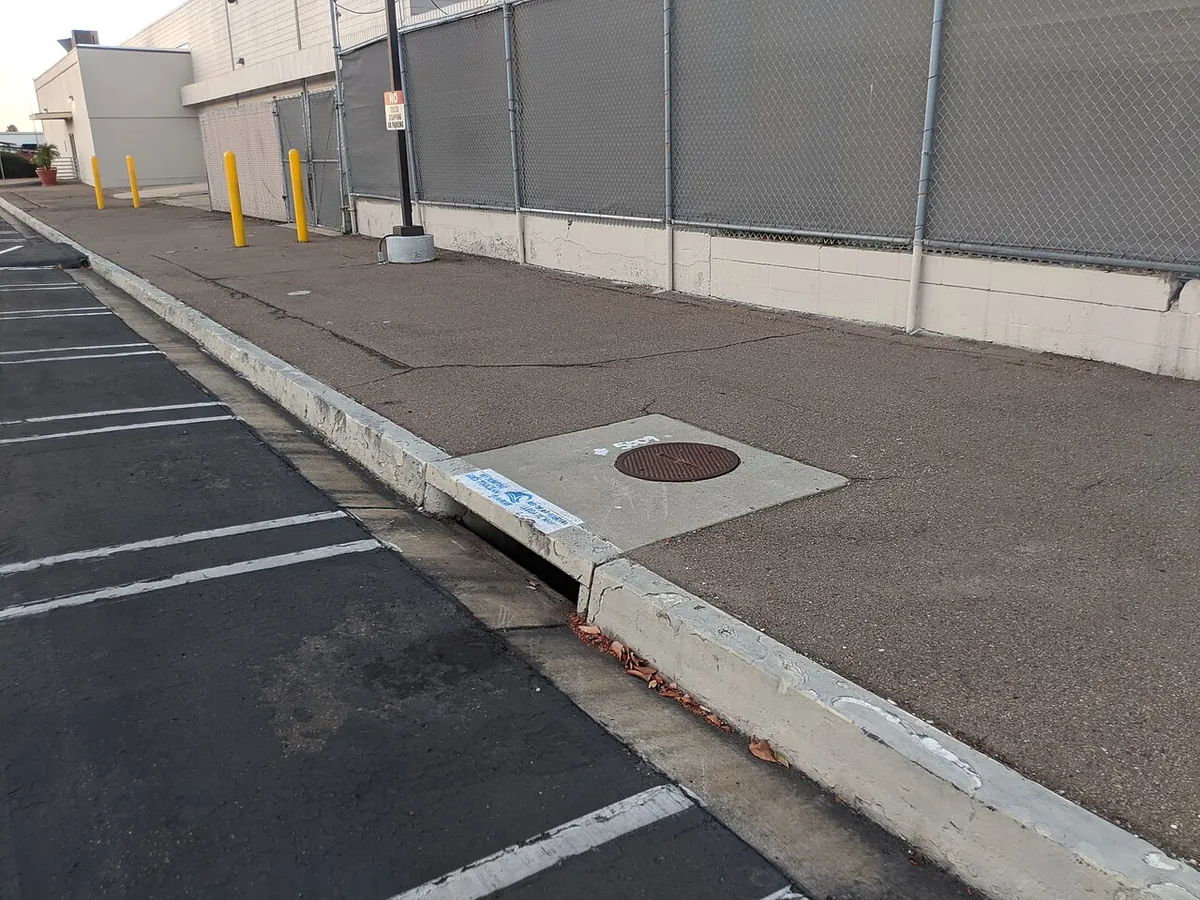
Photo: Mds08011, Wikimedia Commons, CC BY 4.0
Quick Answer
A concrete catch basin is an underground concrete box with a grate or curb opening on top that collects surface runoff, lets sand, silt and debris settle in a sump at the bottom, and sends the water out through a pipe to a storm drain, dry well or outlet. Most are precast concrete boxes from about 12 x 12 inches for yards to 4 x 4 feet or more for streets and parking lots, with cast iron or steel grates rated for the traffic above. A small yard or driveway catch basin costs about $300 to $1,500 installed with pipe, while a commercial concrete catch basin typically runs $2,000 to $8,000 or more. Catch basins need cleaning when the sump is about half full of sediment.
Wherever rain runs across hard surfaces, it has to be collected and carried away, or it ponds, floods buildings and erodes soil. In streets, parking lots and large driveways, that job falls to catch basins. The photo above shows a typical example at the edge of a parking lot: a concrete curb inlet lets water from the gutter flow into an underground concrete catch basin, reached through the round cast iron cover in the sidewalk. The blue marker on the curb reminds people that whatever goes into the drain flows to local waterways.
This guide explains how a concrete catch basin works, the parts inside it, precast and cast-in-place types, sizes, grates and load ratings, where catch basins are used, how to install one in a yard or driveway, cleaning and maintenance, common problems and costs.
What Is a Concrete Catch Basin?
A catch basin, also called a storm drain inlet, drop inlet, catch pit or curb inlet depending on its design and region, is a box set into the ground at a low point where surface water collects. Water enters through a grate on top or an opening in a curb, falls into the box, and leaves through an outlet pipe connected to the storm sewer or drainage system. The key feature that makes it a catch basin rather than a simple inlet is the sump: the bottom of the box sits below the outlet pipe, so water slows down and heavy material such as sand, grit, gravel and leaves settles out instead of being carried into the pipes, where it could cause blockages.
Concrete is the most common material for catch basins on roads, parking lots, commercial sites and many residential properties, because it is strong enough to carry traffic, heavy enough to stay in place in wet soil, does not corrode or rot, and lasts for decades. Plastic catch basins are common for small residential yard drains, while concrete catch basins are used where traffic loads, depth or size call for something more robust. Similar precast concrete structures are used as manholes, junction boxes and drop inlets in the same storm drain systems. See precast concrete.
How a Concrete Catch Basin Works
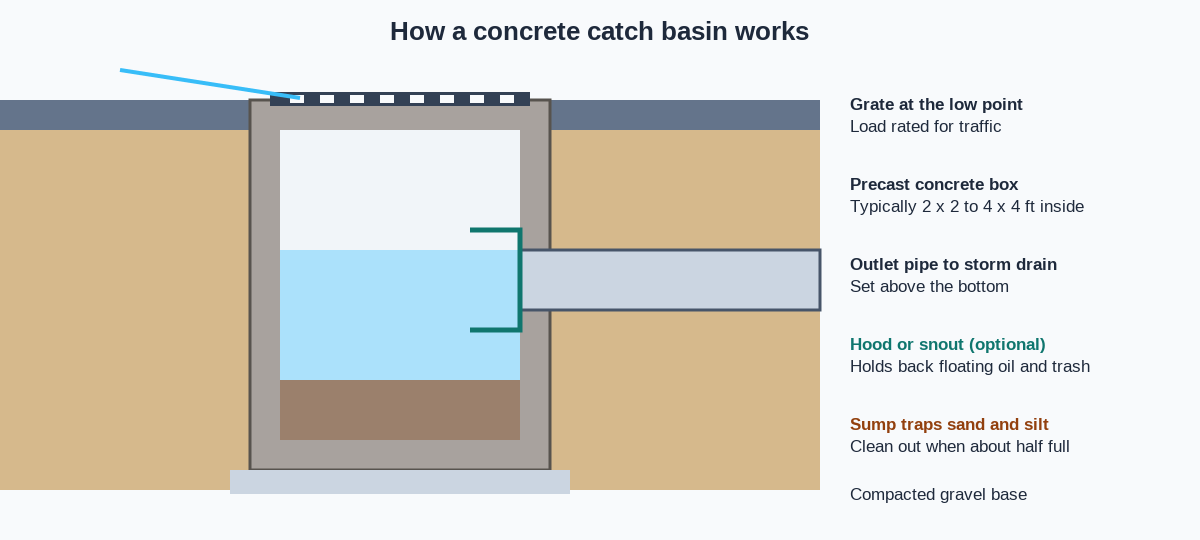
The diagram above shows the parts of a typical concrete catch basin. Water from the surrounding pavement or lawn flows to the grate at the low point and drops into the box. The outlet pipe leaves the box some distance above the floor, typically 12 to 24 inches for street basins and less for small yard basins. The space below the outlet is the sump. As water fills the box and rises to the outlet, it slows down, and sand, grit and heavy debris sink into the sump. Cleaner water flows out the pipe.
Many catch basins also have a hood, snout or trap over the outlet pipe. The hood is a curved cover that extends below the water surface, so water must flow underneath it to reach the pipe. Floating trash, leaves, oil and grease stay behind on the surface of the water in the basin instead of being carried into the storm drain. Some municipalities require hoods on all new catch basins to protect streams and lakes. Over time, the sump fills with sediment and the floating material builds up, which is why catch basins must be cleaned regularly.
Precast vs Cast-in-Place Concrete Catch Basins
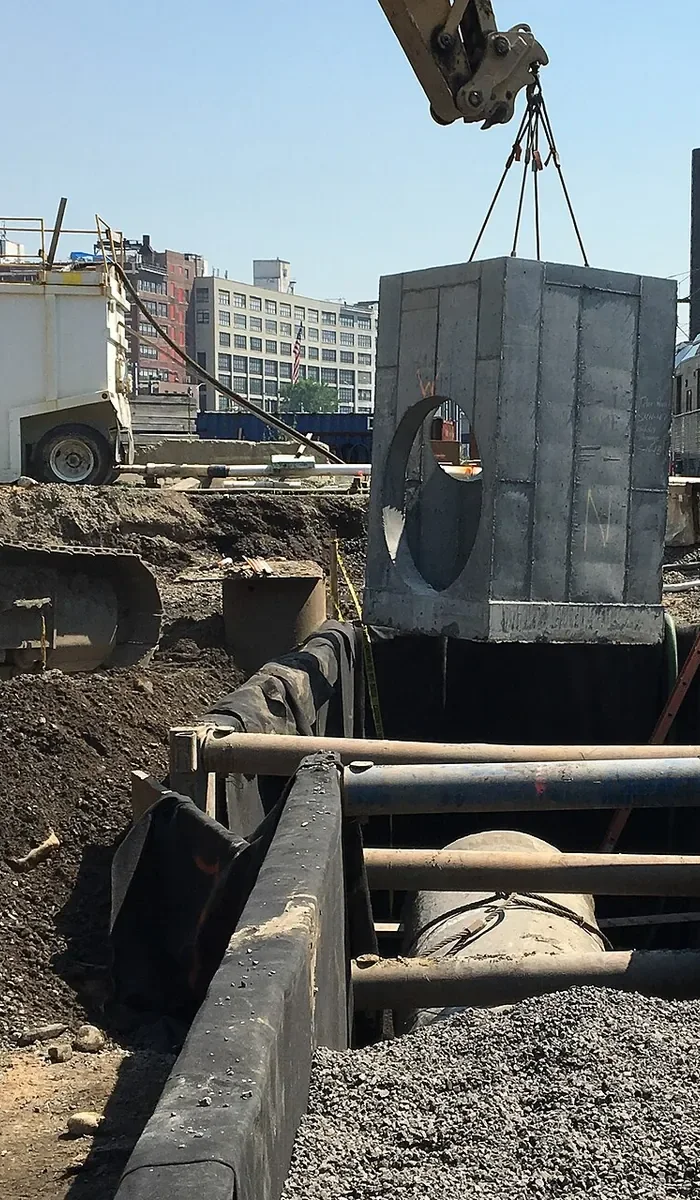
Photo: MTA Capital Construction, Wikimedia Commons, CC BY 2.0 (cropped)
Most concrete catch basins today are precast. They are made in a factory in standard sizes, with the floor and walls cast as one piece and openings, called knockouts, for pipes at the sides. Risers and tops are added to reach the right height. The photo above shows a precast drainage structure with a large pipe opening being lowered by excavator into a trench, where the pipe already waits on a gravel bed. Precast concrete catch basins go in quickly, often in under an hour once the hole is dug, and the concrete quality is consistent. Precasters make them to standards such as ASTM C913 for precast water and wastewater structures and to local highway department specifications.
Cast-in-place concrete catch basins are formed and poured on site. They are used where an unusual size or shape is needed, where trucks and lifting equipment cannot reach, or where an old basin is rebuilt in place. Small residential catch basins can also be built from concrete block, laid in mortar on a concrete footing and plastered inside, a traditional method still used in some areas. Precast is usually faster and cheaper, while cast-in-place offers flexibility. See how to build concrete forms and concrete masonry unit.
Sizes of Concrete Catch Basins
Catch basin sizes depend on the area drained, the amount of runoff, the pipe sizes and local standards. Typical sizes are:
- Small yard and patio basins: 12 x 12 to 18 x 18 inches inside, 12 to 24 inches deep, often with 4 to 6 inch pipe connections.
- Driveway and residential site basins: 18 x 18 to 24 x 24 inches, 2 to 4 feet deep, with 6 to 12 inch pipes.
- Parking lot and commercial basins: 2 x 2 to 4 x 4 feet inside, 3 to 8 feet deep, with 12 to 24 inch pipes.
- Street catch basins and curb inlets: usually 3 to 6 feet across, sometimes much larger, sized by the city's engineers for the design storm.
Wall thickness for precast basins is usually 4 to 8 inches, and weights range from a few hundred pounds for a small yard concrete catch basin to several tons for large street structures, which is why the bigger ones are set by excavator or crane.
Grates, Frames and Load Ratings
The grate is the visible part of a catch basin. It must let water in quickly, keep people and vehicles safe, and resist the loads above it. Grates are usually cast iron or ductile iron for streets and parking lots, steel for some commercial uses, and plastic or light cast iron for yards and patios. They sit in a frame cast into or bolted onto the top of the concrete catch basin.
Grates are rated for the loads they can carry. In North America, ratings commonly follow AASHTO standards, where H-20 or HS-20 is the usual rating for areas with highway traffic, and lighter ratings are used for pedestrian and landscape areas. In Europe, EN 124 classes run from A15 for pedestrians to D400 for roads and higher for heavy industrial areas. In driveways, choose a grate rated for vehicles. Grate openings in pedestrian areas should be small enough that heels, canes and wheelchair wheels do not catch, which accessibility guidelines generally limit to about 1/2 inch in one direction. Bicycle-safe grates have bars set across the direction of travel. See concrete trench drain for linear drain grates and load classes.
Where Concrete Catch Basins Are Used
Streets and roads. Curb inlets and catch basins along gutters collect runoff from the roadway and send it into the storm sewer system.
Parking lots. Catch basins are placed at low points across the lot, which is graded so water flows to them. See asphalt parking lot cost.
Driveways. A catch basin at the low point of a driveway, especially one that slopes toward a garage, collects water before it reaches the building. Trench drains are often used instead of, or together with, a catch basin. See concrete driveway cost.
Yards and patios. Low spots that hold water after rain can be drained with a small catch basin connected to buried pipe that leads to a lower area, a dry well or the street where allowed.
Downspouts. Roof drains often connect to a catch basin or a buried pipe that carries water away from the foundation. See concrete splash blocks.
Construction sites. Catch basins on construction sites are protected with filter inserts or sediment barriers to keep mud out of the storm drain system during construction.
How to Install a Concrete Catch Basin in a Yard or Driveway
Installing a small concrete catch basin is a reasonable DIY project for a handy homeowner, though larger basins and connections to public storm drains should be done by a contractor with the right permits. These are the general steps.
1. Plan the drainage. Find the low point where water collects and decide where the water will go. The outlet pipe needs a continuous downhill slope of at least 1/8 inch per foot, and preferably 1/4 inch per foot, to the outlet, which may be a lower part of the yard, a dry well, a ditch or an approved connection to the storm drain. Never connect to a sanitary sewer. Check local rules and call 811 to locate utilities before digging.
2. Dig the hole. Excavate a hole a few inches larger than the catch basin on all sides and deep enough for a gravel base plus the basin, with the grate ending slightly below the surrounding grade so water flows into it. Dig the trench for the outlet pipe at the planned slope.
3. Prepare the base. Place 4 to 6 inches of crushed stone in the bottom, compact it and level it. A firm, level base prevents the basin from settling or tilting.
4. Set the basin. Lower the precast concrete catch basin into place, check that it is level and at the right height, and adjust the base as needed. Knock out the pipe openings if the basin has knockouts.
5. Connect the pipe. Insert the outlet pipe into the opening, seal around it with non-shrink grout, hydraulic cement or a rubber boot, and lay the pipe in the trench on a bed of gravel, checking the slope with a level. Connect any inlet pipes from downspouts the same way.
6. Backfill. Backfill around the basin and over the pipe in layers, compacting each layer, so the ground does not settle later.
7. Finish the surface. In a lawn, regrade so the soil slopes gently toward the grate and replace the sod. In a driveway or patio, pour concrete around the top of the basin to form a collar, sloped toward the grate, and set the frame and grate. See how to mix concrete.
8. Test. Run a hose into the catch basin and confirm water flows freely out of the outlet.
Cleaning and Maintenance
A concrete catch basin only works if its sump has room to trap sediment. When the sump fills, sediment and debris wash straight into the pipes, causing blockages and pollution, and the basin may overflow. Inspect catch basins at least once or twice a year, and after major storms. Clean them when the sump is about half full. Small yard basins can be cleaned by lifting the grate and scooping out debris by hand or with a shop vacuum. Large commercial and municipal basins are cleaned with vacuum trucks. Keep the grate clear of leaves, trash and snow so water can enter, and check that hoods are in place. Many cities require private property owners to maintain their catch basins and keep records, especially for commercial sites under stormwater permits.
Common Problems With Catch Basins
Clogged grates. Leaves and trash block the grate, so water ponds over it. Clear the grate regularly, especially in fall.
Full sumps. Sediment fills the sump and washes into pipes. Clean the basin.
Sinking or tilted basins. Caused by a poor base or poorly compacted backfill. The basin may need to be reset.
Cracked concrete and broken frames. Old concrete catch basins in roads can crack around the top from traffic, freeze-thaw and deicing salt, and frames can come loose. The top can be rebuilt with new concrete or a precast adjusting ring. See concrete spalling and does salt damage concrete.
Settlement around the basin. Soil washes into the basin through joints or around pipes, leaving sinkholes nearby. Joints and pipe connections must be sealed.
Odors and mosquitoes. Standing water in the sump can breed mosquitoes and smell in hot weather. Regular cleaning and, where allowed, mosquito control help.
Cement Catch Basin or Concrete Catch Basin?
People often search for a cement catch basin, but the product they mean is a concrete catch basin. Cement is the gray powder that, mixed with water, sand and stone, becomes concrete; it is one ingredient, not the material of the box. A basin made only of cement paste would be weak and would crack. Precast catch basins are made of reinforced concrete, usually 4,000 to 5,000 psi, with steel mesh or rebar in the walls and floor. Older catch basins in some towns were built of brick or concrete block set in cement mortar and plastered inside with a cement render, which may be where the cement catch basin name comes from. Whether you call it a cement catch basin or a concrete catch basin, the important things are the same: a strong box, a sump below the outlet, a grate rated for the loads above, and tight, sealed pipe connections. See cement vs concrete.
Choosing the Location and Size
A concrete catch basin works only if water reaches it. Place it at the true low point of the area to be drained, and make sure the surrounding surface slopes toward it from all sides. On lawns, a slope of at least 2 percent, about 1/4 inch per foot, toward the grate is a good target. On pavement, the slope is built into the grading. For a long driveway or a large patio, one catch basin at the lowest corner may not be enough, and several basins or a trench drain may be needed. Keep catch basins away from foundations, and make sure the outlet pipe can drain by gravity to its destination; if the yard is flat and there is nowhere lower for water to go, a dry well or a pump basin may be needed instead.
Size depends on the area drained and the intensity of local storms. For a typical residential lawn low spot or patio, a 12 or 18 inch concrete catch basin with a 4 or 6 inch outlet handles most situations. Driveways and larger paved areas often use 18 to 24 inch basins with 6 to 8 inch pipes. Commercial sites are designed by engineers using local rainfall data, so that the inlets and pipes can carry the runoff from a design storm without flooding the pavement.
Catch Basins and Stormwater Rules
Catch basins are part of the stormwater system, and that system usually flows untreated to streams, rivers, lakes or the ocean. In the US, the Clean Water Act and EPA stormwater rules require cities to control what enters their storm drains, and many cities pass those requirements on to property owners. Commercial and industrial sites with parking lots often must inspect and clean their catch basins on a schedule, keep records, and sometimes install filter inserts or hooded outlets that capture oil and trash. Never pour paint, oil, solvents, grass clippings, pet waste or concrete washout into a catch basin; it is illegal in many places and harms waterways. That is why many cities stencil or mark their catch basins, like the blue marker on the curb in the photo at the top of this page. See concrete washout.
Replacing or Rebuilding an Old Catch Basin
Older catch basins, especially brick or block basins and those in roads exposed to traffic and road salt, eventually crack, settle or collapse around the top. A failing catch basin often shows up as a sinking or broken area of pavement around the grate, a frame that rocks under traffic, or a hole beside the basin where soil has washed in. Sometimes only the top needs to be rebuilt: the pavement around the frame is cut out, the top courses or adjusting rings are replaced, the frame is reset at the right height, and a new concrete collar is poured. If the walls or floor are badly deteriorated, the whole structure is dug out and replaced with a new precast concrete catch basin, and the pipes are reconnected. Contractors also offer structural lining systems that coat the inside of old basins with a cement-based or polymer liner to restore them without digging. See concrete removal cost and how to cut concrete.
Tips for a Long-Lasting Catch Basin
A few simple choices make a concrete catch basin last for decades with little trouble. Set it on a compacted gravel base so it never settles. Seal every pipe connection so soil cannot wash in around the pipes. Use a grate and frame rated for the heaviest vehicle that might ever drive over it, not just the cars you have now; delivery trucks and moving vans often end up in driveways. Pour a reinforced concrete collar around the frame in paved areas so it does not rock loose. Add a hood or snout on the outlet if leaves or oil are a concern. Keep the grate clear, and clean the sump on a schedule rather than waiting for a flood. And make sure the outlet pipe discharges somewhere it will not cause erosion or a nuisance for neighbors, with a splash pad or stone at the end where it daylights.
Concrete Catch Basin Cost
Costs depend on size, depth, location and the amount of pipe and surface restoration. Typical US prices are:
- Small precast yard catch basin (12 to 18 inch): $100 to $400 for the basin and grate; $300 to $1,500 installed with a short pipe run.
- Driveway catch basin (18 to 24 inch) with traffic-rated grate: $500 to $3,000 installed, depending on pipe length and concrete work.
- Commercial or parking lot concrete catch basin: $2,000 to $8,000 or more installed, including excavation, the precast structure, frame and grate, and connections.
- Street catch basins and curb inlets: often $5,000 to $20,000 or more as part of public works projects.
- Cleaning: $100 to $500 per basin for vacuum truck service, less per basin for multiple basins.
Extra costs include long pipe runs, rock excavation, removing and replacing pavement, dry wells, permits and engineering. See concrete culvert for the pipes that carry storm water, and concrete repair cost for patching pavement around a new basin.
Catch Basin vs Trench Drain vs French Drain vs Dry Well
Homeowners dealing with water problems often compare several drainage options. A concrete catch basin collects water at a single low point and is best where water flows to one spot. A trench drain collects water along a line, such as across the bottom of a driveway or in front of a garage, and is best for sheet flow across a wide surface. A French drain is a gravel-filled trench with a perforated pipe that collects groundwater and seepage below the surface, best for soggy lawns and foundations. A dry well is an underground chamber or pit filled with stone that receives water from a pipe and lets it soak into the soil, often used as the outlet for catch basins and downspouts where there is no storm drain. Many drainage systems combine several of these. See concrete trench drain and pervious concrete.
Frequently Asked Questions
What is the purpose of a concrete catch basin?
To collect surface water, trap sand and debris in its sump, and send cleaner water through a pipe to the storm drain or outlet.
How deep is a catch basin?
Small yard basins are 12 to 24 inches deep. Street and parking lot catch basins are commonly 3 to 8 feet deep.
How often should catch basins be cleaned?
Inspect them at least once or twice a year and clean them when the sump is about half full of sediment.
Can I install a catch basin myself?
Yes, a small yard or driveway basin is a manageable DIY job. Connections to public storm drains usually need a permit and a licensed contractor.
Is a concrete or plastic catch basin better?
Plastic is light and cheap for yards. Concrete is stronger, heavier and longer lasting, and is standard under traffic and for larger, deeper basins.
Sources
- US EPA: municipal stormwater and catch basin cleaning
- National Precast Concrete Association: precast drainage structures
- ASTM C913: precast concrete water and wastewater structures
- FHWA: urban drainage design manual (HEC-22)
Related Guides
- Concrete cloth — rolled concrete for ditches and slopes