
Spalling Concrete: Causes, Concrete Spalling Repair and Prevention
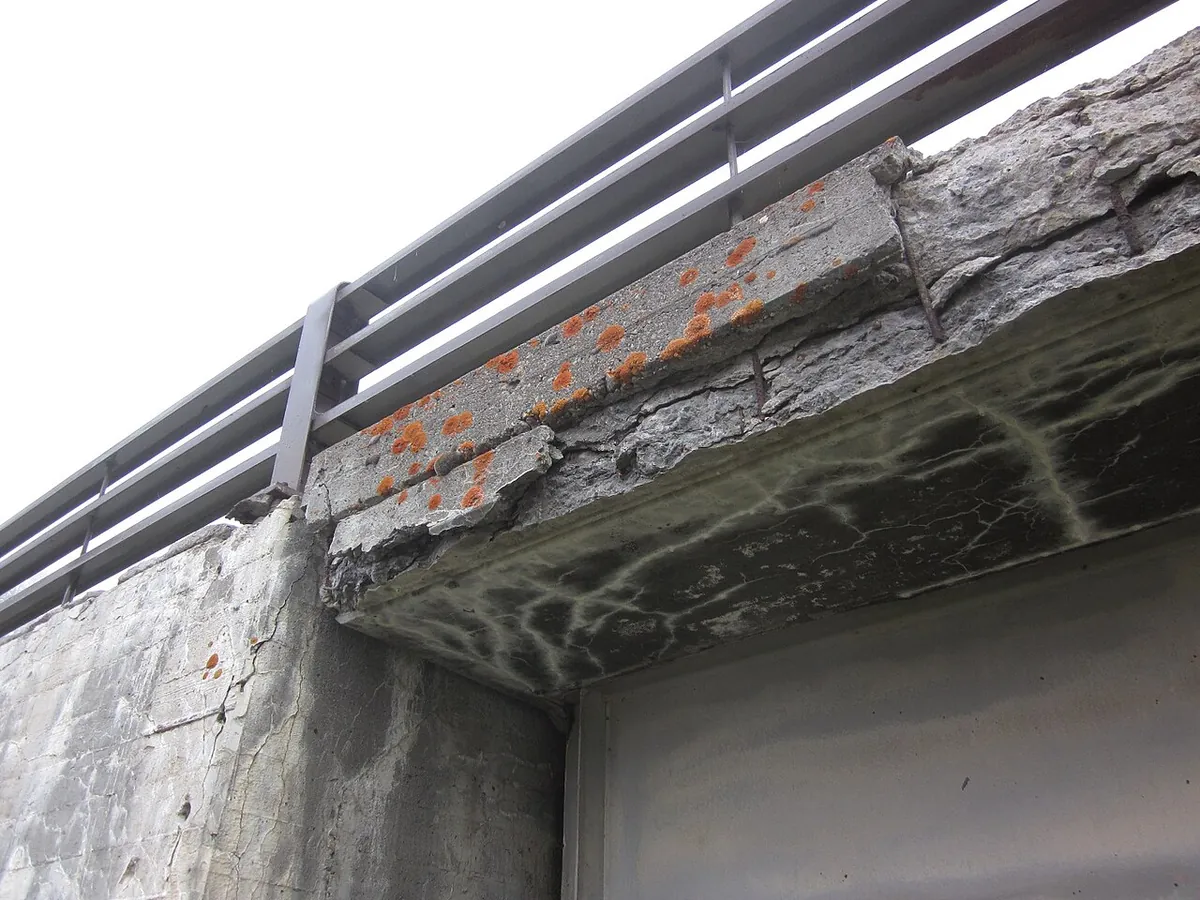
Photo: NPS / Doug Madsen, Wikimedia Commons, public domain.
Quick Answer
Spalling concrete is concrete whose surface has broken off in chips, flakes or chunks, leaving rough, pitted holes. Concrete spalling is usually deeper than scaling, which only peels off a thin skin of cement paste. The most common causes are rusting rebar or wire mesh (rust takes up more room than steel and pushes the concrete off), freeze-thaw cycles and deicing salt, poor finishing or curing, and bad joints. To fix spalling concrete, chip out every loose piece down to sound concrete, square the edges with a saw cut, clean and coat any exposed steel, then fill with a cement-based repair mortar and cure it. Small spalls are a DIY job; wide or deep concrete spalling, or spalling over a lot of exposed rebar, is a job for a contractor or engineer.
Spalling concrete is one of the most common problems homeowners see on driveways, garage floors, steps, patios, pool decks and foundation walls. It starts as a few rough spots where the top has popped off and, if nothing changes, slowly spreads as water gets into the broken surface. The good news is that most concrete spalling on a home can be repaired, and once you know what caused it, you can usually stop it from coming back.
This guide explains what spalling concrete is, what causes it, how concrete scaling vs spalling differ, how to repair spalling concrete yourself, when to call a pro, what spall repair costs, and how to prevent new damage.
What Is Spalling Concrete?
What is spalling concrete, exactly? Spalling is when pieces of the concrete surface break away from the body of the slab, wall or step. The broken piece is called a spall, and the hole it leaves behind is also often called a spall. You will see spalled concrete as shallow craters with rough edges, sometimes with a piece of aggregate or a rusty bar showing at the bottom.
What is concrete spalling compared with normal wear? Normal wear polishes or roughens the surface evenly. Spalling of concrete is different: it is a failure where the bond inside the concrete gives way, so whole pieces come off at once. Concrete spalling can be as small as a coin or as large as a dinner table, and from a fraction of an inch to several inches deep.
Engineers and highway departments treat spalls in concrete as a sign that something inside the concrete is pushing outward or that the surface was weak from the start. The Texas Department of Transportation, for example, describes spall repair on bridges as removing the unsound concrete, cleaning the reinforcing steel and replacing the concrete with a repair material, because simply covering a spall over does not fix the cause.
Concrete Scaling vs Spalling: What Is the Difference?
Concrete scaling vs spalling is the first thing to sort out, because the repair is different. Both are surface damage, and people often use the words for the same thing, but they are not quite the same.
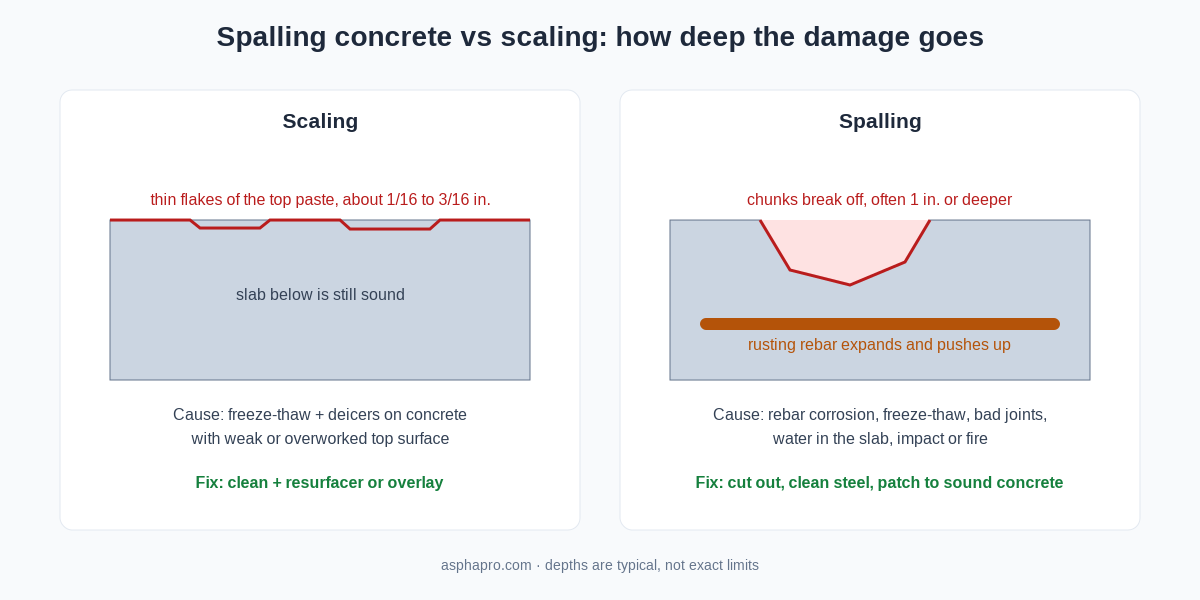
- Scaling is the loss of a thin top layer of cement paste and fine sand, often about 1/16 to 3/16 of an inch. It looks like the surface has peeled, and you see the sand and small stones underneath. Scaling usually covers wide areas and is linked to freeze-thaw cycles, deicing salt and weak, overworked or poorly cured surfaces.
- Spalling is deeper and more local. Chunks break off, often an inch or more deep, and the edges are sharp and broken rather than flaky. Spalling in concrete is often linked to something under the surface, such as rusting steel, water trapped under a weak top layer, or stress at a joint.
The Missouri Department of Transportation's maintenance guide notes that scaling and spalling can look equally rough and deep in some cases but come from different causes, which is why it treats them as separate kinds of surface failure. For a homeowner, the simple test is depth and shape: wide, shallow flaking is scaling; separate, deeper pits and chunks are spalling. Many old driveways have both.
What Causes Concrete Spalling?
Spalling concrete almost always has a cause you can find. Knowing it matters, because a patch over an active cause will spall again.
1. Rusting rebar or wire mesh
Steel inside concrete is normally protected by the high alkalinity of the cement paste. Over time, salt from deicers or seawater and carbon dioxide from the air can reach the steel, and it begins to rust. Rust takes up several times more room than the steel it came from, so it pushes outward with great force. The concrete cover over the bar cracks, then pops off, leaving spalled concrete with a rusty bar at the bottom. This is the classic cause of concrete spalling on bridges, parking garages, balconies and old driveways with mesh close to the surface. Rust stains bleeding from cracks are an early warning.
2. Freeze-thaw cycles
Water expands by about 9 percent when it freezes. When water soaks into concrete and freezes, the pressure can break the surface. Concrete made for cold climates is air-entrained, which means it has billions of tiny air bubbles that give the freezing water room to expand. Concrete without enough entrained air, or with a dense, overworked surface that lost its air, is much more likely to spall in cold regions. Many sources call freeze-thaw damage and deicing the most common causes of concrete spalling in cold climates.
3. Deicing salt and chemicals
Salt does not freeze-dry concrete by itself, but it makes freeze-thaw damage worse: it keeps the surface wetter, increases the number of freeze-thaw cycles and, with chloride salts, speeds up the rusting of steel. Some deicers, such as magnesium chloride and ammonium-based products, can also attack the cement paste chemically. New concrete is most at risk during its first winter. Our guide on whether salt damages concrete covers safer deicers.
4. Poor finishing
A lot of surface spalling starts on the day of the pour. Finishing while bleed water is still on the surface, sprinkling water on to make troweling easier, over-troweling an air-entrained driveway, or finishing too early can all make a weak top layer that later breaks away. A delaminated surface often sounds hollow when tapped and can come off in thin sheets before the slab is even a year old.
5. Poor curing
Concrete needs moisture and moderate temperatures for the first days to gain strength. A surface that dries out too quickly in sun and wind is weaker than the concrete below it, and that weak skin is the first part to scale or spall. See how long concrete takes to cure for the basics.
6. Joints and edges
Spalls in concrete are very common along joints and slab edges. When joints are too shallow, filled with hard debris, or poorly sawn, the slabs push against each other as they expand in summer, and the edges break off. Heavy wheels rolling over unsupported edges do the same thing. If your spalling concrete lines up along joints, the joints are part of the problem. Our guide to why concrete cracks explains joint spacing.
7. Impact, fire and pop-outs
Dropped tools, snowplows and heavy equipment can knock out pieces of concrete, especially at edges. Fire can cause explosive spalling, where water in the concrete turns to steam and blows pieces off (see can concrete burn). Small cone-shaped pits with a broken stone at the bottom are pop-outs, caused by absorbent pieces of aggregate swelling when wet or frozen. Pop-outs look like small spalls but are usually cosmetic.
Is Spalling Concrete Dangerous?
On a patio or driveway, spalling concrete is mostly a looks, tripping and durability issue. Rough holes catch shoes, hold water and get bigger each winter, but the slab will usually keep carrying cars for years.
It is more serious when it involves structure. Spalling of concrete on a balcony, garage ceiling, beam, column, foundation wall or retaining wall, especially with exposed and rusting steel, can mean the reinforcement is losing section. That needs a structural engineer or experienced repair contractor, not just a patch. Falling pieces from overhead concrete are also a safety hazard. If you see wide cracks, sagging, or large areas of spalled concrete over rebar on any structural element, get it inspected.
How to Tell How Bad the Concrete Spalling Is
Before you decide how to fix spalling concrete, size up the damage:
- Tap test. Tap around each spall with a hammer or drag a chain over the surface. Sound concrete rings; delaminated concrete sounds hollow or dull. Mark the hollow areas, because they will come off next.
- Depth. Measure the deepest spot. Under about 1/4 inch is a surface repair; deeper spalls need a real patching mortar and edge preparation.
- Steel. Look for exposed or rusty rebar or mesh, and rust stains. Steel changes the repair and is the main reason spalls come back.
- Pattern. Spalling concrete along joints points to joint problems; spalling in wheel paths points to traffic; random spalling with rust points to steel; widespread flaking points to freeze-thaw and scaling.
- Area. If more than about a third of a slab is spalled or hollow, compare the cost of repair with a resurfacing overlay or replacement.
How to Repair Spalling Concrete: Step by Step
Here is how to repair spalling concrete on a driveway, walk, step or slab. This is the general method most repair mortar makers and highway departments use; always follow the instructions on the product you buy, because priming, thickness and curing differ.
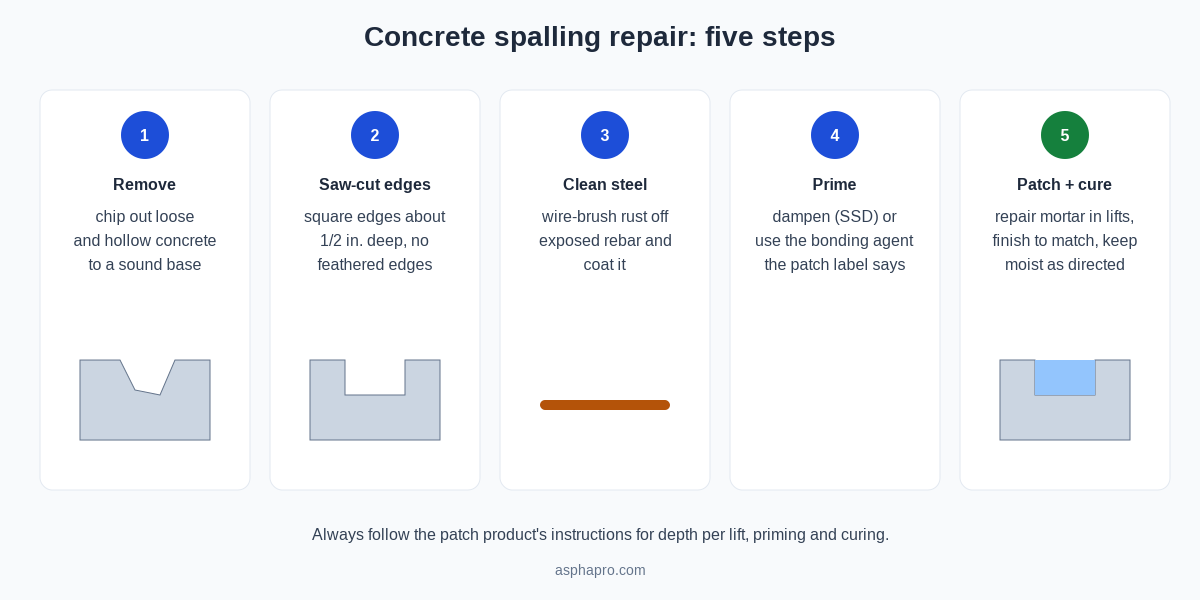
Step 1: Remove all loose and hollow concrete
Use a hammer and cold chisel, or a small chipping hammer for big areas, to break out everything that is loose, cracked or sounds hollow. Keep going until you reach hard, sound concrete all around and at the bottom. This is the step people rush, and it is the reason many spall repairs fail: a patch is only as good as the concrete it is stuck to.
Step 2: Square the edges
Thin, feathered edges are where patches crack and peel. Outline the repair with straight lines just outside the damaged area, and cut along them with an angle grinder and diamond blade to about 1/2 inch deep (check your product's minimum). Then chip out to the cut so the patch has square shoulders to hold onto. On spalling concrete with steel, chip at least about 3/4 inch behind any exposed bar so the patch can wrap around it. Wear eye and hearing protection and control dust; see how to cut concrete for silica safety.
Step 3: Clean the steel and the surface
Wire-brush or grind exposed rebar or mesh until it is free of loose rust. If a bar has lost a lot of its thickness, get advice before patching. Many repair systems use an anti-corrosion coating on cleaned steel. Then vacuum or blow out all dust; dust is the second big cause of failed concrete spall repair.
Step 4: Prime
Most cement-based patches want the old concrete saturated surface dry: soak it, then remove standing water so it is damp but not shiny. Some products use a bonding agent or a scrub coat of the patch material instead. Follow the label exactly.
Step 5: Patch, finish and cure
Mix the repair mortar to the stiffness the bag calls for, press it firmly into the hole, and work it against the edges and around any steel. Build deep repairs in lifts if the product requires it. Strike it flush, then finish it to match the surrounding surface, such as a light broom finish on a driveway. Curing matters as much as with new concrete: keep the patch damp or covered as directed, often for several days, and keep traffic off until the product says it is ready.
What Product to Use for Spalling Concrete Repair
| Damage | Typical product | Notes |
|---|---|---|
| Light scaling, shallow surface spalls under about 1/4 in. | Concrete resurfacer (polymer-modified) | Covers the whole slab for an even look; needs clean, sound concrete |
| Spalls about 1/4 to 2 in. deep | Polymer-modified repair mortar or vertical/overhead patch for walls | Square the edges; build in lifts per label |
| Deep spalls, full-depth damage | Repair mortar extended with pea gravel, or concrete | Large areas may need forming and a contractor |
| Spalled edges at joints | Fast-setting repair mortar or joint-edge repair product | Keep the joint open and reseal it afterward |
| Spalling over rusting rebar | Repair mortar plus steel cleaning and coating | Structural members need an engineer |
| Cracks next to spalls | Crack filler or sealant | See our guide on concrete repair |
Avoid using plain concrete mix or plain mortar in thin layers; without polymers they do not bond well to old concrete and tend to pop off. Avoid asphalt patch on concrete for anything but a temporary fix.
How to Fix Spalling Concrete on Different Surfaces
Driveways
Driveways usually show spalling concrete in wheel paths, near the street where salt splashes, and along joints. Small spalls can be patched one by one. If the whole driveway is scaling and has scattered spalls, the usual fix is to patch the deep spots first, then cover the whole surface with a resurfacer so the color matches. Seal the driveway after the repair cures to slow future damage.
Garage floors
Garage floors spall where salty slush drips off cars every winter. Patch the spalls, then consider a penetrating sealer or a coating. Our guide to concrete coating cost compares epoxy and other floor coatings.
Steps
Steps lose their corners and front edges first. Repairing them uses the same method, with a simple wood form held against the face to rebuild the nose. See fixing broken concrete steps for a full walkthrough.
Walls and foundations
On vertical surfaces, use a patching product rated for vertical and overhead use so it does not sag. Spalling concrete on a basement wall often comes with water problems; fix drainage and grading outside first. Foundation spalling with rusty steel or cracks wider than about 1/4 inch should be looked at by a professional.
Pool decks and patios
Pool chemicals, splash-out and freeze-thaw make pool decks prone to scaling and spalling. Patch, then resurface and seal with a product rated for pool decks.
Concrete Spalling Repair Cost
What spalling concrete repair costs depends on the size, depth and whether steel is involved:
| Job | Typical cost |
|---|---|
| DIY patch of a few small spalls | About $20 to $100 in repair mortar and supplies |
| Professional patching of small areas | Often a few hundred dollars, because of minimum charges |
| Resurfacing a scaled and spalled slab | About $3 to $5 per square foot |
| General slab or sidewalk repair | About $3 to $8 per square foot |
| Replacing badly spalled panels | About $6 to $14 per square foot including removal |
| Structural spall repair with rebar work | Quoted per job after an inspection |
These ranges match our concrete repair cost guide, which uses published cost guides such as HomeGuide. Concrete spalling repair on structures like balconies and parking decks is priced per project and can cost much more because of engineering, shoring and access.
Repair, Resurface or Replace?
Most spalled concrete does not need to be torn out. Whether to fix concrete spalling with patches, a resurfacer or new concrete is a simple decision:
- Repair when the spalls are scattered, the slab is level and the rest of the surface is sound.
- Resurface when there is widespread scaling plus a number of spalls, but the slab is still structurally sound and not badly cracked or sunken.
- Replace when spalling concrete covers large areas, the slab is broken into pieces or heaving, the steel is badly rusted, or repairs keep failing.
Our guides to concrete removal cost and concrete driveway cost help you compare the price of starting over.
Why Spall Repairs Fail
If you fix spalling concrete and it comes back within a year or two, one of these is usually the reason. Fixing concrete spalling for good means avoiding all of them:
- Loose or hollow concrete was left under or around the patch.
- The patch was feathered to nothing at the edges.
- Dust or sealer on the old surface kept the patch from bonding.
- The patch dried out instead of curing.
- Rusting steel was covered over without cleaning or coating it.
- The real cause, such as water, salt or a jammed joint, was not fixed.
- The product was the wrong type, such as a thin coat of plain mortar.
How to Prevent Spalling Concrete
For new concrete, prevention starts with the mix and the finishing; for existing concrete, it is about water, salt and joints.
On new concrete
- Order air-entrained concrete for any outdoor slab in a freeze-thaw climate, with a strength suitable for the use.
- Do not add extra water at the truck or on the surface during finishing.
- Do not finish while bleed water is on the surface, and do not over-trowel exterior slabs.
- Keep enough concrete cover over rebar and mesh, and support the steel on chairs so it ends up in the middle of the slab, not near the top.
- Cure properly for at least the first week.
- Keep deicing salt off new concrete during its first winter.
- Plan joints at the right spacing and depth.
On existing concrete
- Seal outdoor concrete with a good penetrating sealer and reseal every few years. See how to reseal concrete.
- Use sand or a gentler deicer, shovel early, and avoid piling salty snow on concrete.
- Fix gutters, downspouts and grading so water does not sit on or under slabs.
- Keep joints clean and sealed so slabs can move and edges do not crush.
- Repair small spalls before winter, while they are still small.
Spalling Concrete vs Other Surface Problems
Several problems look similar to spalling concrete:
- Scaling: wide, shallow flaking of the top paste (covered above).
- Pop-outs: small cone-shaped pits with a split stone at the bottom.
- Pitting: many small holes across the surface, often from salt or weak paste.
- Delamination: a thin top layer that sounds hollow and peels in sheets.
- Crazing: a fine web of shallow surface cracks, mostly cosmetic.
- Efflorescence: a white powder on the surface from salts carried by water, not damage by itself.
The fix for each is a little different, so it pays to look closely before buying products.
A Worked Example: Spalled Driveway Apron
Say the bottom 10 feet of a 20-foot-wide driveway, where salt spray from the street lands every winter, has a dozen spalls from the size of a palm to the size of a plate, 1/2 to 1 inch deep, with no exposed steel. The rest of the driveway is lightly scaled.
- Tap-test and mark all hollow areas.
- Saw-cut and chip each spall back to sound concrete with square edges.
- Clean, dampen, and fill each spall with polymer-modified repair mortar. Cure as directed.
- A few days later, pressure-wash the whole 200 square foot apron and apply a resurfacer so the patches and the scaled areas blend in.
- After it cures, seal the apron and switch to a gentler deicer.
DIY materials for this job might run a few hundred dollars. A contractor at about $3 to $5 per square foot for resurfacing would charge roughly $600 to $1,000 for the apron, plus any minimum for the patching.
Spalling Concrete on Structures
On bridges, parking garages, balconies and other structures, concrete spalling repair follows formal methods. Engineers locate the steel, map delaminated areas, remove concrete behind the bars, clean or replace corroded steel, and place repair concrete or mortar, often with coatings or cathodic protection to slow future corrosion. Highway department manuals such as TxDOT's spall repair procedure and MoDOT's surface failure repair guide describe this process. If you own a condo, multi-family building or commercial property with spalling concrete overhead, it is a job for professionals.
Frequently Asked Questions
What is spalling concrete?
Spalling concrete is concrete whose surface has broken away in chips or chunks, usually because of rusting steel inside, freeze-thaw damage, deicing salt, poor finishing or stress at joints.
How do you fix spalling concrete?
Remove all loose and hollow concrete, saw-cut the edges square, clean any exposed steel, prime or dampen the surface, then fill with a polymer-modified repair mortar and cure it as the product directs.
How do you repair spalling concrete on a driveway?
Patch each spall with repair mortar after removing loose material, then apply a resurfacer over the whole area if you want an even look. Seal the driveway after curing and use gentler deicers.
What is the difference between concrete scaling vs spalling?
Scaling is shallow flaking of the top layer of paste over wide areas. Spalling is deeper, more local breakage, often caused by rusting steel or water trapped under a weak surface.
Is concrete spalling a structural problem?
On driveways and patios it is usually not structural. On walls, beams, columns, balconies and foundations, spalling with exposed or rusting rebar can be structural and should be inspected.
How much does concrete spall repair cost?
DIY patches cost about $20 to $100 in materials. Resurfacing a spalled slab costs about $3 to $5 per square foot, and replacing badly spalled panels about $6 to $14 per square foot.
Can you seal spalling concrete?
Sealing helps prevent new damage but does not fix existing spalls. Repair the spalls first, let the repair cure, then seal.
Will spalling concrete keep getting worse?
Usually yes. Water collects in the broken areas, freezes and breaks more concrete, and rusting steel keeps expanding. Small spalls are cheapest to fix early.
Sources
- Texas Department of Transportation: Concrete Spall Repair
- Missouri DOT Engineering Policy Guide: Repair of Concrete Surface Failures
- Iowa State University InTrans: Revisiting Concrete Scaling (MAP Brief)
- U.S. General Services Administration: Types of Cracks in Concrete and Typical Causes
- Angi: Concrete Spalling
- HomeGuide: Concrete Resurfacing Cost
Related Guides
- Concrete pitting, flaking and popping out — how to fix pitted concrete
- How to repair concrete cracks — crack sealer, filler or caulk by crack size
- Epoxy concrete repair — when epoxy is the right fix for cracks
- Concrete patching compound guide — which concrete patch or repair mortar to use
- Concrete pool deck repair — cracks, coping joints and settled slabs
- How to resurface concrete — products, steps and fixing surface cracking
- Concrete driveway resurfacing — cost vs replacement and step-by-step process
- Honeycombing concrete — causes, how serious it is and repair
- How to cover concrete patio slabs — overlays, pavers, tile and other ideas
- Concrete rebar guide — bar sizes, slab spacing, chairs and dowels
- Precast concrete steps — sizes, cost and mobile home steps
- Concrete aggregate guide — sizes, grading and types of stone
- Calcium chloride in concrete — accelerators, risks and rapid set options
- Is concrete waterproof? — porosity, waterproof concrete and sealants
- Concrete porch — building, repairing and updating porches
- Concrete fire pit — block, poured and fire pits on concrete
- Is calcium chloride safe for concrete? — choosing the best ice melt
- Concrete pool coping — poured and precast coping, joints and repair
- Concrete restoration — repair process, methods and cost
- Concrete lintel — precast lintels over openings
- Concrete chisel — hand and SDS chisels
- Concrete stair treads — precast and poured treads
- Concrete wall crack repair — injection, sealants and when cracks are structural