
Concrete Leveling Cost in 2026: What It Costs to Raise a Sunken Slab (Mudjacking vs Foam)
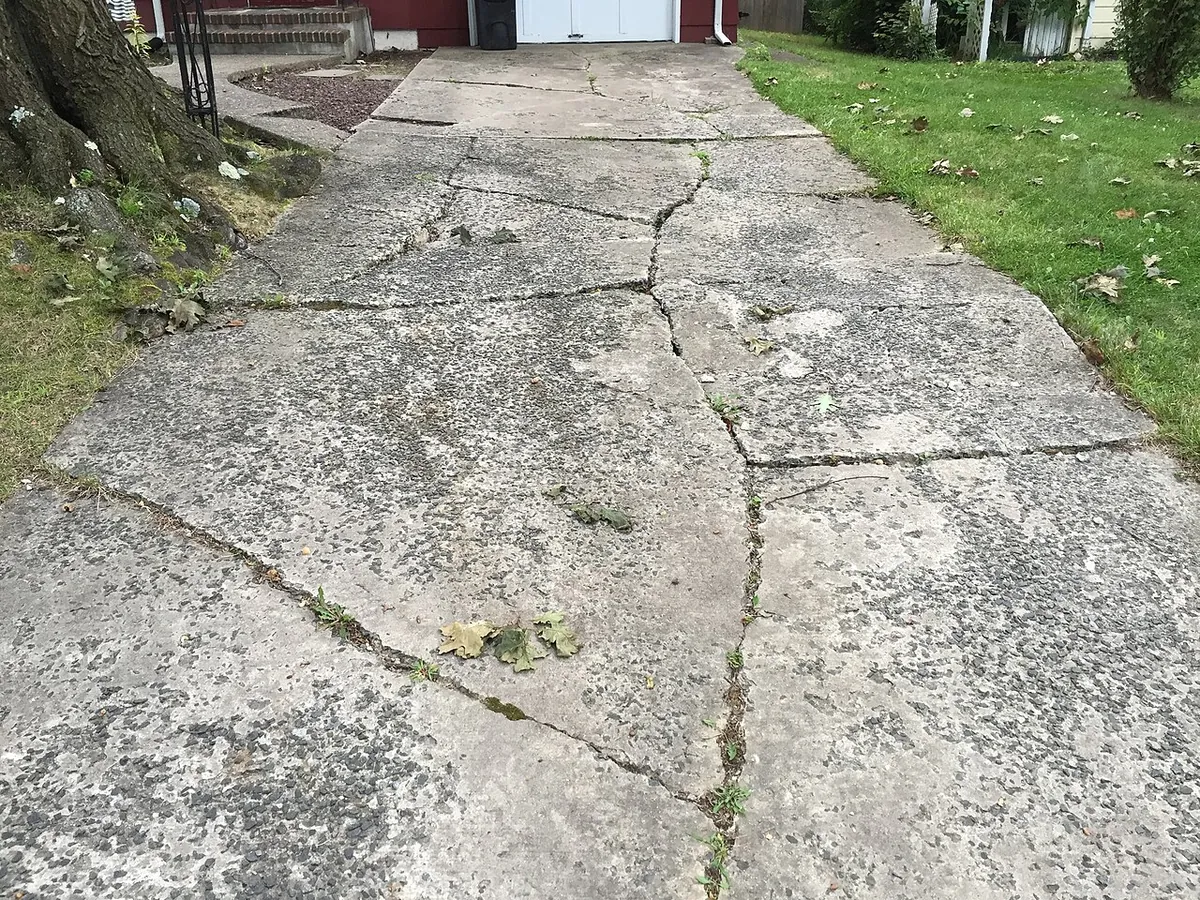
Photo: Famartin, Wikimedia Commons, CC BY-SA 4.0
Quick Answer
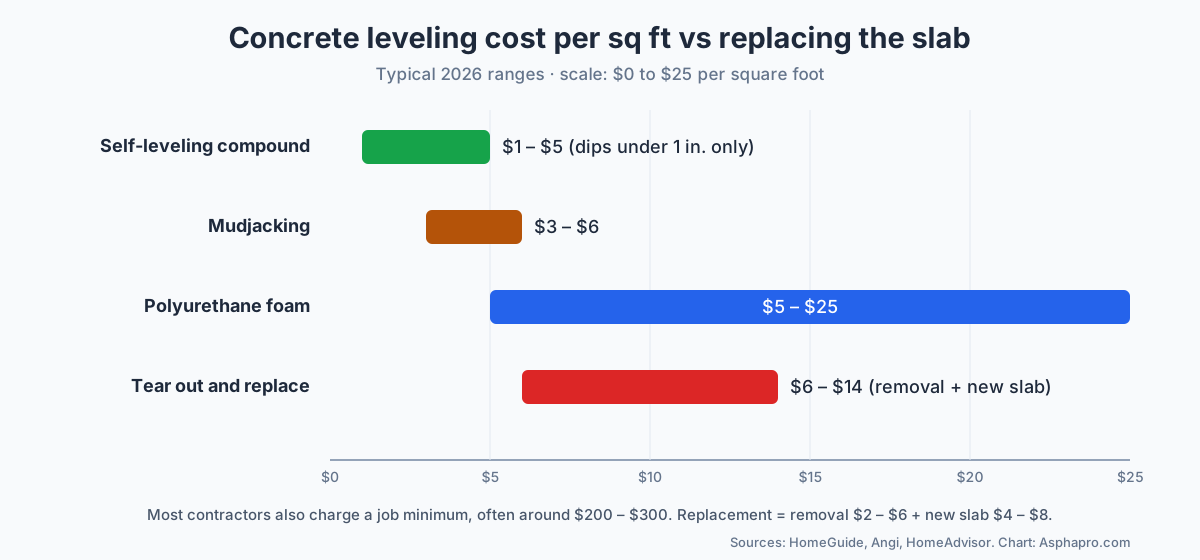
The typical concrete leveling cost in 2026 is about $3 to $6 per square foot for mudjacking and $5 to $25 per square foot for polyurethane foam lifting. Most homeowners pay $500 to $1,800 for a mudjacking job on a driveway, walkway or patio section, and many contractors charge a minimum of about $200 to $300. Self-leveling compound ($1 to $5 per sq ft) only fixes dips under about an inch. Tearing out and replacing the slab usually costs $6 to $14 per square foot, so lifting is often half the price of replacement or less.
Sunken concrete is one of the most common problems around a house. A driveway slab drops at the garage, a sidewalk panel tips and becomes a trip hazard, a patio slopes back toward the foundation, or a step pulls away from the porch. In most cases the concrete itself is still sound; the soil underneath has washed out, settled or was never compacted properly. That is why lifting the slab back into place is usually much cheaper than replacing it.
This guide explains the concrete leveling cost for each method in 2026, what affects the price, how mudjacking and polyurethane concrete raising compare, when leveling will not work, and worked examples for driveways, sidewalks, patios and garage floors. Price ranges come from HomeGuide, Angi and HomeAdvisor cost data listed in the sources.
Concrete Leveling Cost at a Glance
| Method | Cost per sq ft | Typical job | Best for |
|---|---|---|---|
| Mudjacking (slabjacking) | about $3 – $6 | $500 – $1,800 | Driveways, sidewalks, patios on stable soil |
| Polyurethane foam (polyjacking) | about $5 – $25 | higher than mudjacking | Quick return to use, small holes, weak soils |
| Self-leveling compound | about $1 – $5 | small areas | Indoor or low dips under about 1 inch |
| Remove and replace | about $6 – $14 | depends on size | Badly broken, crumbling or heaved slabs |
Some markets and some contractors quote mudjacking a little higher, around $4 to $9 per square foot, especially for small jobs where the minimum charge dominates. Always ask for a written quote by the job, not just a rate per square foot.
Why Concrete Sinks in the First Place
Knowing why a slab dropped helps you choose a method and avoid paying for concrete leveling twice. The common causes are:
- Poor compaction. Fill dirt around new houses settles for years. Slabs poured on loose backfill, especially next to foundations, often drop within the first decade.
- Water washing out the base. Downspouts, gutter overflow and poor grading send water under the slab, carrying fine soil away and leaving voids.
- Expansive clay. Clay soils swell when wet and shrink when dry, so slabs heave in wet seasons and sink in droughts.
- Tree roots and decay. Roots can lift slabs; when a tree is removed, rotting roots leave voids that later collapse.
- Freeze-thaw. Water in the base freezes, expands and lifts the slab, then the soil is looser when it thaws.
- Plumbing leaks. A leaking pipe under a slab can wash out a large void quickly.
If the cause is water, fix the drainage first. Extend downspouts, regrade soil away from the slab and seal the joint between the slab and the house. Otherwise the soil keeps washing out, and the concrete raising you paid for will not last.
Mudjacking Cost (Concrete Jacking Cost) and How It Works
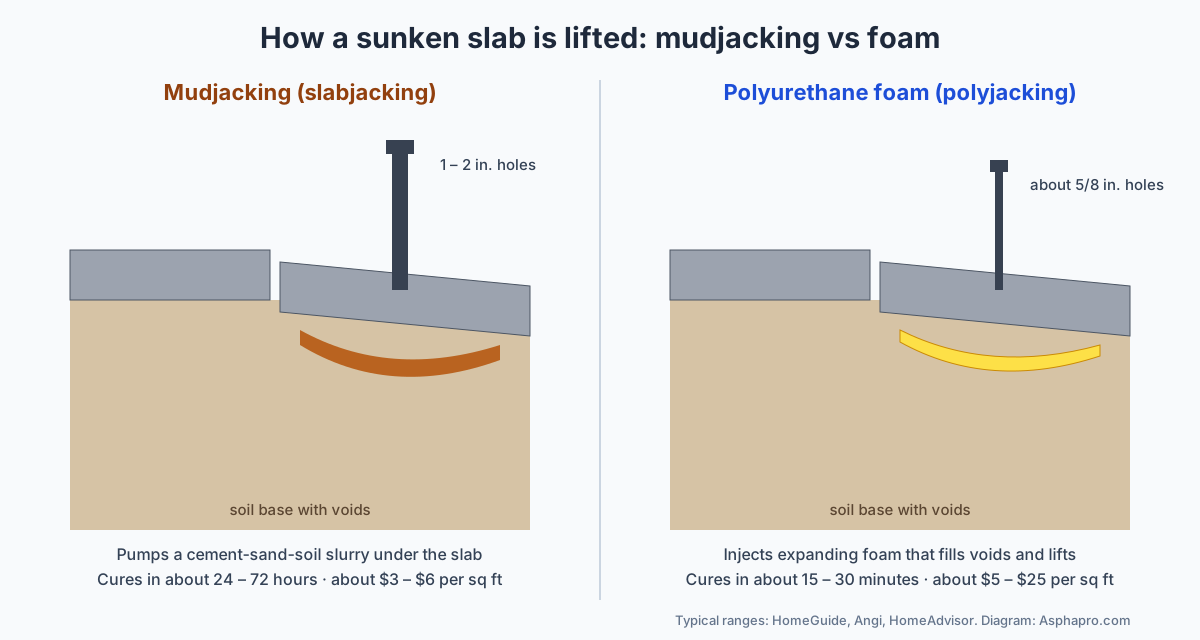
Mudjacking, also called slabjacking or concrete pumping, is the older and usually cheaper concrete lifting method. The crew drills holes about 1 to 2 inches wide through the sunken slab, then pumps a slurry of water, soil, sand and cement under it. The slurry fills the voids, and as more is pumped in, it lifts the slab back toward level. The holes are then patched with cement.
Contractors use different names for the same work, so you may see it quoted as concrete raising cost, concrete lifting cost or concrete jacking cost. The method matters more than the name. Mudjacking is usually the $3 to $6 per square foot end of the range, while foam is the $5 to $25 end. Ask every contractor which material they pump, so you compare the same job.
HomeGuide puts mudjacking cost at roughly $3 to $6 per square foot, with an average job around $500 to $1,800. The price depends mostly on the area lifted, how far it has dropped, how much slurry is needed to fill the voids, and access for the pump trailer.
Mudjacking pros
- Usually the lowest concrete leveling cost per square foot.
- Uses natural materials (soil, sand, cement and water).
- Works well on driveways, sidewalks and patios on reasonably stable soil.
- Fills large voids with a dense, solid material.
Mudjacking cons
- Larger holes, about 1 to 2 inches, which leave more visible patches.
- The slurry is heavy and can add weight to already weak soil, which may cause it to settle again.
- Needs about 24 to 72 hours to cure before heavy use.
- Can wash out over time if water still runs under the slab.
Polyurethane Foam Leveling Cost (Polyjacking)
Polyurethane foam leveling, often called polyjacking or foam jacking, works the same way but uses a two-part expanding foam instead of slurry. The crew drills holes about 5/8 inch wide, injects the liquid foam, and the foam expands under the slab, filling voids and lifting it. The foam is very light, so it adds little weight to the soil, and it does not absorb water.
HomeGuide puts polyjacking at about $5 to $25 per square foot. The wide range reflects how much foam a job needs: a slab with large voids or a big drop uses far more material than one that sank half an inch. The foam usually cures in about 15 to 30 minutes, so you can often walk or drive on the slab the same day.
Polyurethane foam pros
- Small holes, about the size of a pencil eraser, so patches are less visible.
- Lightweight material that adds little load to weak soil.
- Water-resistant and does not wash out like slurry.
- Fast cure: the slab is usually usable within hours.
- Precise lifting with fine control.
Polyurethane foam cons
- Higher cost per square foot, sometimes several times the mudjacking cost.
- Foam is a petroleum product, which some homeowners prefer to avoid.
- Pricing is harder to predict because it depends on how much foam fills hidden voids.
Polyurethane Concrete Raising vs Mudjacking
Polyurethane concrete raising vs mudjacking is the main choice most homeowners face. Here is a side-by-side comparison:
| Factor | Mudjacking | Polyurethane foam |
|---|---|---|
| Cost per sq ft | about $3 – $6 | about $5 – $25 |
| Hole size | about 1 – 2 in. | about 5/8 in. |
| Cure time | about 24 – 72 hours | about 15 – 30 minutes |
| Material weight | heavy slurry | very light foam |
| Water resistance | can erode if water keeps flowing | does not absorb water |
| Best on | stable soil, budget jobs | weak soil, fast return to use, visible areas |
For a typical sidewalk or patio on firm soil where the drainage problem has been fixed, mudjacking is often the better value. For a driveway on soft or clay soil, a garage floor, or a slab near a foundation where weight matters, polyurethane foam is often worth the higher concrete leveling cost. Ask contractors which method they recommend for your soil, and why.
Cost of Raising a Concrete Slab: Worked Examples
Here is the cost of raising a concrete slab for common jobs, using the typical ranges above. Real quotes depend on how far each slab dropped and how big the voids are.
To raise concrete slab cost estimates of your own, measure the sunken area in square feet and multiply by the per-square-foot range for the method you want. Then check it against the contractor's minimum charge, because a small job often costs the minimum no matter how few square feet it is. Concrete slab lifting cost per square foot also drops on bigger jobs, since setup time is spread over more area.
| Project | Area lifted | Mudjacking | Polyurethane foam |
|---|---|---|---|
| One sidewalk panel | 5 × 5 ft = 25 sq ft | minimum charge, about $200 – $300 | minimum charge or a few hundred dollars |
| Four sidewalk panels | 100 sq ft | $300 – $600 | $500 – $2,500 |
| Patio section | 12 × 12 ft = 144 sq ft | $430 – $860 | $720 – $3,600 |
| Driveway apron at the garage | 10 × 20 ft = 200 sq ft | $600 – $1,200 | $1,000 – $5,000 |
| Garage floor section | 20 × 20 ft = 400 sq ft | $1,200 – $2,400 | $2,000 – $10,000 |
Compare those with replacement. Replacing a 200 square foot apron at about $6 to $14 per square foot (removal plus a new slab) would run roughly $1,200 to $2,800, plus the days it is out of use while new concrete cures. For a slab that is otherwise in good shape, concrete lifting is usually the cheaper and faster option. To measure your own area, use the calculator below.
What Affects Concrete Leveling Cost
- Area of the slab. Larger areas cost more in total but usually less per square foot.
- How far it sank. A 3 inch drop needs far more material than a half inch drop.
- Size of the voids. Hidden voids are the big unknown, especially for foam pricing.
- Soil type. Soft clay or loose fill may need more material or foam instead of slurry.
- Access. Mudjacking rigs need to get close; tight backyards may cost more.
- Number of slabs. Lifting several panels in one visit spreads the trip and setup cost.
- Extra work. Crack repair, joint sealing and caulking along the house add to the bill.
- Minimum charges. Many contractors have a job minimum of about $200 to $300.
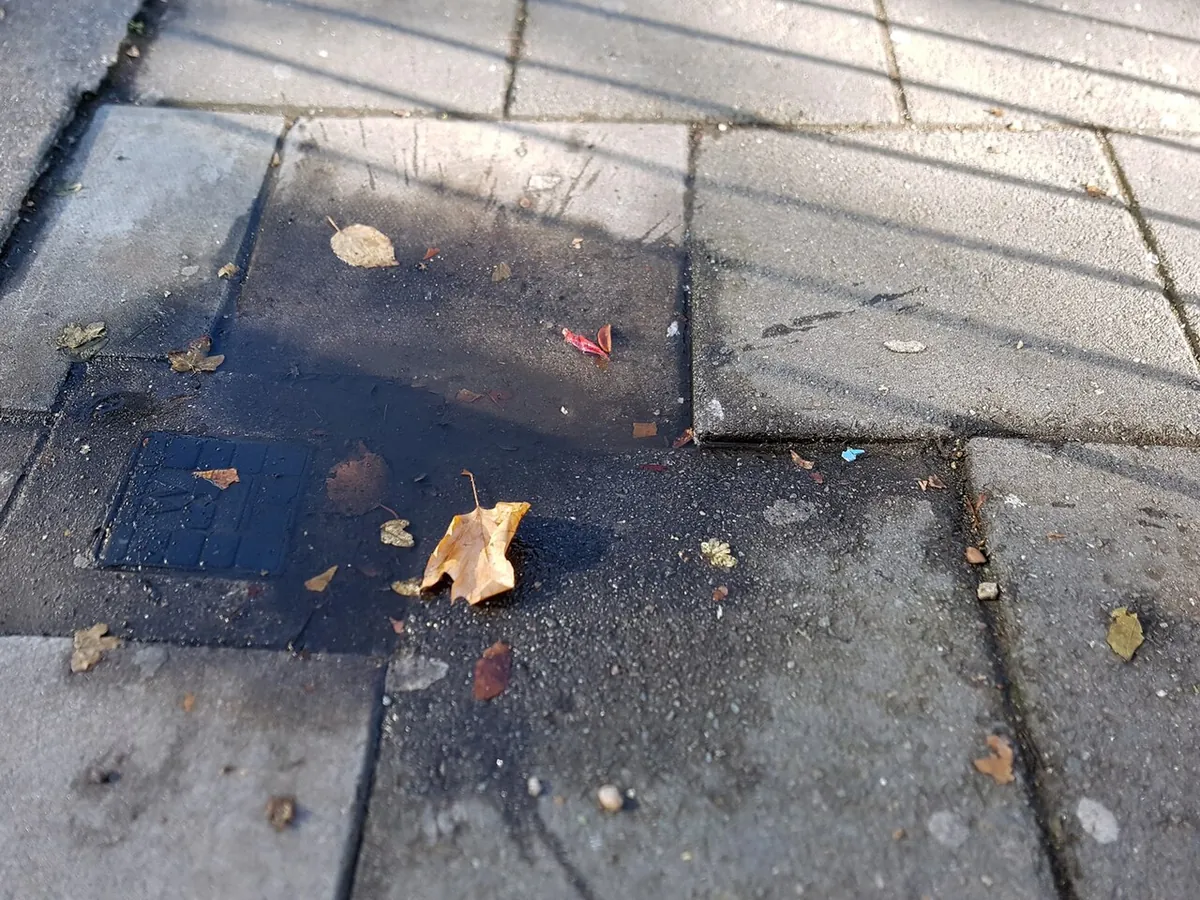
Photo: Acabashi, Wikimedia Commons, CC BY-SA 4.0
Concrete Leveling Cost by Project
Driveway leveling
Driveways usually sink where they meet the garage, at the street apron, or along edges where water runs off. Lifting a single driveway section often falls within the typical $500 to $1,800 range for mudjacking. Because cars and trucks load the slab, many contractors recommend foam on soft soils. See our full concrete driveway cost guide if you are weighing replacement.
Sidewalk leveling
Sidewalk panels are small and light, so a single panel is often priced at the contractor's minimum. Raised or sunken sidewalk edges are trip hazards and, in many cities, the homeowner's responsibility. Lifting several panels in one visit is the best value. Compare with concrete sidewalk cost for full replacement prices.
Patio leveling
A patio that slopes toward the house can send water into a basement or crawl space. Raising the slab to restore a slope away from the foundation is a common concrete leveling job. If the patio is badly cracked or the surface is flaking, an overlay or replacement may be better.
Garage floor and interior slabs
Interior slabs can be lifted with both methods, but foam is often preferred indoors because the holes are smaller and the cure is faster. For a floor with only minor dips and no structural settling, a self-leveling underlayment may be all you need; see self-leveling concrete.
Pool decks and steps
Pool decks often sink near the coping as water gets under the slab. Foam is popular here because it does not absorb water. Sunken concrete steps can sometimes be lifted, but steps that have pulled away from the house or broken apart usually need repair or replacement; see how to fix concrete steps.
Self-Leveling Compound: The Cheapest Option for Small Dips
Self-leveling compound is a pourable cement mix that flows out to a flat surface. At about $1 to $5 per square foot, it is the lowest concrete leveling cost, but it does something different: it fills low spots on top of the slab instead of lifting the slab. That makes it useful for interior floors before tile or flooring, and for shallow dips under about an inch. It will not fix a slab that tips toward the house or a raised edge that trips people, because the slab itself has not moved.
When Concrete Leveling Will Not Work
Lifting is not always the right answer. Replacement is usually better when:
- The slab is broken into many small pieces or crumbling.
- The surface is badly scaled or spalled from salt and freeze-thaw.
- The slab has heaved up from roots or frost rather than sunk.
- The concrete is very thin or has no base, so it will just crack again.
- The settling is caused by an ongoing problem that cannot be fixed, such as a major plumbing leak or a foundation issue.
Foundation settlement is a separate problem. If the house itself is sinking, with wall cracks, sticking doors or a sloping floor inside, call a foundation specialist; that is a different job from leveling exterior flatwork. For full replacement prices, see concrete removal cost and concrete slab cost.
Concrete Lifting Cost vs Replacement: Which Saves More?
For a slab that is structurally sound, concrete lifting usually saves money. Replacement means breaking up and hauling away the old concrete (about $2 to $6 per square foot), then pouring new concrete (about $4 to $8 per square foot for a plain slab), for roughly $6 to $14 per square foot in total. You also lose the use of the area for about a week while new concrete cures. Lifting is usually done in a day, and with foam you can often use the slab within hours.
The trade-off is appearance. A lifted slab keeps its old cracks, stains and the patched drill holes. If the concrete looks bad and you planned to replace it soon anyway, putting the money toward new concrete may make more sense.
DIY Concrete Leveling: Can You Do It Yourself?
DIY options are limited. Homeowners can use self-leveling compound for interior dips, patch cracks, and fix drainage problems. Some rental shops carry small foam kits, but professional lifting rigs give much better control. Raising a heavy slab unevenly can crack it, and pumping too much material under a slab near a foundation can push on the wall. For most homeowners, professional concrete raising is the safer choice; the money you save on DIY is small compared with the risk of breaking the slab.
DIY concrete lifting with rented foam kits or homemade concrete jacking with a pump and grout is possible on small, light slabs like a single sidewalk panel. The risks are uneven lifting, cracking the slab and filling voids you cannot see. If you try it, lift slowly in small steps, keep a level on the slab the whole time, and stop as soon as it is flush with its neighbor.
What you can do yourself is reduce the chance of settling again: extend downspouts at least several feet from slabs, slope soil away from concrete, fill and seal open joints and cracks, and keep the joint between a patio and the house caulked. See concrete repair cost for crack sealing prices.
How Long Does Concrete Leveling Last?
Properly done, a lifted slab can stay level for many years, often as long as the original concrete lasts, provided the cause of settling is fixed. Foam generally holds up better in wet areas because it does not wash out. Mudjacking slurry can erode if water keeps flowing under the slab. Many contractors offer a warranty on lifting work; ask what it covers and for how long. For more on how long concrete lasts overall, see how long concrete lasts.
Signs Your Concrete Needs Leveling
Small changes are easy to ignore until they become a hazard or let water into the house. Watch for these signs that a slab has started to sink:
- Uneven joints. One slab edge sits higher than its neighbor. A difference of about half an inch or more can trip people.
- Water pooling. Puddles that never used to form, especially near the house or garage door.
- A gap at the garage. The driveway drops away from the garage floor, leaving a step or a gap under the door seal.
- Slope toward the house. A patio or walkway that now drains toward the foundation instead of away.
- Hollow sound. Tapping the slab sounds hollow in spots, a sign of voids underneath.
- New cracks. Cracks that appear as the slab bends over a void.
- Steps pulling away. A gap opening between steps and the porch or house.
Catching settling early usually keeps the concrete leveling cost down. A slab that dropped half an inch needs far less material than one that dropped three inches, and it is less likely to crack while it is raised.
What Happens on Concrete Leveling Day
Most residential lifting jobs follow the same steps, whether the contractor uses slurry or foam:
- Inspection. The crew checks which slabs have sunk, how far, and where the voids are. They look at drainage and nearby downspouts.
- Drilling. Holes are drilled through the slab in a pattern that lets material spread evenly underneath: about 1 to 2 inches wide for mudjacking, or about 5/8 inch for foam.
- Injection. Slurry or foam is pumped in slowly. The crew watches the slab and adjoining edges with a level or a string line, so the slab rises evenly instead of tilting or cracking.
- Patching. The holes are filled with a cement patch. The patches are usually close to the slab color but rarely an exact match.
- Sealing. Good contractors seal the joints and cracks afterward, so water cannot get back under the slab.
- Cure and use. Foam-lifted slabs are often usable the same day. Slurry-lifted slabs need about a day or more before heavy loads.
Clear the area beforehand: move cars, planters and furniture, and mark any sprinkler lines or buried utilities near the slab. If the crew finds a much bigger void than expected, especially with foam, the price can change. Ask how they handle that before they start.
Mistakes That Raise Your Concrete Leveling Cost
- Waiting too long. Bigger drops need more material and are more likely to crack during the lift.
- Ignoring drainage. If water keeps washing out the base, you pay for lifting again in a few years.
- Lifting one slab at a time. Each visit carries its own minimum charge. Group nearby slabs into one job.
- Skipping joint sealing. Open joints let water straight under the slab you just raised.
- Choosing on price alone. A cheap foam quote may assume small voids; ask how extra material is billed.
- Raising a broken slab. If the concrete is badly cracked or crumbling, lifting only delays the replacement you will need anyway.
Concrete Leveling vs Grinding a Raised Edge
For a sidewalk with a small lip, some contractors offer to grind the raised edge down instead of lifting the sunken slab. Grinding removes the trip hazard but does not fix the cause, and it leaves a rough, sloped spot. It makes sense only when the height difference is small and the slabs are not tipping toward the house. When a slab has sunk more than about an inch, or water is pooling, concrete raising is the real fix, and the concrete leveling cost is usually only slightly higher than grinding once the minimum charge is counted. Ask for both prices if a contractor offers grinding, and compare them with the mudjacking cost for the same panels.
Who Pays for Sidewalk Leveling?
In many U.S. cities, the homeowner is responsible for the sidewalk in front of the property, even though it sits on public land. Rules differ a lot by city: some cities repair sidewalks themselves, some share the cost, and some send repair notices and bill the owner if the work is not done. Check with your city before you hire a contractor, since some require permits or approved contractors for public sidewalk work. A raised panel is also a liability concern, so lifting it promptly is often worth the minimum charge.
How to Get a Fair Concrete Leveling Quote
- Get at least two or three quotes, including at least one for each method.
- Ask for the price per job, not just per square foot, and what is included.
- Ask how they will find and fill voids, and how they handle extra material if voids are bigger than expected.
- Ask whether joint and crack sealing is included after lifting.
- Ask about the warranty and what it covers.
- Check that they will lift adjoining slabs together so edges line up.
- Group several slabs into one visit to spread the minimum charge.
Frequently Asked Questions
How much does concrete leveling cost?
Typical concrete leveling costs about $3 to $6 per square foot for mudjacking and $5 to $25 per square foot for polyurethane foam. Most mudjacking jobs run about $500 to $1,800, and many contractors have a minimum around $200 to $300.
What is the cost of raising a concrete slab?
Raising a 200 square foot driveway section typically costs about $600 to $1,200 with mudjacking or $1,000 to $5,000 with foam, depending on how far it sank and how big the voids are.
Is polyurethane concrete raising better than mudjacking?
Foam uses smaller holes, is lighter, resists water and cures in minutes, but costs more. Mudjacking is cheaper and works well on stable soil when drainage is fixed. The best choice depends on your soil, budget and how soon you need the slab.
Is it cheaper to level or replace concrete?
Leveling is usually cheaper. Replacement runs about $6 to $14 per square foot including removal, while mudjacking runs about $3 to $6.
How long does concrete leveling take?
Most residential jobs take a few hours. Foam cures in about 15 to 30 minutes; mudjacking slurry needs about 24 to 72 hours before heavy use.
Can self-leveling concrete fix a sunken slab?
No. Self-leveler fills shallow dips on top of a slab, usually under about an inch. It does not lift a slab that has sunk or tipped.
How much does concrete lifting cost?
Concrete lifting costs about $3 to $6 per square foot with mudjacking and about $5 to $25 per square foot with polyurethane foam. Most driveway, walkway and patio jobs land between $500 and $1,800, with minimum charges around $200 to $300.
What is the cost of raising concrete compared with replacing it?
Raising concrete usually costs about half of replacement or less. Lifting runs about $3 to $6 per square foot with mudjacking, while tearing out and repouring runs about $6 to $14 per square foot.
Sources
- HomeGuide, "How much does mudjacking cost?" homeguide.com
- HomeGuide, "How much does polyjacking cost?" homeguide.com
- Angi, "How much does concrete leveling cost?" angi.com
- HomeAdvisor, "How much does it cost to level a concrete slab?" homeadvisor.com
- HomeGuide, concrete removal and driveway cost guides (replacement ranges). homeguide.com
- Image credits: driveway photo by Famartin and sidewalk photo by Acabashi, both CC BY-SA 4.0 via Wikimedia Commons. Diagrams and chart by Asphapro.com.
Prices checked November 2026. They are national ranges; local contractors can be higher or lower.
Related Guides
- Can you lay pavers over concrete? — sand-set vs mortar-set overlays
- Why does concrete crack? — causes, joints and prevention
- How to use self leveling concrete — prep, pour and dry times
- Can rats chew through concrete? — rodent entry points and termites