
Concrete Sidewalk Cost in 2026: Walkway Prices per Square Foot and Linear Foot
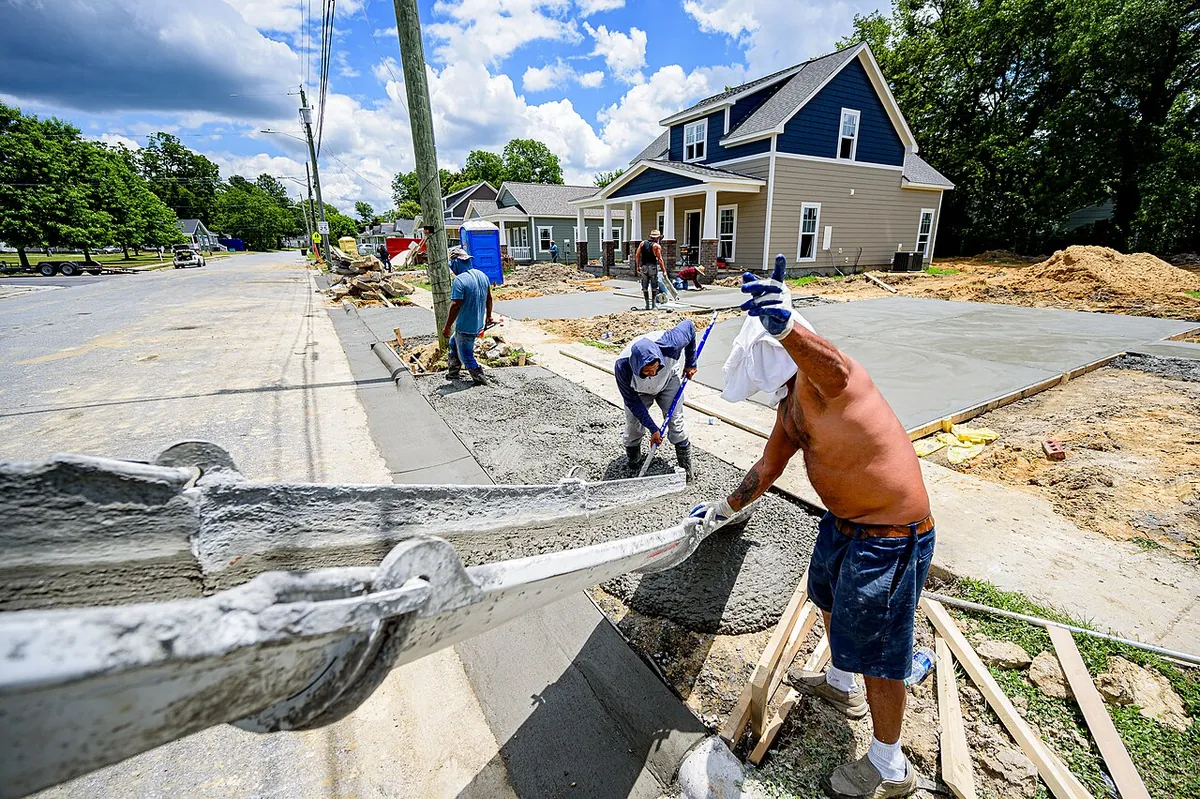
Photo: City of Greenville, North Carolina, Wikimedia Commons, public domain
Quick Answer
The typical concrete sidewalk cost in 2026 is about $7 to $17 per square foot installed, according to HomeGuide, or about $28 to $68 per linear foot for a standard 4 foot wide walk. A 200 square foot walkway (4 × 50 feet) usually costs about $1,400 to $3,400. LawnStarter puts most sidewalks at about $5.89 to $12 per square foot before site prep. Removing an old sidewalk adds about $2 to $6 per square foot, and repairing cracked or uneven sections usually costs about $3 to $8 per square foot.
A concrete sidewalk or walkway connects the street, driveway, front door, backyard and garden. It is a small project compared with a driveway, but sidewalks are narrow and long, which means a lot of forming and edging for the amount of concrete. That is why the cost of a concrete walkway per square foot is often higher than the cost of a large slab.
This guide breaks down concrete sidewalk cost in 2026 per square foot and per linear foot, prices by length and width, replacement and repair costs, public sidewalk rules, decorative options and concrete walkway ideas. Price ranges come from HomeGuide, LawnStarter, HomeAdvisor and Angi, listed in the sources.
Concrete Sidewalk Cost at a Glance
| Item | Typical 2026 cost | Source |
|---|---|---|
| New concrete sidewalk, installed | $7 – $17 per sq ft | HomeGuide |
| 4 ft wide sidewalk | $28 – $68 per linear ft | HomeGuide |
| Typical 200 sq ft walkway | $1,400 – $3,400 | HomeGuide |
| Sidewalk, excluding site prep | $5.89 – $12 per sq ft | LawnStarter |
| Remove old sidewalk | $2 – $6 per sq ft | HomeAdvisor |
| Full repour or replacement | $5 – $10 per sq ft | Angi |
| Repair cracks or uneven sections | $3 – $8 per sq ft | HomeGuide |
Ranges differ between sources because some include site preparation, removal and permits while others list them separately. Use the ranges as a starting point and compare local quotes line by line.
Concrete Sidewalk Cost per Linear Foot
Because sidewalks are long and narrow, contractors often price them per linear foot. Here is the cost by width, using HomeGuide's $7 to $17 per square foot:
| Walk width | Cost per linear foot | 50 ft walkway |
|---|---|---|
| 3 ft (garden path) | $21 – $51 | $1,050 – $2,550 |
| 4 ft (standard front walk) | $28 – $68 | $1,400 – $3,400 |
| 5 ft (public sidewalk, wide entry) | $35 – $85 | $1,750 – $4,250 |
| 6 ft (wide entry walk) | $42 – $102 | $2,100 – $5,100 |
A 4 foot concrete sidewalk lets two people walk side by side and is the most common front walk size. Many cities require 4 to 5 feet for public sidewalks. Garden paths can be narrower, but 3 feet is about the practical minimum for a wheelbarrow or mower.
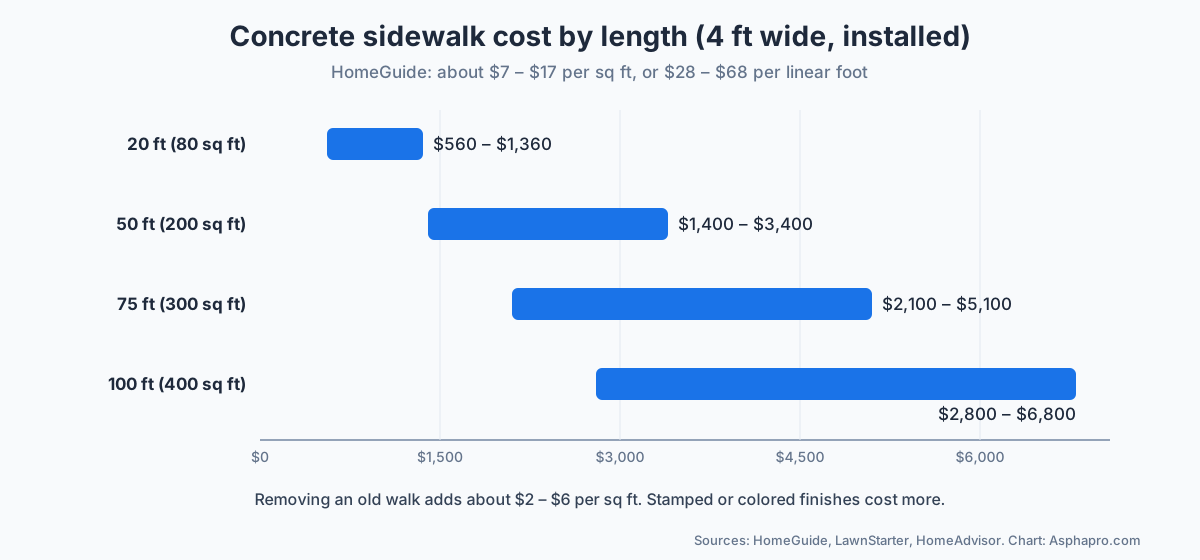
Cost of a Concrete Walkway by Length
Most residential walks are 3 to 4 feet wide, so the cost of concrete walkway projects is easiest to estimate by length. Multiply the length by the width to get square feet, then by $6 to $12 per square foot.
| Walkway (4 ft wide) | Square feet | Concrete at 4 in. (cu yd) | Installed cost |
|---|---|---|---|
| 10 ft | 40 | 0.5 | often a minimum charge, $280 – $680+ |
| 20 ft | 80 | 1.0 | $560 – $1,360 |
| 30 ft | 120 | 1.5 | $840 – $2,040 |
| 50 ft | 200 | 2.5 | $1,400 – $3,400 |
| 75 ft | 300 | 3.7 | $2,100 – $5,100 |
| 100 ft | 400 | 4.9 | $2,800 – $6,800 |
Short walks often hit a contractor's minimum price, and small concrete orders can carry a short-load fee from the ready-mix plant. See concrete price per yard for how those fees work.
What Is Included in the Price
The cost to install concrete sidewalk sections covers more than concrete. A typical quote includes layout, digging out sod and soil, a compacted gravel base, forms, the pour, a broom finish, control joints and cleanup. If you use a concrete sidewalk cost calculator, check whether its numbers include removal of an old walk, because that is often extra.
- Layout and excavation: marking the path, removing sod and digging about 8 inches for a 4 inch walk on 4 inches of base.
- Base: compacted gravel for drainage and support.
- Forms: straight or curved forms along both edges. Curves take more labor.
- Reinforcement: often fiber or wire mesh; rebar for sections crossed by vehicles.
- Concrete: usually 4 inches thick, sometimes 5 to 6 inches where cars cross.
- Finishing: edging, a broom finish for grip, and control joints about every 4 to 5 feet on a 4 foot walk.
- Curing and cleanup: removing forms and backfilling the edges with soil.
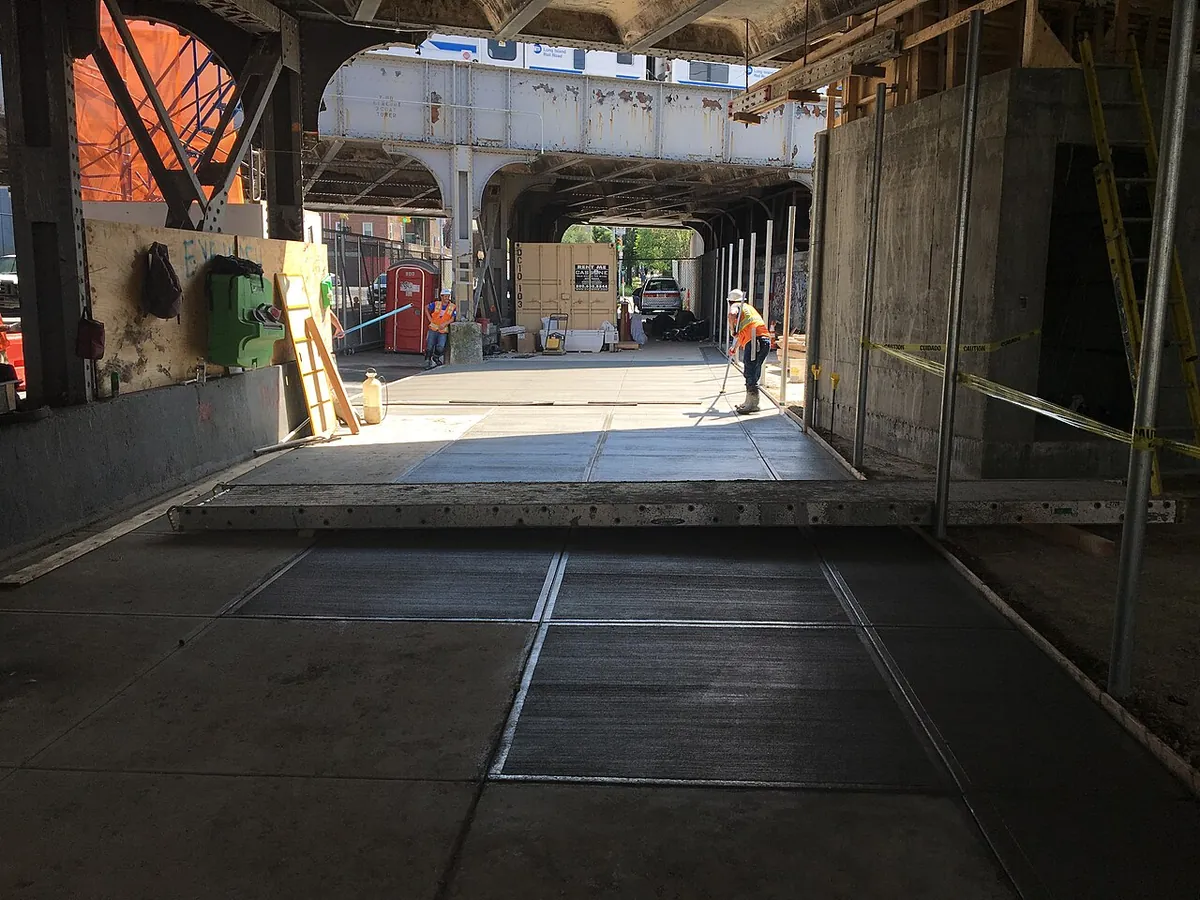
Photo: MTA Capital Construction, Wikimedia Commons, CC BY 2.0
Concrete Sidewalk Replacement Cost
Replacing a sidewalk means removing the old concrete and pouring new. HomeAdvisor puts concrete removal at about $2 to $6 per square foot, and Angi lists full repour or replacement at about $5 to $10 per square foot. Combined with typical new sidewalk prices, replacing a walk usually lands around $8 to $17 per square foot in total. For a 4 × 50 foot walk, that is roughly $1,600 to $3,400. Thicker slabs, rebar, tight access and hauling distance push the price up. See concrete removal cost.
Sidewalk Repair Cost
Not every damaged sidewalk needs to be replaced. HomeGuide puts sidewalk repair at about $3 to $8 per square foot for moderate cracks, surface wear or uneven sections. Common repairs include:
- Crack filling for narrow cracks, to keep water out.
- Leveling sunken panels with mudjacking or foam; see concrete leveling cost.
- Grinding small raised lips to remove trip hazards.
- Resurfacing worn or scaled surfaces with an overlay; see concrete overlay cost.
- Replacing single panels that are badly broken.
For more repair options, see concrete repair cost.
Who Pays for Public Sidewalks?
In many U.S. cities, the homeowner is responsible for maintaining the public sidewalk in front of their property, even though it is on city land. Rules vary a lot: some cities repair sidewalks themselves, some share the cost with homeowners, and some send notices requiring repair within a set time. Public sidewalk work usually needs a permit and must follow city standards for width, thickness, slope and curb ramps. Angi notes that sidewalk slabs are typically at least 4 inches thick. Check with your city before hiring a contractor, and ask whether they are licensed for work in the public right of way.
Concrete Sidewalk Cost for Common Home Projects
- Front walk from driveway to door: often 4 × 20 to 4 × 40 feet, so roughly $560 to $2,720 for a new concrete sidewalk at $7 to $17 per square foot.
- Side yard concrete walkway to a gate or trash area: often 3 × 30 feet, about $630 to $1,530.
- Backyard concrete walkway to a shed or garden: length varies; curved paths and tight access add cost.
- Public concrete sidewalk replacement in front of a house: often a few 5 × 5 foot panels; city permits and standards apply.
- Walkway with steps to a porch: price the steps separately; see concrete steps cost.
Concrete Walkway Ideas
A walkway does not have to be a plain gray strip. Popular concrete walkway ideas include:
- Broom finish with a smooth border: a simple, low-cost upgrade that frames the walk.
- Curved walkways: softer lines through a garden; curves add forming labor.
- Exposed aggregate: decorative stone on the surface with good grip.
- Stamped concrete: patterns like stone, brick or slate, at a higher price.
- Colored or stained concrete: warm tones that match the house.
- Concrete stepping pads: separate pads set in gravel or grass for a garden path; see how to make concrete stepping stones.
- Saw-cut patterns: joints cut in a grid or diamond pattern for a tiled look.
- Lighting: low-voltage path lights along the edges.
- Steps and landings: where the walk meets a slope or porch; see concrete steps cost.
Decorative finishes can raise the cost of a concrete walkway well above plain concrete; stamped concrete commonly runs about $12 to $18 per square foot. For a comparison with pavers, see paving stones vs concrete.
What Affects Concrete Sidewalk Cost
- Length and width: the main cost driver; narrow walks cost more per square foot.
- Shape: curves, steps and many corners take more forming time.
- Removal: taking out an old walk adds about $2 to $6 per square foot.
- Access: backyard paths may need wheelbarrows or a pump.
- Slope: steep walks may need steps, thicker sections or extra base.
- Finish: plain broom finish is cheapest; stamped and colored cost more.
- Permits: required for public sidewalks and many entry walks.
- Region: labor costs vary widely.
Concrete Walkway Cost: Budget, Mid-Range and High-End
Budget concrete walkway
A straight, 3 to 4 foot wide concrete walkway with a broom finish, poured on easy ground with no removal, lands near the low end of the ranges. Expect roughly $7 to $9 per square foot from a contractor, or less if you pour a short walk yourself. This is the most common choice for side yards, paths to sheds and simple front walks.
Mid-range concrete walkway
A mid-range concrete walkway adds features such as a gentle curve, a smooth trowel border, a few steps or a landing at the door, or removal of an old walk. Those details push the price toward about $10 to $14 per square foot. Many front walks fall in this range.
High-end concrete walkway
A high-end concrete walkway may be stamped and colored, have integrated lighting, wide landings, steps with handrails, and curved edges through landscaped beds. Those walks often cost about $15 per square foot or more, plus lighting and railings. Decorative work needs resealing every few years, which adds to the lifetime cost of a concrete sidewalk.
Adding a Walkway to a New Driveway
If you are pouring a new driveway, adding the front walk at the same time can lower the concrete sidewalk cost. The crew, equipment and ready-mix truck are already on site, and a larger total pour avoids short-load fees. The walk and driveway can share forms and finishing crews. Ask your contractor to price the walkway as part of the driveway job; see concrete driveway cost.
Concrete Sidewalk Cost by Region
Labor makes up much of a sidewalk's price, so regional wages matter. In high-cost metro areas, a new concrete sidewalk can cost toward or above the top of the national range, especially for short walks with minimum charges. In smaller towns and rural areas, prices are often closer to the low end, although long trips from a ready-mix plant can add delivery fees. Cities with strict public sidewalk standards may also add permit and inspection costs for work in the right of way.
How a Concrete Sidewalk Is Built
Knowing the steps helps you understand quotes and spot shortcuts that raise the long-term concrete sidewalk cost:
- Plan the route and slope. Walks should slope slightly to one side, about 1/8 to 1/4 inch per foot, so water runs off. Where the walk meets the house, it should slope away from the foundation.
- Mark and excavate. The crew strips sod and digs to depth, usually about 8 inches for a 4 inch walk on 4 inches of base.
- Compact and add base. The soil is compacted, then crushed stone is spread and compacted in layers.
- Set forms. Boards or flexible forms for curves are staked along both edges at the finished height and slope.
- Add isolation joints where the walk meets the house, steps, driveway or curb, so each piece can move on its own.
- Pour and screed. Concrete is placed, struck off level with the forms and floated.
- Edge and joint. Edges are rounded with an edger, and control joints are tooled or cut at regular spacing.
- Broom finish and cure. A light broom finish adds traction; the walk is kept moist or sprayed with curing compound.
- Strip forms and backfill. Forms come off after a day or two, and soil is placed along the edges.
Sidewalk Thickness and Joint Spacing
Most residential concrete sidewalks are 4 inches thick. Where vehicles cross the walk, such as at a driveway, the concrete is often thickened to 5 or 6 inches, and many cities require thicker sections at driveway crossings. Control joints on a 4 foot wide walk are usually spaced about 4 to 5 feet apart, creating roughly square panels. Wider spacing tends to produce random cracks across the walk. Joints should be cut or tooled to about a quarter of the slab depth. For more on thickness, see concrete slab thickness.
Public Sidewalks and Accessibility Rules
Public sidewalks, and walks at many businesses and multifamily buildings, must follow accessibility rules. The 2010 ADA Standards for Accessible Design set requirements for accessible routes, including a minimum clear width of 36 inches, limits on cross slope (no steeper than 1:48), and limits on running slope before the walk is treated as a ramp (1:20). Cities often require wider sidewalks, curb ramps with detectable warning surfaces at crossings, and specific concrete thickness and joint patterns. Private front walks at single-family homes usually do not have to meet ADA rules, but following similar slopes makes them safer and easier to use for everyone.
Tree Roots and Sidewalks
Tree roots are one of the most common reasons concrete sidewalks crack and heave, especially near large street trees. Roots grow under the slab, where moisture collects, and slowly lift panels. Options include grinding small lips, lifting and resetting panels, replacing panels with thicker or reinforced concrete, adding root barriers, or rerouting the walk around the tree. Cutting large roots can harm or kill the tree and may be restricted in some cities, so check with an arborist and the city before removing roots near street trees. Root-related repairs can add to the concrete sidewalk cost, especially when panels must be replaced more than once.
Concrete vs Other Sidewalk Materials
| Material | Typical cost | Pros | Cons |
|---|---|---|---|
| Plain concrete | $7 – $17 per sq ft (HomeGuide) | Durable, low upkeep, smooth for wheels | Can crack; replacement means demolition |
| Stamped or colored concrete | about $12 – $18 per sq ft | Decorative, still one piece | Needs resealing |
| Pavers | about $10 – $30 per sq ft | Decorative; individual pieces can be replaced | Weeds, settling, higher cost |
| Flagstone | varies widely | Natural look | Uneven surface, higher labor |
| Gravel | much lower | Cheap, drains well | Loose, hard for wheels and snow shovels |
| Asphalt | varies by region | Flexible, lower upfront in some areas | Softens in heat, needs sealing |
Winter Care and Salt
De-icing salts can damage concrete sidewalks and concrete walkways, especially in their first winter, causing the surface to flake or scale. Use sand for traction where possible, avoid salt on new concrete for the first year, and choose de-icers labeled as safer for concrete. Sealing a sidewalk every few years with a penetrating sealer helps keep water and salt out. Shovel early, before snow is packed into ice. See does salt damage concrete and how to seal concrete.
How Long Does a Concrete Sidewalk Last?
A well-built concrete sidewalk with a good base, proper joints and good drainage often lasts several decades. The most common reasons sidewalks fail early are tree roots, poor compaction, water washing out the base, freeze-thaw damage with salt, and thin concrete where cars cross. Regular crack sealing and keeping downspouts from draining onto the walk help it last longer. See how long concrete lasts.
Project Timeline
A typical residential concrete walkway takes about one to three days of work: one day to remove the old walk or sod, excavate and set base and forms, and another for the pour and finish. Short walks are often done in a single long day. You can usually walk on new concrete after about 24 to 48 hours and should keep vehicles off thickened driveway crossings for about a week. See how long concrete takes to cure.
Three Concrete Sidewalk Cost Examples
Front walk, 4 × 30 feet
120 square feet of plain broom-finished concrete, with easy access and no removal. At $10 per square foot, about $1,200.
Replace a cracked walk, 4 × 50 feet
200 square feet. Removal at about $3 per square foot ($600) plus new concrete at about $9 per square foot ($1,800), for about $2,400.
Curved stamped garden path, 3 × 60 feet
180 square feet of stamped, colored concrete with curves at about $16 per square foot, for about $2,900.
Maintaining a Concrete Walkway
A little upkeep keeps a concrete walkway safe and good-looking for decades. Sweep or rinse it regularly so dirt and leaves do not stain the surface. Fill cracks with a flexible concrete crack filler as soon as they appear, before water can wash out the base. Reseal every few years with a penetrating sealer, especially in cold climates where salt is used. Keep downspouts and sprinklers from soaking the edges. If a panel starts to sink or lift, fix it early; lifting a slightly sunken panel is much cheaper than replacing a broken one, and it removes a trip hazard. These steps cost little compared with the full concrete sidewalk cost of replacement.
Concrete Sidewalk Cost vs an Asphalt or Gravel Path
For long rural paths or informal garden walks, some owners consider asphalt or gravel instead of concrete. Gravel is the cheapest option and drains well, but it is loose underfoot and hard to shovel. Asphalt paths can cost less upfront in some areas and are flexible, but they soften in hot weather and need sealing. A concrete sidewalk costs more than gravel but gives a firm, smooth, long-lasting surface that works well for strollers, wheelchairs and snow shovels. For front walks and paths that get daily use, concrete is usually the best value over time.
Questions to Ask Your Contractor
- Is your concrete sidewalk cost per square foot or per linear foot, and what is included?
- How thick will the walk be, and will driveway crossings be thicker?
- How deep is the gravel base?
- How far apart will the control joints be?
- Will you install isolation joints at the house, steps and driveway?
- Is removal of the old walk and haul-away included?
- Who gets the permit for public sidewalk work?
DIY Concrete Walkway Cost
A short concrete walkway is one of the more realistic DIY concrete projects. For a 4 × 20 foot walk, 4 inches thick, you need about 1 cubic yard of concrete, about 45 bags of 80 lb mix plus extra, or a small ready-mix delivery. At about $5.32 to $5.91 per bag, bags cost roughly $265 to $295 for that walk. Add gravel, form boards, stakes and tools. The main challenges are keeping the forms straight and level, finishing the concrete before it sets, and cutting joints. See how many bags of concrete are in a yard.
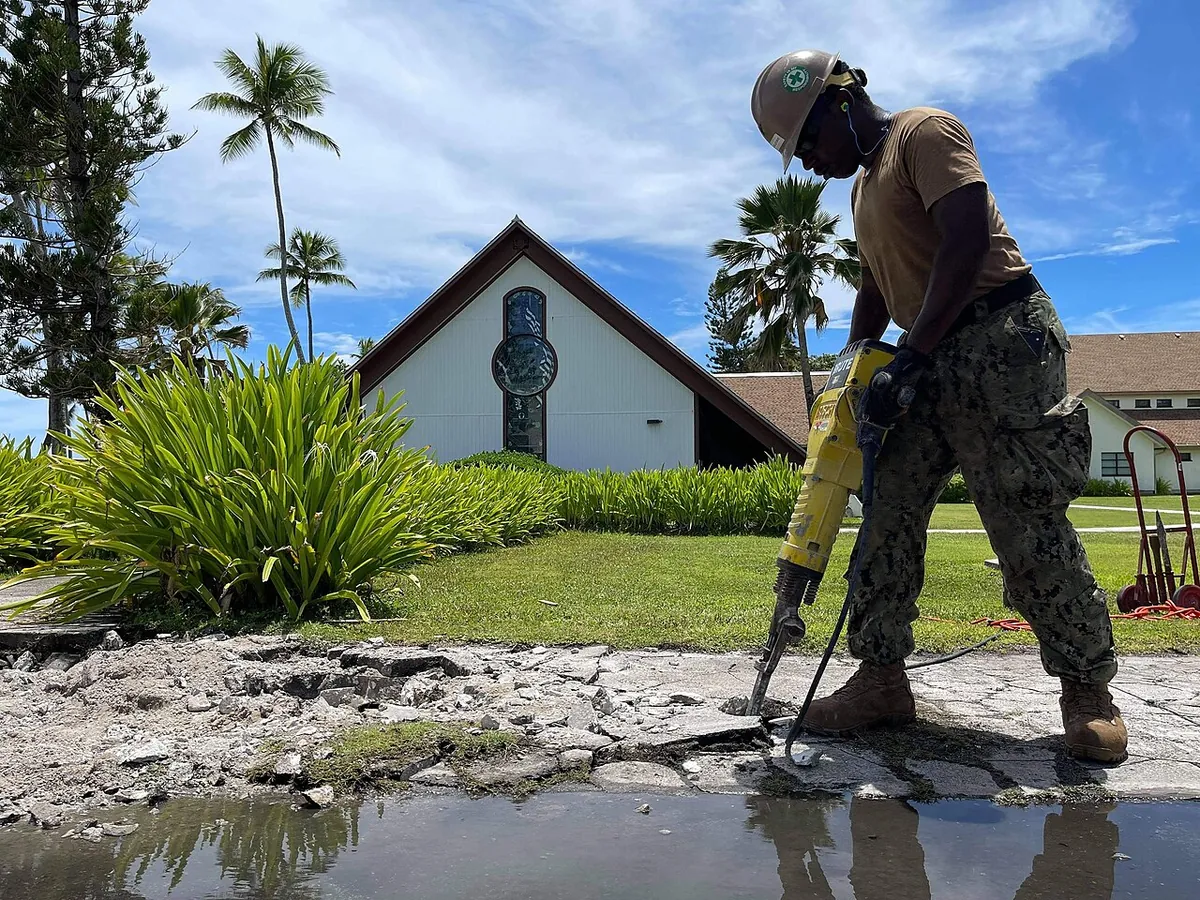
Photo: U.S. Navy / Brandon Blevins, Wikimedia Commons, public domain
Frequently Asked Questions
How much does a concrete sidewalk cost?
About $7 to $17 per square foot installed, or $28 to $68 per linear foot for a 4 foot wide walk, according to HomeGuide.
What is the cost of a concrete walkway 50 feet long?
About $1,400 to $3,400 for a 4 foot wide, 200 square foot walkway.
How much does it cost to replace a sidewalk?
Usually about $8 to $17 per square foot including removal, or roughly $1,600 to $3,400 for a 4 × 50 foot walk.
How thick should a concrete sidewalk be?
A concrete sidewalk should be at least 4 inches thick, and thicker where vehicles cross. Public sidewalks follow city standards.
Is a concrete walkway cheaper than pavers?
Usually. A plain concrete walkway costs less than pavers, which often run about $10 to $30 per square foot installed.
What is the concrete sidewalk cost per linear foot?
About $28 to $68 per linear foot for a 4 foot wide walk, or about $21 to $51 for a 3 foot garden path, based on HomeGuide's $7 to $17 per square foot.
How much does a concrete walkway cost compared with a patio?
A concrete walkway usually costs more per square foot than a patio because it is narrow and needs more forming and edging for the same amount of concrete.
How much does a concrete sidewalk cost for a front walk?
A typical 4 × 30 foot front walk is 120 square feet, so a new concrete sidewalk there usually costs about $840 to $2,040 at $7 to $17 per square foot.
Is a stamped concrete walkway worth it?
It costs more, about $12 to $18 per square foot, and needs resealing, but it gives a decorative look. A stamped border on a plain concrete walkway is a cheaper middle option.
Can I pour a concrete sidewalk myself?
A short, straight concrete sidewalk is a realistic DIY project. Use straight forms, a gravel base, control joints every 4 to 5 feet and a broom finish, and keep the concrete moist while it cures for at least several days after the pour.
Do I need a permit for a sidewalk?
Usually for public sidewalks and work in the right of way, and sometimes for private walkways. Check with your city before you start.
Sources
- HomeGuide, "How much does a concrete sidewalk cost?" homeguide.com
- LawnStarter, "How much does a concrete sidewalk cost?" lawnstarter.com
- HomeAdvisor, "How much does a concrete walkway cost?" homeadvisor.com
- Angi, "Sidewalk repair and replacement cost." angi.com
- Image credits: hero photo by the City of Greenville, NC and placing photo by the U.S. Navy (public domain); finishing photo by MTA Capital Construction (CC BY 2.0), via Wikimedia Commons. Chart by Asphapro.com.
Prices checked November 2026. They are national ranges; local prices can be higher or lower.
Related Guides
- How to get concrete splash off bricks — fresh splatter, lumps and haze
- How to cut concrete — saws, blades and dust safety
- How to build concrete forms — layout, stakes and slope
- Types of concrete finishes — broom, trowel, stamped, polished
- Mortar vs concrete — differences and which to use
- Can you pour concrete in the rain? — risks and how to protect a pour
- Why does concrete crack? — causes, joints and prevention
- Does salt damage concrete? — deicers, scaling and protection
- Can rats chew through concrete? — rodent entry points and termites