
Can You Lay Pavers Over Concrete? Methods, Problems and Step-by-Step
Quick Answer
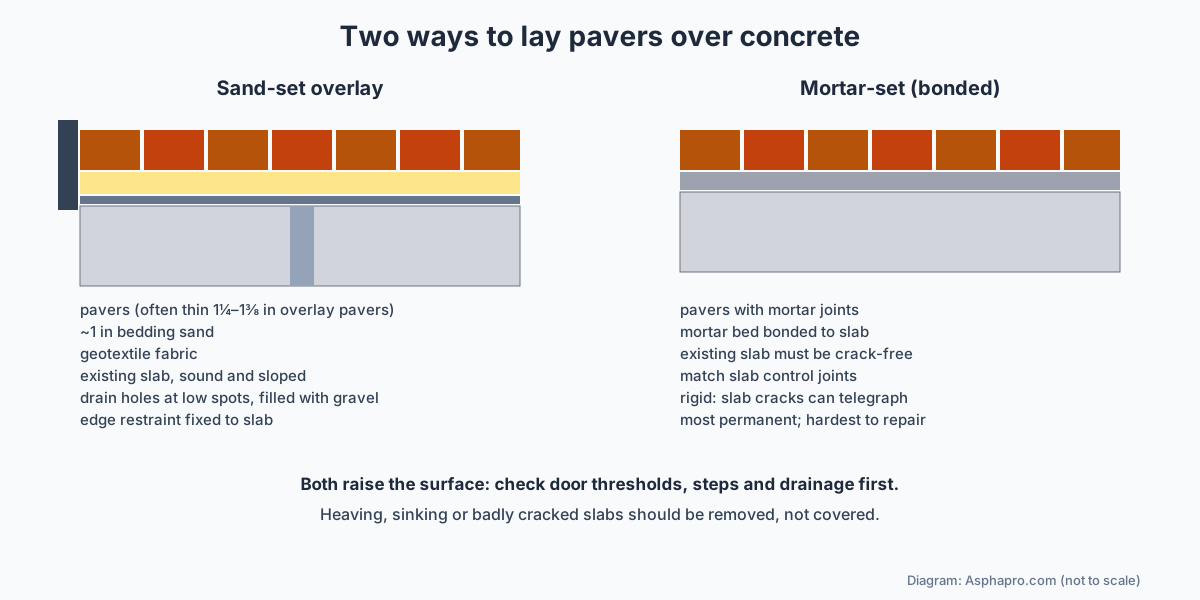
Yes, you can lay pavers over concrete if the slab is solid, stable and drains well. There are two main methods. In a sand-set overlay, you lay about 1 inch of bedding sand over the slab, set the pavers, and add drain holes at low spots so water does not pool under the sand. In a mortar-set (bonded) install, you set the pavers in a mortar bed glued to the slab. Both raise the surface by roughly 2 to 3½ inches, so check door thresholds and steps; thin overlay pavers about 1¼ inches thick help. Do not cover a slab that is heaving, sinking or badly cracked; those problems will show through. Polymeric sand in the joints firms up when wetted but does not harden like concrete.
An old concrete patio, walkway or porch can look tired, stained and cracked, but tearing it out is noisy, dusty and costly. Laying pavers over it can give you a new look without demolition. It is a popular project, and it works well in the right conditions. In the wrong conditions it can lead to wobbly pavers, puddles, heaving, and cracks that reappear in the pavers.
This guide answers "can you lay pavers over concrete?" in detail: when you can put pavers on top of concrete, the problems with pavers over concrete to avoid, how to lay concrete pavers over a slab step by step, and whether polymeric sand hardens like concrete.
When You Can Put Pavers on Top of Concrete
The existing slab becomes the base for your pavers, so it must be a good one. Check these points:
- Stable: no heaving, sinking or rocking sections. Lay a long straightedge across the slab; big humps or dips are a warning.
- Cracks: hairline cracks are usually fine for sand-set pavers. Wide cracks, offset cracks or cracks that are still growing mean the slab is moving.
- Drainage: the slab should slope away from the house. Water should not pond on it.
- Height: there must be room to raise the surface without blocking doors, burying siding, or creating a trip step.
- Edges: the slab edges should be intact so you can attach an edge restraint.
- Use: patios, walkways and porches are common candidates. Driveways need more care because vehicles stress the paver system.
If the slab fails these checks, it is usually better to remove it and build a proper gravel base. See concrete removal cost and paving a patio DIY.
How to Inspect Your Slab Before You Start
Spend an hour checking the slab before you buy materials. It is the best predictor of whether the project will last.
- Walk it after rain: note where water pools and how long it stays. Ponding areas need patching or drain holes.
- Check flatness: drag an 8- or 10-foot straightedge across the slab in several directions. Gaps of more than about ¼ inch should be leveled with patching mortar before a sand-set overlay.
- Inspect cracks: measure width with a coin or card. Hairline cracks are cosmetic. Cracks wider than about ⅛ inch, or with one side higher than the other, suggest movement.
- Tap for hollow spots: drag a chain or tap with a hammer; a hollow sound can mean voids underneath or delaminated surface layers.
- Check edges: broken edges need repair before attaching edge restraints.
- Look at history: if the slab has moved noticeably over the years, especially on expansive clay, expect it to keep moving.
If you find settling or voids, slab leveling may fix the base first; see concrete leveling cost. For cracks, see concrete repair cost.
How Long Does It Take?
For a DIYer, a 200-square-foot sand-set overlay usually takes a long weekend: a day to clean, patch, drill drain holes and set edging, and a day or two to spread sand, lay and cut pavers, compact and fill joints. Polymeric sand needs dry weather before and after activation, so plan around the forecast. Mortar-set installs take longer because mortar must be mixed in small batches and cured. Add time if you need to rent a compactor or saw, and keep a few spare pavers for future repairs.
Two Methods: Sand-Set vs Mortar-Set
How to lay pavers on concrete comes down to one choice: set them on a thin bed of sand, or glue them down with mortar. Each suits a different slab and use.
| Factor | Sand-set overlay | Mortar-set (bonded) |
|---|---|---|
| Bedding | About 1 inch of bedding sand | Mortar bed bonded to the slab |
| Joints | Joint sand or polymeric sand | Mortar |
| Drainage | Needs drain holes in the slab at low spots | Water runs on top; slab slope matters |
| Slab condition | Tolerates hairline cracks | Needs a very sound, crack-free slab |
| Repairs | Easy: lift and reset pavers | Harder: chisel out and re-mortar |
| Freeze-thaw climates | Common and flexible | Risk of cracking and debonding if water gets in |
| DIY friendliness | Good | Moderate; mortar skills needed |
For most homeowners, a sand-set overlay is the more forgiving choice. Mortar-set pavers can look very clean on porches and steps but depend on the slab never moving.
How to Lay Concrete Pavers Over a Slab (Sand-Set)
- Clean the slab: pressure wash or scrub off dirt, moss and oil. Fix loose or broken edges.
- Check slope and fix low spots: fill small dips with patching mortar so water does not pool under the sand.
- Drill drain holes: at low spots and along the downhill edge, drill holes through the slab (about 1 to 2 inches in diameter, every few feet as needed) and fill them with clean gravel so water under the sand can escape.
- Install edge restraints: attach plastic, aluminum or concrete edging to the slab perimeter with masonry screws or construction adhesive. Without edges, sand and pavers creep outward.
- Lay geotextile: a layer of non-woven geotextile fabric over the slab, and especially over drain holes, keeps sand from washing down.
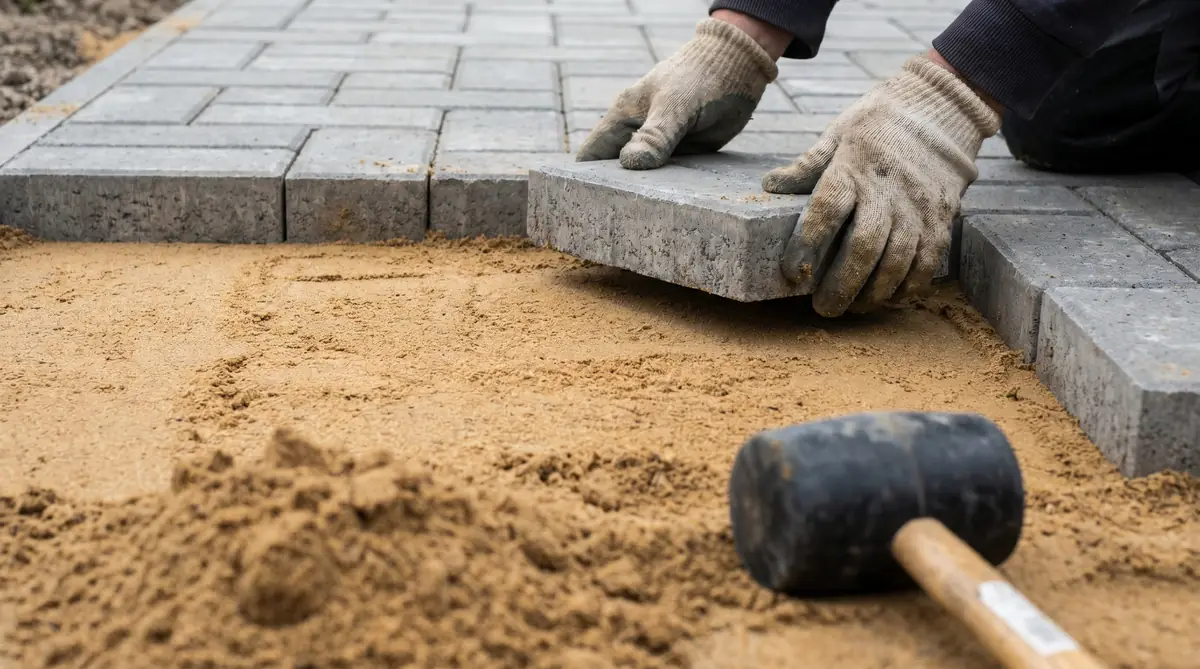
- Spread and screed sand: spread about 1 inch of coarse, washed concrete sand (not stone dust or play sand) and screed it flat with pipes or rails as guides.
- Lay pavers: start at a straight edge or corner, place pavers straight down onto the sand without disturbing it, and keep joints tight and lines straight with string.
- Cut edge pavers: use a wet saw or paver splitter for pieces along the edges.
- Compact: run a plate compactor with a protective pad over the pavers to seat them. Some installers skip or limit compaction over concrete; follow the paver maker's guidance.
- Fill joints: sweep joint sand or polymeric sand into joints, compact again, and top up.
Edge Restraints Over Concrete
Pavers stay tight only when their edges are locked in. On a normal paver base, edge restraints are spiked into the gravel. Over a concrete slab, spikes will not work, so fix edging another way:
- Masonry screws or concrete anchors through plastic or aluminum edging into the slab, close to the edge but far enough in not to break it off.
- Construction adhesive made for masonry, under the edging, for slabs with weak edges.
- A mortared soldier course: set the perimeter row of pavers in mortar on the slab, let it cure, then sand-set the field inside it. This is a strong, clean-looking edge favored by many installers.
- Existing walls or curbs: where the patio meets a house wall or raised planter, that structure can act as the restraint.
Where the overlay is higher than the surrounding ground, backfill soil against the edge and plant or sod it so the edge is supported and does not become a trip hazard. See types of concrete anchors for fastener options.
Mortar-Set Pavers Over Concrete
- Confirm the slab is sound and clean. Grind off sealers and coatings that stop bonding.
- Apply a bonding agent or slurry coat to the slab as the mortar maker directs.
- Spread a mortar bed, typically about ½ to 1 inch, in small areas.
- Back-butter pavers if recommended and press them into the bed, leaving even joints.
- Carry the slab's existing control joints up through the pavers with flexible joints, so slab movement does not crack the new surface.
- Fill joints with mortar once the pavers are set, and tool them.
- Keep the mortar damp while it cures.
Choosing Pavers for an Overlay
- Thin overlay pavers: many makers sell concrete pavers about 1¼ to 1⅜ inches thick made for laying over existing slabs. They keep the height increase small and weigh less.
- Standard concrete pavers: usually about 2⅜ inches (60 mm) thick. They work but add more height.
- Clay brick pavers: classic look; thin brick pavers are available for overlays.
- Natural stone: flagstone, bluestone and travertine can be mortar-set over concrete or sand-set if they are uniform in thickness.
- Porcelain pavers: about ¾ inch (20 mm) thick outdoor porcelain is light and thin, often set on pedestals, sand or mortar depending on the system.
Match the paver to the method. Thin pavers on sand need a very flat slab and good edge restraint. Uneven natural stone is easier to mortar-set because the mortar bed takes up thickness differences.
Dealing With the Height Increase
Height is the number one practical limit when you put pavers on top of concrete. Measure from the slab surface to the bottom of each door threshold. Building guides commonly recommend that an exterior landing be no more than a small step below an exterior door. Water also needs to drain away, not toward the house.
- Use thin pavers to reduce the buildup.
- Mortar-set to save the inch of sand.
- Cut back the slab near the door and set pavers on a gravel base there at the right height.
- Step the edges: where the patio meets the lawn, add soil and sod up to the new edge, or use a border paver set lower.
- Watch siding: keep paving below the weep screed, sill plate and siding by the distance your local code and siding maker require.
Pavers Over Concrete Porches and Steps
Porches and steps are common places to put pavers over concrete because the concrete often looks worn. Mortar-setting is usual here, since sand cannot be confined on vertical faces. Cover treads with pavers and finish risers with thin pavers, stone veneer or a bullnose edge paver. Keep all risers equal in height after adding pavers, because a different top step is a trip hazard. If steps are cracked or crumbling, repair them first; see how to fix concrete steps.
Pavers Over a Concrete Driveway
Laying pavers over a driveway is possible, but vehicle loads make it harder. Turning tires twist pavers and push sand around. Many paver makers recommend mortar-setting or a specially engineered bonded system for overlays on driveways, or removing the slab and building a full paver base with thicker vehicle-rated pavers. A cracked driveway is a poor base, and the work may not be cheaper than a new paver driveway. See concrete driveway cost and driveway cost per square foot.
Pavers Over a Pool Deck
Pool decks are often overlaid with pavers or travertine. Height at the coping is a key detail: the pool coping may need to be replaced or raised to match. Water from splash-out must drain away from the pool and off the deck, and drain holes in a sand-set system should not route water toward the pool shell. Many pool deck overlays use mortar-set travertine or pavers with a bonded system for this reason.
A Worked Example: 12 x 16 Patio Overlay
Say a homeowner has a 12 by 16 foot concrete patio that is stable, with two hairline cracks and some stains. The back door threshold sits 4 inches above the slab.
- They choose thin concrete overlay pavers about 1⅜ inches thick, sand-set.
- Total buildup: about 1 inch of sand plus 1⅜ inches of paver ≈ 2⅜ inches, leaving about 1⅝ inches below the threshold. Acceptable.
- They pressure wash the slab, patch one low spot, and drill four 2-inch drain holes along the low edge, filling them with clean gravel.
- Plastic edge restraint goes around the perimeter, fixed with masonry screws.
- Geotextile fabric covers the slab; 1 inch of washed concrete sand is screeded flat.
- Pavers go down in a herringbone pattern from the house outward; edge pieces are cut on a wet saw.
- They compact with a pad on the plate compactor, sweep in polymeric sand, compact again, sweep the surface clean and mist the joints.
- Soil and sod are raised along the lawn edge to meet the new surface.
About 192 square feet of pavers plus 5 to 10% extra for cuts and waste, depending on the pattern. Herringbone patterns produce more cut waste than running bond.
Overlay vs Remove and Rebuild
Laying pavers over concrete saves the cost of breaking out and hauling away the slab and building a new gravel base. That can be a meaningful saving on a large patio. But if the slab is failing, the overlay inherits its problems, and you may end up paying twice. A good rule: overlay only a slab you would be happy to keep for another 20 years. Otherwise, remove it. Compare with paving stones vs concrete and stamped concrete vs pavers.
Other Ways to Refresh an Old Slab
- Concrete resurfacer or overlay: a thin cement coating that can be smooth, textured or stamped; see concrete overlay cost.
- Staining: acid or water-based stain changes color without adding height; see concrete staining.
- Concrete paint or coatings: see concrete paint.
- Outdoor tile: porcelain tile set in mortar on a sound slab.
- Pour new concrete over old: see can you pour concrete over concrete.
Maintenance
- Sweep regularly and rinse at low pressure; high pressure can blow out joint sand.
- Top up joint sand as it settles, especially in the first year after installation.
- Pull weeds early while they are small; polymeric sand reduces them a lot.
- Reset any paver that sinks or rocks by lifting it, adding sand and tamping it back.
- Keep drain holes clear; if water pools, check whether they are blocked.
- Seal pavers if you want color enhancement and stain resistance, following the maker's advice.
Climate Considerations
In freeze-thaw climates, water trapped under pavers or in mortar beds expands when it freezes. Sand-set overlays with good drainage cope well because they flex. Mortar-set pavers need a sound slab, good slope and quality mortar, and they are more likely to crack or pop loose if water gets underneath. In hot climates, light-colored pavers stay cooler underfoot. Deicing salts can damage some pavers and concrete; use salt sparingly. See does salt damage concrete.
Problems With Pavers Over Concrete
- Trapped water: without drain holes, water sits in the sand on top of the slab, washing sand around, freezing in winter and lifting pavers.
- Reflective cracking: in mortar-set installs, slab cracks and joints often reappear in the paver surface.
- Height problems: raising a patio 2 to 3½ inches can put it too close to door thresholds or siding, or create an awkward step down to the lawn.
- Heaving slabs: if the slab moves with frost or expansive clay, the pavers move with it.
- Edge creep: without edge restraints, pavers spread and joints open.
- Efflorescence: white salt deposits can appear on pavers when water moves through mortar or concrete beneath.
- Mortar debonding: freeze-thaw and poor bonding can loosen mortar-set pavers.
Does Polymeric Sand Harden Like Concrete?
No. Polymeric sand is a fine sand mixed with polymer binders. When you sweep it into joints and mist it with water, the binders activate and the sand firms up as it dries. It resists washout, weeds and ants better than plain sand. But it stays somewhat flexible so pavers can move slightly with temperature and loads. It is nowhere near the strength of concrete or mortar.
- Joints should be fully dry and filled to the right depth before wetting.
- Sweep all polymeric sand off the paver surface before wetting, or it can leave a hard haze.
- Follow the product's water and weather limits; heavy rain soon after can wash it out.
- On sand-set overlays over concrete, make sure drain holes handle water that passes the joints.
Tools and Materials
- Pavers plus 5 to 10% extra for cuts.
- Coarse washed concrete sand for bedding; joint sand or polymeric sand.
- Non-woven geotextile fabric.
- Edge restraint (plastic, aluminum or concrete) with masonry screws or adhesive.
- Hammer drill with a masonry or core bit for drain holes; clean gravel to fill them.
- Screed rails (1-inch pipe) and a straight screed board.
- Wet saw or paver splitter, rubber mallet, string line, level and tape.
- Plate compactor with a urethane pad.
- Push broom, gloves, eye and hearing protection, and a respirator for cutting.
Patterns and Layout
The pattern affects looks, waste and strength. Running bond (like brick in a wall) is simple and wastes little. Basketweave is classic for patios and walks. Herringbone, especially at 45 degrees, interlocks best and handles traffic well, but needs more cuts. Large-format pavers and random multi-size patterns give a modern or stone-like look.
- Start laying from the straightest, most visible edge, usually the house.
- Snap string lines every few feet to keep courses straight.
- Plan so cut pieces are not tiny slivers at edges; shift the layout or use a border course.
- A soldier or sailor course border along the edge looks finished and hides cuts.
Cutting Pavers Safely
Cutting concrete pavers creates silica dust. Use a wet saw, or a cut-off saw with water feed, and wear a respirator, eye and hearing protection. A manual or hydraulic paver splitter makes straight cuts without dust, which is handy for simple straight cuts on small jobs. Mark cuts with a crayon and cut slightly long, then test fit. For more on cutting, see how to cut concrete.
Common Mistakes
- Skipping drain holes on a sand-set overlay.
- Using too much bedding sand; more than about 1 inch tends to shift.
- No edge restraint, so pavers creep out.
- Covering a heaving or sinking slab.
- Ignoring door threshold and siding heights.
- Leaving polymeric sand on the surface before wetting, creating haze.
- Mortar-setting over slab joints without matching movement joints in the pavers.
DIY or Hire a Pro?
A sand-set paver overlay on a small, sound patio is a reasonable weekend or two of DIY for someone comfortable with hard physical work and careful layout. Hire a hardscape contractor for mortar-set installs, steps and porches, pool decks, driveways, complex patterns, or when the slab condition is doubtful. Ask contractors how they handle drainage under the pavers, edge restraints and height at doors, and look at past overlay projects they have done.
Quick Reference
- Can you lay pavers over concrete that is sound and sloped? Yes, sand-set with drain holes or mortar-set.
- Can you put pavers on top of concrete that is heaving? No; remove or repair the slab.
- Problems with pavers over concrete: trapped water, cracks showing through, height, edge creep.
- How to lay concrete pavers over a slab: clean, drain holes, edge restraint, fabric, 1 inch sand, pavers, compact, joint sand.
- Does polymeric sand harden like concrete? No; it firms up but stays flexible.
Frequently Asked Questions
Can you lay pavers over concrete?
Yes, if the slab is stable, drains well and there is room for the height increase. Use a sand-set overlay with drain holes or a mortar-set method.
Can you put pavers on top of concrete without sand?
Yes, by mortar-setting them or gluing thin pavers with an approved adhesive, but the slab must be crack-free and stable.
What are the problems with pavers over concrete?
Trapped water, cracks showing through, height issues, edge creep and movement if the slab heaves.
How much height do pavers over concrete add?
Usually 2 to 3½ inches with a standard paver and 1 inch of sand, less with thin overlay pavers.
Does polymeric sand harden like concrete?
No. It firms up and resists washout but stays flexible and much weaker than concrete.
Can I lay pavers over a cracked concrete patio?
Hairline cracks are fine for sand-set pavers. Wide, uneven or moving cracks mean the slab should be repaired or removed.
Do I need to drill holes in concrete before laying pavers?
For sand-set overlays, yes, at low spots and along the downhill edge, so water under the sand can drain.
What sand do you use for pavers over concrete?
Coarse, washed concrete sand about 1 inch thick for bedding. Avoid stone dust and fine play sand.
Can you glue pavers to concrete?
Some thin pavers can be set with an approved paver adhesive or mortar. The slab must be clean, sound and crack-free.
How long do pavers over concrete last?
On a sound, well-drained slab, they can last decades. On a moving or poorly drained slab, problems appear within a few seasons.
Sources
- Concrete Masonry and Hardscapes Association (formerly ICPI), guidance on interlocking concrete pavement and overlays. masonryandhardscapes.org
- Paver and polymeric sand manufacturer installation guides.
- Image credits: images and diagram by Asphapro.com.
Follow your paver maker's installation guide. Checked November 2026.
Related Guides
- How to make concrete stepping stones — molds, mix and setting a path