
Concrete Parking Blocks: Sizes, Placement, Installation and Cost
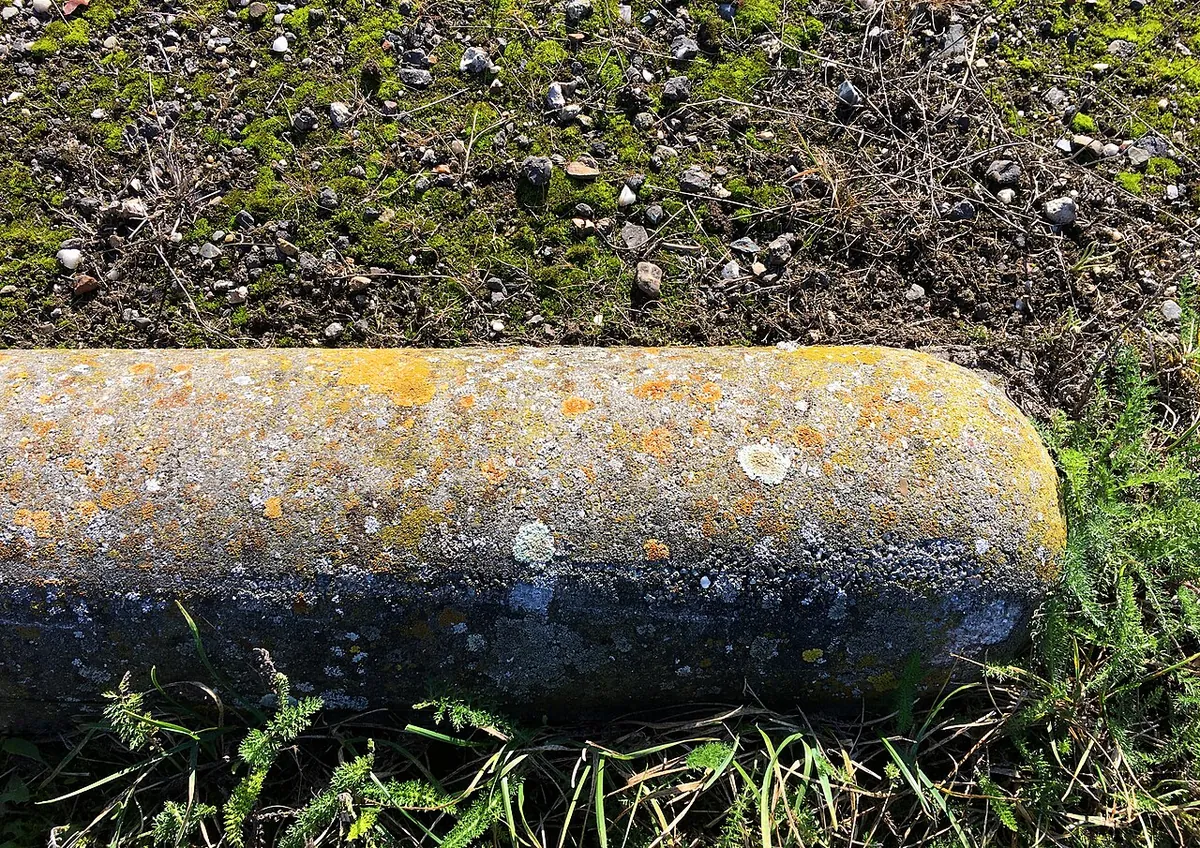
Photo: Industrees, Wikimedia Commons, CC0
Quick Answer
Concrete parking blocks, also called concrete parking stops, wheel stops or concrete parking bumpers, are precast concrete bars placed at the end of parking spaces to stop tires before a car hits a curb, wall, sidewalk, building or landscaping. A typical block is about 6 feet long, 6 to 9 inches wide and 4 to 6 inches high, reinforced with rebar, and weighs roughly 200 to 350 pounds. Blocks are set about 2 to 3 feet from the curb or wall and pinned to the pavement with two rebar pins through pre-cast holes, or glued to concrete. They typically cost about $40 to $120 each for the block, plus delivery and installation. Rubber and plastic wheel stops are lighter alternatives.
Concrete parking blocks are one of the most common sights in parking lots, but they are easy to overlook until a car rolls into a storefront or a bumper hangs over a sidewalk. They protect buildings, walls, landscaping, sidewalks and pedestrians by giving drivers a firm, low barrier to stop against. They also help define parking spaces and keep vehicles aligned. For homeowners, they are useful in garages, carports, driveways and RV pads.
This guide explains what concrete parking stops do, standard sizes and weights, where to place them, how to install a concrete parking block on asphalt or concrete, costs, maintenance, and how they compare with rubber and plastic alternatives.
What Concrete Parking Stops Do
Concrete parking stops create a physical stop for tires. When a driver pulls forward, the front tires bump against the block, signaling that the car is in position and preventing it from rolling farther. This protects the curb and sidewalk from front overhang, keeps bumpers from damaging walls, storefront glass, fences and landscaping, keeps parked cars from blocking walkways, and helps align vehicles within stalls. In parking garages, concrete parking bumpers protect walls, columns and railings. At businesses, they reduce the risk of vehicles striking pedestrians and buildings. They are not crash barriers: they will not stop a car moving at speed, which is the job of bollards and barriers. See concrete barriers.
Concrete Parking Block Sizes and Weight
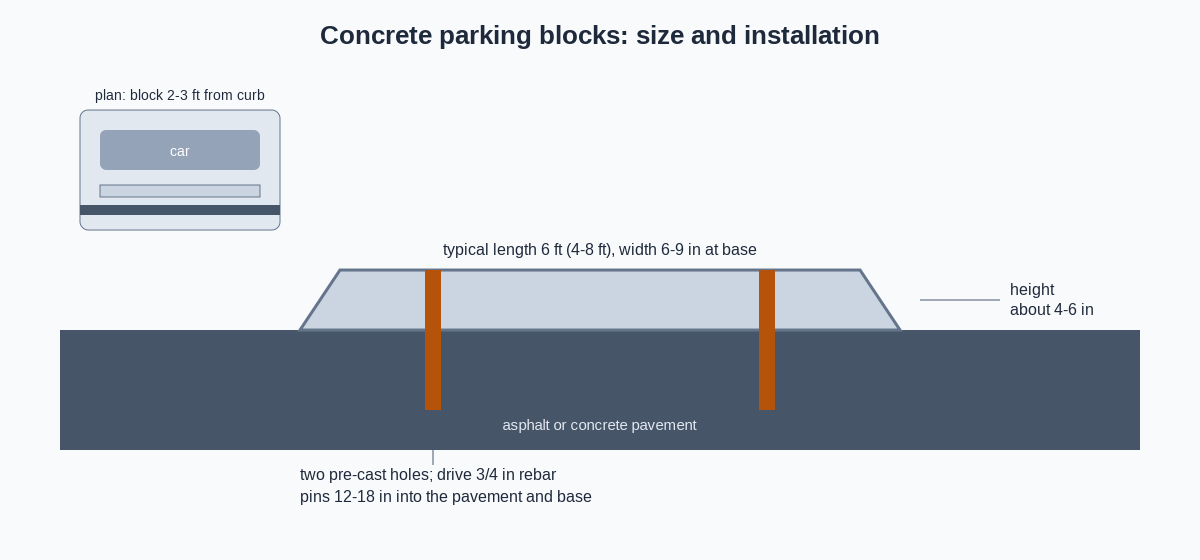
Most concrete parking blocks are precast in a few standard sizes. The most common is about 6 feet long, which spans the width of a typical car's front tires; shorter 4 to 5 foot blocks are used for compact spaces and motorcycles, and 8 foot blocks for trucks and wide stalls. Heights of about 4 to 6 inches stop tires without scraping most bumpers; lower blocks may be used where low cars park. Widths are typically 6 to 9 inches at the base, with a sloped or rounded top so tires roll against them smoothly. Each concrete parking block is usually reinforced with two or more steel bars and has two holes cast through it for anchor pins. A standard 6 foot concrete parking block weighs roughly 200 to 350 pounds, depending on its cross section, which makes it stable but means it needs two or more people or a machine to move. See precast concrete.
Where to Place Concrete Parking Stops
Placement affects how well parking stops protect what is beyond them. The usual guideline is to set the front face of the block about 2 to 3 feet from the curb, wall or object being protected, measured from the face of the block, so the front overhang of most vehicles stays clear. In head-in stalls next to a sidewalk, this keeps bumpers from blocking the walkway; many codes require a clear sidewalk width, and wheel stops are one way to protect it. Center the block across the width of the stall. In angled parking, align it with the stall angle. Leave gaps between blocks in adjacent stalls for drainage and pedestrian movement. Check local codes and accessibility rules: wheel stops must not block accessible routes or access aisles, and some jurisdictions discourage wheel stops where they create tripping hazards in pedestrian paths.
In home garages, a concrete parking stop placed so the car stops with enough room to walk in front and close the garage door prevents bumping the back wall, shelves or water heater. For RV and trailer pads, larger concrete parking curbs keep vehicles from rolling off the pad.
How to Install Concrete Parking Blocks
Installing concrete parking blocks is straightforward with the right tools and help. First, mark the location: measure from the curb or wall and snap a chalk line across the stall for consistent placement. Second, move the block into place using a dolly, pallet jack, forklift or skid steer; avoid dragging it on the pavement, which can chip the block and scar the surface. Third, mark the holes through the pre-cast holes onto the pavement, then move the block slightly aside if needed. Fourth, drill pilot holes for the pins with a hammer drill or rotary hammer, slightly smaller than the pins on asphalt or to the pin diameter on concrete. Fifth, set the block back and drive the pins: use 3/4 inch smooth or deformed rebar pins, typically 12 to 18 inches long, through the block holes and into the pavement and base with a sledgehammer, until the tops are flush with or slightly below the block surface. On concrete pavement, many installers use epoxy adhesive in the holes or adhesive under the block instead of, or in addition to, pins. Sixth, finish: clean up chips, and paint or mark the blocks if required. See how to drill into concrete and types of concrete anchors.
Concrete Parking Curbs on Asphalt vs Concrete
On asphalt, long rebar pins work well because they pass through the asphalt into the base and resist sliding; asphalt is softer, so pins are easy to drive. On concrete pavement, drilling is harder, and pins rely on a tight fit or epoxy; many installers glue concrete parking curbs to concrete slabs with a construction adhesive designed for exterior concrete, and add pins in high-traffic or sloped locations. On gravel lots, longer pins anchor the blocks into the gravel and subgrade. For any surface, pinned or glued blocks stay in place much better than loose ones, which drift when bumped and can become trip hazards.
Concrete Parking Block Cost
A standard 6 foot precast concrete parking block typically costs about $40 to $120 each at precast yards and supply stores, depending on size, region and quantity. Delivery is often a separate charge because of the weight. Installation by a contractor commonly adds about $50 to $150 per block, including drilling, pins and placement, with discounts for larger lots. Painting and striping add more. For a small business lot with 20 spaces, expect roughly $2,000 to $5,000 for concrete parking stops installed, depending on local rates. For homeowners, one or two blocks are a modest DIY project if you have help moving them.
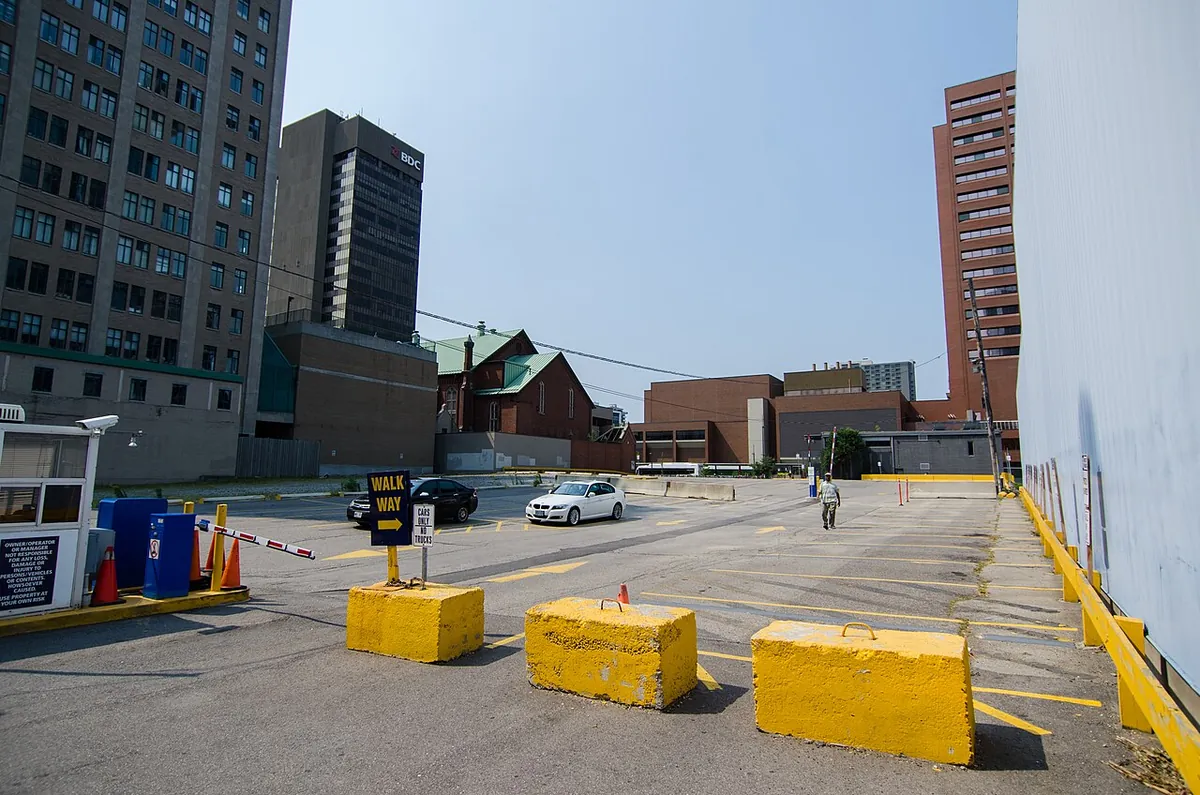
Photo: Jeff Hitchcock, Wikimedia Commons, CC BY 2.0
Painting and Marking Parking Blocks
Painted parking blocks are easier to see, which reduces trips and bumps. Yellow is the most common color for general visibility, like the large yellow concrete blocks pictured above; blue marks accessible stalls, and red or white may be used for fire lanes or reserved spaces depending on local practice. Use exterior traffic or masonry paint, applied to clean, dry concrete, and repaint every year or two as paint wears. Some precast suppliers sell blocks with integral color or reflective strips, which last longer than paint.
Rubber, Plastic and Concrete Parking Bumpers Compared
Wheel stops come in three main materials. A concrete parking bumper is the traditional choice: heavy, durable, inexpensive and resistant to fire and sun, but heavy to handle, prone to chipping and cracking over time, and hard on low bumpers that hit it. Rubber wheel stops, made from recycled tires, are light, flexible, easy to install with lag bolts, and do not chip or crack; they are often yellow-striped for visibility and do less damage to vehicles, but cost more per piece and can be pulled up if poorly anchored. Plastic or polymer stops are light, colorful and resistant to salt and chemicals, but may become brittle in sun and cold. For commercial lots with heavy use and a tight budget, the concrete parking bumper remains the most common choice; for garages and areas where weight and vehicle damage are concerns, rubber is popular.
Parking Stops in Concrete Lots and Garages
In parking garages and lots with concrete pavement, parking stops concrete installers often use adhesive and short dowels, because drilling deep pin holes into reinforced or post-tensioned slabs can damage reinforcement. In elevated or post-tensioned parking decks, drilling should only be done with permission and after scanning, because cutting a tendon is dangerous and expensive. Many garage owners choose rubber or plastic wheel stops glued down for this reason. On slabs on grade, standard pinning works well. See post-tensioned concrete slab and concrete core drilling.
Parking Concrete Block Maintenance
A parking concrete block needs little maintenance, but inspecting it regularly prevents hazards. Look for blocks that have shifted, rotated or come loose, which can become trip hazards; re-set and re-pin them. Replace blocks with broken ends or large chips, because exposed rebar and sharp edges are dangerous. Check that pins are flush and not sticking up. Repaint faded blocks. Clear debris and snow around them, because plows often hit parking concrete blocks and move or break them; some lots remove or mark blocks before winter. In freeze-thaw climates, deicing salts can scale the surface of older blocks, so replacing worn blocks every 10 to 20 years is common.
Parking Block Concrete Quality
Good parking block concrete is dense, air-entrained in cold climates, and reinforced with at least two bars so the block does not break if lifted at the ends or struck. Quality precast suppliers produce blocks with smooth, consistent shapes, chamfered edges that resist chipping, and well-placed holes. When buying, check that the parking block concrete has no large cracks or voids, that the reinforcement is not exposed, and that the holes are clear. Cheap blocks made with weak, poorly cured concrete crumble within a few years, especially where salt and plows are involved.
Concrete Parking Curb Options
A concrete parking curb is a related but larger product: a continuous curb or a longer precast curb section that defines the edge of a lot, a planting island or a sidewalk, rather than a separate block in each stall. Parking curbs concrete contractors install may be cast in place with a curb machine, or set as precast sections on a base. Continuous curbs stop vehicles along the whole edge and direct drainage, while individual wheel stops leave gaps for water and people. In many lots, a combination works best: continuous curbs around islands and walks, with wheel stops in stalls that face buildings. See concrete sidewalk cost and asphalt parking lot cost.
Parking Concrete Blocks for Homes
At home, parking concrete blocks solve several common problems. In garages, a block keeps the car from hitting the back wall, a workbench or the water heater, and helps everyone park in the same spot every time. On driveways, blocks keep cars from rolling onto the lawn or into a fence, especially on slopes. On RV and boat pads, larger blocks or curbs keep heavy vehicles positioned on the pad. For a garage floor, choose a shorter, lighter block or a rubber stop, set it so the car stops with room to walk around it, and glue it down so it does not slide on the smooth floor. Homeowners can often buy single blocks from precast yards or home centers and install them with a helper.
Safety and Accessibility
Wheel stops are useful, but they can also be trip hazards, especially in poorly lit lots and where people walk between cars. To reduce risks, paint blocks a contrasting color, keep them out of marked walkways and accessible routes, align them neatly, and make sure lighting is adequate. Accessible parking spaces and access aisles must stay clear of obstructions, so place wheel stops so they do not narrow the access aisle or block the route to the entrance. Some property owners choose continuous curbs or bollards instead of wheel stops in high pedestrian areas. Always check local codes, which may set requirements for wheel stop placement and marking.
Planning a Parking Lot With Concrete Parking Blocks
When planning a new or resurfaced lot, decide early where concrete parking blocks are needed. Stalls that face buildings, sidewalks, landscape islands, fences and steep edges usually benefit from wheel stops. Stalls that face other stalls in a double row often do not need them, because vehicles can overhang safely into the opposite stall's front space, though some owners add them to keep cars aligned. Coordinate wheel stop locations with striping, accessible spaces, drainage inlets and snow storage areas. Order blocks after paving and striping are complete, and install them once the pavement has cured, so pins do not disturb fresh asphalt or concrete. Keep a few spare blocks for replacements, because blocks get broken by plows and vehicles over time.
DIY Concrete Parking Stops
Some homeowners and farms make their own concrete parking stops by casting concrete in simple wooden forms. A form about 6 feet long, 6 inches high and 8 inches wide at the base, with a slightly narrower top, can be built from lumber. Place two pieces of rebar inside, about 2 inches from the bottom and sides, and set two pieces of PVC pipe vertically through the form to create holes for anchor pins. Fill with a strong concrete mix, consolidate it by tapping the form, finish the top smooth, and cure it covered for a week before moving it. Homemade blocks are heavy, so cast them close to where they will be used or plan how to move them. For most people, buying precast blocks is easier and only slightly more expensive. See how to build concrete forms and how to mix concrete.
Handling Concrete Parking Blocks Safely
Because a concrete parking block weighs several hundred pounds, handling it safely matters. Use mechanical help: a forklift, skid steer with forks, pallet jack, hand truck rated for the weight, or a pair of block tongs. If lifting by hand, use at least two or three people, keep backs straight, lift with legs, and coordinate movements. Wear steel-toe boots and gloves, because dropped blocks crush feet and pinch fingers. Never lift a block by one end only, which strains the reinforcement and can break the block. When driving pins, wear eye protection, because concrete and metal chips fly. See how much a concrete block weighs.
Snow Plowing Around Wheel Stops
Snow plows and concrete parking stops do not mix well. Plows catch blocks hidden under snow, breaking them or ripping them loose, and blocks damage plow blades. In snowy regions, some properties remove wheel stops for the winter, use flexible rubber stops, mark block locations with tall stakes or flags before the first snow, or choose continuous curbs instead of individual blocks. Painting blocks a bright color helps plow drivers see them. Include block locations in the snow removal contract so the plowing contractor knows where they are.
Buying Concrete Parking Blocks
Concrete parking blocks are sold by precast concrete plants, building material suppliers, some home centers, and parking lot maintenance companies. When buying, compare length, height and weight to make sure the blocks suit your vehicles and pavement; check whether pins are included and what length; ask whether the blocks are air-entrained and reinforced; confirm delivery costs and whether the truck has a boom or forklift for unloading; and ask about color options. Buying in quantity usually lowers the price per block. For a few blocks for a home garage or driveway, check local precast yards, which often sell single pieces at fair prices and may load them into a pickup with a forklift.
Many parking lot maintenance and striping contractors supply and install concrete parking stops as part of a package with sealcoating, crack filling and striping, which can be convenient for business owners managing a whole lot. See asphalt parking lot cost.
Concrete Parking Blocks and Drainage
Because concrete parking stops sit on top of the pavement, they can interfere with drainage if placed in water paths. Water flowing across a lot toward a curb inlet can pool behind a line of blocks, creating puddles and ice. To avoid this, leave gaps between blocks, place them away from drainage swales and inlets, and check that the lot slope carries water around them. Some precast blocks have notches on the bottom that let water pass underneath. On sloped lots, position blocks so water drains around their ends rather than collecting at the upslope face.
Concrete Parking Bumper Lifespan
A well-made concrete parking bumper typically lasts 15 to 25 years or more in a normal lot. Blocks in harsh climates with heavy salt use, frequent plowing or heavy truck traffic may need replacement sooner. Chipped ends, exposed rebar, cracks through the block, and loose pins are signs it is time to replace a block. Because individual blocks are inexpensive, replacing damaged ones promptly is better than leaving hazards in place.
Alternatives to Wheel Stops
Concrete parking blocks are not the only way to control where vehicles stop. Continuous concrete curbs along walks and islands stop tires along the whole edge. Bollards, steel or concrete posts set in the ground, protect storefronts, utility equipment and building corners from impact and are stronger than wheel stops. Raised planters and landscape walls double as barriers and greenery. Painted stall lines and signs guide drivers but do not stop them physically. Parking sensors and cameras in modern cars help drivers judge distance, though they do not replace a physical stop. Many properties combine several of these: wheel stops in front of walkways, bollards at building entrances, and curbs around islands.
For homeowners, alternatives in a garage include a hanging tennis ball or laser parking guide, which shows the driver where to stop without anything on the floor to trip over. On driveways, landscape timbers or a low curb can keep cars off the lawn. Still, for durability and low cost, a concrete parking block remains hard to beat, and it works without batteries, adjustment or attention, year after year.
Concrete Parking Blocks for Commercial Properties
For commercial properties, concrete parking blocks are a small item in the budget but a visible part of safety and appearance. Well-aligned, freshly painted concrete parking stops make a lot look cared for, while broken, shifted or missing blocks suggest neglect and create liability risks. Include wheel stops in annual lot inspections along with pavement, striping, lighting and signs. Keep a record of block locations and replacement dates. When a lot is resurfaced, remove the blocks first, then reinstall or replace them afterward with fresh pins, so the new pavement is not damaged by old pin holes. A small investment in good concrete parking blocks and their upkeep protects buildings, landscaping and visitors for many years, and it costs far less than repairing a damaged storefront or a broken curb. Walk the lot each spring and fall, note any concrete parking stop that has moved, cracked or lost its paint, and fix it before it turns into a trip hazard or an insurance claim from a visitor or a customer on your property.
Removing and Replacing Concrete Parking Stops
To remove old concrete parking stops, pull or cut the pins first: pins can often be pried up with a pry bar or pulled with a puller, or cut flush with an angle grinder. Then lift or slide the block away with equipment. Broken blocks can be recycled with other concrete. When replacing, fill old pin holes in asphalt with cold patch or crack filler, or in concrete with patching mortar, so they do not collect water. Install new blocks in the same positions or adjust placement to meet current needs. See crushed concrete.
Frequently Asked Questions
How much does a concrete parking block weigh?
A standard 6 foot block typically weighs about 200 to 350 pounds, depending on its size and shape.
How far should a parking block be from the curb?
About 2 to 3 feet from the curb or wall, measured from the block face, so most vehicles' front overhang stays clear.
How do you anchor concrete parking stops?
Drive 3/4 inch rebar pins through the pre-cast holes into the pavement and base, or use adhesive on concrete slabs.
Are rubber wheel stops better than concrete?
Rubber is lighter, easier to install and gentler on vehicles; concrete is cheaper, heavier and very durable.
Sources
- U.S. Access Board: ADA accessible parking spaces and access aisles
- American Concrete Institute: ACI 330R guide for concrete parking lots
- National Precast Concrete Association: precast site products
- OSHA: safe lifting and material handling
Related Guides
- Concrete barriers — jersey barriers, bollards and interlocking blocks
- Concrete railroad ties — prestressed ties and reuse in landscaping