
Concrete Barriers: Jersey Barriers, Interlocking Blocks, Bollards and Costs
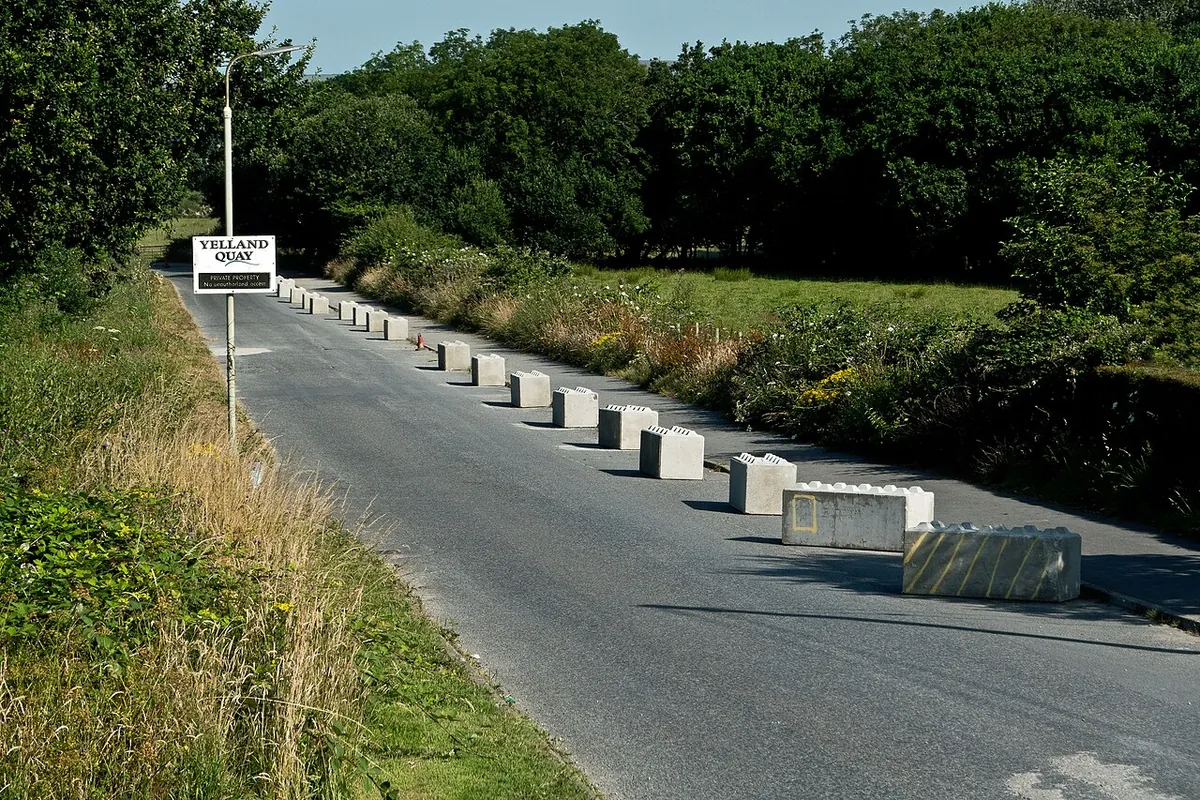
Photo: Roger A Smith, Wikimedia Commons, CC BY-SA 2.0
Quick Answer
Concrete barriers are heavy precast or cast-in-place concrete units used to separate traffic, protect workers, control access and secure perimeters. The main types are concrete jersey barriers (sloped-face highway and work-zone barriers, about 32 to 42 inches tall and 10 to 20 feet long, weighing several thousand pounds), interlocking concrete blocks (large stackable blocks, often about 2 by 2 by 4 to 6 feet, used for walls, bins and road closures), and concrete bollards (posts that stop vehicles while letting people pass). New jersey barriers often cost roughly $300 to $1,500 per section, large concrete blocks about $60 to $300 each, plus delivery and placement with a crane or forklift; renting is common for short-term work zones and events.
Concrete barriers are everywhere once you notice them: along highway medians and construction zones, around parking lots and storage yards, in front of government buildings and stadiums, and blocking off private roads, as in the photo above. Their strength comes from weight and shape. A barrier that weighs several tons is hard to push aside, and a carefully designed profile can redirect a vehicle instead of stopping it abruptly.
This guide explains the main types of concrete barriers, their sizes and weights, where each type is used, how they are moved and placed, costs to buy or rent, and practical tips for using them on job sites, farms, businesses and private property.
Concrete Jersey Barriers
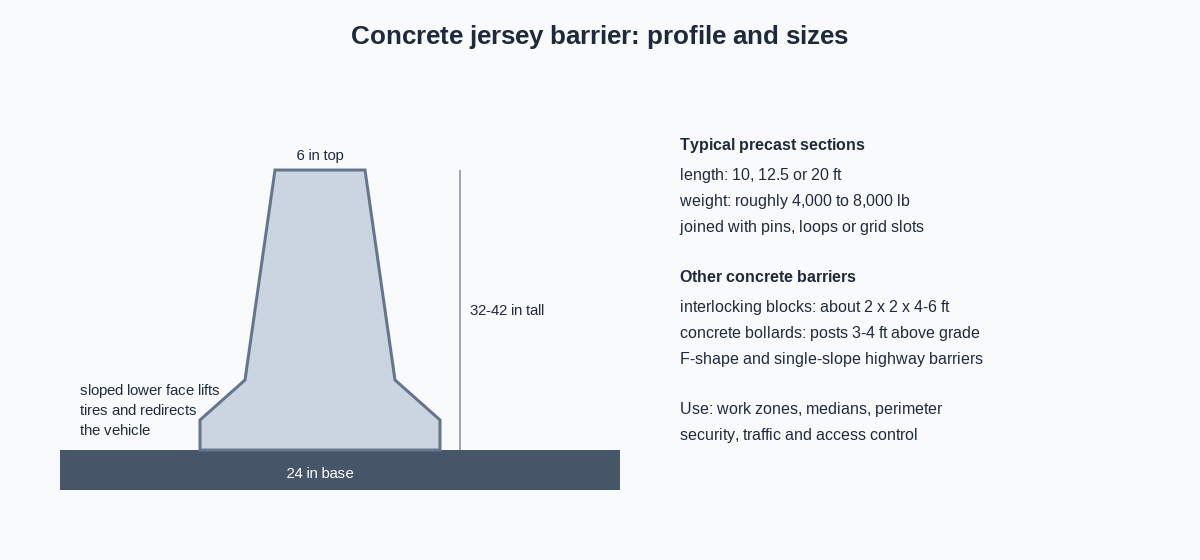
The concrete jersey barrier, named after its development in New Jersey in the 1950s, is the most recognized concrete barrier. It has a wide base, a narrow top and a sloped lower face. When a vehicle hits it at a shallow angle, the tires ride up the lower slope, which lifts the vehicle slightly and redirects it back into its lane instead of letting it go through or stopping it dead. Typical precast concrete jersey barriers are 32 to 42 inches tall, about 24 inches wide at the base and 6 inches at the top, and 10, 12.5 or 20 feet long. A 10 foot section weighs roughly 4,000 pounds, and a 20 foot section around 8,000 pounds. Sections connect end to end with steel pins, loops or grid slots so a run acts as one long barrier.
Related designs include the F-shape barrier, which has a slightly different slope that performs better for some vehicles, and the single-slope barrier, with a constant slope, often cast in place along highway medians. Temporary barriers used in work zones are often called K-rail in some states. Concrete jersey barriers used on public roads must meet crash test standards set by highway agencies.
Concrete Highway Barriers
Concrete highway barriers line medians, bridges, ramps and work zones on major roads. Permanent concrete highway barriers are usually cast in place with slipform machines, continuous along miles of median, with reinforcement and drainage openings. Temporary concrete highway barriers are precast sections set by crane to protect workers and separate traffic during construction, then moved to the next phase. Highway barriers concrete agencies use must be crash-tested and installed with the right connections, anchoring and end treatments, because the end of a barrier run can be a hazard if it is blunt. Crash cushions or sloped end sections protect drivers at the ends. Concrete highway barrier designs also include taller glare screens and noise walls that block headlights and road noise from nearby homes.
Concrete road barriers are also used on smaller roads and private property to close lanes, divide traffic at events, and block access to closed roads or bridges. A concrete road barrier used outside the highway system does not always need crash-test approval, but it should be placed so it is visible, marked with reflectors, and not create a hidden hazard.
Interlocking Concrete Blocks
Interlocking concrete blocks are large precast blocks, often about 2 by 2 feet in cross section and 4 to 6 feet long, with knobs on top and matching recesses on the bottom, like giant building bricks, as in the photo at the top of this page. A single interlocking concrete block weighs roughly 1,500 to 4,000 pounds. Because they stack and lock together without mortar, they are used to build retaining walls, storage bins for gravel, sand, salt and compost, push walls in transfer stations, temporary walls on construction sites, fire breaks, and road closures. Many are made by concrete plants from leftover returned concrete, which keeps costs low. Concrete interlocking blocks can be moved and reused many times, and walls can be extended or rearranged as needs change. See concrete batching plant and concrete block wall cost.
Large Concrete Blocks for Access Control
Large concrete blocks are a simple, low-cost way to stop vehicles from entering an area. Farms, businesses, parks and landowners place a large concrete block or a row of them across access roads, field entrances, vacant lots and trail heads to prevent dumping, trespassing and off-road driving. Retail stores sometimes use them to protect storefronts and outdoor seating. They are not crash-rated like engineered barriers, but their weight stops most casual vehicle access. When using large concrete blocks, leave gaps for pedestrians where appropriate, keep emergency vehicle access in mind, and make the blocks visible with paint or reflectors so drivers do not hit them at night.
Concrete Bollards
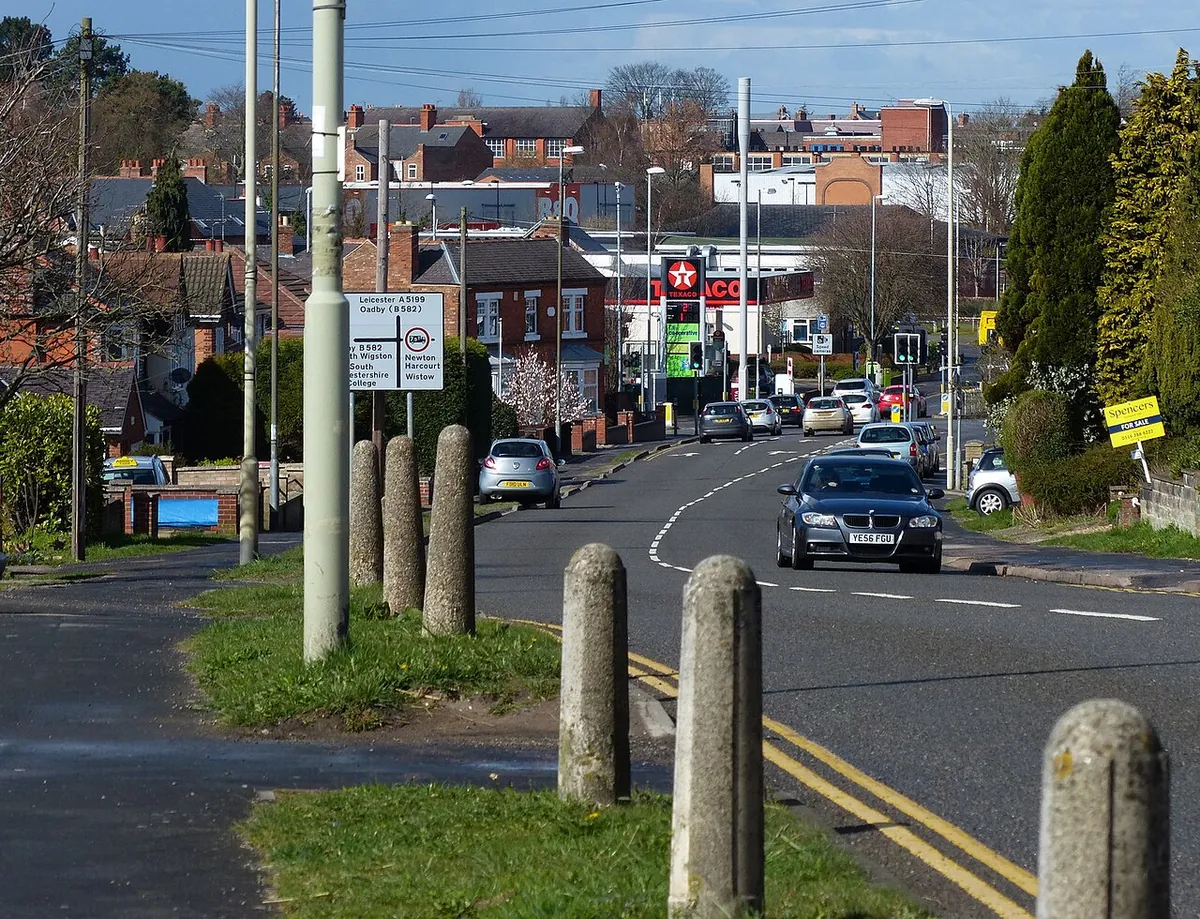
Photo: Mat Fascione, Wikimedia Commons, CC BY-SA 2.0
Concrete bollards are short, sturdy posts set in a row to stop vehicles while letting pedestrians and bicycles pass between them, like the roadside bollards pictured above. A concrete bollard may be solid precast concrete, a steel pipe filled with concrete and set in a concrete footing, or a decorative concrete shape such as a sphere or planter. They protect storefronts, building entrances, sidewalks, utility equipment, gas meters and corners from vehicles. Security-rated bollards are designed and tested to stop vehicles at certain speeds and are anchored in deep reinforced foundations. Decorative concrete bollards provide traffic guidance and visual separation but less impact resistance. Bollards concrete contractors install typically extend 3 to 4 feet above grade, are spaced about 3 to 5 feet apart, and are set several feet deep in concrete footings. See concrete footings.
Concrete Barrier Blocks for Construction Sites
On construction sites, concrete barrier blocks separate work areas from traffic and pedestrians, protect excavations, form temporary walls for material storage, and secure perimeters. Concrete barriers blocks are favored because they do not blow over like plastic barriers, need no ballast, and can be moved by site equipment. Plastic water-filled barriers are lighter and easier to set up for short-term pedestrian control, but concrete barriers provide much more protection from vehicle impacts. Many contractors rent concrete jersey barriers for the duration of a project rather than buying them. See concrete pump truck cost for planning site access around heavy equipment.
Concrete Barrier Costs
Costs vary with size, type, quantity, region and delivery distance. As a rough guide, new precast concrete jersey barriers often cost about $300 to $1,500 per section, depending on length and specification; crash-tested highway barriers cost more. Interlocking concrete blocks typically cost about $60 to $300 each, with blocks made from returned concrete at the lower end. Precast concrete bollards range from about $200 to over $1,000 each installed, and security-rated bollards cost several thousand dollars each with foundations. Delivery is often the largest added cost, because a flatbed truck carries only a few barriers, and placement requires a crane truck, forklift or excavator. Rentals for work zones and events are commonly priced per section per day, week or month, plus delivery and pickup.
Moving and Placing Concrete Barriers
Concrete barriers are heavy, so placing them takes planning. Jersey barriers have lifting slots, loops or holes for chains and hooks, and are set with a boom truck, crane, telehandler or large forklift. Interlocking blocks have lifting loops or are lifted with special block clamps. Check the ground: barriers should sit on firm, level surfaces, because soft ground lets them settle or tip. Plan the layout before delivery so the truck can unload each barrier close to its final position. Connect jersey barrier sections according to the manufacturer's design, because unconnected sections can be pushed apart in an impact. Only trained operators and riggers should lift and place barriers, and no one should stand under or near a suspended load. See how much a concrete block weighs.
Buying vs Renting Jersey Barriers
Renting makes sense for short projects such as road work, events, festivals, temporary detours and construction phases lasting weeks or a few months, because rental companies handle delivery, placement and pickup. Buying makes sense for long-term or permanent uses, such as perimeter security, farm and yard bins, permanent road closures, and repeated projects where a contractor reuses barriers. Used jersey barriers concrete suppliers sell are a good value for non-highway uses like site perimeters and storage, as long as they are not badly chipped or cracked. For highway work zones, agencies often require barriers that meet current crash-test standards, which may rule out older used units.
Choosing the Right Concrete Barrier
Match the barrier concrete type to the job. To redirect vehicles along a road or work zone, use crash-tested concrete jersey barriers or F-shape barriers, connected and with proper end treatments. To block vehicle access while allowing pedestrians, use concrete bollards spaced 3 to 5 feet apart. To close a road or field entrance cheaply, use large concrete blocks or interlocking concrete blocks with reflectors. To build bins, retaining walls or push walls, use interlocking concrete blocks stacked in staggered courses. For storefront and building protection, use bollards or engineered planters; security-rated products are needed where vehicle attacks are a concern. For temporary pedestrian guidance, plastic barriers may be enough, with concrete where vehicles pass nearby.
Interlocking Concrete Block Walls and Bins
An interlocking concrete block wall can be built in a day with an excavator or loader and a crew of two or three. Prepare a level, compacted gravel base slightly wider than the blocks. Set the first course carefully level and in line, because every course above follows it. Stack additional courses with joints staggered, like brickwork, letting the knobs lock into the recesses. For retaining walls, lean the wall back slightly into the slope, include drainage gravel and a drain pipe behind it, and have an engineer design walls taller than about 4 feet or walls that carry loads like driveways. For storage bins, build three-sided bays with the open side facing the loader, sized to the bucket width. Interlocking concrete block walls can be dismantled and rebuilt elsewhere, which makes them popular on farms, quarries and recycling yards. See concrete aggregate and crushed concrete.
Concrete Barriers for Security
For security, concrete barriers protect buildings, crowds and critical infrastructure from vehicles. Simple solutions include rows of large concrete blocks, planters and bollards around plazas and entrances. Engineered security barriers are tested to stop specific vehicle weights at specific speeds, and they must be installed with deep foundations or connected systems; ordinary concrete jersey barriers that are not anchored can be pushed aside by a heavy truck. Event organizers often place temporary concrete barriers at the ends of closed streets to protect pedestrians. Security barrier design should involve security professionals and engineers, and placement must keep emergency access possible.
Concrete Barriers on Farms and Rural Properties
Farms and rural landowners use concrete barriers in many ways. Interlocking concrete blocks make durable bunker walls for silage, bins for gravel, sand and manure, and walls for equipment storage. A large concrete block or jersey barrier at a field or trail entrance stops illegal dumping and off-road vehicles. Barriers protect fuel tanks and utility equipment from accidental impact. Used jersey barriers and returned-concrete blocks from local plants are often inexpensive and practical for these jobs. Make sure barriers on roads and gateways are visible at night and do not block emergency vehicles or farm machinery that needs access.
Painting and Marking Concrete Barriers
Visibility matters. Concrete barriers in roads and parking areas should be marked with reflective tape, delineators or reflectors, especially at the ends of runs, so drivers see them at night and in rain. Work zone barriers often carry warning lights or reflective panels as required by traffic control standards. Barriers on private property can be painted yellow or striped for visibility. Some communities turn concrete jersey barriers into public art with murals, which also discourages graffiti. Use exterior masonry or traffic paint on clean, dry concrete.
Maintenance and Reuse
Concrete barriers are durable but not indestructible. Inspect them for cracks, broken ends, exposed reinforcement and damaged connection hardware, especially after impacts. Damaged highway barriers should be replaced, because they may not perform as designed. Chipped blocks and bollards can be patched with repair mortar if they are structurally sound. Because barriers and blocks are reusable, contractors and owners often keep an inventory and move them from project to project. At the end of their life, concrete barriers can be crushed and recycled as aggregate. See concrete patching compound.
How Concrete Barriers Are Made
Most concrete barriers are precast in plants using steel forms. Concrete jersey barriers are cast with reinforcing steel, lifting inserts and connection hardware placed in the form, then filled with a strong, air-entrained mix, consolidated with vibrators and cured before shipping. Some plants cast barriers upside down or on their sides for a smooth finish. Interlocking concrete blocks are often cast from concrete left over in returning ready-mix trucks: rather than wash it out, the plant pours it into block molds, which turns waste into a useful product and explains why these blocks are inexpensive and sometimes vary in color. Permanent highway median barriers are usually slipformed in place by a machine that extrudes continuous barrier along a guide wire. Concrete bollards are cast in molds or made by filling steel pipes with concrete. See precast concrete and concrete washout.
Planning a Barrier Layout
Before ordering barriers, plan the layout on paper. Measure the length to be protected and divide by the barrier length to estimate how many sections you need, adding extra for corners, gaps and end treatments. Mark where pedestrian or emergency access openings must stay clear. For road closures, check sight lines so drivers see the barriers in time, and add warning signs as required. For work zones, follow the traffic control plan, which specifies barrier type, offsets from traffic, end treatments and lighting. For walls and bins, plan heights and the number of courses, and make sure the ground can support the load. Share the layout with the supplier so the truck delivers barriers in the right order and can place each one with minimal moves.
Delivery and Site Access
Delivery affects both cost and feasibility. Flatbed trucks with cranes can carry a few jersey barriers or several interlocking blocks per trip and set them within reach of the boom. Check that the truck can reach the placement area: soft lawns, steep driveways, low overhead wires, narrow gates and weight limits on private roads can all prevent delivery. On tight sites, barriers may need to be dropped at an accessible spot and moved with a loader or telehandler. Ask the supplier about minimum delivery charges and whether placement is included. For large projects, schedule deliveries in phases so barriers do not block other work.
Concrete Barriers and the Law
Placing barriers on or near public roads usually requires permission. Barriers in the public right of way need approval from the road authority and must meet traffic control standards. Blocking a private road or easement may affect neighbors' or utility companies' legal access, so check deeds and easements first. Barriers that block fire lanes or emergency access can violate fire codes. Liability matters too: an unmarked barrier that causes an accident can create legal exposure, so always make barriers visible and place them sensibly. When in doubt, ask the local road or building department before placing concrete barriers in any area vehicles may use.
Concrete Barriers for Events and Public Spaces
Cities and event organizers increasingly use concrete barriers to protect crowds at markets, parades, concerts and sports events. Rows of jersey barriers or large concrete blocks close streets to vehicles while staff manage pedestrian entry through gaps. Planters, benches and bollards made of concrete provide permanent protection in plazas and pedestrian streets while looking more welcoming than bare barriers. For temporary events, barriers are delivered before the event, placed overnight, and removed afterward. Planning must balance security, crowd flow, accessibility for people with disabilities, and emergency vehicle access, usually with removable sections or gates at key points.
Concrete Barriers for Homeowners
Homeowners do not usually need highway barriers, but a few concrete barrier products are useful around a house. A pair of concrete bollards can protect a garage corner, gas meter or air conditioner from being hit by cars. A few large concrete blocks at the end of a long driveway or rural lane stop vehicles from cutting across a lawn or field. Interlocking blocks make sturdy compost or firewood bins, raised bed walls, or a retaining wall on acreage where heavy equipment is available. For most homes, a short row of precast bollards or a low concrete curb gives protection without looking industrial. Consider appearance, local rules and neighbors before placing large barriers in front yards.
Environmental Benefits of Reusable Barriers
Concrete barriers have a long service life and can be reused many times, which reduces waste compared with single-use alternatives. Interlocking blocks made from returned concrete keep material out of landfills and reduce the need for new aggregate. At the end of their life, barriers are crushed into recycled aggregate for road base and fill. When buying, ask suppliers about recycled content and whether they buy back used barriers, which some do for refurbishment or crushing.
Questions to Ask a Barrier Supplier
Before ordering, ask the supplier which barrier types and lengths they stock, the weight of each unit, whether the barriers are new or used and their condition, whether they meet highway crash-test standards if you need that, what connection hardware is included, how delivery and placement are priced, what equipment the truck has for unloading, how far the boom can reach, the rental terms and damage charges if you are renting, and whether they buy back or remove barriers at the end. Getting these answers in writing avoids surprises on delivery day, such as a truck that cannot reach your site or barriers that do not connect to each other.
Concrete barriers are simple products, but choosing the right type, planning the layout, and arranging safe delivery and placement make the difference between a barrier that protects people and property for years and one that becomes a hazard itself. Start with the purpose, match the barrier to it, and work with an experienced supplier for the heavy lifting. A well-planned row of concrete barriers quietly protects workers, drivers, pedestrians and buildings every day, needs almost no maintenance, and can be moved and reused for the next project when the current one is finished. Few site products give so much protection for so little ongoing cost, which is why concrete barriers appear on highways, farms, construction sites and city streets alike, all over the world.
Concrete Barriers vs Steel Guardrails
On roads, concrete barriers and steel guardrails do similar jobs in different ways. Steel guardrails flex on impact, absorbing energy and catching the vehicle, which can be gentler for occupants but leaves the rail damaged and needing repair. Concrete highway barriers barely deflect, redirecting vehicles with their shape; they need little repair after most impacts and take less space, which is why they are common in narrow medians and work zones. Engineers choose between them based on traffic speed and volume, available space, what is behind the barrier, and maintenance budgets. Cable barriers are another option in wide medians.
Frequently Asked Questions
How much does a concrete jersey barrier weigh?
A 10 foot section weighs roughly 4,000 pounds, and a 20 foot section about 8,000 pounds, depending on height and profile.
How much do concrete barriers cost?
Often about $300 to $1,500 per jersey barrier section, $60 to $300 per interlocking block, and more for security bollards, plus delivery and placement.
What are interlocking concrete blocks used for?
Retaining walls, storage bins, push walls, temporary walls, road closures and perimeter barriers.
Can I rent concrete barriers?
Yes. Many suppliers rent jersey barriers and blocks for work zones and events, including delivery, placement and pickup.
Sources
- Federal Highway Administration: roadside safety hardware and barriers
- FHWA MUTCD: temporary traffic control and channelizing devices
- National Precast Concrete Association: precast barriers and blocks
- OSHA: work zone safety and rigging
Related Guides
- Concrete parking blocks — wheel stops: sizes and installation
- Concrete storm shelters — storm cellars and tornado shelters
- Concrete masonry unit (CMU) — dimensions, sizes and block walls
- Concrete culvert — concrete pipe and box culverts
- Concrete retaining walls — poured, precast and bag walls
- Concrete burial vault — vaults, grave liners and cost
- Concrete fence — panel, poured and block fences
- Concrete railroad ties — prestressed ties and reuse in landscaping