
How Long Do Pool Liners Last? Lifespan, Warning Signs and Care Tips
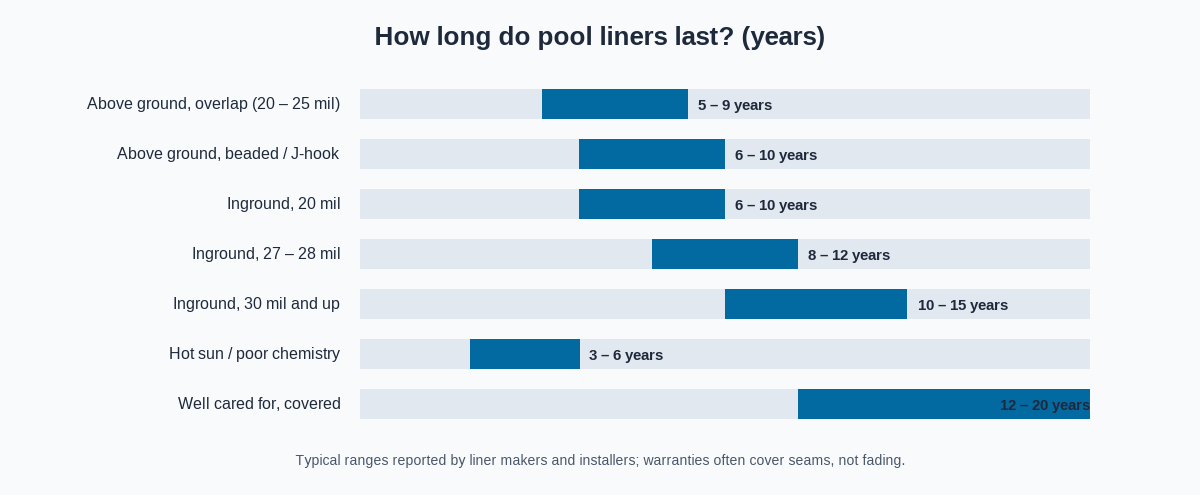
Chart: Asphapro.com
Quick Answer
Most pool liners last 5 to 12 years. Above ground pool liners usually last 5 to 9 years, and inground vinyl liners usually last 8 to 12 years, with thicker liners and well-cared-for pools reaching 15 years or more. The biggest factors are water chemistry (low pH and high chlorine wear vinyl fast), sun exposure, liner thickness, the quality of the install and base, and how well you avoid tears and low water levels. Replace a liner when it is brittle, badly faded, pulling from the track, or leaking in several places.
A vinyl liner is the waterproof skin of an above ground pool and of many inground pools. It holds the water, gives the pool its color and pattern, and protects the walls and floor beneath. Like any material exposed to sun, chemicals and constant water, vinyl wears out over time. Knowing how long do pool liners last helps you plan for replacement, spot problems early and take the steps that add years to your liner.
This guide explains how long does a pool liner last for different pool types and thicknesses, what shortens liner life, the warning signs, and how to make your liner last longer. For replacement prices, see our guide on pool liner replacement cost.
How Long Do Pool Liners Last by Pool Type?
Above Ground Pool Liners: 5 to 9 Years
Above ground pool liners usually last 5 to 9 years. Overlap liners, which hang over the top of the wall and are held by coping strips, are often thinner (20 to 25 gauge) and tend toward the lower end of that range. Beaded and J-hook liners, which snap into a track or hook over the wall, often use slightly better vinyl and can last 6 to 10 years. Above ground pool liners face more sun on the water line and more temperature swings, and they are often not protected by a deck, which shortens their life.
Inground Vinyl Liners: 8 to 12 Years
Inground pool liners usually last 8 to 12 years. Thicker liners, such as 27, 28 or 30 mil, generally last longer than 20 mil liners, as long as they are installed well and the water is kept in balance. Many owners with good water care and an automatic cover get 12 to 15 years or more. In hot, sunny climates with heavy use and poor chemistry, a liner may last only 5 or 6 years.
Thickness: Mil vs Gauge
Liner thickness is given in mil or gauge. A mil is one thousandth of an inch, and it is a true measure of thickness. Gauge is a less exact industry term; a "20 gauge" liner is often thinner than a 20 mil liner. Thicker liners resist punctures and stretching better, but thickness is not everything. The quality of the vinyl, the UV and chemical inhibitors added to it, and the print quality all affect how long should a pool liner last. A well-made 20 mil liner in a well-kept pool can outlast a cheap thick liner in a poorly kept one.
What Shortens Pool Liner Life?
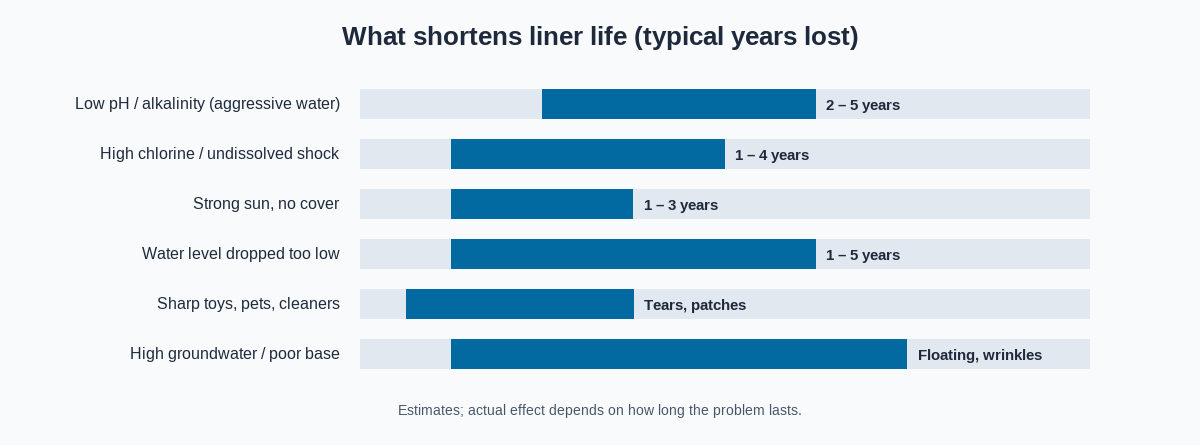
Chart: Asphapro.com
Low pH and alkalinity. Water with low pH, low alkalinity or low calcium is aggressive. It makes vinyl absorb water, swell and wrinkle, and it speeds up loss of plasticizers that keep vinyl soft. Keeping pH at 7.4 to 7.6 and alkalinity at 80 to 120 ppm protects the liner.
High chlorine and undissolved shock. Very high chlorine bleaches the pattern. Granular shock or tablets that sit on the floor can bleach white spots and weaken the vinyl. Always pre-dissolve granular chlorine and never drop tablets directly into a vinyl pool.
Sunlight. UV rays fade the pattern and dry out the vinyl above the water line, making it brittle. Liners in full sun all day wear faster.
Low water level. If the water drops too low for long, the exposed liner dries out and shrinks, and it can pull out of the track. In cold weather, an exposed liner can crack.
Sharp objects and pets. Toys, pool cleaners with worn parts, sticks and dog claws can puncture or tear the liner.
Poor installation or base. A liner that is the wrong size, stretched too much during install, or set over a rough or uneven base will wear faster. Groundwater under an inground pool can push the liner up when the water level is lowered, causing floating and wrinkles.
Draining the pool. Fully draining a vinyl pool lets the liner shrink and dry out, often ruining it. Never fully drain a vinyl liner pool without a plan to replace the liner.
How Long Should a Pool Liner Last Before Replacing? Warning Signs
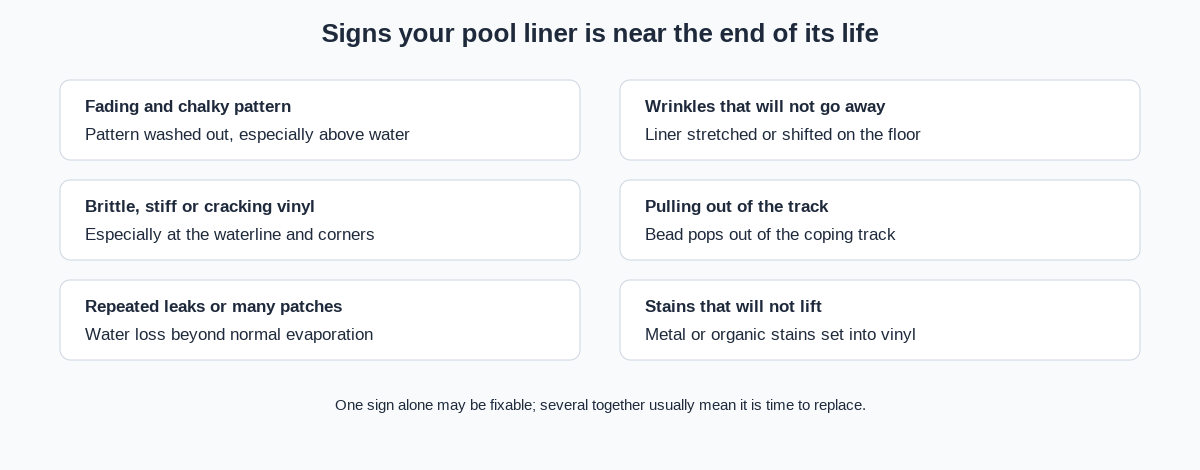
Diagram: Asphapro.com
Watch for these signs that your liner is near the end of its life: a pattern that is badly faded or chalky; wrinkles that will not smooth out; stiff, brittle vinyl that cracks when touched, especially at the water line; the liner bead pulling out of the track; repeated leaks or many patches; stains that will not lift; and visible stretching at steps and corners. One problem alone, such as a small tear, can usually be patched. When several appear together, replacement is usually the best value.
How to Make a Pool Liner Last Longer Than Average
Keep water balanced. Test at least weekly. Keep pH at 7.4 to 7.6, alkalinity at 80 to 120 ppm, calcium hardness at 150 to 250 ppm, and free chlorine matched to your stabilizer level without going extremely high. See how to raise alkalinity in pool water.
Dissolve chemicals first. Pre-dissolve granular chlorine and other chemicals in a bucket of pool water before adding them. Use floaters or feeders for tablets.
Use a cover. A solar, mesh or automatic cover blocks UV and keeps debris out.
Keep the water level steady. Keep it at the middle of the skimmer, and never let it fall below the bottom of the skimmer for long.
Use soft-bristled brushes and liner-safe cleaners. Avoid stiff brushes and cleaners with worn wheels or exposed metal.
Watch toys and pets. Keep sharp toys, sticks and pet claws away from the liner.
Close and open the pool properly. Keep the water at the right level in winter and use a well-fitted cover. See how to winterize a pool.
Fix leaks quickly. Small tears can be patched underwater with vinyl patch kits. See how to find a leak in a pool.
Photo: Greg, Wikimedia Commons, CC BY-SA 2.0
Pool Liner Warranties vs How Long Pool Liners Last
Many liners come with warranties of 20 to 30 years or even "lifetime," but these usually cover seams only, not fading, wrinkles, stains, punctures or chemical damage. Prorated warranties pay less as the liner ages. Read the terms carefully, keep your receipt and installation records, and remember that a long warranty does not mean the liner will last that long.
Pool Liner Replacement Cost
Replacing an above ground pool liner costs about $300 to $1,000 for the liner and $500 to $2,000 installed, depending on size and type. Replacing an inground liner costs about $4,000 to $8,000 installed for most pools, and more for large pools, steps, thick liners and custom patterns. The cost of water to refill the pool is extra. See cost of pool liner installation and how to install above ground pool liner.
How Long Does a Pool Liner Last in Different Climates?
Climate has a big effect on how long does a pool liner last. In hot, sunny regions such as Arizona, Texas and Florida, liners face strong UV most of the year, warm water that speeds chemical reactions, and long swim seasons with heavy chlorine use. Liners in these areas often sit at the low end of the normal range, around 6 to 9 years for inground pools and 4 to 7 years for above ground pools, unless they are protected by covers and careful chemistry. In cooler northern climates with shorter swim seasons, liners spend much of the year under a winter cover, out of the sun, in cold water. Many northern owners find their liners last 10 to 15 years, though freeze damage and ice can cause problems if the pool is not closed properly.
Mild coastal climates fall in between. Salt air does not harm vinyl directly, but it can corrode steel walls and coping behind the liner. Wherever you live, the answer to how long do pool liners last in your area depends partly on how many months a year the liner is exposed to sun and warm, chlorinated water.
How Long Should a Pool Liner Last in a Salt Water Pool?
Owners often ask how long should a pool liner last if they switch to salt. Salt itself does not harm vinyl. In fact, salt systems tend to keep chlorine steadier, avoiding the high spikes from heavy shocking that can bleach liners. Many salt pool owners report liners lasting as long as or longer than in chlorine pools. The main risks with salt are high pH, since salt pools tend to drift up in pH, and running the cell at a high output that keeps chlorine too high for long periods. Keep pH at 7.4 to 7.6 and free chlorine at your target, and a liner in a salt pool should last as long as any other. Check that the pool's metal parts, such as steel walls on some above ground pools, are rated for salt. See how to maintain a saltwater pool.
How Long Do Pool Liners Last With Heavy Use?
Heavy use shortens liner life in several ways. More swimmers mean more sunscreen, oils and sweat, which use up chlorine and lead to more shocking. Kids jumping, games and pool toys put more stress on the liner, especially on steps and the floor. Pets in the pool scratch the vinyl. Pool parties often mean more chemicals added in a hurry. If your pool sees daily use by a busy family, expect your liner to sit toward the lower end of how long do pool liners last for your pool type. To offset this, keep up with water testing, use soft pool toys, train pets to use the steps, and add a protective step pad on vinyl steps where people stand most.
Patching vs Replacing a Liner
Small tears and holes are common and do not mean the liner is finished. Vinyl patch kits work underwater and cost a few dollars, and a well-placed patch can last for years. Professional underwater repair costs $100 to $300 per visit. Patching makes sense when the liner is otherwise soft, the pattern is in good shape, and the damage is limited to a few spots. Replacing makes sense when the vinyl is brittle, when tears keep appearing in new places, when the liner has pulled out of the track in several spots, or when the cost of repeated repairs and lost water approaches the cost of a new liner. If your liner is near the end of how long should a pool liner last for its type and you are paying for frequent repairs, it is often wiser to replace it on your own schedule rather than wait for a major failure.
How Long Does a Pool Liner Last Compared With Other Surfaces?
When planning a pool, it helps to compare how long does a pool liner last with other surfaces. A vinyl liner usually lasts 8 to 12 years in an inground pool and costs $4,000 to $8,000 to replace. A plaster finish in a concrete pool lasts about 7 to 12 years and costs $6,000 to $12,000 to resurface. Pebble and quartz finishes last 15 to 25 years and cost more to redo. A fiberglass gelcoat can last 15 to 25 years before it needs refinishing, though fiberglass shells rarely need full replacement. Over 30 years, a vinyl pool may need two or three liners, while a concrete pool may need two or three resurfacings. The total cost of upkeep is often similar, but liners are cheaper to replace each time and let you change the pattern. See fiberglass vs vinyl pool.
Buying a Home With a Vinyl Liner Pool
If you are buying a home with a vinyl pool, ask the seller when the liner was installed and request receipts. Knowing how long do pool liners last helps you judge how much life is left. A liner over 8 years old in an inground pool may need replacing soon, which can be a negotiating point. During a home inspection, look for faded patterns, wrinkles, brittleness, bead pulling from the track, stains and patches, and ask about water loss. A pool inspector can check for leaks and assess the liner's condition for $150 to $400. Budget for a new liner within a few years if the current one is near the end of its expected life.
Choosing a New Liner That Lasts
When it is time for a new liner, a few choices make a big difference to how long it will last. Choose a reputable brand and installer, and ask what vinyl and UV inhibitors the liner uses. Consider a thicker liner, especially for pools with heavy use, pets or steps. Choose a pattern with some color variation, which hides fading and minor stains better than a solid color. Make sure the installer measures carefully and inspects the walls, floor and track before installing. Ask for the walls and floor to be repaired, smoothed and cleaned, and for a foam wall lining if the walls are rough. A liner set on a smooth, well-prepared base with the right fit will last far longer than one stretched over a rough surface.
Seasonal Liner Care Calendar
Spring opening. Remove the cover carefully to avoid dumping debris on the liner. Inspect the liner for tears, wrinkles and track problems. Balance the water before shocking, and pre-dissolve any granular shock. See how to open a pool after winter.
Summer. Test water two or three times a week. Keep pH and chlorine steady. Brush with a soft brush weekly. Use a cover when the pool is not in use. Keep the water level at mid-skimmer, topping up as needed.
Fall closing. Clean and balance the water. Lower the water only as far as needed for your climate, usually just below the skimmer or returns. Add winter chemicals as directed, and use a well-fitted cover with water bags or straps. Keep the cover clear of standing water and heavy debris during the winter.
Winter. Check the cover after storms, pump off excess water and keep an eye on the water level under the cover. A sudden drop can mean a leak, which can let the liner shift.
Worked Examples
Example 1: well-kept inground pool. An owner in Ohio installed a 27 mil inground liner, keeps an automatic cover on when the pool is not in use, tests water twice a week and closes the pool carefully each fall. After 13 years, the liner is faded above the water line but still soft and leak-free. The owner plans to replace it in two years, getting about 15 years of use.
Example 2: sunny climate, heavy shocking. A family in Arizona with a 20 mil liner shocks often with granular cal-hypo poured directly into the pool and rarely tests pH. White bleached spots appear within three years, and the liner is brittle and leaking at the steps by year six. Replacement costs $5,500.
Example 3: above ground pool. An owner with a 24-foot round above ground pool and an overlap liner gets 7 years before the liner fades and cracks at the water line. The replacement beaded liner, with better UV inhibitors and a solar cover in summer, is still in good shape after 8 years.
How Long Do Pool Liners Last: Common Myths
"A lifetime warranty means a lifetime liner." Most warranties cover only seams, so a "lifetime" liner can still fade, stretch or tear within 10 years.
"Thicker always means longer." Thickness helps, but poor water care can ruin any liner in just a few seasons.
"Salt water destroys liners." Salt itself does not harm vinyl; high pH and high chlorine do.
"You can drain a vinyl pool to clean it." Fully draining a vinyl pool can shrink and crack the liner. Clean it with the water in.
Understanding the facts behind how long does a pool liner last helps you avoid costly mistakes and get the most from your pool. Good habits, steady water balance and a cover do more for liner life than any label or warranty, and they cost far less than an early replacement.
How Long Does a Pool Liner Last on Steps and Benches?
Steps, benches and swim-outs often wear faster than the rest of the liner. People stand, sit and climb on them every time they use the pool, and the vinyl stretches more around corners and edges during installation. On many inground pools, the step area is the first place to show cracks, thinning and pulled seams. If you ask how long does a pool liner last on the steps compared with the floor and walls, the honest answer is often a few years less. Step pads and treads help protect the vinyl. Some owners choose a pool with fiberglass or acrylic steps rather than vinyl-covered steps for this reason. When you replace a liner, ask the installer about thicker vinyl or reinforcement for the step area.
How Long Do Pool Liners Last in Semi Inground Pools?
Semi inground pools use liners much like above ground and inground pools. Because the walls are partly buried and often surrounded by a deck, the liner is protected from some of the temperature swings and sun that wear above ground liners. Many semi inground pool owners report liners lasting 7 to 12 years, close to inground pools. As with any pool, the answer to how long do pool liners last in a semi inground pool depends most on water care, the quality of the liner and how well it was installed. See cost of semi inground pool.
Planning and Budgeting for Liner Replacement
Since you know roughly how long should a pool liner last, you can plan for replacement rather than being caught by surprise. Divide the expected replacement cost by the expected life to find a yearly amount to set aside. For an inground pool, a $6,000 liner over 10 years works out to $600 a year, or $50 a month. For an above ground pool, a $1,200 installed liner over 7 years is about $170 a year. Setting this money aside in a pool fund means you can replace the liner in spring or fall, when installers are less busy and prices may be lower, rather than in a rush in mid-summer after a failure.
How Long Do Pool Liners Last: Key Points
- Above ground liners last 5 to 9 years; inground liners 8 to 12 years.
- Water chemistry, sun and installation quality matter most.
- Keep pH, alkalinity and chlorine balanced and dissolve chemicals first.
- Replace when the liner is brittle, faded, pulling out or leaking repeatedly.
Frequently Asked Questions
Can a pool liner last 20 years?
Rarely, but some well-cared-for inground liners with covers reach 15 to 20 years. When people ask how long do pool liners last, the usual answer for inground pools is 8 to 12 years.
How long does an above ground pool liner last?
Usually 5 to 9 years, depending on liner type, sun exposure and water care. Beaded liners with good UV protection and a cover in summer often reach the upper end.
Can I replace my pool liner myself?
Above ground liners are often replaced by owners with a helper over a weekend. Inground liners are best done by pros, since they must be measured precisely and set with a vacuum to remove wrinkles.
Does a thicker liner last longer?
Often, since it resists tears and stretching, but water care matters more. A thick liner in poorly balanced water can still fail early.
When is the best time to replace a pool liner?
Spring or fall, when installers are less busy and the weather is mild. Avoid very hot days, since vinyl stretches more in heat, and avoid freezing weather, when vinyl is stiff and hard to fit.
Can you paint a vinyl pool liner?
No. Paint will not bond well to vinyl and will peel, flake into the water and clog the filter. If the liner is faded or worn, replace it instead, and pick a pattern that hides fading better next time.
Sources
- Pool and Hot Tub Alliance
- CDC: Pool chemistry and testing
- Trouble Free Pool: Pool water chemistry
- US Department of Energy: Swimming pool covers