
30x30 Concrete Slab Cost in 2026: Shop, Garage and Barn Slab Prices (30x40, 30x50, 40x60)
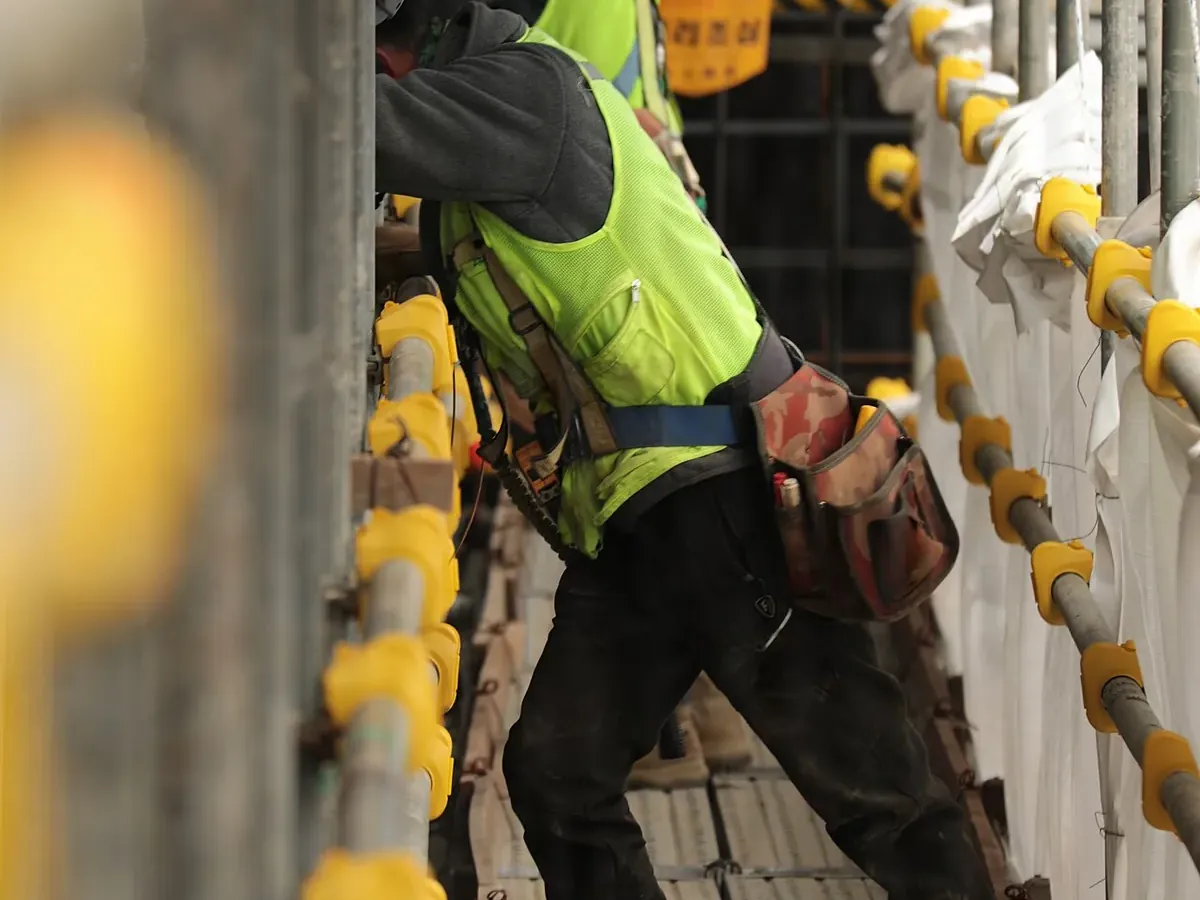
Photo: U.S. Army / Monique Freemon, Wikimedia Commons, public domain
Quick Answer
The typical 30x30 concrete slab cost in 2026 is about $3,600 to $7,200 installed for a 4 inch slab at $4 to $8 per square foot. Shop and garage floors that are 5 to 6 inches thick with rebar and thickened edges often cost $5,400 to $9,000 or more. A 30x30 slab needs about 11 cubic yards of concrete at 4 inches, usually two trucks. Larger slabs cost about $4,800 to $9,600 for 30x40, $6,000 to $12,000 for 30x50 and $9,600 to $19,200 for 40x60 at 4 inches.
A 30 by 30 foot slab, 900 square feet, is a common size for a three-car garage, a workshop, a small pole barn, an RV and boat storage pad, or a base for a steel building. Slabs this size and larger are usually poured by contractors with ready-mix trucks, and often finished with power trowels or laser screeds. Because the area is large, the price per square foot is often a little lower than for small pads, but the total cost adds up quickly.
This guide covers the 30x30 concrete slab cost for different thicknesses and uses, plus 30x40, 30x50 and 40x60 slab prices, how much concrete and how many trucks each size needs, what is included in a shop slab quote, metal building slabs, and how to keep costs under control. Price ranges come from Angi, HomeAdvisor and HomeGuide, listed in the sources.
30x30 Concrete Slab Cost at a Glance
| Slab size | Square feet | 4 in. slab at $4 – $8/sq ft | Typical uses |
|---|---|---|---|
| 30 × 30 | 900 | $3,600 – $7,200 | Three-car garage, workshop |
| 30 × 40 | 1,200 | $4,800 – $9,600 | Shop, pole barn, RV storage |
| 30 × 50 | 1,500 | $6,000 – $12,000 | Larger shop, equipment storage |
| 40 × 60 | 2,400 | $9,600 – $19,200 | Barn, commercial shop, barndominium |
These are for a plain slab. Thicker shop floors, rebar, perimeter footings, vapor barriers, insulation and power-troweled finishes all add to the price. On the other hand, large open sites with easy truck access can come in toward the lower end per square foot. HomeAdvisor puts the average slab near $6 per square foot, which would make a plain 30x30 concrete slab about $5,400.
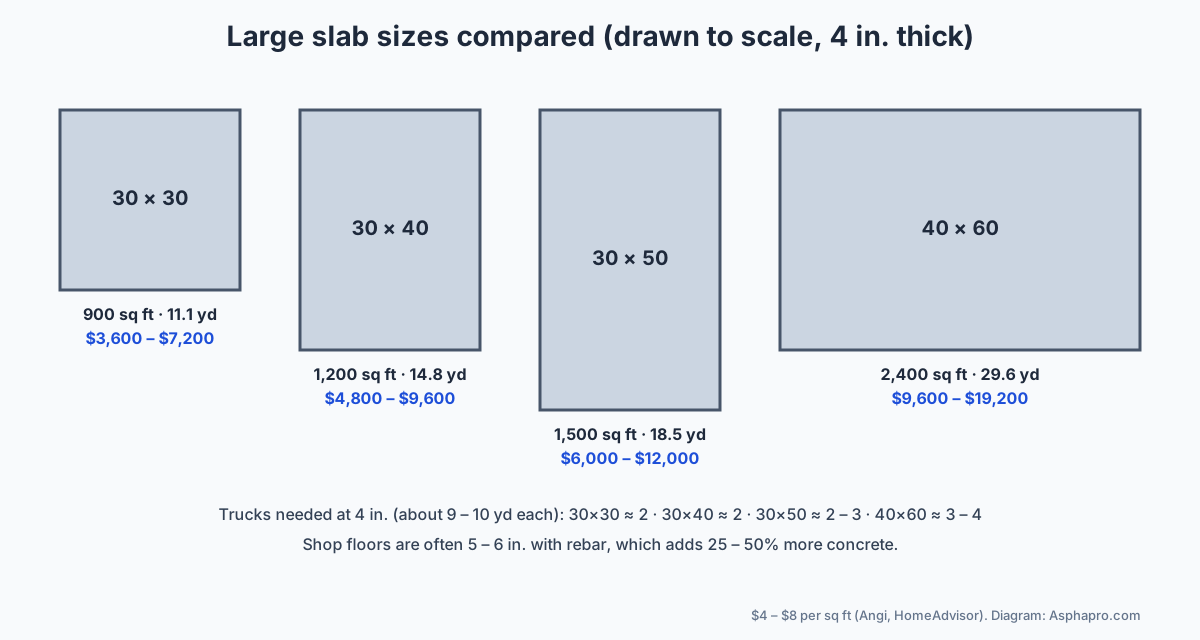
How Much Concrete Do Large Slabs Need?
| Slab | 4 in. (cu yd) | 5 in. (cu yd) | 6 in. (cu yd) | Trucks at 6 in. (about 9 – 10 yd each) |
|---|---|---|---|---|
| 30 × 30 | 11.1 | 13.9 | 16.7 | 2 |
| 30 × 40 | 14.8 | 18.5 | 22.2 | 3 |
| 30 × 50 | 18.5 | 23.1 | 27.8 | 3 |
| 40 × 60 | 29.6 | 37.0 | 44.4 | 5 |
Add about 5 to 10 percent for waste, uneven base and thickened edges. At $125 to $200 per yard, the concrete alone for a 6 inch 30x30 slab (about 17.5 yards with waste) runs roughly $2,200 to $3,500. See concrete price per yard and how many yards of concrete are in a truck.
What a 30x30 Shop Slab Quote Includes
- Site work: clearing, excavation and grading. Large slabs often need a building pad built up with compacted fill.
- Base: about 4 to 6 inches of compacted crushed stone; more on soft soils.
- Perimeter footings or thickened edges to carry walls or posts, sized to local frost depth and building loads.
- Vapor barrier under enclosed buildings, and sometimes rigid insulation for heated shops.
- Reinforcement: rebar grid or heavy mesh, often with fiber in the mix.
- Embeds: anchor bolts, column base plates, plumbing or floor drains, and conduit for in-floor heat or power.
- Concrete: usually 4 to 6 inches, sometimes thicker under equipment.
- Finishing: power trowel for a smooth shop floor, or broom finish for open pads.
- Saw-cut joints at regular spacing, cut within a day of the pour.
- Curing with compound or covers.
How Thick Should a 30x30 Slab Be?
| Use | Typical thickness | Reinforcement |
|---|---|---|
| Garage, cars and light trucks | 4 – 5 in. | Mesh or rebar |
| Workshop with tools and lifts | 5 – 6 in., thicker at a car lift | Rebar |
| Pole barn with tractors | 5 – 6 in. | Rebar |
| RV, boat and equipment storage | 6 in. or more | Rebar |
| Heavy equipment or semi trucks | 6 – 8 in. or engineered | Engineered design |
Car lifts often need a minimum slab thickness and strength in the lift area; check the lift manufacturer's requirements before you pour. See concrete slab thickness for more detail.
30x40 Concrete Slab Cost
A 30x40 slab is 1,200 square feet, one of the most popular shop and pole barn sizes. At $4 to $8 per square foot, the 30x40 concrete slab cost is about $4,800 to $9,600 for 4 inches. For a 6 inch shop floor with rebar and thickened edges, budgets of $7,200 to $12,000 or more are common. It needs about 15 yards at 4 inches or 22 yards at 6 inches, so two to three trucks.
30x50 Concrete Slab Cost
A 30x50 slab is 1,500 square feet. The 30x50 concrete slab cost is about $6,000 to $12,000 at 4 inches. At 5 to 6 inches with rebar, expect more. It needs about 18.5 yards at 4 inches and 27.8 yards at 6 inches, so two to three trucks. This size fits a large garage-shop combo, farm equipment storage, or a hobby shop with a lift and a work area.
40x60 Concrete Slab Cost
A 40x60 slab is 2,400 square feet, a common size for a large barn, commercial shop or barndominium. The 40x60 concrete slab cost is about $9,600 to $19,200 at 4 inches. Slabs for living space, such as a barndominium, need a full foundation design with footings, under-slab plumbing, insulation and inspections, which raises the cost well beyond a basic slab. At 6 inches, a 40x60 needs about 44 yards, so four to five trucks scheduled back to back.
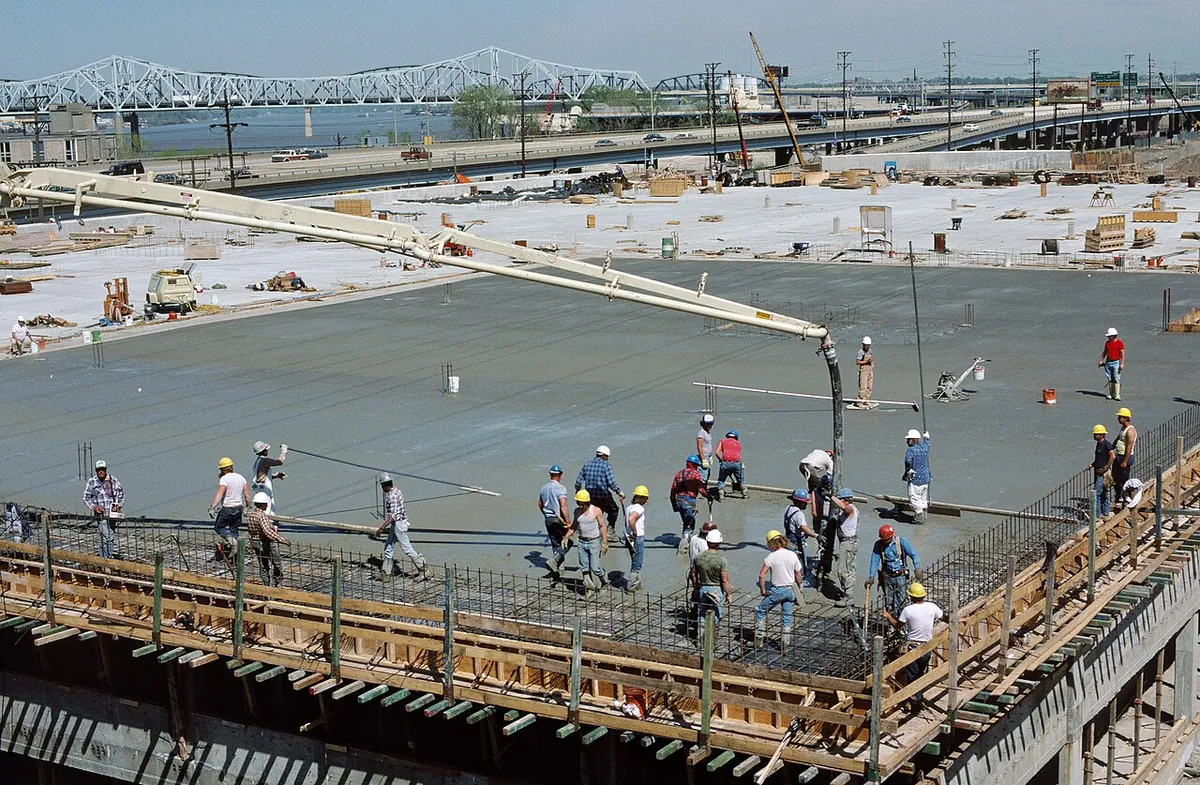
Photo: William Alden, Wikimedia Commons, CC BY-SA 2.0
Metal Building and Pole Barn Slabs
Many 30x30, 30x40 and 40x60 slabs are poured for steel buildings or pole barns. HomeGuide puts prefab metal buildings at about $10 to $25 per square foot for the kit, or about $20 to $50 per square foot installed including foundation and assembly. For a 30x40 building, that suggests roughly $12,000 to $30,000 for a kit and $24,000 to $60,000 installed.
- Steel buildings usually need anchor bolts in exact positions and footings or thickened edges at columns. Get the building's foundation plan before you pour.
- Pole barns often have posts set in their own footings, and the slab is poured inside after the building is up. That can make the slab simpler but harder to reach with trucks, so a pump may be needed.
- Heated shops may add under-slab insulation and in-floor heating tubes, which must be placed before the pour.
30x30 Concrete Slab Cost by Finish
| Finish | Cost per sq ft | 30x30 total |
|---|---|---|
| Broom finish (outdoor pad) | $4 – $8 | $3,600 – $7,200 |
| Power-troweled smooth (shop floor) | similar to slightly more | $3,600 – $8,100 |
| Colored or stained | $8 – $12 | $7,200 – $10,800 |
| Stamped (patio or pool deck) | $12 – $18 | $10,800 – $16,200 |
Shop floors are often sealed, coated or polished later; see polished concrete cost and concrete coating cost.
What Drives the Price of Large Slabs
- Thickness and steel: 6 inches with rebar can add 50 percent or more to the concrete and steel cost compared with 4 inches with mesh.
- Site prep: building up a level pad on a sloped lot can cost as much as the slab.
- Footings: perimeter footings in frost areas add excavation, forms and concrete.
- Access: slabs inside a finished pole barn or far from the road often need a pump.
- Finish: power troweling takes skilled finishers and machines.
- Embeds and plumbing: drains, in-floor heat and conduit add labor before the pour.
- Permits and engineering: buildings need permits and sometimes engineered plans.
- Region: labor and concrete prices vary widely.
Site Prep for Large Slabs
Site work is the hidden part of a 30x30 concrete slab cost. A small patio can often sit on lightly graded ground, but a 900 to 2,400 square foot building slab needs a flat, stable pad. On a sloped lot, the contractor may need to cut the high side and fill the low side with compacted material, sometimes a foot or more. Fill must be placed in thin layers and compacted, or the slab will settle. Soft or wet soils may need to be dug out and replaced, or covered with geotextile fabric and extra stone. Many contractors price site work separately from the slab, so ask whether grading, fill, compaction testing and drainage are included. On some lots, site prep costs as much as the concrete.
Footings and Frost Protection
Garages, shops and barns carry wall and roof loads at the edges, so most large slabs need perimeter footings or thickened edges. In cold climates, footings usually go below the local frost depth, or the slab is built as a frost-protected shallow foundation with insulation around the edges. A monolithic slab, where the footing and slab are poured together, is common for garages and saves time. A separate footing and stem wall, poured first, is common for taller buildings and sloped sites. Your building department sets the minimum requirements. Footings add excavation, steel and concrete, so they can add a large share to the 30x30 concrete slab cost. See concrete footing cost for prices.
Power Troweling, Laser Screeds and Pumps
Big slabs are usually finished with equipment rather than only by hand. A laser screed or a vibrating power screed sets the surface flat across a wide area. Ride-on or walk-behind power trowels then polish the surface smooth for shop floors. These machines need experienced operators and good timing, but they produce flatter floors than hand tools and let a crew finish 900 to 2,400 square feet in a day. If trucks cannot reach every part of the slab, a concrete pump places the concrete; Angi puts pumping at about $120 to $300 per hour with minimum charges of roughly $400 to $1,500. On a large slab, the pump cost per square foot is usually small, and it can save hours of wheelbarrow work.
Weather and Large Pours
Large pours take hours, so weather matters even more than on a small pad. Hot, dry, windy days make the surface dry before it can be finished and cause plastic shrinkage cracks; crews start early, use evaporation reducers and may add retarders. In cold weather, the slab must be protected from freezing with blankets or heat, and the mix may include accelerators, which add to the price per yard. Heavy rain during a pour can ruin the surface. Contractors often watch the forecast closely and may move the date. See pouring concrete in cold weather.
Removing an Old Large Slab
If an old slab must come out first, removal usually costs about $2 to $6 per square foot. For a 30x30 slab, that is about $1,800 to $5,400; for a 40x60, about $4,800 to $14,400. Thick slabs with heavy rebar cost more. A 4 inch 30x30 slab weighs about 22 tons, so hauling and disposal are a big part of the job. See concrete removal cost.
Mistakes That Raise the Cost of Big Slabs
- Pouring before the building plan is final. Wrong anchor bolt positions or missing footings are expensive to fix.
- Skipping compaction on fill. Large slabs on uncompacted fill settle and crack.
- Cutting joints late. Saw cuts made too late often miss the cracks that already formed.
- Too few finishers. A large slab sets unevenly if the crew cannot keep up.
- No vapor barrier in a heated shop. Moisture coming up through the slab can damage coatings and stored items.
- Forgetting plumbing and conduit. Adding a floor drain after the pour means cutting the slab.
Three Large Slab Cost Examples
Example 1: 30x30 detached garage
A 30x30 slab, 5 inches thick with #4 rebar on 24 inch centers, thickened 12 inch edges, vapor barrier, anchor bolts and a power-troweled finish. At about $8 per square foot, the 30x30 concrete slab cost is about $7,200, plus permit fees.
Example 2: 30x40 pole barn floor
A 30x40 floor poured inside an existing pole barn, 5 inches thick with mesh and fiber, broom finish. A pump is needed. At about $6.50 per square foot plus about $1,000 for the pump, the total is about $8,800.
Example 3: 40x60 shop slab
A 40x60 shop slab, 6 inches with rebar, perimeter footings, two floor drains and a smooth finish, on a pad that needs about 1 foot of fill. At about $9 per square foot for the slab and separate site work, the slab is about $21,600, with site work on top.
Can You DIY a 30x30 Slab?
It is not recommended for most homeowners. A 30x30 slab needs 11 to 17 yards of concrete, two or more trucks, and an experienced crew of six or more to place and finish it before it sets. Large slabs are usually finished with power trowels, and saw cuts must be made at the right time to control cracking. A practical approach is to do the clearing and some site prep yourself, then hire a concrete contractor for the forming, pour and finish. If you do take it on, pour in sections with construction joints and hire experienced finishers for each pour day.
Planning the Pour Day for a 30x30 Slab
Pour day for a 30x30 slab or larger is a coordinated job. The contractor schedules two or more ready-mix trucks to arrive in sequence, so the crew can keep placing concrete without a break that would leave a cold joint. Before the first truck arrives, the forms, base, vapor barrier, steel, anchor bolts and any plumbing must be inspected and ready. The crew usually includes people placing and raking concrete, a screed operator, finishers with bull floats and power trowels, and someone ready to start saw cutting joints at the right time. On very large slabs, contractors may pour in two or more sections on different days with construction joints between them. That spreads the work out and lowers risk, but each section adds setup time, which can raise the 30x30 concrete slab cost slightly. Ask your contractor whether they plan one pour or several, and how they will handle the joints between sections.
Control Joints for Large Slabs
Large slabs must be divided by joints to control cracking. A common rule is to space joints no farther apart in feet than about 2 to 3 times the slab thickness in inches. For a 5 inch slab, that means about every 10 to 15 feet, so a 30x30 slab is usually cut into nine 10 × 10 panels or four 15 × 15 panels. Joints should be cut to at least a quarter of the slab depth, usually within the first day. See why concrete cracks.
How Long Does a Large Slab Project Take?
- Site work and base: one to several days depending on fill and grading.
- Footings, forms, plumbing, steel: one to three days, plus inspections.
- Pour day: usually one long day with trucks scheduled back to back.
- Saw cutting: the same day or the next morning.
- Curing: light use after about a week; heavy equipment after the concrete approaches full strength around 28 days.
Materials vs Labor on a 30x30 Slab
On a plain 4 inch 30x30 concrete slab, about 11.7 yards of ready-mix with waste costs roughly $1,460 to $2,340 at $125 to $200 per yard. Gravel base, forms, mesh or rebar, vapor barrier and saw blades add more. On a $5,400 job, materials are often around half the bill, and labor, equipment and overhead make up the rest. Large slabs spread setup costs over more area, which is why their price per square foot can be a little lower than small pads, but they also need more workers and machines on pour day.
Large Slab Prices by Region
Labor rates, concrete prices and demand vary a lot across the country. High-cost metro areas can be well above $8 per square foot even for plain slabs, while rural areas with competitive contractors may come in near the low end. Rural sites far from a ready-mix plant can pay delivery or zone fees per truck, which matters when a 40x60 slab needs four or five loads. Always compare local quotes rather than relying on national averages alone.
Permits and Inspections
Garages, shops, barns and metal buildings almost always need a building permit. Inspectors may check the footings and steel before the pour, the location of anchor bolts, and sometimes the vapor barrier and insulation. Agricultural buildings are exempt from some permit rules in certain areas, but not all. Permit fees, engineering and any required soil tests are often listed separately from the 30x30 concrete slab cost, so ask what is included.
Questions to Ask Before You Hire
- What thickness, psi mix and steel are included for the whole slab and at any lift or equipment area?
- Are footings or thickened edges included, and to what depth?
- Who is responsible for site grading, fill and compaction?
- Is a vapor barrier or insulation included?
- How will the slab be finished, and will it be power troweled?
- When and how deep will joints be saw cut?
- Are the pump, permits and inspections in the price?
Caring for a Shop or Garage Slab
Keep the slab moist or covered while it cures, and keep heavy equipment off until the concrete approaches full strength. Seal or coat a shop floor once it has cured to make it easier to clean and to resist oil and chemicals. Fill cracks and joints in outdoor slabs to keep water out. See how to seal concrete and how to remove oil stains from concrete.
Ways to Save on a 30x30 or Larger Slab
- Get the building's foundation plan early so the slab is designed once.
- Prepare the pad yourself if you have equipment, or hire excavation separately.
- Pour before walls go up when possible so trucks can reach the whole slab.
- Use thicker concrete only where needed, such as at a car lift or under equipment.
- Choose a plain finish and seal it rather than polishing, if looks are not important.
- Collect three or more quotes with the same thickness, steel and finish.
Frequently Asked Questions
How much does a 30x30 concrete slab cost?
About $3,600 to $7,200 installed at 4 inches. Shop and garage floors at 5 to 6 inches with rebar often cost $5,400 to $9,000 or more.
How much concrete is needed for a 30x30 slab?
About 11.1 cubic yards at 4 inches, 13.9 at 5 inches and 16.7 at 6 inches, plus 5 to 10 percent extra.
What is the 30x40 concrete slab cost?
About $4,800 to $9,600 for a 4 inch slab, and often $7,200 to $12,000 or more for a 6 inch shop floor with rebar.
How much is a 30x50 concrete slab?
About $6,000 to $12,000 at 4 inches, using about 18.5 cubic yards of concrete.
How much does a 40x60 concrete slab cost?
About $9,600 to $19,200 at 4 inches. Thicker shop floors and slabs for living space cost more.
Is it cheaper per square foot to pour a large slab?
Often a little, because setup and minimum charges are spread over more area. Thicker concrete, rebar and footings can still make the total high.
How thick should a 30x30 shop slab be?
Usually 4 to 5 inches for cars and light use, and 5 to 6 inches with rebar for shops, lifts, tractors and RVs. Check car lift and building manufacturer requirements before you pour, since some lifts need a thicker, stronger pad.
How much does a 30x30 concrete slab weigh?
At 4 inches, a 30x30 slab holds about 11 cubic yards of concrete and weighs roughly 45,000 pounds, about 22 tons.
How long does a 30x30 slab take to build?
Usually about three to five working days from site prep to pour, plus inspections and any wait for good weather or truck availability. The pour itself is typically one long day, and the slab needs about a week before light vehicle use.
How many trucks of concrete for a 30x40 slab?
About two trucks at 4 inches (about 15 yards) and about three trucks at 6 inches (about 22 yards).
Sources
- Angi, "How much does a concrete slab cost?" angi.com
- HomeAdvisor, "How much does a concrete slab cost?" homeadvisor.com
- HomeGuide, "How much does a metal building cost?" homeguide.com
- HomeGuide, "Concrete driveway cost" (finish ranges). homeguide.com
- LawnStarter and HomeGuide, ready-mix price per yard. lawnstarter.com
- Image credits: slab placement photo by the U.S. Army (public domain) and large pour photo by William Alden (CC BY-SA 2.0), via Wikimedia Commons. Diagram by Asphapro.com.
Prices checked November 2026. They are national ranges; local prices can be higher or lower.
Related Guides
- How to build concrete forms — layout, stakes and slope