
Pervious Concrete Driveway vs Permeable Concrete Pavers: How They Work and What They Cost
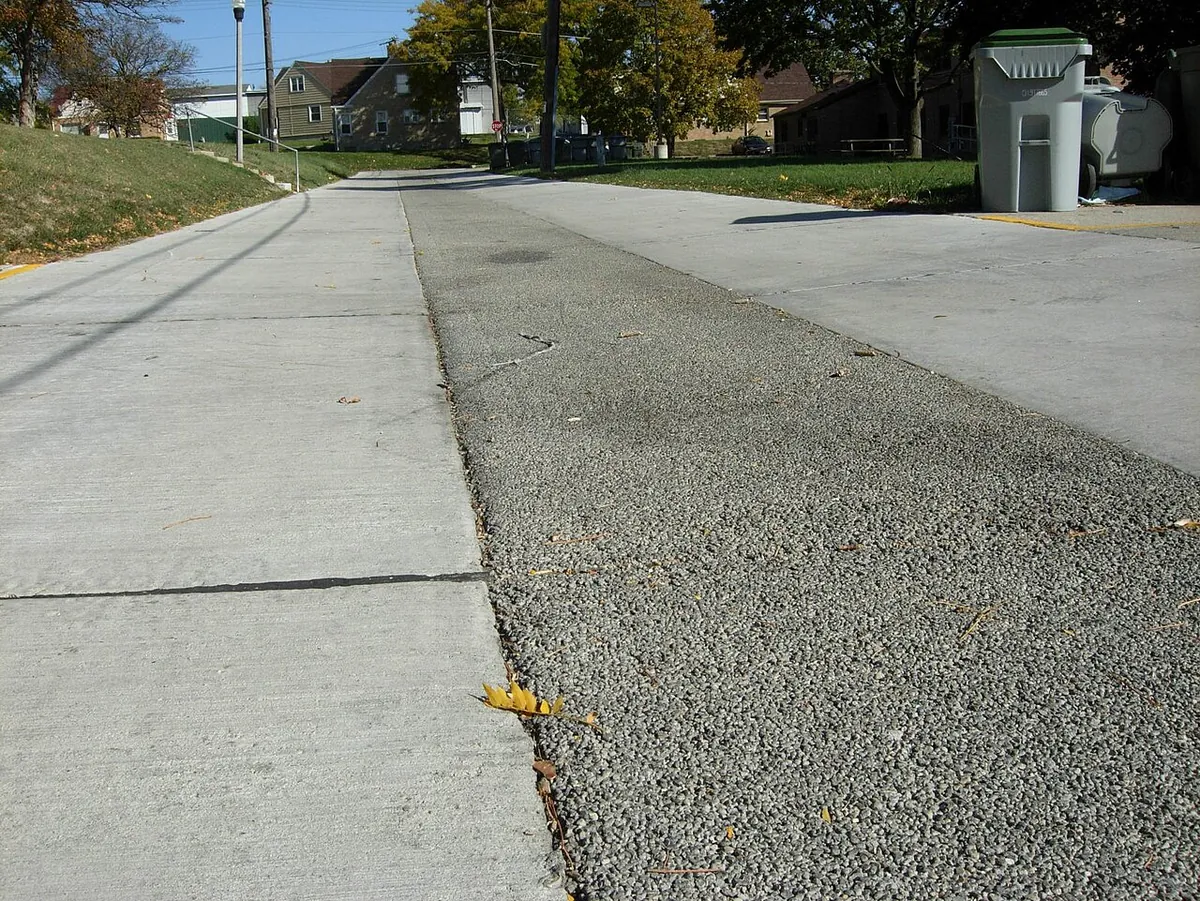
Photo: Aaron Volkening, Wikimedia Commons, CC BY 2.0
Quick Answer
A pervious concrete driveway is made with a special mix of cement, water and single-size coarse stone with little or no sand, leaving about 15 to 25 percent open voids so rain drains straight through the slab into a deep stone base below, instead of running off. It can absorb heavy rain, often hundreds of inches per hour, reduces puddles and ice, and can help meet stormwater rules. It is weaker and rougher than regular concrete, needs a 6- to 18-inch open-graded stone base, careful installation by trained crews, immediate curing under plastic, and regular vacuum sweeping to prevent clogging. Pervious concrete typically costs about $8 to $15 per square foot installed. Permeable concrete pavers, interlocking blocks with stone-filled joints, are a popular alternative at about $12 to $30 per square foot.
Ordinary driveways shed water. Every inch of rain on a 600-square-foot driveway sends about 370 gallons of water toward the street, the yard, or the garage. In many cities, that runoff overloads storm drains and carries oil and silt into streams, and new rules limit how much hard surface a lot can have. A pervious concrete driveway takes a different approach: it lets water pass through the pavement itself and soak into the ground below. Permeable concrete pavers do the same with joints instead of pores.
This guide explains how pervious concrete works, what goes into a pervious concrete driveway, how it is built, how it performs in winter, how to keep it from clogging, what it costs, and how permeable concrete pavers compare.
What Is Pervious Concrete?
Pervious concrete, also called porous or no-fines concrete, is made with portland cement, water and a narrowly graded coarse aggregate, usually 3/8-inch stone, with little or no sand. The cement paste coats the stones and glues them together at their contact points but does not fill the spaces between them. The result is a rigid, rough-looking material, a bit like a rice crispy treat made of gravel, with interconnected voids that let water flow straight through. According to American Concrete Institute guidance (ACI 522), pervious concrete typically has 15 to 25 percent voids, weighs about 100 to 125 pounds per cubic foot, and drains water at rates often quoted in hundreds of inches per hour, far more than any storm delivers.
Because of its open structure, pervious concrete is weaker than conventional concrete, commonly about 500 to 4,000 psi in compression, with typical mixes around 2,500 to 3,000 psi, and it has lower flexural strength. That is enough for driveways, parking lots, walks and light traffic, but it is not used for heavy truck routes or highways.
How a Pervious Concrete Driveway Works
The pervious slab is only half of the system. Below it sits a reservoir of clean, open-graded crushed stone, often 6 to 18 inches deep or more, that stores water while it soaks into the soil. In soils that drain slowly, perforated underdrain pipes carry excess water away. A geotextile fabric may separate the stone from the native soil. When it rains, water passes through the pervious concrete instantly, fills the stone reservoir, and then infiltrates the ground over hours or days. The surface stays largely free of puddles, and the system can filter out some pollutants and reduce peak runoff to storm drains.
For a driveway, pervious concrete is usually placed about 4 to 6 inches thick for cars, thicker for heavier vehicles, over the stone base. Site conditions decide the design: soil drainage, groundwater depth, slope, nearby foundations and local stormwater rules. In some areas, engineers test the soil's infiltration rate before designing the base.
Benefits of a Pervious Concrete Driveway
- Less runoff: rain soaks in instead of flowing to the street, which can help meet local stormwater requirements and may count as less impervious area under zoning rules.
- Fewer puddles: water does not stand on the surface.
- Less ice: meltwater drains away instead of refreezing on the surface, which can reduce slip hazards and salt use.
- Groundwater recharge and some filtering of pollutants.
- Cooler surface: the open, lighter surface stays cooler than asphalt in summer.
- Tree-friendly: water and air reach roots under the pavement.
Drawbacks and Limitations
- Higher cost than conventional concrete, mainly for the deep stone base and specialized installation.
- Specialized installation: the mix is very stiff and sets fast, and mistakes during placement or curing lead to raveling. Installers should be trained and, ideally, certified.
- Rough texture: not as smooth as broomed concrete; small stones can ravel from the surface.
- Clogging: sand, silt, leaves and moss can fill the pores over time without maintenance.
- Lower strength: not suited to heavy trucks or sharp turning of heavy vehicles.
- Site limits: slopes, poor soils, high groundwater and nearby basements may need special design.
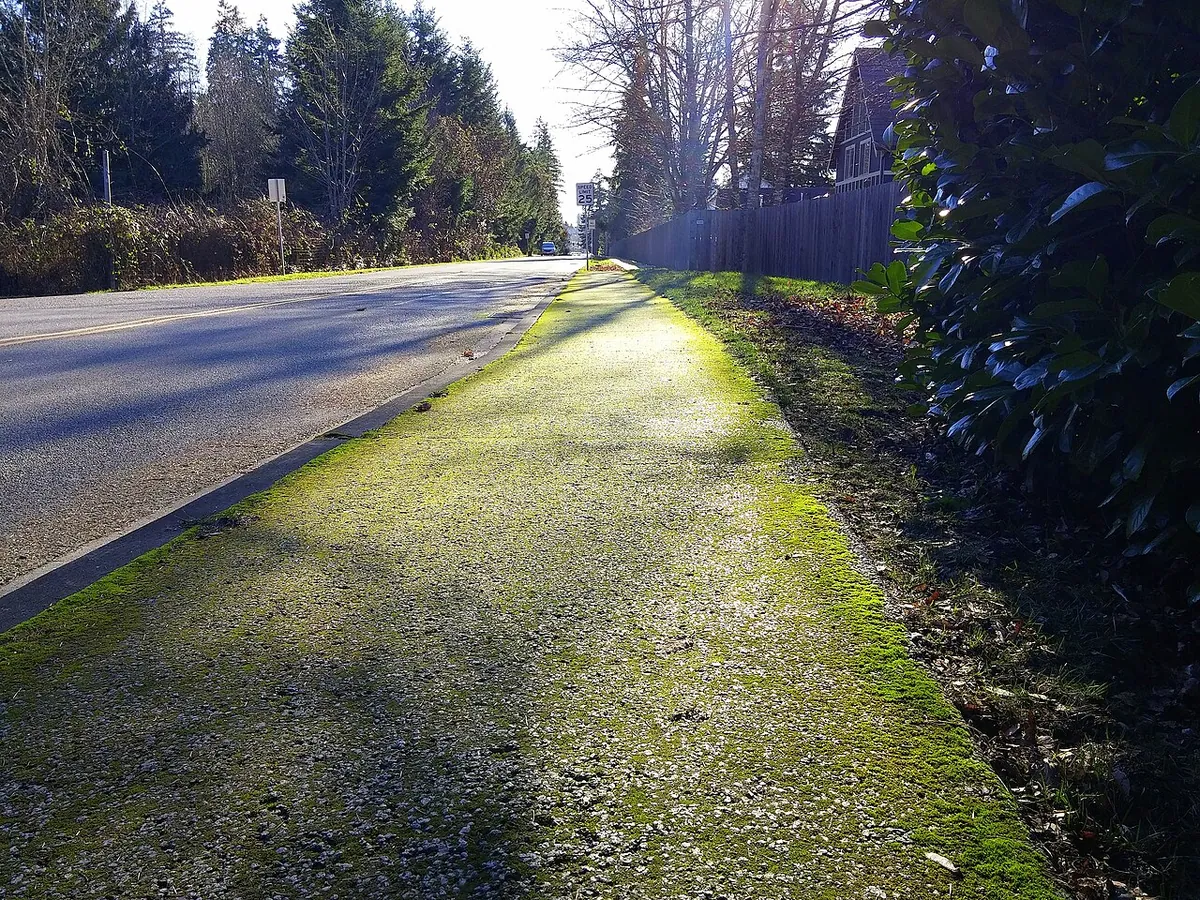
Photo: nick hoke, Wikimedia Commons, CC BY 3.0
How Pervious Concrete Is Installed
- Design and excavation: remove soil to the depth of the slab plus the stone base, slope the subgrade as designed, and avoid over-compacting the native soil, which reduces infiltration.
- Base: place geotextile if specified, then open-graded crushed stone such as No. 57 or No. 2 stone, lightly compacted, with underdrains where needed.
- Forms: set edge forms or curbs; pervious concrete needs firm edges.
- Placement: the mix arrives with near-zero slump, looks dry and crumbly, and must be placed quickly, usually within an hour of batching.
- Screeding and compaction: crews strike off with a vibrating or roller screed set slightly high, then compact with a heavy roller. There is no floating or troweling, which would seal the pores.
- Joints: control joints are rolled in with a special jointing tool while fresh, or saw-cut later.
- Curing: the most critical step. The surface is covered with plastic sheeting within about 20 minutes of placement and kept covered for at least 7 days, because the thin paste dries out fast and raveling follows.
The National Ready Mixed Concrete Association offers pervious concrete installer and technician certification, and many specifications require a certified installer on site.
Pervious Concrete Driveway in Winter
Pervious concrete has been used successfully in cold climates when designed and maintained properly. The key is that the stone base must drain so that the pavement is not sitting saturated when it freezes. Water passing through the slab into a well-drained base leaves the pores mostly empty, so freeze-thaw damage is limited. Snow can be plowed, ideally with the blade slightly raised or with a rubber edge to avoid catching the surface. Avoid sand for traction, which clogs the pores. Deicing salt can be used sparingly, but less is usually needed because meltwater drains away. See does salt damage concrete.
Maintenance: Keeping Pores Open
Clogging is the main enemy of any pervious concrete driveway. Sediment from soil washing onto the surface, sand, leaves, grass clippings and moss, which thrives in shady, damp spots as in the photo above, can gradually block the voids. Typical maintenance includes:
- Vacuum sweeping once or twice a year with a regenerative air or vacuum sweeper, more often near trees or soil.
- Pressure washing to flush partly clogged areas, often combined with vacuuming.
- Keeping soil off: do not stockpile mulch, soil or sand on the driveway, and keep landscape beds from draining onto it.
- Moss and algae control in shade, with cleaning and better sun or drainage.
- Checking infiltration: pour a bucket of water on the surface; it should disappear almost instantly.
Clogged pervious concrete can often be restored by vacuuming and pressure washing; badly clogged areas can be drilled or replaced in small sections.
Permeable Concrete Pavers
Permeable concrete pavers, also called permeable interlocking concrete pavement (PICP), use solid concrete paver units with wider joints filled with small, clean crushed stone instead of sand. Water passes through the joints into layers of open-graded stone below, much like pervious concrete. The pavers themselves are dense and strong, so the surface is durable and looks like a standard paver driveway, while the joints provide drainage. If an area clogs or settles, pavers can be lifted, the joint stone refreshed, and the pavers reset. The Interlocking Concrete Pavement Institute publishes design and installation guidance. See paving stones vs concrete.
Pervious Concrete vs Permeable Pavers vs Porous Asphalt
| Option | Typical installed cost | Look | Maintenance |
|---|---|---|---|
| Pervious concrete driveway | About $8–$15 per sq ft | Rough, open texture | Vacuum sweep; risk of raveling if poorly cured |
| Permeable concrete pavers | About $12–$30 per sq ft | Paver patterns and colors | Vacuum and refill joint stone |
| Porous asphalt | About $6–$12 per sq ft | Dark, open asphalt | Vacuum sweep; no sealcoating |
| Conventional concrete | About $6–$12 per sq ft | Smooth or broomed | Sealing; runoff must be managed |
Prices vary widely by region, base depth and site conditions. See concrete driveway cost.
Is a Pervious Concrete Driveway Right for Your Site?
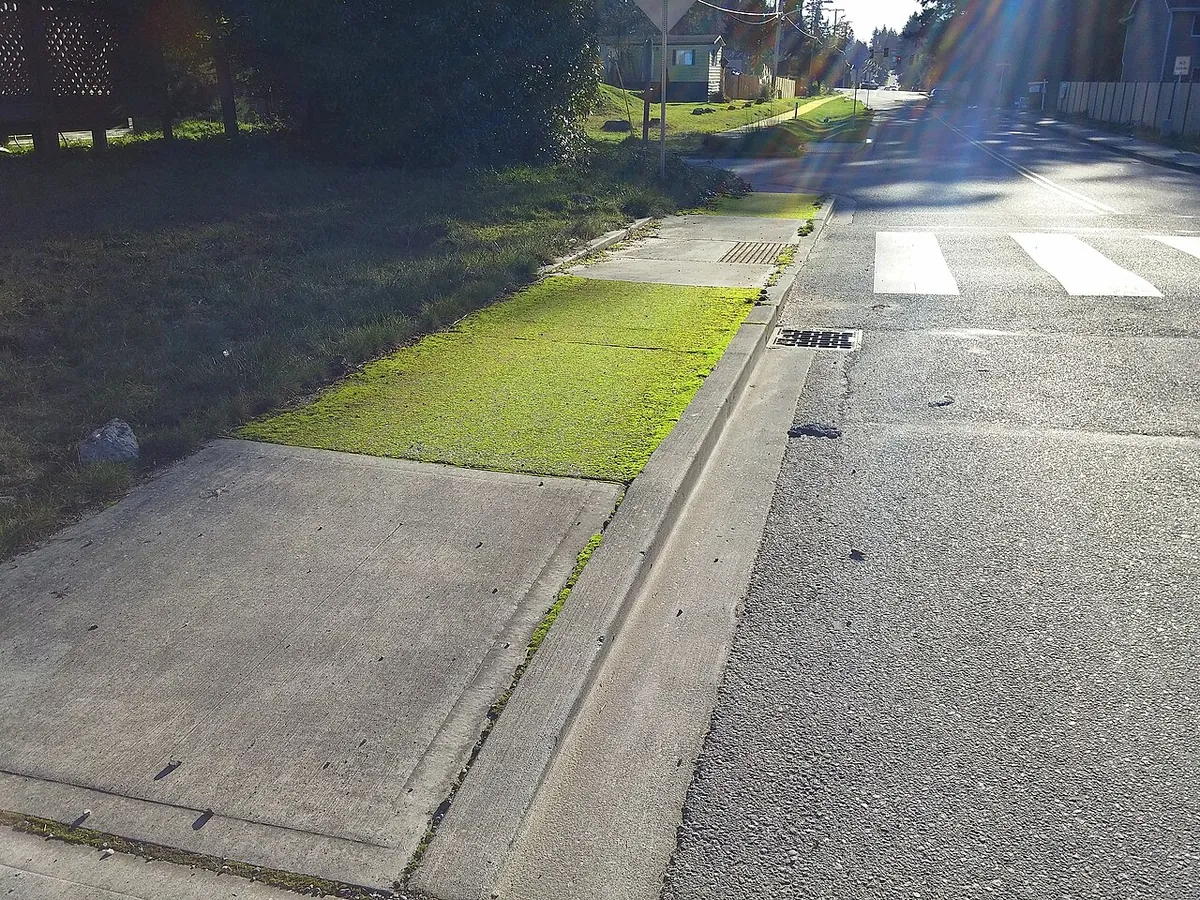
Photo: nick hoke, Wikimedia Commons, CC BY 3.0
A pervious concrete driveway works best on fairly flat sites, under about 5 percent slope, with soils that drain reasonably well and groundwater well below the base. Sunny locations away from heavy leaf fall and exposed soil stay clean longest; the photo above shows what happens to pervious panels in a damp, shady spot without maintenance, where moss fills the surface while the regular concrete beside it stays bare. Steep driveways need terraced bases or check dams so water does not run through the base and out the bottom. Heavy clay soils may need underdrains. Sites close to basements need care so water is not directed toward the foundation. If your lot has these challenges, an engineer or experienced installer can design around them, or you may choose permeable concrete pavers, porous asphalt, or a conventional driveway with a rain garden instead.
Stormwater Rules and Credits
Many cities and counties limit the amount of impervious surface on residential lots or charge stormwater fees based on it. Pervious concrete and permeable concrete pavers can count as pervious or partly pervious area, which can make room for a larger driveway or patio, reduce fees, or satisfy requirements for new construction and additions. Some utilities offer rebates for installing permeable pavement. Rules vary from town to town, so check with your local building or stormwater department before you design, and ask what documentation they need, such as base depth and infiltration testing. For commercial projects, pervious pavement is a common way to meet stormwater management requirements and green building credits.
Design Details: Thickness, Base and Slope
For residential driveways, pervious concrete is commonly 5 to 6 inches thick, compared with about 4 inches for a conventional concrete driveway, because pervious concrete has lower flexural strength. The stone base below is designed for both support and water storage; its depth depends on the design storm, soil infiltration rate and frost depth, and commonly ranges from 6 to 18 inches or more. The surface is usually built nearly flat so water enters evenly; on slopes, the base may be divided into level cells with barriers so water does not all collect at the low end. Edges need firm restraint, such as concrete curbs or a thickened conventional concrete border, to prevent raveling at the sides. Many designs include an overflow path, so that in an extreme storm, water can leave the system safely instead of backing up.
Common Mistakes With Pervious Concrete
Most failures of pervious concrete driveways trace back to a few mistakes. Adding water to the mix to make it easier to place fills the voids with paste and seals the surface. Overworking the surface with floats or trowels does the same. Delaying the plastic sheeting even half an hour on a warm, windy day lets the thin paste dry out, so stones ravel off the surface within months. Over-compacting the native soil under the base reduces infiltration. Letting soil wash onto the new pavement from nearby construction or landscaping clogs it before it ever works. And skipping maintenance for years lets sediment and moss build up. Hiring a certified installer, insisting on immediate curing and planning maintenance avoids almost all of these.
Repairing a Pervious Concrete Driveway
Raveled spots, where stones have loosened from the surface, can be cleaned and patched with a pervious repair mix or, in small areas, a resin binder made for pervious surfaces. Clogged areas can usually be restored with vacuum sweeping and pressure washing. Cracked or badly damaged panels can be cut out at joints and replaced with fresh pervious concrete over the existing base. Avoid patching with ordinary concrete or asphalt, which blocks drainage and creates a spot where water runs off instead of soaking in. Because repairs need the same care as new work, keep the contact information of your installer and the mix details for future use.
Installing Permeable Concrete Pavers
Permeable concrete pavers are installed much like regular pavers, but with open-graded stone throughout. A typical section, following industry guidance, includes a subbase of large clean stone (often No. 2), a base of medium stone (No. 57), a bedding layer of small stone (No. 8) about 2 inches thick, and pavers set on top with joints filled with No. 8 or similar small stone. Edge restraints hold the system together. There is no sand in the system, since sand would clog. The result is a strong, attractive surface that drains through its joints. Maintenance is similar to pervious concrete: vacuum the joints periodically and top up the joint stone. Because individual pavers can be lifted and reset, utility repairs and settlement are easier to fix than with any monolithic pavement. See can you lay pavers over concrete and concrete sand.
A Short History of Pervious Concrete
No-fines concrete, the ancestor of pervious concrete, was used for house walls in Europe in the 19th and early 20th centuries and widely after World War II in Britain, where it saved cement and gave insulating, lightweight walls. Its use as a drainable pavement grew in the United States from the 1970s and 1980s, especially in Florida and other rainy regions, and expanded rapidly in the 2000s as stormwater rules tightened. Today pervious concrete and permeable concrete pavers are standard tools for green streets, parking lots, alleys and driveways in many cities.
What It Is Like to Live With a Pervious Concrete Driveway
Homeowners with a pervious concrete driveway usually notice the difference the first time it rains hard: instead of sheets of water running toward the garage or the street, the surface simply darkens and the water disappears. In winter, many find less ice forms at the bottom of the driveway, where meltwater used to refreeze. The texture is coarser than broomed concrete, a little like a fine gravel surface glued in place, which gives good traction but is less comfortable for bare feet, roller skates or chalk drawing. Small loose stones may ravel from the surface in the first few months, especially near edges and where cars turn their wheels while parked. Oil drips from parked cars soak in rather than staining the surface as visibly, though large spills should still be cleaned. Most owners find the maintenance manageable if they schedule a cleaning once or twice a year, usually in spring after winter sand and pollen and in fall after leaves drop.
Cost Breakdown for a Pervious Concrete Driveway
For a typical 20 × 30-foot, 600-square-foot driveway, a pervious concrete driveway might cost roughly $5,000 to $9,000 installed, compared with about $3,600 to $7,200 for a conventional concrete driveway, depending on region and site work. The difference comes mainly from the deeper stone base, the extra excavation, the thicker slab, specialized crews and stricter curing. Permeable concrete pavers for the same area might cost roughly $7,000 to $18,000. Against those costs, weigh possible savings on stormwater fees, avoided drainage structures, and the ability to add paved area where impervious limits would otherwise block it. Get at least two quotes from installers who have built pervious concrete before, and ask to see their past work. See concrete driveway cost and driveway cost per square foot.
Questions to Ask an Installer
- How many pervious concrete driveways or parking areas have you built, and can I see some that are a few years old?
- Is your crew NRMCA-certified for pervious concrete installation?
- How deep will the stone base be, what stone will you use, and will you test soil infiltration?
- How thick will the pervious slab be, and what strength and void content does the mix target?
- How will you cure it, and how quickly will the plastic go on?
- How will the edges be restrained, and where will overflow go in a very large storm?
- What maintenance do you recommend, and do you offer cleaning?
A contractor who answers these clearly and confidently is far more likely to deliver a driveway that drains and lasts.
Pervious Concrete for Patios, Walks and Parking Pads
The same material works beyond driveways. Pervious concrete patios and walkways stay free of puddles and can drain toward lawns and gardens without runoff toward the house, as long as they are kept away from foundations or designed with drainage. Parking pads for boats, trailers or extra cars are a common use, since they add paved area without adding runoff. Around trees, pervious pavement lets water and air reach roots, which is why many cities use it in tree wells and along sidewalks. For any of these, the same rules apply: a good stone base, careful installation, immediate curing and regular cleaning. For areas that will see bare feet or furniture, some homeowners prefer permeable concrete pavers, which have a smoother surface on the paver faces while still draining through the joints.
Pervious Concrete and Water Quality
Besides reducing the volume of runoff, pervious pavement improves water quality. As stormwater passes through the concrete and the stone base, much of the sediment and the pollutants attached to it, such as oils, metals and some nutrients, are trapped or broken down by microorganisms in the base and soil instead of being washed into storm drains and streams. Runoff that does leave the site is also cooler than runoff from hot pavement, which matters for streams with fish that need cool water. These benefits are why environmental agencies list pervious concrete and permeable pavers among recommended stormwater practices.
Combining Pervious and Conventional Concrete
Many driveways combine materials: a conventional concrete apron at the street and garage, where vehicles turn and stop, with a pervious concrete driveway section or pervious strips in between. Ribbon driveways, two concrete wheel tracks with a pervious or grassed strip between them, are another option. Combining materials can lower cost and keep the hardest-working areas smooth, while still letting much of the rain soak in. The joint between pervious and conventional sections should be detailed so water from the conventional area drains toward the pervious section rather than toward the garage or house.
Testing Whether Your Driveway Still Drains
A simple check tells you whether a pervious concrete driveway is still doing its job. Pour a 5-gallon bucket of water quickly onto one spot and watch. On a healthy surface, the water disappears almost as fast as you pour it, with little or no spreading. If it puddles, spreads widely or runs off, that area is partly clogged and due for cleaning. Engineers use a more formal version, ASTM C1701, which measures the time for a known volume of water to pass through a ring sealed to the surface. Test a few spots every year, especially near the street, under trees and where soil or mulch beds drain onto the pavement, and note the results so you can see if drainage is declining. Cleaning before the pores are fully blocked is much easier than restoring a heavily clogged surface, and it keeps the driveway working the way it was designed to for many more years.
Frequently Asked Questions
How long does a pervious concrete driveway last?
Properly installed and maintained, often 20 to 40 years. Poor curing or clogging can shorten its life considerably.
Is pervious concrete strong enough for cars?
Yes for cars and light trucks with a properly designed thickness and base. It is not intended for heavy truck traffic.
Do permeable concrete pavers cost more than pervious concrete?
Usually yes, about $12 to $30 per square foot installed versus about $8 to $15 for pervious concrete, but pavers are easier to repair and refresh.
Can I install a pervious concrete driveway myself?
It is not recommended. The mix sets fast, needs special compaction and immediate curing, and mistakes cause raveling. Hire a trained installer.
Sources
- American Concrete Institute: ACI 522R report on pervious concrete
- National Ready Mixed Concrete Association: pervious concrete pavement
- Interlocking Concrete Pavement Institute: permeable interlocking concrete pavement
- U.S. EPA: stormwater best management practices, permeable pavements
Related Guides
- Is concrete waterproof? — porosity, waterproof concrete and sealants
- Crushed concrete — driveways, calculator and concrete crushers
- How to clean moss from concrete — removing moss and stopping regrowth
- Concrete splash blocks — downspout splash blocks and drainage
- Concrete trench drain — channel drains, grates, install and cost
- Concrete catch basin — storm inlets, sizes and install
- Concrete cloth — rolled concrete for ditches and slopes
- Roller compacted concrete — RCC pavements and dams
- Green concrete — low-carbon mixes with fly ash, slag and Type IL, plus fresh green concrete