
Concrete Cutter Guide: Saw Types, Stihl Models and the Concrete Chainsaw
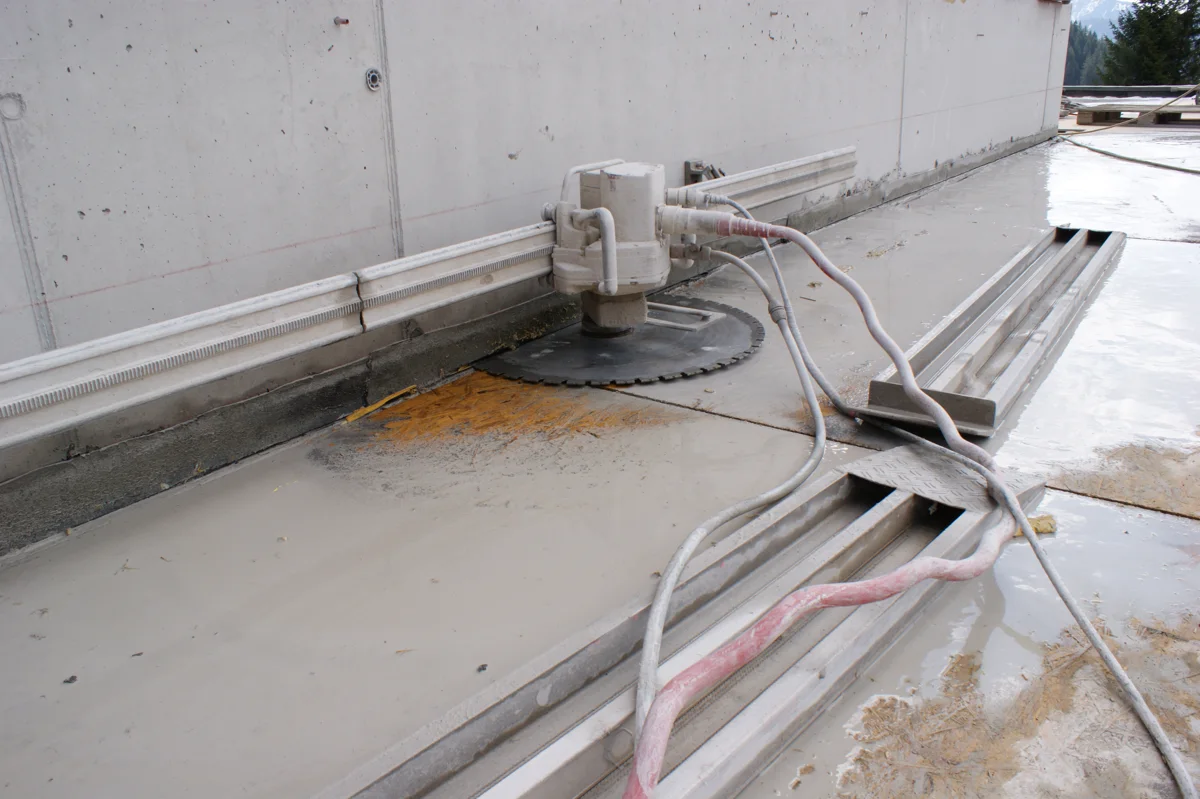
Photo: Asurnipal, Wikimedia Commons, CC BY-SA 4.0
Quick Answer
A concrete cutter is any power saw built to cut concrete with a diamond blade or diamond chain. The common types are the handheld cut-off saw (12 to 16 inch blade, about 4 to 6 inches deep), the concrete chainsaw (a chainsaw for concrete that uses a diamond chain and cuts about 12 to 16 inches deep with square corners), the walk-behind floor saw for long, straight slab and pavement cuts, and the track-mounted wall saw for thick walls. A popular gas Stihl concrete cutter such as the TS 420 uses a 14 inch blade and cuts about 5 inches deep. Renting a cut-off saw costs roughly $70 to $120 per day, a concrete chainsaw about $150 to $250 per day plus chain wear, and hiring professional concrete cutters typically runs $3 to $10 per linear foot for a 4 inch slab, with a trip minimum.
Cutting concrete is a job where the tool decides almost everything: how deep you can go, how square the corners are, how much dust you make and how long the job takes. A concrete cutter that is perfect for slicing a 4 inch patio slab is useless against a 10 inch foundation wall, and a machine that cuts a doorway through that wall is overkill for a driveway control joint. The photo above shows a track-mounted wall saw, a heavy concrete cutter that runs along a rail bolted to the concrete and cuts a deep, perfectly straight line.
This guide explains each type of concrete cutter, how deep it cuts, when to choose a concrete chainsaw, the main Stihl concrete cutter models, blades and water, safety and silica rules, and what renting or hiring concrete cutters costs. For the general how-to of cutting, see how to cut concrete.
What Is a Concrete Cutter?
A concrete cutter is a saw designed to cut hardened concrete, masonry, stone and, in many cases, asphalt and reinforcing steel. Ordinary wood and metal saws cannot cut concrete because the material is harder than their teeth. Concrete cutters instead use industrial diamonds: diamond segments brazed or laser-welded onto a steel blade, or diamond segments on the links of a special chain. The diamonds grind through the concrete rather than slicing it, and water is usually fed to the cut to cool the diamonds and control dust.
The phrase concrete cutter is used for the tool and also for the people who run them. Professional concrete cutters are specialty contractors who saw openings, remove sections of slab, cut expansion and control joints, and core holes for pipes. Many jobs that look like demolition, such as cutting a new basement door or removing a strip of floor for plumbing, are really sawing jobs done by these specialists. Related tools are covered in our guides to the concrete saw and concrete core drilling.
Types of Concrete Cutters
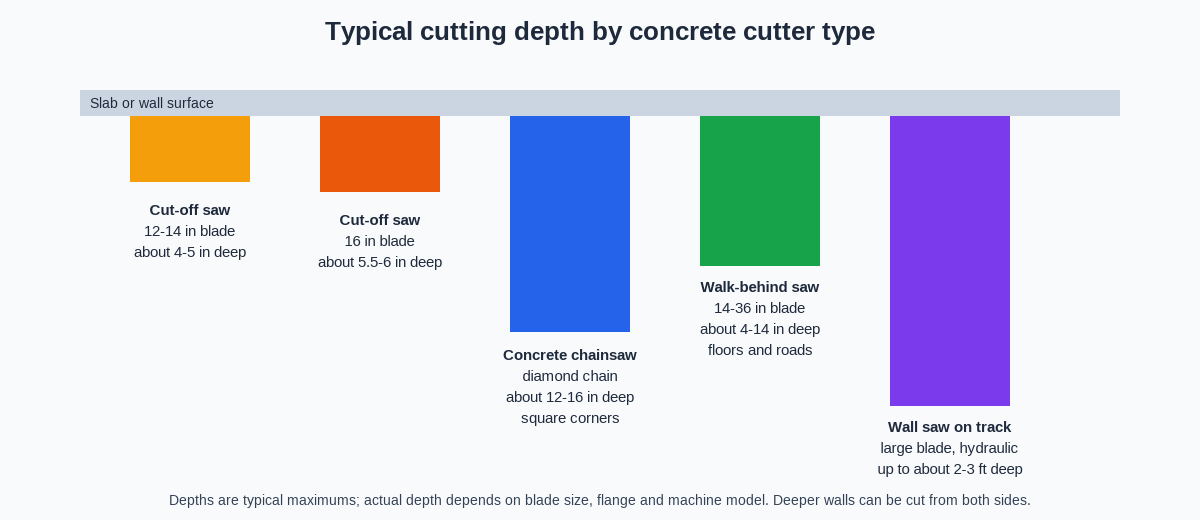
The chart above compares typical cutting depths. Here is what each concrete cutter does best.
Handheld cut-off saw
The handheld cut-off saw, also called a power cutter, quick cut saw or demo saw, is the most common concrete cutter. It is a gas, electric or battery motor driving a 12, 14 or 16 inch diamond blade, held with both hands. A 14 inch blade cuts about 5 inches deep, which is enough to go straight through most residential slabs, sidewalks and patios. Cut-off saws are fast, portable and relatively affordable, and they also cut block, brick, pavers, pipe and rebar with the right blade. Their limits are depth and corners: a round blade leaves overcuts at the ends of an opening, and anything thicker than about 5 or 6 inches must be cut from both sides or with a different machine.
Concrete chainsaw
A concrete chainsaw looks like a heavy-duty timber chainsaw, but its chain carries diamond segments and is fed constantly with water. A chainsaw for concrete cuts much deeper than a cut-off saw, typically 12 to 16 inches, and because the bar plunges straight in, it makes square inside corners without overcuts. That makes the concrete chainsaw the tool of choice for cutting doors and windows in foundation walls, finishing the corners of openings started with a larger saw, cutting small square holes for pipes and vents, and cutting concrete block walls in one pass from one side.
Walk-behind floor saw
A walk-behind saw, also called a flat saw, slab saw or road saw, is a concrete cutter on wheels with a blade from 14 to 36 inches or more, driven by a gas, diesel, electric or propane engine. The operator pushes it along a chalk line while the blade is lowered to depth. Walk-behind saws cut long, straight lines through slabs, driveways and roads, often 4 to 14 inches deep, and they are used to cut control joints in new concrete. They are the fastest way to remove large sections of floor or pavement.
Wall saw and wire saw
For thick walls and structures, contractors use a wall saw: a hydraulic or electric saw head that runs on a track bolted to the wall, as in the photo at the top of this page. Wall saws cut very straight, clean openings through walls 2 feet thick or more. Wire saws, which pull a diamond-beaded steel cable through the concrete in a loop, can cut almost unlimited thicknesses and are used for bridge piers, dams and massive foundations. These are professional concrete cutters' tools, not rental items.
Grinders and tuckpointers
A 4-1/2 to 9 inch angle grinder with a diamond wheel is a small concrete cutter for shallow cuts, trimming pavers and cutting out cracks before repair, with depths of about 1 to 3 inches. See concrete grinding.
Stihl Concrete Cutter Models
Stihl is one of the best-known makers of handheld cut-off saws, which it sells under the Cutquik name. When people search for a Stihl concrete cutter, they usually mean one of these gas or battery saws, or Stihl's concrete chainsaw. Specifications below are approximate and come from Stihl's published data; always check the current model sheet, since specs and prices change.
Stihl TS 410. A 66.7 cc gas cut-off saw with a 12 inch wheel and about 4 inches of cutting depth. It is lighter and easier to handle than the 14 inch models, and suits pavers, block and thinner slabs.
Stihl TS 420. The same 66.7 cc engine with a 14 inch wheel and about 5 inches of depth. The TS 420 is the classic rental-yard Stihl concrete cutter and weighs roughly 21 to 22 pounds without fuel or blade.
Stihl TS 440. A 14 inch, 66.7 cc saw with Stihl's QuickStop blade brake, which stops the wheel quickly in a kickback.
Stihl TS 500i. A 72.2 cc fuel-injected 14 inch saw with about 5 inches of depth. Fuel injection makes starting and power more consistent.
Stihl TS 700 and TS 800. Larger 98.5 cc saws. The TS 700 uses a 14 inch wheel; the TS 800 uses a 16 inch wheel and cuts about 5-1/2 to 5-3/4 inches deep. These are heavy, powerful saws for daily professional cutting.
Stihl TSA 230 and TSA 300. Battery cut-off saws. The TSA 230 uses a 9 inch wheel and cuts about 2-3/4 inches deep; the TSA 300 uses a 12 inch wheel and cuts about 4 inches deep. With no exhaust, battery saws can be used indoors and in trenches where gas saws are a carbon monoxide hazard.
Stihl GS 461 Rock Boss. Stihl's concrete chainsaw, a 76.5 cc gas saw with a diamond chain and water feed that cuts about 15 to 16 inches deep.
Approximate prices for a new gas Stihl concrete cutter range from about $1,100 to $1,900 depending on size, with battery models plus batteries and charger in a similar range, and the GS 461 concrete chainsaw at roughly $2,000 or more before chain and bar. Other well-known brands of cut-off saws and concrete chainsaws are made by Husqvarna, Makita, Hilti, ICS and others, and rental yards stock whichever brand their dealer carries.
Concrete Chainsaw: When to Use a Chainsaw for Concrete
A concrete chainsaw is the right concrete cutter when you need depth from one side or square corners. Common jobs include:
Doors and windows in foundation walls. An 8 or 10 inch poured wall or a block wall can be cut through from one side, and the corners stay square.
Finishing corners. Wall saws and cut-off saws leave the corners of an opening uncut because the round blade cannot reach them without overcutting. A chainsaw for concrete plunges in to finish them cleanly.
Small square openings. Vents, dryer ducts, plumbing chases and electrical boxes in thick walls.
Pipe and block cutting. Large concrete pipe and stacked block walls.
Running a concrete chainsaw is different from running a wood saw. The chain is worn away by the concrete as it cuts, so chains are a consumable, typically $250 to $500 each, and they must always run with water. Gas concrete chainsaws need a good garden hose supply at the pressure and flow the maker specifies; hydraulic concrete chainsaws, used by professionals, run from a separate hydraulic power unit and deliver more power with less vibration. The cut is started with the bar tip in a shallow guide cut, then plunged and moved slowly, letting the diamonds work. Concrete chainsaws cut rebar, but heavy steel wears the chain quickly. Rental yards usually charge a chain wear fee measured by how much the segments are worn when the saw comes back.
Cutting a Slab with a Concrete Cutter
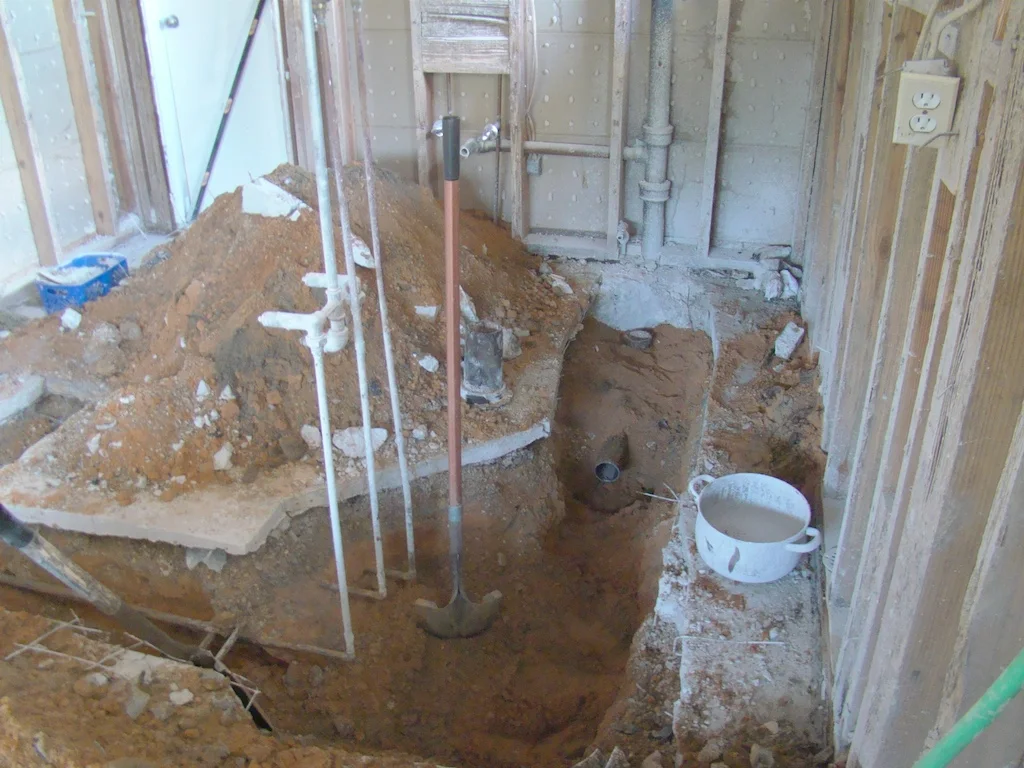
Photo: PatHayes, Flickr, CC BY-SA 2.0
The photo above shows a common reason to rent a concrete cutter: a trench cut through a slab floor inside a house to reach or reroute plumbing. Two parallel saw cuts give straight, clean edges, the concrete between them is broken out, and after the pipe work the trench is patched with new concrete doweled to the old slab. A handheld cut-off saw or a small walk-behind saw is the usual concrete cutter for this job, wet cutting where possible or with a vacuum shroud indoors, since a slab inside a home makes a large amount of dust. See slab leak repair and concrete removal cost.
Steps for a slab cut:
1. Locate what is inside and under the slab. Use plans, a utility locate and, for important cuts, ground-penetrating radar scanning to find post-tension cables, conduit, radiant heat tubing and pipes. Cutting a post-tensioned cable can be dangerous and costly.
2. Mark the lines. Snap chalk lines or use a straightedge, and mark a no-overcut point at the ends if needed.
3. Make a shallow guide pass. Cut about 1/2 inch deep along the whole line to set a straight kerf.
4. Cut to depth in passes. Deepen the cut in passes of 1 to 2 inches, letting the blade cut at its own pace.
5. Break and remove. Break the concrete between cuts with a breaker or sledgehammer, cut any rebar or mesh, and haul away the pieces.
Concrete Cutter Blades
The blade is half of any concrete cutter. Diamond blades vary by bond hardness, segment type and intended material:
Segmented blades have gaps between diamond segments that let water and slurry flow, and are the standard for wet cutting concrete.
Turbo and continuous rim blades cut more smoothly, with less chipping, and are used for tile, pavers and finished edges.
Hard-aggregate vs. soft-aggregate blades. Concrete made with hard aggregate, such as granite or river gravel, needs a softer bond so the diamonds are exposed as the metal wears, while abrasive materials like green concrete, block and asphalt need a harder bond.
Asphalt blades have undercut protection to resist wear from the abrasive material.
Wrong blade choice is the most common reason a concrete cutter seems slow or a blade glazes over. See concrete saw blades for a full guide.
Wet Cutting, Dust and Silica Rules
Cutting concrete releases respirable crystalline silica, which causes silicosis, lung cancer and other diseases. In the United States, OSHA's construction silica standard sets controls for each type of concrete cutter in its Table 1. For handheld power saws, the control is water delivered to the blade; when used outdoors for four hours or less a shift, no respirator is required, but longer use or indoor use requires a respirator with an assigned protection factor of at least 10. Walk-behind saws must also use water, and indoors the area must be ventilated. Drivable saws, wall saws and concrete chainsaws are also listed or follow similar wet methods.
Wet cutting creates slurry, a gray cement paste that should not be washed into storm drains. Collect it with a wet vacuum or let it settle and dry, then dispose of the solids. See concrete slurry and concrete dust.
For indoor work where water is not practical, some electric concrete cutters use a dust shroud connected to a HEPA vacuum that meets OSHA's requirements, but a gas concrete cutter should never be used indoors because of carbon monoxide.
Concrete Cutter Safety
Kickback. On a cut-off saw, cutting with the upper front quarter of the blade can throw the saw back toward the operator. Cut with the lower front part of the blade, keep both hands on the handles, and stand to the side of the cutting line.
Pinching. If the cut closes on the blade, the saw can jump or the blade can shatter. Support pieces so the kerf opens as you cut, and cut the final section last.
Guards and blade speed. Never remove the blade guard and never use a blade rated for a lower speed than the saw.
Protective gear. Safety glasses or a face shield, hearing protection, gloves, steel-toed boots, long sleeves and a respirator as required.
Hidden hazards. Electric lines, gas pipes and post-tension cables inside or under concrete are serious risks. Scan or locate before cutting.
Structure. Cutting openings in load-bearing walls or structural slabs requires an engineer's design, temporary shoring and often a permit.
Renting vs. Buying a Concrete Cutter
For most homeowners, renting is the obvious choice. Typical rental prices in the United States are:
Handheld gas cut-off saw: about $70 to $120 per day, often with a blade wear charge or blade purchase.
Concrete chainsaw: about $150 to $250 per day, plus a chain wear fee.
Walk-behind saw: about $100 to $200 per day, plus blade wear.
Buying makes sense for contractors and landscapers who cut weekly. A new gas Stihl concrete cutter or similar brand at $1,100 to $1,900, plus $100 to $400 blades, pays for itself after roughly 15 to 25 rental days. Battery concrete cutters cost more for batteries but avoid fuel mixing, starting problems and exhaust.
What Professional Concrete Cutters Charge
Hiring professional concrete cutters is often worth it for deep, structural or precise cuts. Prices vary widely by region, thickness and access, but typical ranges are:
Slab sawing: about $3 to $10 per linear foot for a 4 inch slab, more for thicker or heavily reinforced slabs.
Wall sawing: about $10 to $30 or more per linear foot depending on thickness.
Basement door or egress window opening: commonly $1,500 to $4,000 or more including the lintel or header, depending on wall thickness and finish work.
Core drilling: about $50 to $200 per hole depending on diameter and depth.
Minimum charge: most concrete cutters have a trip minimum of about $250 to $500.
Prices usually include the saw cut only; breaking out, hauling and disposal are often extra.
Gas, Electric, Battery or Hydraulic Concrete Cutters
Gas concrete cutters are the standard for outdoor work. Two-stroke engines from about 65 to 100 cc give plenty of power, run anywhere and refuel in seconds. Their downsides are noise, vibration, fuel mixing, pull starting and exhaust, which rules them out indoors and in trenches or basements without strong ventilation.
Electric concrete cutters plug into a wall outlet and are used for indoor cutting, often with a water feed from a pump tank and a ground-fault protected cord. They are quieter and produce no fumes, but their power depends on the circuit, and cords and water must be managed carefully.
Battery concrete cutters such as the Stihl TSA models combine indoor-friendly operation with portability. Run time per battery is limited, often enough for a few dozen feet of shallow cutting, so serious users carry several batteries.
Hydraulic concrete cutters, including hydraulic cut-off saws and hydraulic concrete chainsaws, are run from a separate power unit or from a skid steer or excavator's hydraulics. They are powerful, light for their output, and can even work underwater, which is why utility crews, fire departments and professional concrete cutters use them.
Choosing a Concrete Cutter for Common Jobs
Removing a section of patio or sidewalk: a 14 inch cut-off saw cuts through 4 inch concrete from the top in one or two passes.
Cutting control joints in a new slab: an early-entry saw or a small walk-behind saw within hours of finishing, or a cut-off saw the next day, cutting about one quarter of the slab depth. See control joints in concrete.
Plumbing trench in a house slab: a cut-off saw with water or a vacuum shroud, or an electric walk-behind saw for long runs.
New door or egress window in a poured foundation: a wall saw or a concrete chainsaw, usually by professional concrete cutters, after an engineer sizes the header.
Opening in a concrete block wall: a concrete chainsaw cuts an 8 inch block wall from one side with square corners; a cut-off saw can do it from both sides with some overcuts.
Driveway removal: a walk-behind saw cuts the driveway into slabs that a skid steer can lift out. See concrete driveway cost.
Pavers and block: a cut-off saw or a tile and block wet saw.
Concrete Cutter Maintenance
Concrete dust is extremely abrasive, so a concrete cutter wears faster than most power tools. To keep one running:
Clean the air filter daily. Gas cut-off saws have multi-stage filters; a clogged filter starves the engine and lets dust in, which ruins the piston and cylinder quickly.
Check the drive belt. Most cut-off saws drive the blade with a belt that stretches and wears; adjust tension as the manual describes.
Rinse slurry off. After wet cutting, rinse the guard, arm and water fittings so slurry does not harden inside.
Inspect the blade. Look for cracks, missing segments, a bent core or glazed segments. A glazed blade can often be dressed by making a few cuts in a soft abrasive block.
Concrete chainsaw care. Flush the chain and bar with water after use, check chain tension often, and replace the sprocket with every chain or two, since a worn sprocket destroys new chains.
Fuel. Use fresh fuel mixed at the ratio the maker specifies, or premixed ethanol-free fuel, especially for saws that sit for weeks between jobs.
Frequently Asked Questions
What is the best concrete cutter for a homeowner?
A rented 14 inch gas cut-off saw handles most home jobs: patios, walkways, slab trenches and pavers.
How deep can a Stihl concrete cutter cut?
About 4 inches with a 12 inch wheel, about 5 inches with 14 inch models such as the TS 420, and about 5-3/4 inches with the 16 inch TS 800.
How long does a concrete cutter blade last?
A quality 14 inch diamond blade on a concrete cutter typically cuts a few hundred to over a thousand linear feet of 4 inch slab, depending on aggregate hardness, depth, water use and operator technique.
Can a concrete cutter cut asphalt?
Yes. The same cut-off saws and walk-behind saws cut asphalt, but use an asphalt blade or a general-purpose blade rated for it, since asphalt wears concrete blades quickly. See how to cut asphalt.
Which is better, a Stihl concrete cutter or another brand?
Stihl, Husqvarna, Makita and other major brands all make capable cut-off saws. Dealer support, parts availability and the blade you choose matter more than the brand for most users.
Can a concrete chainsaw cut rebar?
Yes, a concrete chainsaw cuts rebar, but heavy steel wears the diamond chain faster.
Can you use a regular chainsaw for concrete?
No. A chainsaw for concrete needs a diamond chain, a reinforced bar, water feed and more power. A wood chain would be destroyed instantly.
Do I need water to use a concrete cutter?
Wet cutting is strongly recommended and, for work under OSHA rules, required or paired with a respirator. Water also keeps the blade cool and extends its life.
Sources
- OSHA: silica in construction, Table 1 controls for saws
- STIHL USA: cut-off machine specifications
- NIOSH: crystalline silica
- Concrete Sawing and Drilling Association
Related Guides
- Concrete disposal — concrete dumpster rental, recycling yards, landfill fees and washout
- Concrete machines — mixers, placer booms, screeds, trowels, sprayers, saws and scrubbers