
Concrete Slurry: What It Is, How to Mix It, Use It and Dispose of It

Photo: Z22, Wikimedia Commons, CC BY-SA 4.0
Quick Answer
Concrete slurry is a thin, watery mix of cement (and sometimes fine sand or fly ash) and water. Contractors use it in three main ways: as a bonding slurry brushed onto old concrete before a patch or overlay, as flowable fill (also called slurry mix or controlled low-strength material) to fill trenches and voids, and, in a different sense, the term also describes the wet waste slurry produced when concrete is sawed, ground or core drilled. Waste concrete slurry is highly alkaline, often pH 11 to 13, and must be collected and disposed of properly, not washed into storm drains. A bag of cement for a bonding slurry costs about $15 to $20, flowable fill typically costs $100 to $180 per cubic yard delivered, and slurry cleanup on cutting jobs often adds $0.50 to $2 per linear foot of cut.
The word slurry shows up all over concrete work, and it does not always mean the same thing. A finisher talks about brushing a cement slurry onto a slab before a topping. A utility contractor orders a truck of concrete slurry to backfill a trench. A sawcutting crew worries about how to vacuum up the gray concrete slurry their blades leave behind, because a city inspector will fine them if it runs into a storm drain. The photo above shows yet another use: a polymer-modified cement slurry rolled onto a crosswalk and stamped with a brick pattern.
This guide explains each kind of concrete slurry, how to mix and apply a bonding slurry, when flowable fill makes sense, how to manage and dispose of cutting and grinding slurry, how slurry walls are built, the safety risks of wet cement, and what concrete slurry work typically costs.
What Is Concrete Slurry?
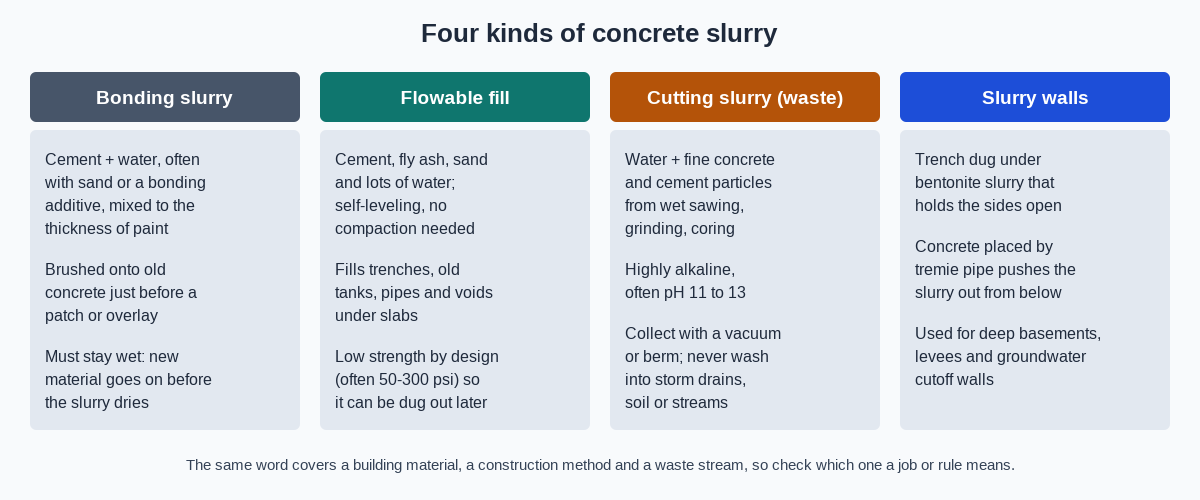
As the diagram shows, concrete slurry is a general name for any fluid mixture of cement particles and water that is thin enough to pour, pump or brush. Ordinary concrete is a stiff mix of cement, water, sand and gravel. A concrete slurry has much more water and little or no coarse aggregate, so it flows like a thick liquid. The four common meanings are:
1. Bonding slurry (cement slurry). Portland cement and water, sometimes with fine sand, latex or acrylic bonding additive, mixed to the thickness of paint or pancake batter. It is scrubbed into a clean, damp concrete surface just before new concrete, mortar or a patch is placed, to improve the bond between old and new.
2. Flowable fill (slurry mix). A low-strength concrete slurry of cement, fly ash, sand and water that flows into place without compaction. It is used to backfill utility trenches, fill abandoned tanks and pipes, and fill voids under slabs. Highway and utility specifications call it controlled low-strength material, or CLSM.
3. Cutting and grinding slurry. The gray mud produced when concrete is wet sawed, core drilled, ground or polished. Water cools the blades and controls dust, and it carries away fine concrete and cement particles. This concrete slurry is a waste product with a very high pH, and it is regulated.
4. Slurry walls. A construction method in which a deep trench is excavated while filled with bentonite or cement slurry that holds the trench walls open. Concrete is then placed under the slurry to form an underground wall.
There is also cement slurry used to cement oil and gas wells, and slurry used in shotcrete and grouting, but for most builders and homeowners the first three are the ones that matter.
How to Mix a Cement Slurry Bonding Coat
A bonding slurry is one of the simplest and most useful tricks in concrete repair. Fresh concrete or mortar placed on old, dry concrete often fails to bond: the old surface sucks water out of the new material, and dust or laitance on the surface acts as a weak layer. A thin concrete slurry coat fills the pores, wets the surface and gives the new material something to grip.
Basic recipe. Mix Portland cement and water to a creamy consistency, about the thickness of house paint. Many finishers add an equal volume of fine sand for a slightly thicker cement slurry on rough surfaces. For better bond and flexibility, replace part or all of the mixing water with a latex or acrylic bonding admixture, following the product label. A typical starting point is one part bonding additive to two or three parts water, but manufacturers' ratios vary.
Surface preparation. The old concrete must be sound and clean. Remove loose concrete, dirt, oil, paint and sealers by scraping, grinding or pressure washing. Roughen smooth surfaces so the slurry and new material can key in. The day before, or at least a few hours before, wet the concrete so it reaches a saturated surface dry condition: damp throughout, with no standing water on top.
Application. Scrub the cement slurry into the surface with a stiff broom or brush, working it into every pore and crack. Apply only as much area as you can cover with new concrete or patching material within a few minutes. The concrete slurry must still be wet and tacky when the new material goes on. If the slurry dries to a white skin, it becomes a weak layer instead of a bond coat, and it should be removed or recoated.
Where it is used. A concrete slurry bond coat is common under concrete toppings and overlays, when resurfacing steps and slabs, under patches, when setting new concrete against old at a cold joint, before stuccoing over block or concrete, and when bedding pavers or stone in mortar. See how to resurface concrete, concrete patching compound and cold joints in concrete.
Cement Slurry vs. Bonding Agents
A plain cement slurry is cheap and works well when applied correctly, but it is unforgiving: it must be applied to a properly dampened surface and covered while still wet. Commercial bonding agents fall into two groups. Re-emulsifiable bonding agents can be painted on and allowed to dry, then reactivated by the moisture of the new concrete, which gives more working time but lower strength, so they are best for interior, non-wet areas. Non-re-emulsifiable bonding agents, usually latex or acrylic types mixed into a cement slurry, and epoxy bonding agents give stronger, more water-resistant bonds for exterior and structural work. Many contractors use a combination: a latex-modified concrete slurry scrubbed into the surface just before placing the new material. See concrete primer for related surface treatments.
Flowable Fill: Concrete Slurry for Trenches and Voids
Flowable fill is one of the most common uses of concrete slurry on construction sites. Ready-mix plants batch it like concrete, but with much less cement, plenty of fly ash or sand, and a lot of water. It arrives in a mixer truck and is poured straight into a trench, hole or void, where it levels itself and fills every space without tamping or compaction. Because it contains so little cement, its compressive strength is usually only 50 to 300 psi, compared with 3,000 psi or more for ordinary concrete. That low strength is intentional: it is strong enough to support pavement and loads above it, but weak enough to dig out by hand or with a small excavator if utilities need to be reached later.
Common uses for flowable fill concrete slurry:
Utility trenches. Backfilling trenches for water, sewer, gas and electrical lines under roads and driveways, where poorly compacted soil would settle and crack the pavement.
Abandoned tanks and pipes. Filling old fuel oil tanks, septic tanks, culverts and pipes that are left in place, which many local codes require to prevent collapse.
Voids under slabs and behind walls. Filling washouts under sidewalks and driveways, voids behind retaining walls, and the space around foundations where access for compaction is difficult.
Bridge abutments and culverts. Placing fill around structures where heavy compaction equipment could damage them.
Advantages of flowable fill over compacted soil include speed, no settlement, no need for compaction crews and testing, and the ability to fill narrow and irregular spaces. Disadvantages include material cost, the need for a ready-mix truck, and the fact that it is a fluid: forms, bulkheads or sandbags may be needed to keep it in place, and buoyant pipes can float unless they are weighted or placed in lifts. Mudjacking, covered below, uses a similar concrete slurry pumped under sunken slabs.
Slurry Mix and Mudjacking
Mudjacking, also called slabjacking, uses a concrete slurry pumped through small holes drilled in a sunken slab. The slurry, usually a mix of cement, sand, topsoil or limestone, and water, fills the void under the slab and lifts it back toward level. It is an older and cheaper alternative to polyurethane foam leveling. The slurry is heavier than foam, which can lead to further settlement on weak soils, but it is mineral-based and fills large voids well. See concrete leveling cost and self-leveling concrete.
Concrete Slurry from Sawing, Grinding and Core Drilling
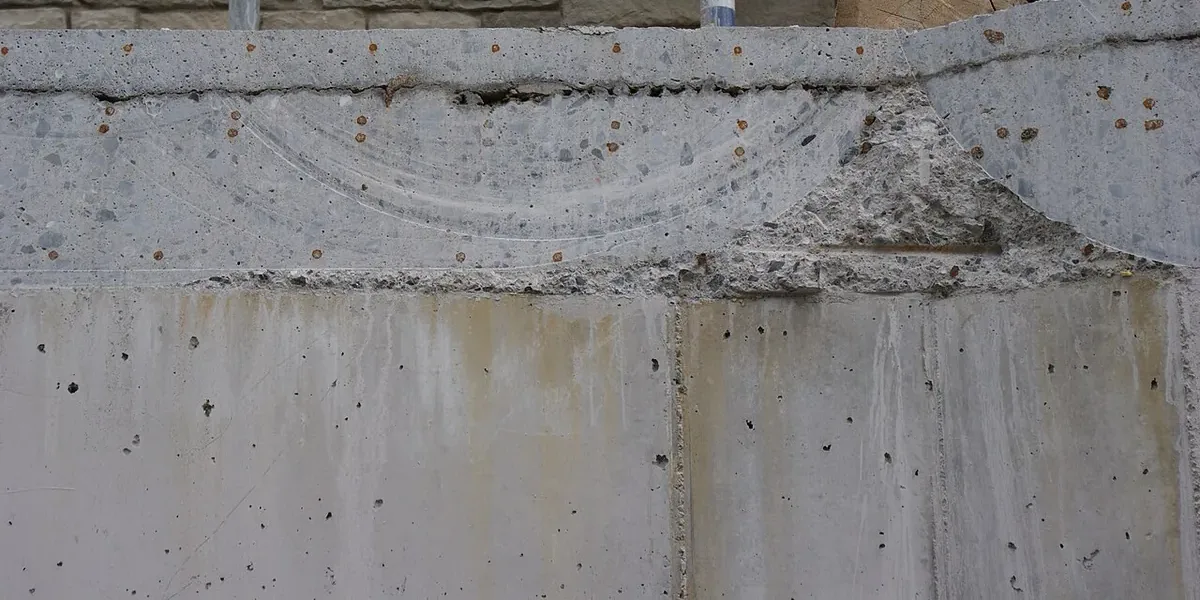
Photo: Asurnipal, Wikimedia Commons, CC BY-SA 4.0 (cropped)
The second big meaning of concrete slurry is the gray, muddy water that comes out of every wet cutting, coring, grinding and polishing job. The photo above shows the dried streaks of concrete slurry left on a wall below a wet saw cut. Wet methods are the standard way to control silica dust from concrete, which OSHA regulates closely, so concrete slurry is produced on almost every cutting job. See concrete saw, concrete core drilling, concrete grinding and concrete dust.
Cutting concrete slurry contains water, very fine concrete and aggregate particles, unhydrated cement, and sometimes traces of metals from blades, oils and other contaminants. Fresh cement makes the water strongly alkaline, typically pH 11 to 13, about as caustic as household bleach or oven cleaner. When concrete slurry reaches a storm drain, it goes straight to a creek, river or lake without treatment, where the high pH and fine sediment can kill fish and smother the habitat they depend on. That is why the Environmental Protection Agency's stormwater programs, state environmental agencies and city ordinances treat concrete slurry as a pollutant.
How to Contain and Collect Cutting Slurry
Good slurry management starts before the first cut:
Plan the work area. Find nearby storm drains, catch basins and gutters. Cover or protect inlets with drain covers, berms or sandbags before cutting begins.
Use as little water as possible. Set the saw's water flow to the minimum needed to cool the blade and control dust. Less water means less concrete slurry to handle.
Contain it as you go. Use temporary berms, absorbent socks or sandbags to keep the concrete slurry in a small area around the cut.
Vacuum it up. Wet/dry vacuums and dedicated slurry vacuums collect the concrete slurry directly from the saw cut or core hole. Many core drilling rigs use a water collection ring that seals against the surface and sends the concrete slurry straight to a vacuum.
Clean the surface. Once the slurry dries, it leaves a hard gray film that is difficult to remove, so clean surfaces before the concrete slurry sets, especially on decorative concrete, stone, glass and painted surfaces.
Disposal of Concrete Slurry
After collection, concrete slurry has to go somewhere. The rules depend on the state and city, but common approved methods include:
Settling and drying. Pump or pour the concrete slurry into a lined washout container or a filter bag, let the solids settle, and let the water evaporate. The dried solids are inert concrete and can usually be disposed of as construction debris or recycled with other concrete.
Solidifiers. Absorbent polymer or mineral solidifiers turn liquid concrete slurry into a solid that can be disposed of with construction waste.
Filtration and pH treatment. Larger jobs use filter presses or settling tanks and neutralize the pH of the separated water, often with carbon dioxide or acid dosing, before reuse or discharge to a sanitary sewer with permission.
Hauling. Some contractors haul concrete slurry back to a ready-mix plant or recycling facility.
Never pour concrete slurry into storm drains, ditches, streams, lawns or landscaping. Discharging it to a sanitary sewer usually requires permission from the local wastewater utility. See concrete washout for washout containers and rules for ready-mix trucks.
Slurry Walls
In heavy construction, the slurry wall method builds deep concrete walls in the ground before excavation. A crew digs a narrow trench in panels, often 2 to 5 feet wide and 50 to 150 feet deep or more, keeping it full of bentonite clay slurry at all times. The heavy, dense slurry presses against the trench walls and prevents collapse, even below the water table. A steel reinforcing cage is lowered into the slurry-filled trench, and concrete is pumped to the bottom through a tremie pipe. Because concrete is heavier than the slurry, it displaces the slurry upward, where it is pumped out, cleaned and reused. Adjacent panels are joined to make a continuous wall.
Slurry walls are used for deep basements and subway stations in cities, for levees and dam cutoff walls that block groundwater flow, and around contaminated sites to contain polluted groundwater. Some cutoff walls use a cement-bentonite slurry that is left in place to harden, without a separate concrete pour. See concrete retaining wall.
Polymer Cement Slurry Coatings
Thin polymer-modified cement slurry coatings, like the crosswalk in the photo at the top of this page, are used to resurface and color asphalt and concrete pavements. The slurry is spread with squeegees or sprayed over a stencil or imprinted pattern, building a hard, colored surface a fraction of an inch thick. These coatings are popular for crosswalks, plazas, parking lots and driveways because they give the look of brick or stone at much lower cost. Similar cement slurry coats are used under stamped overlays and as broadcast finishes on pool decks and patios. See decorative concrete and concrete pool deck resurfacing.
Concrete Slurry vs. Grout vs. Mortar
Concrete slurry, grout and mortar are all mixtures of cement, water and fine material, and the names overlap on jobsites, but they are made for different jobs. Mortar is a stiff, sticky paste of cement, lime, sand and water that holds bricks, blocks and stone together and stays where it is placed. Grout is more fluid, designed to be poured or pumped into block cores, joints, anchor holes and gaps under machinery bases, and it often contains pea gravel or special non-shrink additives. Concrete slurry is the thinnest of the three. A cement slurry is closer to paint than to paste, which is exactly what makes it good for scrubbing into the pores of old concrete. A slurry mix for flowable fill is thinner than grout and much weaker, because it is designed to be dug out later. When a specification or product label uses one of these words, follow its mix proportions rather than assuming the terms are interchangeable. See types of concrete finishes.
Concrete Slurry for Setting Pavers, Stone and Tile
Masons and tile setters use a cement slurry to improve the bond of stone, pavers and tile set in a mortar bed. The slurry is brushed onto the back of each stone, or onto the mortar bed just before the stone is placed, so that the two surfaces are fully wetted and in contact. This slurry bond coat is especially common for natural stone treads, flagstone on concrete slabs and thick tile set on a mortar bed outdoors, where freeze-thaw cycles and moisture quickly reveal weak bonds. The concrete slurry must be used while wet; once it skins over, it stops acting as a bond coat. A small amount of latex additive in the cement slurry improves adhesion and flexibility for exterior work. See laying pavers over concrete and tile over concrete.
Sack Rubbing and Slurry Finishes on Walls
On cast-in-place walls, columns and bridge parts, small bug holes and surface voids are often filled with a cement slurry in a process called sack rubbing or a rubbed finish. Workers dampen the wall, rub a concrete slurry of cement and fine sand into the surface with a burlap sack or rubber float, and then rub off the excess so that the slurry remains only in the holes. The result is a more uniform surface that accepts paint or coatings better. A similar thin cement slurry coat, sometimes called a brush coat or fog coat, is used on concrete block walls before stucco or parging. Because these slurries contain so little aggregate, they should be cured with a light misting of water for a day or two so they do not dry out and crack. See concrete columns and how to paint cinder blocks.
Reusing and Recycling Concrete Slurry
Concrete producers and large cutting contractors increasingly treat concrete slurry as a material to recover rather than a waste to discard. Ready-mix plants run returned concrete and truck washout water through reclaimers that separate sand and gravel for reuse, and the remaining slurry water is often reused as part of the mixing water in new concrete, within limits set by ASTM C1602. The fine solids left behind from concrete slurry can be dried and used as fill or in some cases as a raw material for cement production. Newer systems inject carbon dioxide into wash water, which both lowers the pH and permanently binds the carbon in the solids. On small jobs, the most practical approach is to let the concrete slurry dry in a lined container, break up the solids and recycle them with other broken concrete. See crushed concrete.
Safety When Working with Concrete Slurry
Wet cement is caustic. Concrete slurry on skin can cause chemical burns, especially when it soaks through clothing or gets trapped inside gloves and boots, and the burns often are not felt until hours later. Wear waterproof gloves, long sleeves, long pants and waterproof boots with pants worn over the boot tops, and wash off any concrete slurry immediately with clean water. Wear eye protection; cement slurry in the eyes is a medical emergency that needs prolonged flushing with water. When dried concrete slurry is broken up or swept, it can release fine crystalline silica dust, so clean up while it is still damp or use a vacuum with a HEPA filter.
Concrete Slurry Cost
Typical 2026 costs for concrete slurry work vary by region and job size:
Bonding slurry materials: a 94-pound bag of Portland cement costs about $15 to $20, and latex bonding additives about $20 to $45 per gallon. A bag of cement makes enough cement slurry for a few hundred square feet.
Flowable fill: about $100 to $180 per cubic yard delivered, depending on mix strength, plus delivery minimums and short-load fees for small orders. Filling a 1,000-gallon abandoned tank takes roughly 5 cubic yards.
Mudjacking: commonly $3 to $8 per square foot of slab lifted, often with a minimum charge of a few hundred dollars.
Slurry management on cutting jobs: contractors often add $0.50 to $2 per linear foot of cut, or a flat cleanup fee, for containment, vacuuming and disposal of concrete slurry.
See concrete repair cost and concrete price per yard.
Common Mistakes with Concrete Slurry
Letting the bond coat dry. A cement slurry that dries before the new material goes on becomes a weak, chalky layer and can cause the patch to delaminate.
Applying cement slurry to a dirty or dry surface. Dust, oil and laitance block the bond, and dry concrete pulls water out of the slurry too fast.
Too much water in the mix. An overly thin cement slurry has low strength and shrinks as it dries.
Washing cutting slurry into drains. Even small amounts of concrete slurry can lead to fines and stop-work orders, and the alkaline water harms waterways.
Ordering the wrong flowable fill. A high-strength slurry mix is hard to dig out later; specify an excavatable mix where future access is likely.
Frequently Asked Questions
What is concrete slurry used for?
As a bonding coat between old and new concrete, as flowable fill for trenches and voids, in mudjacking, in slurry walls, and as a thin decorative coating. The term also describes waste water from cutting and grinding concrete.
What is the mix ratio for cement slurry?
For a bonding slurry, mix Portland cement and water, or water plus a bonding additive, to the consistency of thick paint. Adding fine sand at about one part to one part cement gives a heavier slurry for rough surfaces.
Can I dump concrete slurry on the ground?
No. Concrete slurry is highly alkaline. Let it settle and dry in a lined container or use a solidifier, then dispose of the solids as construction debris.
How strong is flowable fill?
Usually 50 to 300 psi, low enough to dig out later. Higher-strength mixes are available for structural fill.
Is concrete slurry the same as grout?
They are similar. Grout is a fluid cement mix designed to fill joints, cores or voids, while slurry usually refers to a thinner mix or to flowable fill and waste water.
Sources
- American Concrete Institute: ACI 229R, controlled low-strength materials
- US EPA: stormwater discharges from construction activities
- OSHA: silica standard for construction, wet methods
- Portland Cement Association: bonding new concrete to old
Related Guides
- Concrete polisher — planetary grinders, hand polishers, pads and rental prices
- Concrete cutter — cut-off saws, Stihl models, concrete chainsaws, depths and rental
- Concrete disposal — concrete dumpster rental, recycling yards, landfill fees and washout