
Concrete Grinding: How to Grind Concrete Floors and Choose Grinders, Discs and Scarifiers
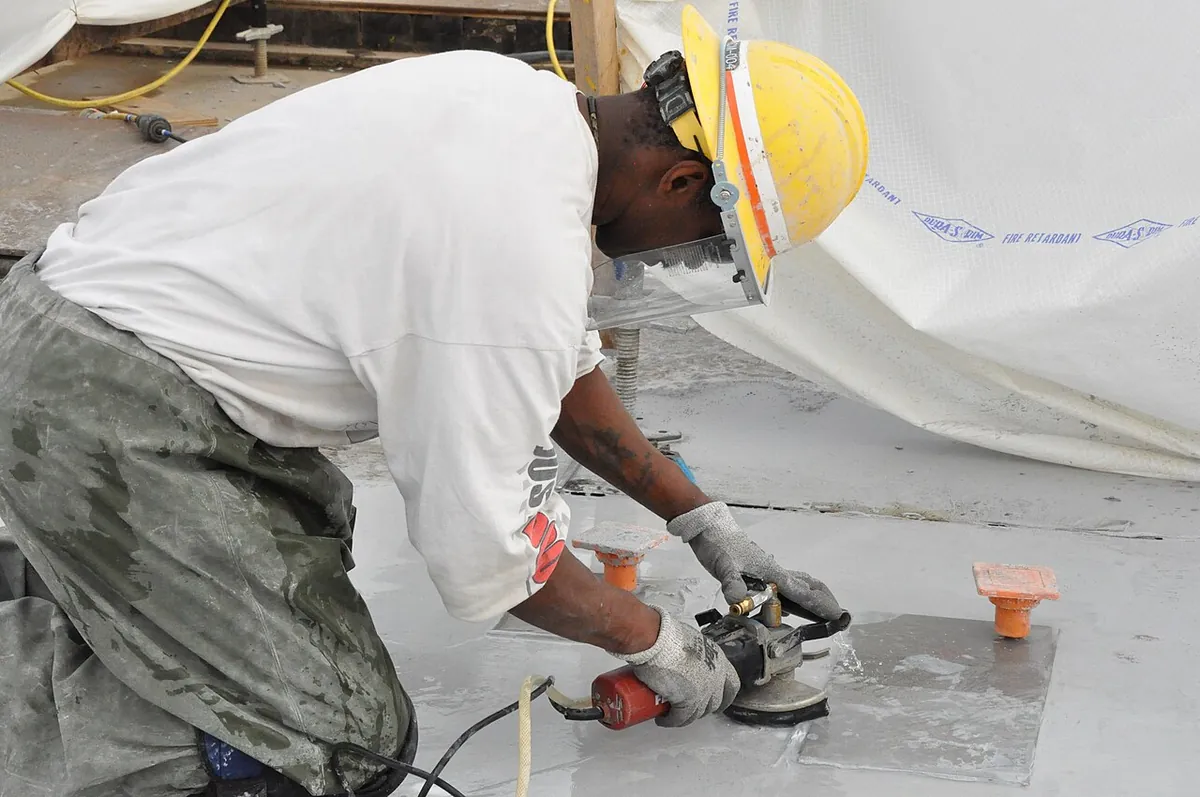
Photo: PEO ACWA, Wikimedia Commons, CC BY 2.0
Quick Answer
Concrete grinding uses rotating diamond tooling to remove a thin layer of a concrete surface: to flatten high spots and lips, remove coatings, glue, paint and thinset, open the surface so new coatings bond, or start the process of polishing. Small areas, edges and high spots are done with a hand held concrete grinder (an angle grinder with a diamond cup wheel and a dust shroud). Whole rooms and garages are done with a walk-behind concrete floor grinder fitted with metal-bond diamond segments, starting coarse and moving to finer grits. A concrete scarifier uses rotating cutters to remove thicker layers fast and leave a rougher surface. You can rent a concrete grinder from most tool rental stores. Always grind with a HEPA dust extractor or water, because concrete dust contains crystalline silica.
Grinding concrete is one of the most useful ways to fix and prepare a slab without tearing it out. It can take down a raised edge where two slabs meet, smooth a rough or uneven garage floor, strip old epoxy or carpet glue, remove a thin layer of damaged surface, and give a floor the right texture for paint, epoxy, an overlay or polishing. It is also dusty, noisy, and easy to get wrong if you choose the wrong machine or diamonds.
This guide explains what concrete grinding can and cannot do, how to choose between a hand held grinder, a concrete floor grinder and a scarifier, how diamond discs and blades work and which to use, how to grind concrete floor surfaces step by step, how sanding differs from grinding, what renting and hiring cost, and how to control dust safely.
What Concrete Grinding Is Used For
Concrete grinding is mainly a surface preparation and leveling process. The most common jobs are removing trip hazards where a sidewalk panel or slab joint has heaved; flattening high spots, ridges and trowel marks before laying tile, vinyl or wood; removing old coatings such as paint, epoxy, sealers, mastic, carpet adhesive and thinset; removing a thin layer of weak, dusty or contaminated surface; opening the surface pores so coatings and overlays bond, often specified as a concrete surface profile (CSP) under the International Concrete Repair Institute's guidelines; and grinding concrete floors as the first stages of polishing.
Grinding concrete cannot fix a slab that is badly cracked, settling or broken. It also cannot level a floor that is far out of level over a large area, because removing more than a fraction of an inch would weaken the slab and expose stones unevenly. For those problems, lifting, self-leveling underlayment or replacement are better options. See concrete leveling cost and self-leveling concrete.
Types of Concrete Grinders
Hand Held Concrete Grinder
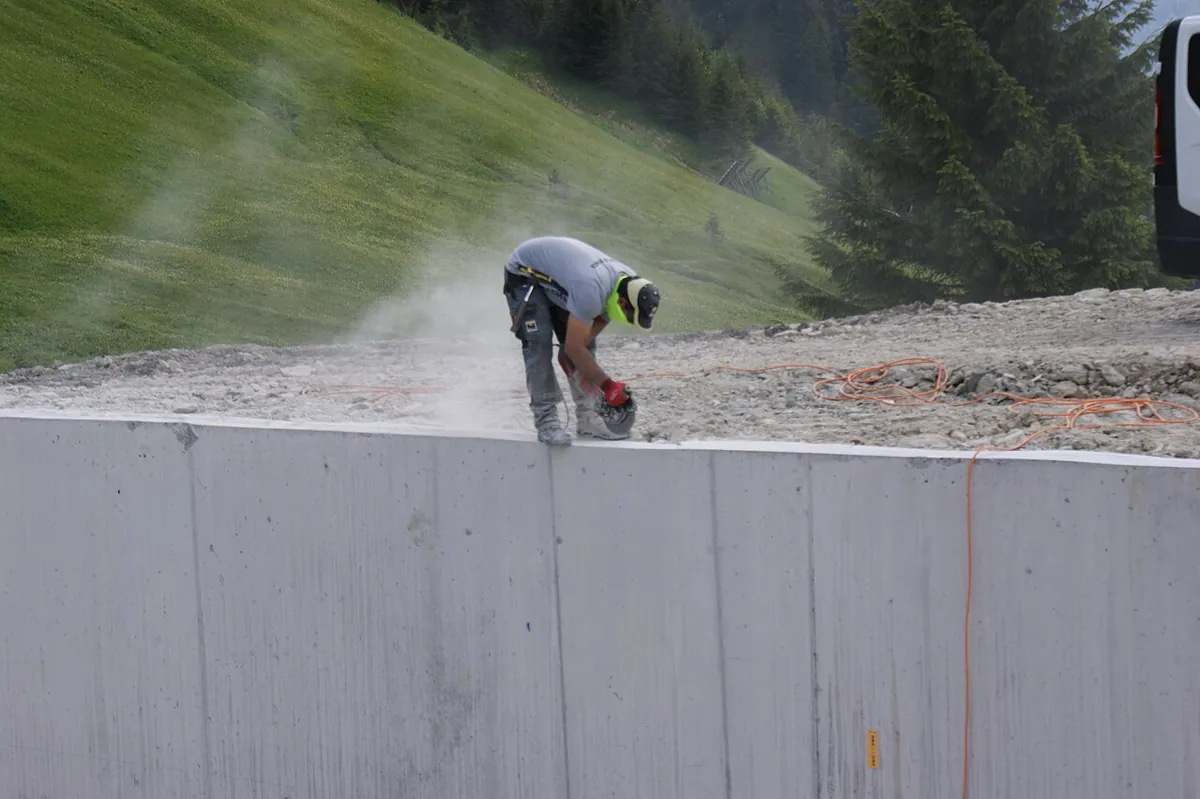
Photo: Asurnipal, Wikimedia Commons, CC BY-SA 4.0
A hand held concrete grinder is usually a 4 1/2, 5 or 7 inch angle grinder fitted with a diamond cup wheel and a dust shroud connected to a vacuum. Dedicated concrete surfacing grinders look similar but are built for constant grinding, often with variable speed and a better shroud. Hand grinders are used for edges, corners, steps, walls, small patches, raised joints and trip hazards, and for jobs too small to justify a big machine. They remove material quickly on a small area but are tiring to use over a whole floor and hard to keep flat. Water-fed hand grinders, like the one in the photo above, keep dust down by grinding wet.
Walk-Behind Concrete Floor Grinder
A concrete floor grinder is a walk-behind machine with one, two, three or four rotating heads holding diamond segments, typically covering a path of about 10 to 30 inches or more. Planetary grinders, where several heads rotate on a plate that also rotates, give a flat, even scratch pattern and are the standard for grinding concrete floors and polishing. Single-disc machines are simpler and cheaper, common in rental fleets, and good for removing coatings and light prep. Small floor grinders for concrete run on standard household circuits; large ones need 240 volt or three-phase power, or propane. Every floor grinder concrete contractors use is paired with a dust extractor.
Concrete Scarifier
A concrete scarifier, also called a scabbler in some regions or a milling machine, uses rows of hardened steel or carbide cutter wheels on a rotating drum that chip and fracture the surface. Concrete scarifiers remove material faster than grinders, from about 1/16 inch up to about 1/4 inch per pass, and leave a rough, grooved surface. They are used for removing thick coatings, rubber and mastic, cleaning up oil-soaked surfaces, cutting grooves for traction, and preparing for thick overlays. A scarifier for concrete leaves a surface too rough for thin coatings, so it is often followed by a grinder.
Other surface prep machines include shot blasters, which throw steel shot at the surface to clean and profile it, and bush hammers. For most homeowners, the choice is between a hand held grinder, a floor grinder and a scarifier. Concrete scarifier and grinder rental is widely available.
Concrete Grinding Discs, Cup Wheels and Blades
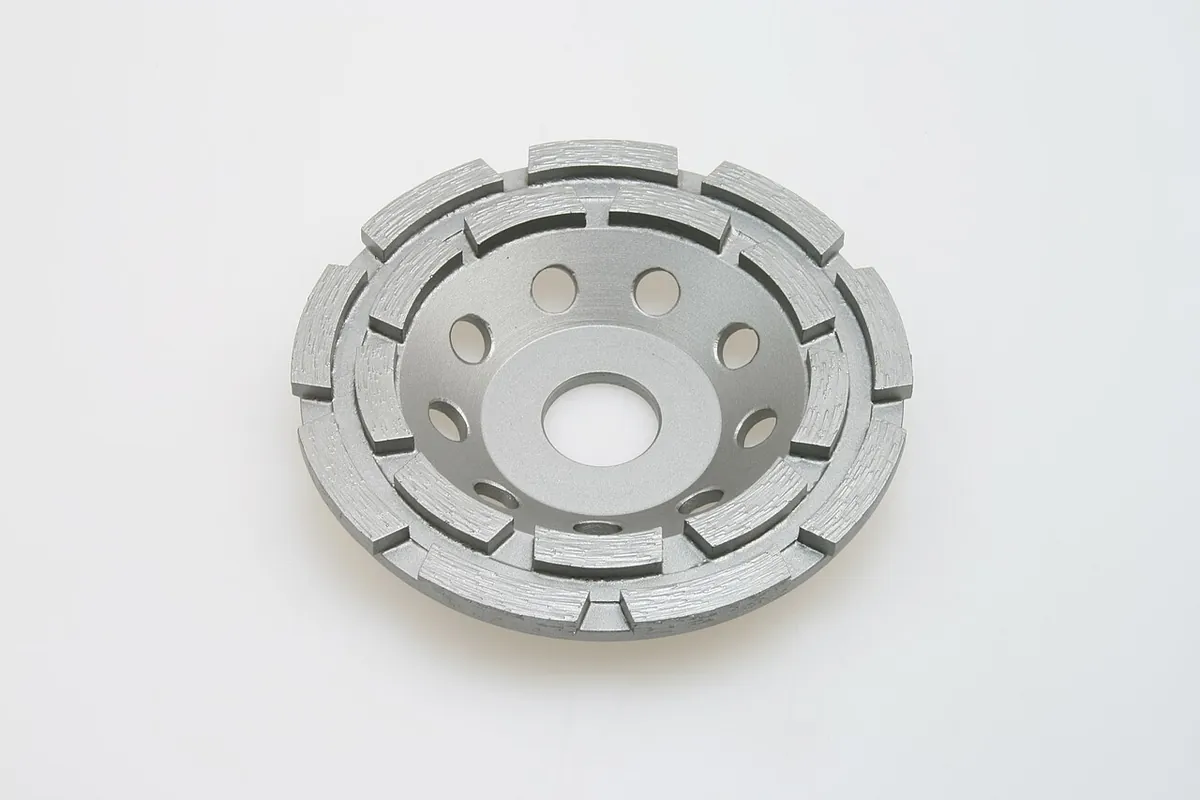
Photo: Diatools at German Wikipedia, Wikimedia Commons, CC BY-SA 3.0
The tooling does the work in concrete grinding. Diamonds embedded in a metal or resin bond scratch away the concrete, and the bond wears slowly to expose fresh diamonds. Choosing the right concrete grinding disc for the job matters as much as choosing the machine.
For angle grinders, the standard disc for grinding concrete is a diamond cup wheel: a steel cup with diamond segments around the rim. Single-row cup wheels cut aggressively and are good for removing coatings and high spots; double-row cup wheels, like the one pictured, are a good all-purpose choice; turbo cup wheels with many small segments leave a smoother finish. PCD (polycrystalline diamond) cup wheels have sharp diamond chunks that scrape off thick, soft coatings such as epoxy, mastic and glue without clogging. The concrete grinder disc size should match the grinder and the shroud.
On a grinder, concrete blade choice is a different matter. Diamond cutting blades, thin segmented or continuous rim discs, are for cutting through concrete, not for grinding its surface. A concrete blade for grinder use in cutting control joints or trimming edges is fine, but never grind with the side of a cutting blade; it is not designed for side loads and can shatter. When people search for a concrete grinder blade, they usually mean a cup wheel or segment for grinding, and the two should not be mixed up. See how to cut concrete and concrete saw.
For walk-behind machines, concrete grinding discs are steel plates or quick-change holders fitted with diamond segments, usually metal-bond for grinding and resin-bond for polishing. Grits run from very coarse, around 16 to 30 for heavy removal, through 40 to 80 for general grinding, to 120 to 150 for a smoother finish, then resin pads from about 50 up to 3,000 for polishing. The bond hardness must match the concrete: soft-bond segments for hard concrete, and hard-bond segments for soft concrete. A wrong match either glazes over and stops cutting, or wears away very quickly.
Choosing a Disc for Concrete Grinder Work
When you pick a disc for concrete grinder jobs, start with the task. To take down a high spot or lip, use an aggressive single-row or double-row cup wheel. To remove paint or thin sealers, a double-row or turbo cup works well. To strip thick epoxy, mastic or glue, use a PCD cup wheel, because ordinary segments clog with soft material. For smoothing after removal, switch to a finer turbo cup or a finer-grit segment. Match the arbor size and diameter to your grinder and shroud, and check the maximum speed rating on the disc against the grinder's speed. Cheap grinding discs for concrete may look the same as quality ones but have fewer diamonds and wear out much faster, so they often cost more per square foot of work.
If you are comparing products, you will see the same tool described many ways: a grinding disc for concrete, a grinder disc, concrete cup wheel, diamond cup, or concrete grinder blades. They all describe diamond tooling for grinding a surface. A disc grinder for concrete is simply an angle grinder or surfacing grinder that takes these discs. On a floor grinder, the equivalent parts are the segment plates and pads. Pick the right grinder disc. Concrete hardness, the coating you are removing, and the finish you want should decide it.
How to Grind Concrete Floor Surfaces, Step by Step
Here is how to grind concrete floor surfaces in a garage, basement or room, with a walk-behind concrete floor grinder and a hand grinder for the edges.
Step one is to prepare the room. Remove everything from the floor, cover drains, seal doorways with plastic sheeting, and protect walls near the floor. Check the slab for nails, bolts, tack strip and metal that could catch the tooling, and grind or cut them flush. Fill large cracks and holes after grinding, not before, unless they would catch the machine.
Step two is to test. Grind a small area with your chosen tooling to see how fast it cuts and what it reveals. If the tooling glazes and barely cuts, the concrete is hard and needs a softer bond; if it wears quickly, the concrete is soft and needs a harder bond. Testing also shows whether a coating gums up the diamonds.
Step three is the first pass. Start in a back corner and work toward the exit in overlapping rows, moving the machine slowly and steadily. Do not let it sit in one spot, which leaves a dip. For grinding concrete floors with coatings, the first pass removes the coating; for bare floors, it opens the surface and takes down high spots. Run the dust extractor the whole time.
Step four is to do the edges. A floor grinder for concrete cannot reach the last inch or two along walls and into corners, so finish those with a hand held concrete grinder fitted with a cup wheel and shroud, matching the grit of the floor machine.
Step five is finer passes. For a coating profile, one or two passes may be enough. For a smoother surface, change to finer diamonds and grind again at right angles to the previous pass, until the scratches from the coarse grit are gone.
Step six is cleaning. Vacuum thoroughly with a HEPA vacuum, inspect the surface, and fill cracks and holes with a suitable repair material, then grind the repairs flush. The floor is now ready for its coating, overlay, sealer or polishing. That is how to grind concrete floor surfaces for most home projects; polishing adds many more steps with resin pads and a densifier. See polished concrete cost and concrete coating cost.
Choosing a Grinder for Concrete Floor Work
The best grinder for concrete floor work depends on area, power and the job. For a single trip hazard or a few square feet, a hand held grinder is enough. For a one-car garage or small basement, a single-disc or small planetary concrete floor grinder that runs on a standard 120 volt circuit is the usual rental choice. For a two-car garage or larger, a bigger machine on 240 volts saves many hours. For commercial floors, large planetary concrete floor grinders with ride-on or remote-controlled models are used by specialist contractors.
Things to compare when choosing floor grinders for concrete include grinding width, head type (single, dual or planetary), weight (heavier machines cut faster), power supply, speed control, how easy it is to change tooling, and how well the shroud seals to the floor for dust collection. A floor concrete grinder that is too light skips over hard concrete; one that is too heavy is hard to move up stairs and into a basement. Ask the rental store which machine they recommend for your square footage, the hardness of the concrete, and the coating you are removing.
Sanding Concrete Floor Surfaces
People often ask how to sand concrete floor surfaces, and whether a concrete sander is different from a grinder. In practice, sanding concrete floor surfaces means the same process with finer abrasives: resin-bond diamond pads, sanding screens or sandpaper-like discs used after grinding, or on their own for light smoothing. A cement floor sander is often a floor grinder fitted with fine pads, or a rotary floor machine like those used for cleaning, fitted with diamond sanding pads. For a small floor, concrete sander attachments for a hand grinder or random orbit sander can smooth patches and remove light stains.
Concrete floor sanding cannot remove much material or fix high spots; it is a finishing step. If you want to sand concrete floor areas to prepare for paint or sealer, a light grind or sand with a medium grit opens the surface enough for penetration. If you only need to clean and lightly roughen the surface, etching or a floor sander for concrete with sanding screens may be enough. Many home centers rent a floor sander for concrete use that is the same machine used to buff hardwood floors, fitted with a diamond or abrasive plate.
Here is how to sand concrete floor surfaces simply: clean the floor, choose a pad around 50 to 100 grit for smoothing or 200 and above for a finer finish, keep the machine moving in overlapping passes, use a vacuum or wet method to control dust, and finish with a HEPA vacuum and damp mop. A cement floor grinder or sander with dust extraction is essential indoors.
Concrete Scarifiers vs Grinders
Choose concrete scarifiers when you need to remove a lot of material quickly or leave a rough profile, for example to remove thick coatings, oil-soaked layers, or to prepare for a thick overlay. Choose a grinder when you need a smoother, more controlled surface for thin coatings, sealers, tile or polishing. A scarifier. Concrete left by it is grooved and rough, so most contractors grind afterwards if a thin coating will go on. Scarifiers are also noisier and vibrate more. See how to resurface concrete.
Grinding Down Trip Hazards and Uneven Joints
A raised edge between two sidewalk panels or slab sections is one of the most common reasons for concrete grinding. A height difference of 1/4 inch or more is a trip hazard and often a code issue for accessible routes. A hand held concrete grinder with a cup wheel can bevel a raised edge of up to about 1/2 inch to a gentle slope, typically 1:2 or flatter, in a few minutes. Larger lips are better fixed by lifting the low panel with mudjacking or foam, or by replacing it. Many cities hire contractors to grind trip hazards rather than replace sidewalks. See concrete sidewalk cost and concrete leveling cost.
Removing Coatings, Glue and Thinset
Grinding concrete is the most common way to remove old floor coverings' residue. Paint and thin sealers come off with a medium-grit cup wheel or floor grinder segments. Thick epoxy, urethane, mastic and carpet glue tend to melt and clog ordinary diamonds; use PCD tooling or a scarifier first, then finish with diamonds. Thinset mortar under removed tile is hard and abrasive and comes off well with coarse metal-bond segments. Some old black mastic may contain asbestos; if your floor adhesive could date from before the 1980s, have it tested before grinding, because grinding it would release fibers. See how to remove paint from concrete.
Grinding a Garage Floor for Epoxy
The most common DIY reason for grinding concrete floor surfaces is preparing a garage for an epoxy or polyaspartic coating. Coating makers usually call for a profile around CSP 2 to 3, which a medium-grit grind gives. Acid etching, the old method, is less reliable because it does not remove sealers or weak surface paste. Grind the whole floor with a walk-behind machine, do the edges with a hand grinder, vacuum thoroughly, fill cracks and divots, and grind the patches flush. Test for moisture before coating, because moisture coming up through the slab is a leading cause of coating failure. See concrete garage floor repair and vapor barrier under concrete.
If you also need to cut out a damaged section or cut a straight edge for a transition strip, switch tools: fit a cutting concrete blade. Grinder guards must stay on, and the cut should be made wet or with a shroud, the same as when grinding. Keep cutting and grinding tooling separate and labeled so a cutting disc is never used on its side for surface work.
Plan the time realistically. A rented single-disc grinder might cover a few hundred square feet per hour on bare concrete with a light grind, but far less when removing thick coatings or working on hard concrete. Edges by hand take longer than most people expect. Budget a full day for a two-car garage, including setup, edges, cleanup and changing tooling.
Renting a Concrete Grinder
Most homeowners rent a concrete grinder rather than buy one. Tool rental stores and home centers rent hand held grinders with shrouds, single-disc floor grinders, and sometimes planetary machines and concrete scarifiers, usually by the half day, day or week. When you look for concrete grinders for rent, ask what tooling is included, what you are charged for tooling wear (many stores charge per millimeter of diamond used or sell the segments separately), whether a dust extractor is included or rented separately, and what power supply the machine needs. A concrete grinder rent rate for a walk-behind machine is typically more than a hand grinder but far cheaper than buying one. Plan the job so you can grind in one rental period, and pick the machine up early in the day.
If you rent a concrete grinder, floor prep and dust control are your responsibility, so rent or bring a HEPA vacuum rated for concrete dust. Ordinary shop vacuums clog quickly and blow fine silica dust back into the room.
Concrete Grinding Cost
Costs vary widely by region and job, but as a rough guide, professional concrete grinding for coating prep often runs about $1 to $3 per square foot, more for heavy coating removal or small areas. Trip hazard grinding is often priced per location or per linear foot. Polished concrete, which adds many more grinding and polishing steps, typically costs more; see polished concrete cost. DIY costs are the rental of the grinder and dust extractor plus tooling, which can add up quickly on hard concrete or thick coatings.
Dust Control and Safety
Concrete grinding produces large amounts of fine dust containing respirable crystalline silica, which can cause silicosis and lung cancer with repeated exposure. OSHA's silica standard lists specific controls: for hand held grinders, a shroud and a vacuum dust collector with enough airflow and a high-efficiency filter, or water; for walk-behind floor grinders, an integrated water system or a dust collection system recommended by the manufacturer with a high-efficiency filter. Add a properly fitted N95 or better respirator for indoor work, hearing protection, safety glasses and gloves. Seal off the work area and clean up with a HEPA vacuum, never by dry sweeping. See concrete dust for exposure limits and cleanup.
Common Concrete Grinding Mistakes
Common mistakes include using the wrong bond so the diamonds glaze or wear out fast; letting the machine dwell in one spot and leaving dips; grinding without dust extraction; using a cutting blade for surface grinding; trying to level a floor that is far out of level by grinding alone; skipping a test area; forgetting the edges; and grinding unknown old mastic that may contain asbestos. Take your time and let the diamonds do the work rather than pushing down hard.
Frequently Asked Questions
Can I grind concrete myself?
Yes. Small areas are easy with a hand held grinder and cup wheel; whole floors are manageable with a rented floor grinder and dust extractor.
What disc do I use to grind concrete?
A diamond cup wheel for angle grinders; PCD cups for thick coatings; metal-bond segments for floor grinders. Do not grind with a cutting blade.
How much concrete can you grind off?
Usually a fraction of an inch. Grinding is for surface prep and small high spots, not for leveling large out-of-level areas.
Is grinding concrete dangerous?
The dust is. Use water or a shroud and HEPA dust extractor, plus a respirator, to control silica exposure.
Sources
- International Concrete Repair Institute: Guideline 310.2R, selecting and specifying concrete surface preparation (CSP profiles)
- OSHA: silica standard Table 1, walk-behind milling and floor grinding machines and handheld grinders
- American Concrete Institute: ACI 310R guide to decorative concrete, polished concrete
- CDC NIOSH: controlling silica dust from grinding concrete
Related Guides
- Concrete core drilling — coring holes, bits, scanning and cost
- Concrete etching — acid washing and etching safely
- Micro cement floor — seamless microcement flooring over tile or concrete
- Concrete floors in homes — pros, cons, finishes and costs indoors
- How to kill roots under concrete — tree roots lifting slabs
- Epoxy for concrete — floor coatings, garages and outdoors
- Concrete cutting blade — diamond and sawzall blades
- Concrete primer — types, prep and application
- How to lay tile on concrete — floors, patios and grouting
- How to smooth concrete — troweling and smoothing hardened concrete
- Concrete densifier — silicate hardeners for floors
- Concrete slurry — bonding slurry, flowable fill and cutting slurry
- World of Concrete — the industry's annual trade show in Las Vegas
- Concrete polisher — planetary grinders, hand polishers, pads and rental prices
- Concrete cutter — cut-off saws, Stihl models, concrete chainsaws, depths and rental