
Dry Pour Concrete: How It Works, When It Works and When to Mix Instead
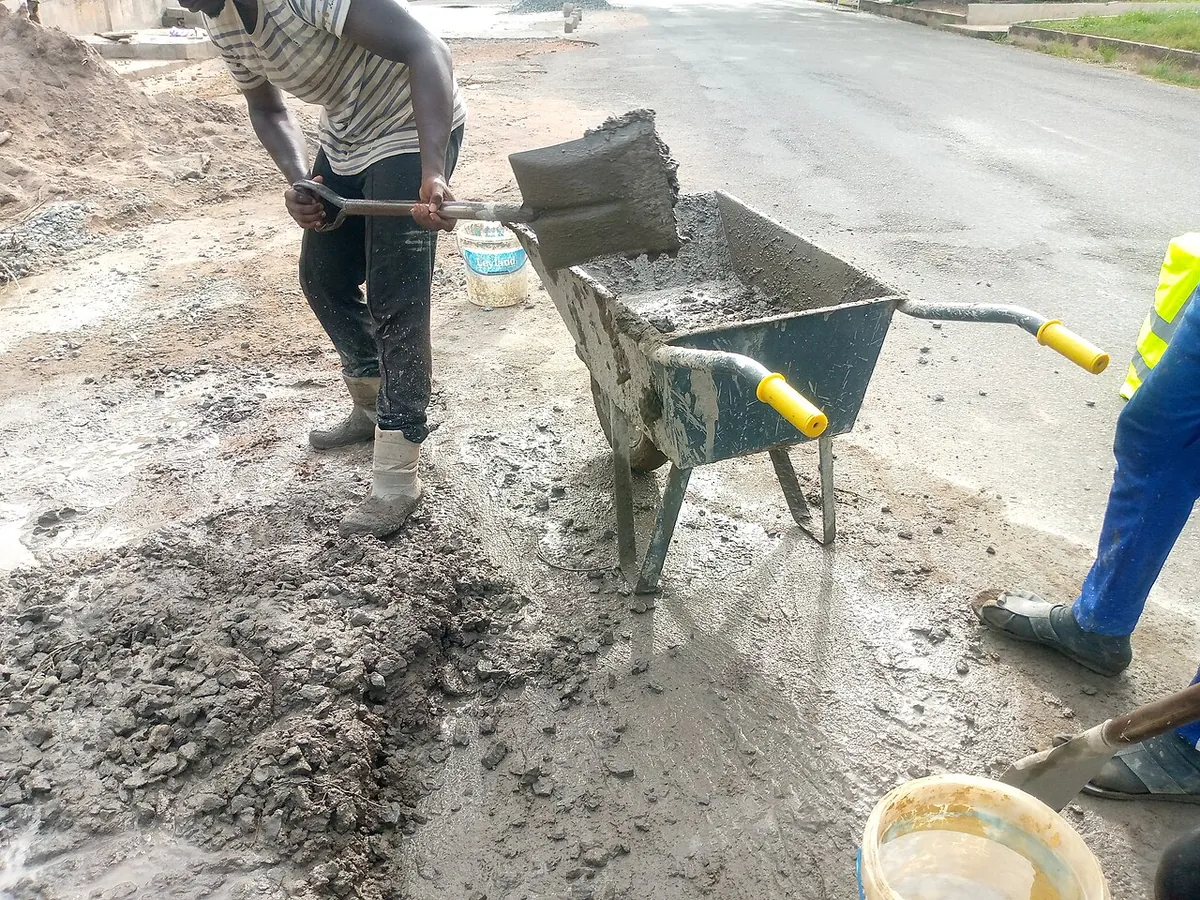
Photo: Azorbli, Wikimedia Commons, CC BY-SA 4.0
Quick Answer
Dry pour concrete means pouring dry bagged concrete mix into a hole or form and adding water on top instead of mixing it first. It works well for fence and mailbox posts set with fast-setting mixes made for the method, and it can work for small, thin, non-structural pads if you place the mix in thin layers of about 2 inches and soak each layer thoroughly. A dry pour concrete slab for a patio, driveway, footing or steps is a poor idea: water rarely reaches the full depth evenly, leaving dry pockets, weak spots and a crumbly bottom, and the concrete cannot be consolidated or finished properly. For anything that carries loads or faces freeze-thaw, mix the concrete first in a wheelbarrow or mixer, or order ready-mix.
Dry pouring concrete has become a popular shortcut in online videos: no mixer, no wheelbarrow, no heavy mixing, just rip open the bags, spread the dry powder in the forms, hose it down and walk away. It is easy to see the appeal. Mixing dozens of 80-pound bags by hand is hard work, and for a small shed pad or path, renting a mixer feels like overkill. But concrete is a chemical product that depends on water reaching every grain of cement in the right amount, and dry pour concrete does not always deliver that.
This guide explains what dry pour concrete is, how to dry pour concrete properly when it makes sense, why dry pouring a concrete slab is risky, how strong dry-poured concrete really is, which jobs it suits, and the easier ways to get properly mixed concrete for bigger projects.
What Is Dry Pour Concrete?
In a normal pour, cement, sand, gravel and water are mixed together until every particle is evenly wet, then placed, consolidated and finished. In a dry concrete pour, the bagged mix is placed dry and the water is added afterward, usually by spraying or flooding the surface, relying on the water to soak down through the dry material and hydrate the cement. Some people also tamp the dry mix before wetting, or mix a little with a shovel in the forms.
Dry pouring is not the same as "dry pack" mortar, which is a stiff but fully mixed mortar used for shower pans, setting stone and packing under base plates. Dry pack is mixed with a small, measured amount of water before placing. Dry pour concrete skips the mixing entirely.
Why Dry Pouring Concrete Is Tempting
- No mixer, no wheelbarrow, little heavy lifting beyond carrying the bags.
- No rush to place each batch before it stiffens.
- Works in remote spots where water and power are limited.
- Fast-setting post mixes are actually designed to be used this way.
- For a few stepping stones or a fence post, it is quick and usually good enough.
The Problems With a Dry Pour Concrete Slab
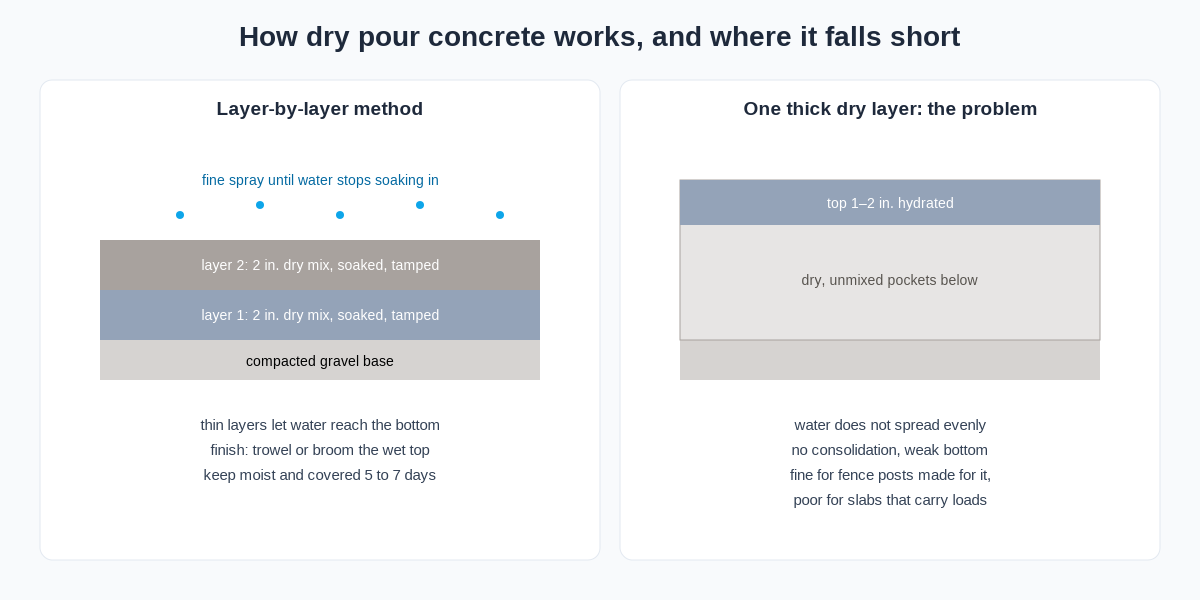
Concrete gets its strength from hydration, the reaction between cement and water, and from being dense, with the paste filling the gaps between sand and stones. A dry pour concrete slab struggles on both counts:
- Uneven water: water soaks into the top inch or two quickly and forms a crust that slows water reaching deeper. Lower layers may stay partly dry, with unhydrated cement that never gains strength.
- Wrong water amount: some areas get too much water and others too little. Concrete strength depends on a consistent water-cement ratio, which dry pouring cannot control.
- Poor mixing of ingredients: bagged mix can separate as it is poured, with gravel rolling to the edges and fines settling, so the slab is not uniform.
- No consolidation: fresh concrete is rodded, vibrated and screeded to remove air voids. Dry powder cannot be consolidated, leaving voids and honeycombing. See honeycombing in concrete.
- Weak surface: flooding the surface washes cement away from the top and leaves a sandy, dusty finish that wears quickly.
- Poor durability: weak, porous concrete absorbs water and suffers in freeze-thaw and with deicing salts. See concrete pitting and flaking.
Many people who dry pour a slab report that it "set up hard," and the top often does. But cutting or breaking an old dry-poured slab often reveals crumbly, partly dry material underneath. For a patio, walkway, shed floor, driveway or anything with weight on it, that is a real risk.
How Strong Is Dry Pour Concrete?
There is no reliable rated strength for dry pour concrete, because the result depends on thickness, how the water was applied, the mix and the weather. Bag manufacturers rate their concrete for mixed use, typically 4,000 psi at 28 days for standard mix and 5,000 psi for high-strength mix, and their instructions for standard mixes call for mixing with water before placing. Thin, well-soaked layers can reach a usable strength for light-duty uses, while a thick slab dry-poured in one go may be far weaker, especially at the bottom. Only fast-setting post mixes are generally labeled for pouring dry into a hole and adding water. When strength matters, mixed concrete is the only way to know what you are getting.
How to Dry Pour Concrete (When It Makes Sense)
If you decide to try it for a small, light-duty job, here is how to dry pour concrete to give it the best chance:
- Prepare a solid base. Excavate, add 3 to 4 inches of compacted gravel, and build sturdy forms. Wet the base lightly so it does not pull water from the first layer.
- Pour in thin layers. Spread about 2 inches of dry mix, level it with a rake, and tamp it lightly.
- Soak each layer. Spray with a fine mist or shower setting until water stops soaking in and just starts to pool, without washing the mix around.
- Repeat layer by layer, working steadily, until you reach the top of the forms, soaking each layer before adding the next.
- Mix the top layer if possible. Many people mix the final inch or two in a bucket and place it wet, so it can be screeded and finished properly.
- Finish lightly with a float or broom once the surface is wet and workable.
- Cure. Keep the concrete moist and covered for at least 5 to 7 days. See concrete curing compound.
Keep dry pouring concrete slab projects small and thin, roughly 3 inches or less, and limited to light uses like garden paths, bin pads and stepping stones.
Dry Pour Concrete for Fence Posts
Fence posts are where dry pour concrete genuinely works, because fast-setting post mixes are designed for it. The method: set the post in the hole on a gravel base, fill the hole with water about a third to half full, pour the dry fast-setting mix in until it reaches a few inches below grade, and let the water soak through; some products ask you to add water on top after pouring the dry mix. The mix sets in 20 to 40 minutes. Standard concrete mix can also be dry-poured into post holes in a pinch, and many fences have stood for years that way, but pre-mixing gives stronger, more uniform concrete for gate and corner posts. See concrete fence posts.
Where Dry Pour Concrete Works and Where It Doesn't
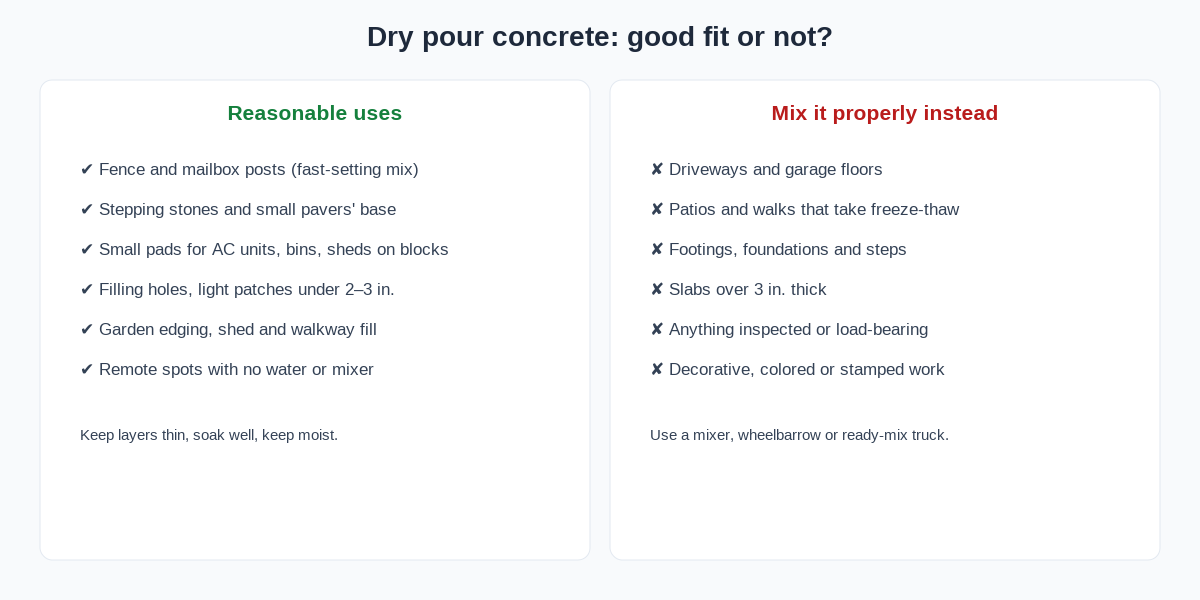
As a rule of thumb, dry pour concrete is acceptable where failure would be cheap and harmless: a few stepping stones, a small pad for trash cans, a path that could be redone. It is not acceptable where concrete carries vehicles, holds up a structure, must pass an inspection, faces harsh winters, or needs a good-looking finish. See concrete slab thickness and concrete pad for shed.
Easier Ways to Get Mixed Concrete
- Mix in a wheelbarrow: one or two bags at a time is manageable for small slabs. See how to make concrete.
- Rent a mixer: an electric drum mixer costs about $40 to $75 per day and turns out a bag every few minutes. See concrete cement mixers.
- Order ready-mix: for a cubic yard or more, a truck is often cheaper and far easier than bags. See concrete price per yard.
- Use a mini-mix or trailer service: some suppliers deliver small loads in trailers.
- Choose pavers or gravel for paths and pads where concrete is not essential.
Why Water Struggles to Reach the Bottom
It seems like water should simply soak down through a dry pour concrete layer the way it soaks into garden soil, but cement changes the picture. As soon as water touches cement, the cement begins to react and the wet paste at the surface thickens and starts to seal. Fine particles of cement and sand wash down with the first water and pack into the gaps just below the surface, slowing further flow. At the same time, the dry powder below pulls water sideways and downward unevenly, following cracks and coarse pockets. The result is a top layer that gets plenty of water, perhaps too much, a middle that gets some, and a bottom that may get very little, especially if the dry layer is thicker than a couple of inches. A garden hose on a 4-inch dry pour concrete slab may look like it is soaking in for minutes, but cores cut from such slabs often show unreacted, crumbly material near the base. That is why thin layers and patient soaking matter so much if you dry pour at all.
Dry Pour vs Mixed Concrete: Time and Cost
Dry pouring concrete saves effort, but not always time or money. For a small 4 × 6-foot pad 3 inches thick, about 6 cubic feet, you need ten 80-pound bags either way. Mixing them in a wheelbarrow takes perhaps an hour for two people; dry pouring them in layers and soaking each layer properly can take almost as long, because each layer needs several rounds of spraying. For bigger areas, a rented mixer at around $40 to $75 a day turns out mixed concrete faster than you can soak dry layers properly, and a small ready-mix load eliminates bag handling entirely. The real saving with dry pour concrete is the physical work of mixing, which matters for some people. Weigh that against the risk of a weaker slab that may need to be redone, which costs far more than a day's mixer rental.
Try a Test Before You Commit
If you are considering a dry concrete pour for a path or small pad, make a test before you dry pour concrete for the whole project. Build a small form, about 2 × 2 feet, at the same thickness you plan to use, and dry pour it with the same mix and method. After a week, break it with a sledgehammer, or at least drill into it, and look at the inside. If the material is uniformly hard and gray from top to bottom, the method may be acceptable for that light-duty use. If the bottom is crumbly, sandy or still powdery, mix the concrete instead. This simple test costs one or two bags and can save a whole project. Run the test in the same weather you expect for the real pour, since temperature and wind change how fast the water soaks in and how the top layer crusts over. Note how long each layer took to soak, so you can plan the real job.
Dry Pouring Concrete Under Pavers, Sheds and Steps
Some people use a dry pour concrete slab as a base under pavers or flagstones, or as a pad for a small shed on blocks. For paver bases, a compacted gravel base with a sand bedding layer is the standard and usually performs better than a thin dry-poured slab, which can crack and trap water. If you want a rigid base, a properly mixed concrete slab with drainage is better. For small sheds on skids or blocks, a gravel pad is often the best foundation; for sheds needing a slab, mix the concrete. For steps, dry pouring is a poor choice because steps need full strength and good edges. See concrete deck blocks and can you lay pavers over concrete.
Common Dry Pour Mistakes
The most common dry pour concrete mistake is pouring the full thickness dry and hosing the top, expecting water to reach the bottom. Others include using a jet of water that washes cement out of the surface and leaves bare gravel; not soaking long enough; pouring on a dry base that sucks water from the bottom layer; skipping forms and expecting the dry mix to hold its shape; pouring in hot, windy weather so the top dries before water soaks down; failing to keep the concrete moist afterward; and using dry pour concrete for structural work like footings, steps or driveways. Each of these lowers strength and durability. If you take one lesson from this guide, it is that thin layers, patient soaking and good curing are the minimum for any dry pour that you want to last.
Weather and Dry Pouring
Weather affects dry pour concrete even more than mixed concrete, and a dry pouring concrete slab in bad weather is a gamble. In hot, dry, windy conditions, the top layer can set and crust before water soaks through the lower layers, trapping dry material underneath. Dry pour in the cool of the morning, keep the area shaded if you can, and keep the surface wet for days afterward. In cold weather, water soaking slowly through dry mix gives freezing a chance to damage the concrete before it sets, so dry pouring below about 40°F is especially risky. Rain right after a dry pour can wash out the surface. Check the forecast and plan to cover the work with plastic if showers are possible in the first day.
What Bag Manufacturers Say
Read the bag before you decide how to dry pour concrete, or whether to. Most standard and high-strength concrete mixes are designed and tested to be mixed with water to a workable consistency before placing, and their published strengths assume that. Fast-setting post mixes usually include instructions for pouring the dry mix into a hole partly filled with water, because their chemistry and particle sizes are made for it. Some manufacturers publish guidance for using standard mix to set posts dry, but not for slabs. Following the label protects both the result and any product warranty. When the bag says mix it, mix it.
Dry Pour Concrete Slab: A Realistic Example
Imagine a 6 × 8-foot garden shed pad, 3 inches thick. That is 12 cubic feet of concrete, or about 20 bags of 80-pound mix. To build it as a dry pour concrete slab, you would set forms over a compacted gravel base, spread about 7 bags across the area for the first 1-inch-plus layer, mist it repeatedly until water stops soaking in, tamp, then repeat for two more layers, and mix the final few bags in a wheelbarrow for a finishable top. Done carefully, this can take several hours, uses a lot of water, and gives a pad that may be adequate for a light shed on skids. Mixing the same 20 bags in a rented mixer and placing them as one wet pour would take a similar amount of time for two people, give a stronger, more uniform slab, and let you screed and finish it properly. For most people, the dry concrete approach is only worth it where carrying water, mixing or renting is truly impractical.
How to Dry Pour Concrete Around Posts and Small Footings
Besides fence posts, people dry pour concrete around mailbox posts, clothesline poles, basketball hoop sleeves and small deck or pergola footings. For lightly loaded posts, the fence post method works: water first, dry fast-setting mix next, and a few minutes of patience. For anything that carries a structure, such as deck and pergola footings, pour properly mixed concrete, since footings must reach full strength to carry their loads and pass inspection. A dry concrete pour around a structural post is one of the riskiest uses of the method, because failure might not show until the structure is loaded. See concrete piers and concrete post base.
Repairing or Replacing a Failed Dry Pour
If a dry-poured slab or path is crumbling, dusting or breaking up, there is usually no good way to strengthen it from the top; resurfacers and sealers need a sound base to bond to. Small failed areas can be cut out and replaced with properly mixed concrete or a repair mortar. A badly failed dry pour concrete slab is usually best broken out and replaced. Before re-pouring, check the base, since a soft or poorly drained base often contributed to the failure. See how to remove concrete and concrete patching compound.
Is Dry Pouring Concrete Allowed by Code?
Building codes do not usually mention dry pouring by name, but they require concrete for footings, foundations and structural slabs to meet a specified strength, typically 2,500 psi or more under the residential code, and to be placed and consolidated properly. Because a dry pour concrete slab cannot be shown to meet those requirements, it is not suitable for permitted structural work, and an inspector who sees bags being spread dry into footing trenches is likely to object. For non-structural work that does not need a permit, such as garden paths, the choice is yours, but the same physics applies. If a project needs a permit or inspection, plan on mixed concrete from the start.
Safety When Dry Pouring
Dry concrete mix releases a lot of fine dust when bags are opened and poured, and that dust contains cement, which is caustic, and crystalline silica, which is harmful to breathe. Wear a well-fitting dust mask or respirator, safety glasses and gloves, pour bags low and slowly to reduce dust, and work upwind. Once wet, the mix can burn skin, so wear boots and long sleeves while soaking and tamping, and rinse any splashes off your skin right away. Keep children and pets away from both the dry powder and the wet concrete, and store any opened bags sealed and off the ground.
Bottom Line on Dry Pour Concrete
Dry pour concrete is a useful trick for setting fence posts and for small, light, low-risk jobs where mixing is impractical, provided you work in thin layers, soak thoroughly and cure carefully. It is not a substitute for properly mixed concrete in slabs that carry weight, structures, steps or anything that must look good and last through harsh winters. When in doubt, mix it: the extra hour of work is cheap insurance for concrete you expect to last for decades. If you do choose to dry pour concrete, keep the job small, keep the layers thin, and give the water time to do its work before you add the next layer or call the job finished.
Tools You Need for a Dry Pour
Even without a mixer, a dry concrete pour needs the right tools to give it a chance. You will want sturdy forms and stakes, a hand tamper or a short length of 4x4 for tamping each layer, a steel rake to spread the dry mix evenly, a garden hose with a gentle shower or mist nozzle (not a jet), a straight board for screeding, a float and a broom or edger for the top, and plastic sheeting or a curing compound to keep the finished work moist. A pump sprayer is useful for wetting edges and corners without washing out the mix. Have more bags than you think you need; dry mix settles and compacts as it gets wet, so the same volume of dry powder makes less finished concrete than you might expect, and running short halfway through leaves a weak joint where you resume.
Frequently Asked Questions
Can you dry pour concrete?
Yes for fence posts with mixes made for it and for small, thin, light-duty pads poured in soaked layers. Not recommended for slabs, driveways, footings or steps.
How to dry pour concrete for a slab?
If you must, place dry mix in 2-inch layers, soak each layer until water stops soaking in, tamp, repeat, mix the top layer wet for finishing, and keep it moist for a week. Expect lower strength than mixed concrete.
Is dry pour concrete as strong as mixed concrete?
Usually not. Water spreads unevenly, the mix cannot be consolidated, and dry pockets often remain, especially in thicker pours.
How thick can you dry pour concrete?
Keep it to about 3 inches or less for light uses, placed and soaked in layers about 2 inches thick.
Sources
- Portland Cement Association: hydration and mixing basics
- ASTM C387: Packaged, Dry, Combined Materials for Concrete
- American Concrete Institute: concrete placement and consolidation
- National Ready Mixed Concrete Association: Concrete in Practice
Related Guides
- Concrete washout — handling rinse water from trucks and tools
- Concrete mixer rental cost — mixer and buggy rental prices
- Concrete retaining walls — poured, precast and bag walls
- Roller compacted concrete — RCC pavements and dams
- 80 lb bags of concrete — yield, price and how many bags you need
- Sakrete concrete mix — High Strength, 5000 Plus and Fast Setting compared