
Outdoor Handrails for Concrete Steps: Types, Code Rules and How to Install Them
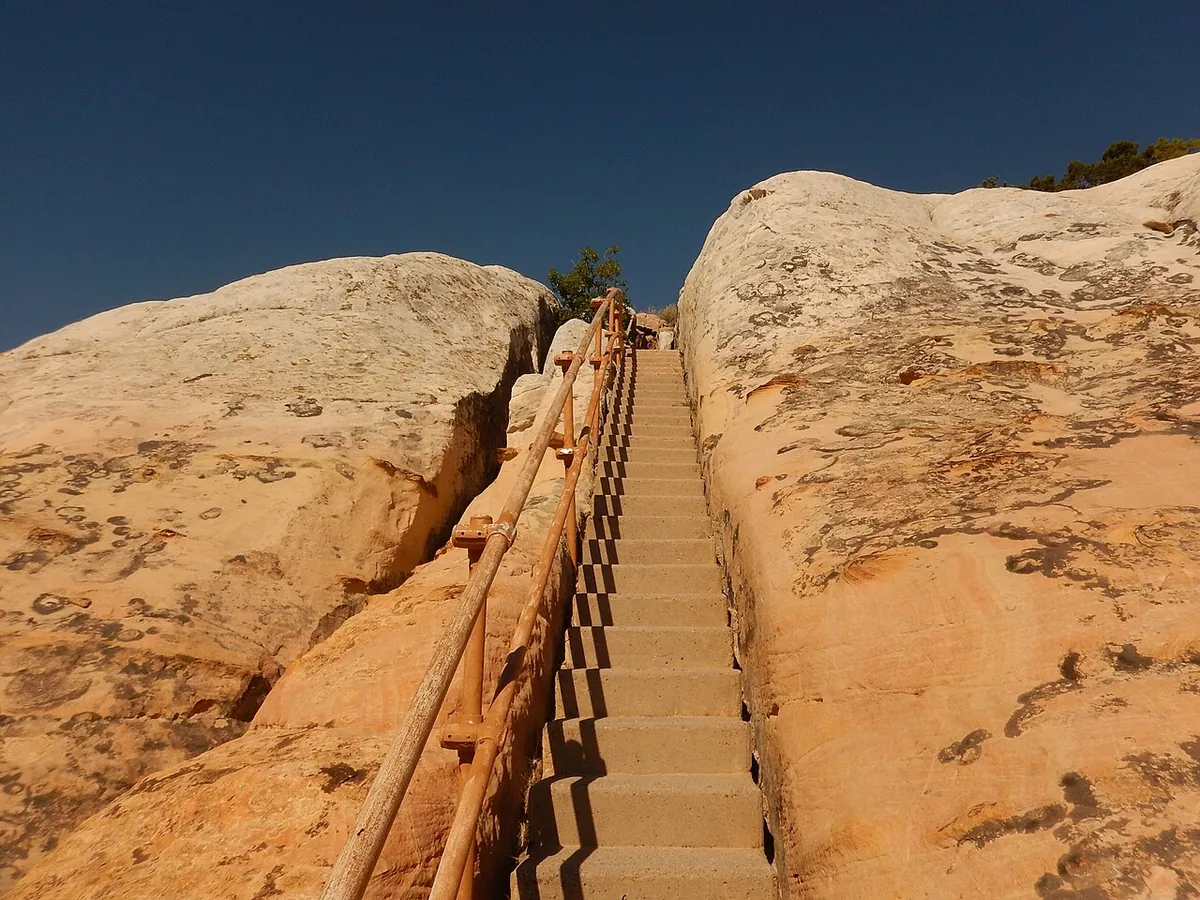
Photo: National Park Service, Wikimedia Commons, public domain.
Quick Answer
Outdoor handrails for concrete steps are usually powder-coated steel, wrought iron, aluminum or galvanized pipe, fastened to the steps with surface-mount flanges, core-drilled posts set in anchoring cement, or side-mount brackets. Under the residential code, a handrail is required on stairs with four or more risers, mounted 34 to 38 inches above the tread nosings, with a graspable grip about 1-1/4 to 2 inches across, running the full flight. To secure a handrail to concrete, use 3/8- or 1/2-inch wedge anchors or epoxy anchors in solid concrete, kept at least 3 to 4 inches from edges. Railing for concrete steps typically costs $100 to $400 per side as a DIY kit and $300 to $1,000+ installed.
A good handrail is the cheapest safety upgrade you can make to a set of steps, and outdoor handrails for concrete steps are simple to add. Wet leaves, ice, snow and a bag of groceries in one hand make outdoor concrete steps one of the most common places for falls at home, especially for children, older adults and anyone with a bad knee. Many older houses have no rail at all, or a loose one wobbling on cracked concrete. Adding a solid rail takes a day or less, and most homeowners can do it with a hammer drill and the right anchors.
This guide covers the types of outdoor handrails for concrete steps, the code rules for height and grip, how to secure handrail to concrete with each mounting method, the best anchors, step-by-step installation, fixing a loose rail, and what railing for concrete steps costs.
Types of Outdoor Handrails for Concrete Steps
- Wrought iron and powder-coated steel. The classic look: square or round posts, a flat or round top rail and balusters. Strong and heavy; needs touch-up paint where the coating chips. Many ready-made kits fit 2 to 5 steps.
- Aluminum. Light, rust-free and often sold as adjustable kits that pivot to match any stair angle. Good for coastal areas and DIY installs.
- Galvanized pipe railing. Round pipe joined with slip-on fittings (Kee-Klamp style) or welded. Industrial look, very strong, easy to adjust, and grips well.
- Stainless steel. Modern look with round tube or cable infill; resists corrosion but costs more.
- Wood or composite. Works when the posts are set in metal post bases on the steps, or when the rail ties into a wood porch; needs more maintenance outdoors.
- Simple grab rails. A single round rail on two or three posts, without balusters, often enough for short flights where no guard is required.
For short flights of two or three risers, a single-post grab rail is often the most practical of the handrails for concrete steps. For taller steps with a high platform, you need a full guard with balusters on any open side above 30 inches.
Code Rules for Handrails on Concrete Steps
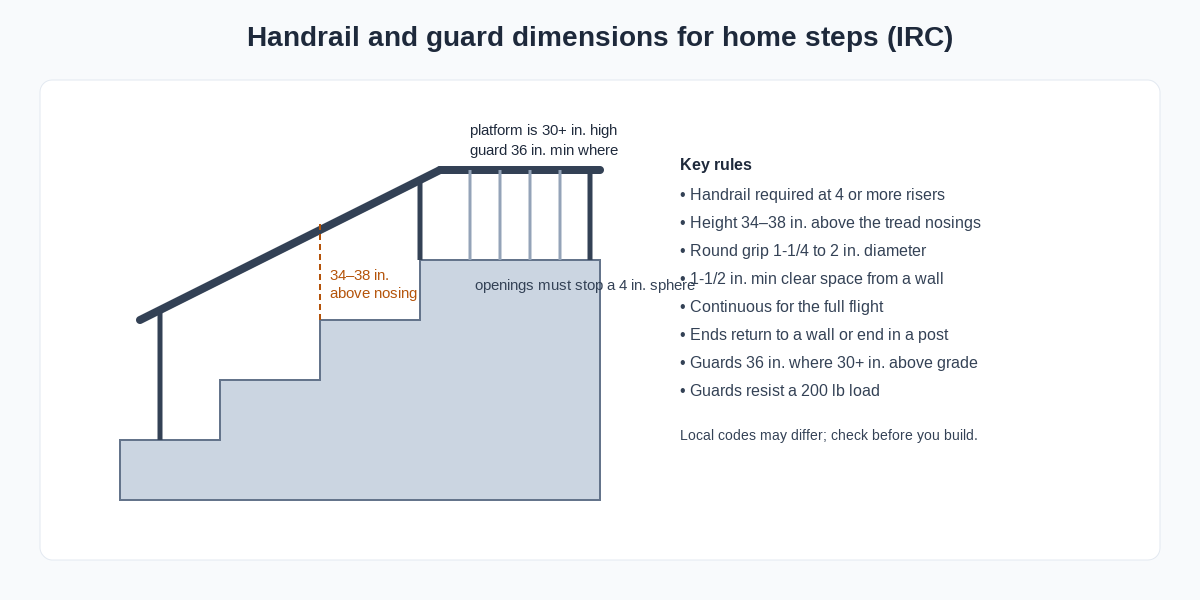
Most U.S. towns use the International Residential Code for house stairs. The key rules for handrails for concrete steps and guards are:
- When required: a handrail on at least one side of each flight with four or more risers.
- Height: 34 to 38 inches, measured straight up from the sloped line connecting the tread nosings.
- Continuity: the rail runs the full length of the flight, from a point above the top riser to a point above the lowest riser.
- Grip size: a round rail 1-1/4 to 2 inches in diameter, or another shape with an equivalent graspable profile.
- Wall clearance: at least 1-1/2 inches between the rail and a wall.
- Ends: returned to a wall or ending in a post or safety terminal, so sleeves and bag straps do not catch.
- Guards: required on open sides of platforms and stairs more than 30 inches above the ground, at least 36 inches high on platforms, with openings small enough that a 4-inch sphere cannot pass through.
- Strength: handrails and guards must resist a 200-pound load applied in any direction.
Even where a rail is not required, adding outdoor handrails for concrete steps at two- and three-step entries is a smart safety upgrade. Commercial buildings follow the International Building Code and accessibility rules, which add rails on both sides and extensions at the top and bottom.
How to Secure Handrail to Concrete: Three Methods
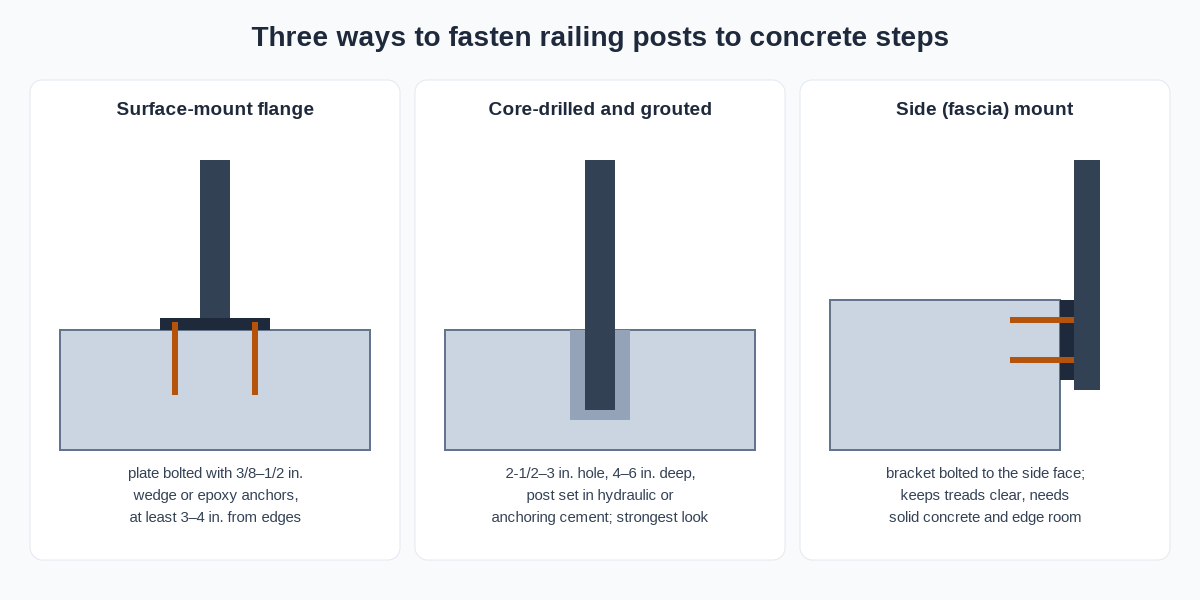
1. Surface-mount flanges with anchors
The most common DIY method for railing for concrete steps. Each post has a steel plate (flange) welded or clamped to its base, with three or four holes. You drill matching holes in the concrete and bolt the plate down with masonry anchors. It is quick, needs only a hammer drill, and works on poured and precast steps that are solid concrete. The downside is that the anchors sit near the step edges, where concrete can crack if the holes are too close or the anchors are overtightened.
2. Core-drilled posts set in anchoring cement
The strongest and cleanest-looking method for outdoor handrails for concrete steps. A core drill cuts a round hole about 2-1/2 to 3 inches across and 4 to 6 inches deep at each post location. The post goes into the hole, is held plumb, and the hole is filled with hydraulic cement, anchoring cement or non-shrink grout. Once cured, the post is locked into the concrete with no visible fasteners. Core drills can be rented, and many railing installers use this method for custom iron rails.
3. Side (fascia) mount brackets
Brackets bolt to the vertical side face of the steps, with the posts rising alongside. That keeps the full tread width clear and avoids drilling near the tread nosing, but it needs a solid, thick side face and enough distance from the top and bottom edges for the anchors.
Wall-mounted rails
Where steps run beside a house wall or retaining wall, the rail can mount on brackets anchored into the wall, with sleeve anchors in brick or block and wedge or screw anchors in solid concrete walls.
Best Anchors for Railing on Concrete Steps
| Anchor | Best for | Notes |
|---|---|---|
| Wedge anchors, 3/8–1/2 in. | Solid poured concrete | Strong and cheap; need edge distance; do not overtighten near edges |
| Epoxy (adhesive) anchors | Solid concrete near edges, heavy rails | No expansion stress; best near edges; cure time needed |
| Concrete screws, 3/8 in. | Light grab rails, solid concrete | Easy to install and remove; lower holding power |
| Sleeve anchors | Brick, block and stone | Grip in hollow or softer masonry |
| Anchoring or hydraulic cement | Core-drilled posts | Sets fast; very strong; no fasteners showing |
Use stainless steel or hot-dip galvanized anchors for any handrail for concrete steps outdoors so rust does not stain or split the concrete. For anchor types and installation in detail, see types of concrete anchors, concrete screws and concrete drill bits.
Edge distance: the most important detail
When you work out how to secure handrail to concrete steps, edge distance comes first. Expansion anchors work by pushing outward against the concrete. Near an edge, that push can break off a chunk of the step. A common rule is to keep expansion anchors at least five anchor diameters from any edge, and more is better: for a 3/8-inch wedge anchor, that is about 2 inches minimum, and 3 to 4 inches is a safer target on steps. When the post must sit closer to the edge, use epoxy anchors, which do not create expansion stress, or core-drill and grout the post.
How to Install Outdoor Handrails for Concrete Steps
- Check the steps. When planning a handrail, concrete steps must be solid where the posts go: make sure the concrete is solid, not crumbling, hollow or badly cracked where the posts will go. Precast steps may be hollow underneath; ask the maker or check for cast-in rail pockets.
- Choose the rail and side. Pick the side people naturally reach for, usually the side away from the door swing or opposite a wall.
- Lay out the posts. Set the bottom post on the bottom tread or landing, the top post on the platform, and intermediate posts so spans do not exceed the rail maker's limit, often 4 to 6 feet. Keep posts at least 3 to 4 inches back from tread nosings and side edges.
- Mark and drill. Set the flange in place and mark the holes. Drill with a hammer drill and carbide bit of the exact diameter on the anchor package, to the depth needed plus a little extra for dust.
- Clean the holes. Blow out dust with a hand pump and brush; dirty holes cut holding power, especially for epoxy.
- Set the anchors and bolt down the flanges, or inject epoxy and set threaded rod, waiting for full cure before loading.
- Attach the rail, check that it is 34 to 38 inches above the nosings along its full length, and tighten all fittings.
- Test it. Push and pull hard in every direction. A good rail does not move.
- Seal. Caulk around flanges or grout to keep water out of the holes.
Core drilling steps
- Rent a wet core drill with a bit about 1 inch larger than the post.
- Drill each hole 4 to 6 inches deep, keeping the drill plumb and using water to cool the bit.
- Dry-fit the rail with posts in the holes and brace it in position.
- Mix anchoring or hydraulic cement and pack it around each post, sloping the top slightly away from the post so water runs off.
- Leave the bracing in place until the cement sets, usually 15 to 60 minutes for fast products.
Choosing Outdoor Handrails for Concrete Steps by Location
- Front entry. The most visible rail, so style matters. Powder-coated steel or aluminum kits in black are the most common outdoor handrails for concrete steps at front doors. Match the house's hardware, light fixtures or fence.
- Back and side doors. Function first: a simple pipe or aluminum grab rail on two posts is often all the railing for concrete steps you need here.
- Mobile and manufactured homes. Taller steps and platforms usually need a full rail and guard. Many precast step suppliers sell matching handrails for concrete steps and install them the same day. See precast concrete steps.
- Basement stairwells. Exterior basement steps need a handrail on the stairs and a guard around the open top of the stairwell.
- Long garden or hillside steps. Continuous pipe rails on posts every 4 to 6 feet, like the park stair at the top of this page, are durable and easy to grip.
Concrete Step Railing Styles and Finishes
Concrete step railing comes in more styles than most people expect. Square-bar balusters with a flat top rail suit traditional houses; round tube and cable infill suit modern ones. Scrolls and twisted pickets give a classic wrought iron look. For grip, the top rail matters most: a round rail 1-1/4 to 2 inches across is easiest to hold, while a wide flat top rail looks good but may need a separate graspable rail under the code. Finishes include powder coat, which is tough and comes in many colors, hot-dip galvanizing, which resists rust without paint, and paint, which is cheapest but needs touching up. In snowy areas, aluminum and powder-coated steel feel less cold to the hand than bare stainless or galvanized pipe.
Handrails for Concrete Steps in Freezing Climates
Winter is when handrails for concrete steps matter most, and also when they take the most abuse. Deicing salt splashes onto posts and flanges, water freezes in post holes, and shovels knock into the base. To make a rail last:
- Choose galvanized, stainless or aluminum hardware, and stainless anchors.
- Seal around flanges and core-drilled posts so water cannot sit in the holes and freeze.
- Slope grout away from posts.
- Use a concrete-safe deicer instead of rock salt; see does salt damage concrete.
- Touch up chipped paint or powder coat each spring before rust spreads.
Handrails on Brick, Block or Stone-Faced Steps
Not every set of steps is solid poured concrete. Brick and block steps, and concrete steps faced with stone or tile, need a different approach to how to secure handrail to concrete or masonry. Sleeve anchors grip in brick and block; epoxy with screen tubes works in hollow block. Where possible, drill through the veneer into the solid concrete core behind it, and avoid anchoring into mortar joints, which are weaker than the bricks. On thin stone or tile caps, a core-drilled post set into the concrete below is usually the most secure. See cinder block vs concrete block for the difference in materials.
Accessibility: Rails on Both Sides
The residential code only requires a handrail on one side, but rails on both sides make steps much easier for anyone using a cane, carrying a child or with weakness on one side. Accessibility guidelines for public buildings go further: handrails for concrete steps on both sides, extensions of 12 inches beyond the top riser and about one tread depth beyond the bottom riser, and continuous gripping surfaces. If someone in your home has trouble with steps, consider rails on both sides with extensions at the top and bottom, even on a short flight.
DIY or Hire a Pro?
Installing a kit rail with surface-mount flanges is a reasonable DIY job if you own or rent a hammer drill and the steps are solid. Hire a pro for custom welded rails, core drilling, rails on brick or stone-faced steps, long runs with guards, or when the concrete near the edges is cracked. Get at least two quotes. Many fence and iron shops measure, build and install outdoor handrails for concrete steps as a package, often within a few weeks.
Planning Outdoor Handrails for Concrete Steps on New Steps
If the steps are not built yet, plan the rail now. For poured steps, set PVC or steel sleeves in the forms where posts will go, or cast in steel plates with welded studs that the rail flanges will bolt to later. For precast steps, ask the supplier for units with cast-in rail pockets or solid zones for anchors, and order the railing for concrete steps at the same time so the installer can set both in one visit. Planning ahead gives you the strongest connection with no drilling near fresh edges, and it lets you place posts exactly where the rail design needs them. See pouring concrete steps for how to set sleeves in the forms.
Maintenance for Handrails for Concrete Steps
- Check every spring and fall. Push and pull the rail hard. Any movement means loose fittings or anchors.
- Look at the base. Cracks radiating from a post, rust staining or crumbling grout mean water is getting in.
- Touch up coatings. Sand rust spots, prime and repaint or use a powder-coat touch-up pen.
- Reseal. Renew the caulk around flanges and core-drilled posts every few years.
- Clear ice. Ice on the rail is as dangerous as ice on the treads; use a concrete-safe deicer on both.
Rail Height Mistakes to Avoid
The most common error with outdoor handrails for concrete steps is getting the height wrong at one end. Because the rail follows the slope of the stairs, its height must be measured straight up from the line of the nosings at several points, not from the landing or the ground. A rail that is 36 inches high at the bottom step can end up 30 inches above the top tread if the posts are set without checking. Other common mistakes: rails that stop short of the bottom step, rails too thick to grip, rails mounted so close to a wall that knuckles scrape, and rails with sharp open ends that catch sleeves. Measure at every post, and again after the anchors are fully tightened, before tightening the fittings, and adjust adjustable kit brackets until the whole rail sits within the 34- to 38-inch range.
Tools You Need
- Hammer drill or rotary hammer with carbide masonry bits sized for your anchors.
- Core drill with a diamond bit, if setting posts in holes.
- Hand pump or vacuum and a wire brush for cleaning holes.
- Torque wrench or socket set for wedge anchors; caulk gun for epoxy.
- 4-foot level, tape measure, marker and a helper to hold the rail.
- Safety glasses, hearing protection and a dust mask; drilling concrete makes silica dust.
Read the anchor package before drilling. Each anchor lists its hole diameter, minimum embedment, minimum edge distance and installation torque, and following those numbers is what gives the rail its strength. Overtightening a wedge anchor near an edge is one of the most common ways to crack a step.
Renters, Landlords and Older Relatives
If you rent, ask the landlord before drilling; many will pay for outdoor handrails for concrete steps because a fall on their property is their liability, and some local housing codes require rails on rental steps. Landlords should check rails at every turnover. If you are adding a rail for an older parent, put it on the side of their stronger hand going down, since most falls on steps happen while descending, and consider a second rail on the other side. Bright, contrasting paint on the tread nosings and good lighting at night make railing for concrete steps even more effective, because people can see each edge as they reach for the rail.
Fixing a Loose Railing on Concrete Steps
A wobbly railing for concrete steps usually means one of four things: loose fittings at the rail, loose anchors, rusted posts, or cracked concrete at the base. Fixes:
- Tighten fittings and set screws on the rail first.
- Loose anchors: remove the flange, move to fresh holes at least an inch away, or upsize the anchor, or switch to epoxy anchors.
- Rusted posts in cracked concrete: cut the post off, chip out the old grout and rust, and reset the post or a new one in anchoring cement.
- Broken step edges: repair the concrete first with a patching mortar, then reinstall the rail farther back. See concrete patching compound and how to fix concrete steps.
Rust that expands inside a core-drilled hole can crack the step around the post. Painting the post base and keeping the grout sloped away and caulked helps prevent it; see removing rust stains from concrete for cleanup.
How Much Do Outdoor Handrails for Concrete Steps Cost?
- DIY railing kits for 2 to 5 steps: about $100 to $400 per side, plus anchors.
- Installed pre-made rail: about $300 to $1,000 per side, depending on length and mounting.
- Custom wrought iron or welded steel: often $50 to $150 per linear foot installed.
- Core drilling: about $50 to $150 per hole by a pro, or $60 to $120 per day to rent a core drill.
- Anchors and epoxy: about $20 to $60 for a typical rail.
For new steps, adding rail sleeves or plates during the pour costs little and saves drilling later. See pouring concrete steps, precast concrete steps and concrete steps cost.
Frequently Asked Questions
Do outdoor concrete steps need a handrail?
Under the residential code, yes when the flight has four or more risers. Adding one to shorter steps is still a good idea for safety.
How do you secure a handrail to concrete?
Bolt surface-mount flanges with wedge or epoxy anchors, core-drill and set posts in anchoring cement, or bolt side-mount brackets to the step face. Keep anchors 3 to 4 inches from edges.
How high should a railing for concrete steps be?
34 to 38 inches above the tread nosings. Guards on platforms more than 30 inches above grade must be at least 36 inches high.
What size anchors for a handrail on concrete steps?
Usually 3/8- or 1/2-inch wedge anchors with about 2-1/2 to 3 inches of embedment, or epoxy-set threaded rod near edges.
Can I put a handrail on precast concrete steps?
Yes, if the area under the post is solid. Many precast steps have rail pockets or solid zones; hollow-back units need care with anchor depth.
Is a handrail on concrete steps required for two steps?
Not under the residential code, which requires one at four or more risers. Many owners still add a short grab rail for safety, especially in icy climates.
What is the best railing for concrete steps outdoors?
Powder-coated aluminum or steel kits for most homes, galvanized pipe for heavy use, and custom wrought iron where appearance matters most.
Sources
- International Code Council: 2021 IRC Sections R311.7.8 handrails and R312 guards
- CDC: older adult fall prevention
- American Concrete Institute: anchoring to concrete
- OSHA: walking-working surfaces, stairs and rails
Related Guides
- Precast concrete steps — sizes, cost and mobile home steps
- Pouring concrete steps — forms, calculator and step-by-step
- Concrete post base guide — anchor 4x4 and 6x6 posts to concrete
- How to drill into concrete — hammer drills, bits and step-by-step
- Concrete porch — building, repairing and updating porches
- Concrete ramp — slope rules, design and cost
- How to remove concrete anchors — wedge, sleeve, screw and epoxy anchors
- Concrete bolts — expansion, lag and anchor bolt sizes
- Concrete decking — concrete decks vs wood
- Concrete stair treads — precast and poured treads