
Concrete Bolts Guide: Expansion Bolts, Lag Bolts, Sizes and Installation
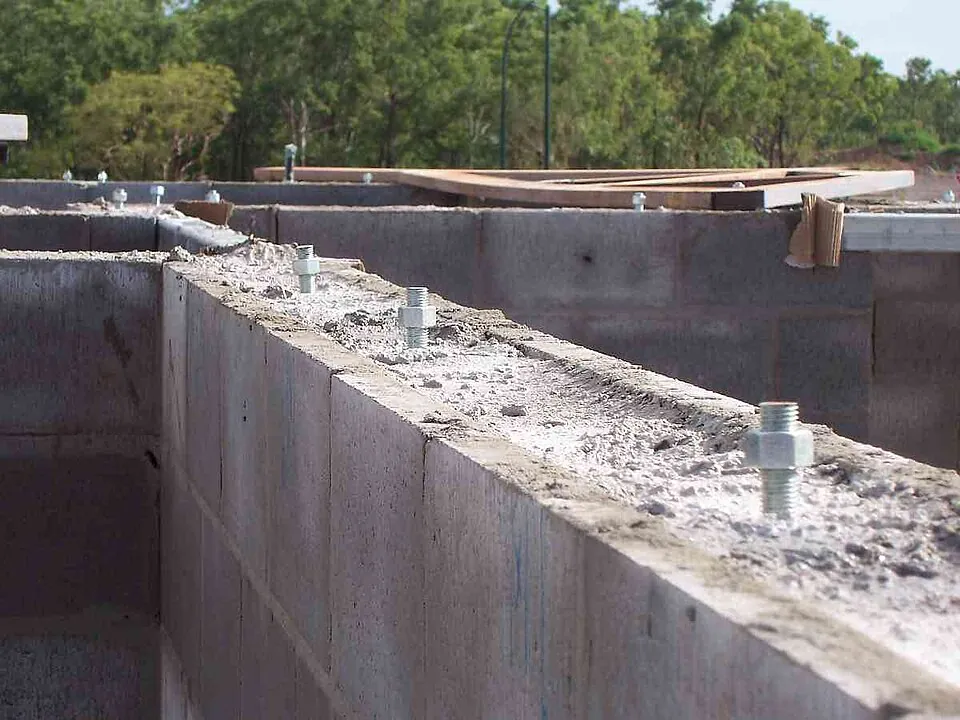
Photo: Bill Bradley, Wikimedia Commons, CC BY 2.5
Quick Answer
Concrete bolts come in two main families: cast-in bolts (J-bolts, L-bolts and headed anchor bolts set in wet concrete) and post-installed bolts drilled into hardened concrete, such as expansion bolts (wedge and sleeve anchors), lag bolts with lag shields, screw anchors and adhesive anchors. For most jobs, a 3/8 inch concrete anchor handles light to medium loads such as railings, shelving and post bases, and a 1/2 inch concrete anchor handles heavier loads such as machinery, sill plates and structural brackets. Drill the hole the same diameter as a wedge anchor, about 1/2 inch deeper than the embedment, clean the dust out, set the bolt, and tighten to the listed torque, usually about 20 to 30 ft-lb for 3/8 inch and 40 to 60 ft-lb for 1/2 inch.
Bolting into concrete is one of the most common jobs in building and home improvement. Sill plates are bolted to foundations, steel columns to footings, handrails to steps, machines to shop floors, posts to patios and roof framing to block walls, like the row of hold-down bolts in the photo above, cast into the grouted top of a block wall in a cyclone region of northern Australia, ready to tie down the roof. Choosing the right bolts for concrete, and installing them correctly, decides whether the connection holds for decades or pulls out under load.
This guide explains the types of concrete bolts, how expansion bolts for concrete work, when to use lag bolts in concrete, how to choose between a 3/8 and a 1/2 inch concrete anchor, drill sizes, embedment depth, edge distance, spacing and torque, step-by-step installation, and the mistakes that cause failures. It focuses on bolts; for screw anchors and a full anchor comparison, see types of concrete anchors and concrete screws.
Types of Concrete Bolts
Cast-in bolts are placed while the concrete is wet. J-bolts and L-bolts have a bent end that hooks into the concrete; headed bolts have a nut or forged head and washer at the bottom. They are used in foundations for sill plates, in footings for steel columns and posts, in light pole and sign bases, and in bond beams for roof tie-downs. Cast-in bolts are very strong and cheap, but they must be placed accurately before the pour, because moving them later is hard. Templates hold them in position while the concrete is placed. See concrete footings and concrete masonry unit.
Post-installed bolts go into holes drilled in hardened concrete. Expansion bolts, the most common type, include wedge anchors, sleeve anchors and drop-in anchors. They hold by pressing outward against the sides of the hole as they are tightened. Lag bolts, also called lag screws, are wood screws with hex heads; in concrete they are used with lead or zinc lag shields that expand as the lag is driven. Screw anchors, such as large concrete screws, cut their own threads into the concrete. Adhesive anchors are threaded rods set in epoxy in a drilled hole. Each type has its strengths, and the right choice depends on the load, the concrete, the distance to edges, and whether the bolt will ever need to come out. See concrete adhesive.
Expansion Bolts for Concrete
Expansion bolts for concrete hold by friction and mechanical interlock. A wedge anchor is a threaded stud with a cone at the bottom and a steel clip around it. You drive it into a hole the same size as the bolt, and as you tighten the nut, the cone is pulled up into the clip, forcing the clip outward to bite into the concrete. Wedge anchors are the strongest of the common concrete expansion bolts and are used for heavy loads: structural brackets, racking, machinery, railings, ledgers and post bases. They need solid concrete; they are not suitable for hollow block or brick. Once set, they cannot be removed without cutting. See how to remove concrete anchors.
A sleeve anchor has a bolt or threaded stud inside a full-length expansion sleeve. Tightening pulls a cone into the sleeve, which expands along a longer length. Sleeve anchors work in concrete, block and brick, are good for medium loads, and are easier to remove than wedge anchors. A drop-in anchor is an internally threaded shell set flush with the surface and expanded with a setting tool; you then thread a bolt or rod into it. Drop-ins are common for overhead work, such as hanging pipe and conduit from slabs. Each concrete expansion bolt has rules for minimum embedment, edge distance and spacing, because the expansion force can crack the concrete if the bolt is too close to an edge or another anchor.
Lag Bolts for Concrete
Lag bolts are designed for wood, but concrete lag bolts are common in older and lighter applications using lag shields. A lag shield is a lead, zinc alloy or plastic sleeve set in a drilled hole; when the lag bolt is driven in, it expands the shield against the concrete. Lag bolts for concrete with shields are used for attaching ledger boards, wood posts, gates, mailboxes and lighter brackets, especially in masonry where expansion bolts might crack the material. The shield's hole size is larger than the lag, so follow the shield's label for the drill bit size. Today, heavy-duty screw anchors and sleeve anchors have replaced many lag shield uses because they install faster and hold better, but lag shields are still useful when you need a lag bolt head and threads into wood on the outside. For structural connections such as deck ledgers on concrete foundations, codes and manufacturers specify particular anchors and spacing, so follow the approved method. See how to anchor a post to concrete.
Choosing a 3/8 or 1/2 Inch Concrete Anchor
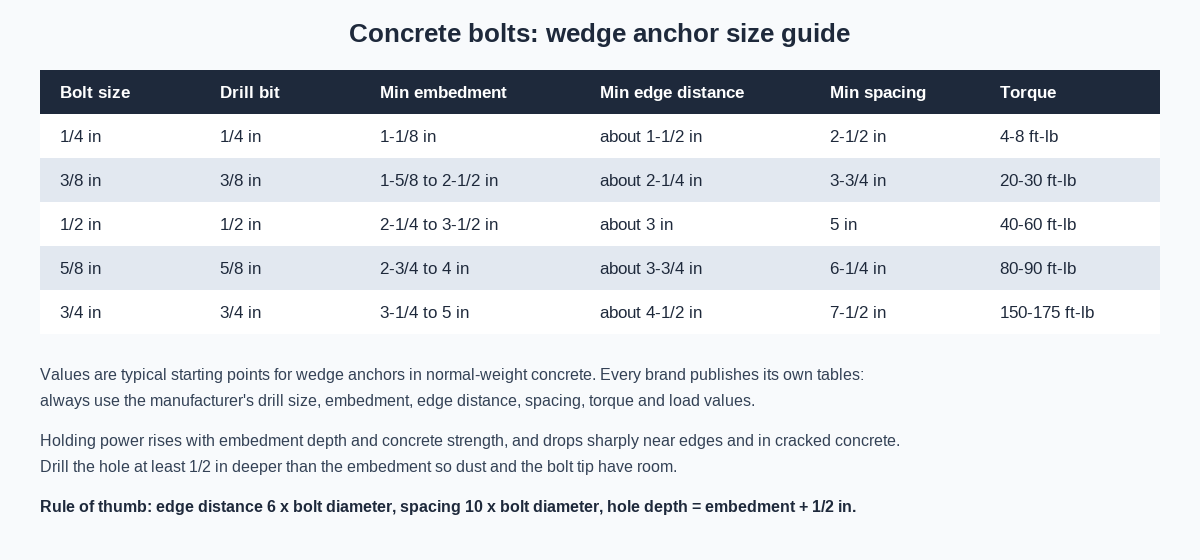
Diameter is the first decision. The 3/8 concrete anchor is the workhorse for light to medium loads: handrails, shelving, small post bases, signs, light fixtures, door stops, thresholds, garden structures and equipment that is not heavy or vibrating. It installs quickly with a standard hammer drill and a 3/8 inch bit. The 1/2 inch concrete anchor is the step up for heavier loads: sill plates on foundations, heavy post bases for pergolas and decks, car lifts, machinery, storage racks, steel brackets and anything that carries significant tension or shear. Larger 5/8 and 3/4 inch bolts are used for structural steel, heavy equipment and lifts. The chart above shows typical drill sizes, embedment, edge distance, spacing and torque for each size of wedge anchor.
Holding power depends on more than diameter. Deeper embedment increases pullout strength, often dramatically, so a 3/8 inch bolt embedded 2-1/2 inches can outperform a 1/2 inch bolt embedded only 2 inches. Stronger concrete holds better. Edges reduce strength: a bolt close to the edge of a slab or step can break out a cone of concrete. Groups of bolts placed too close together share the same cone and hold less than the sum of single bolts. Cracked concrete holds less than uncracked concrete, which is why structural anchors are tested and rated for cracked conditions. For anything that supports people, such as railings, or anything overhead, use the manufacturer's published load tables and safety factors, and follow your local code. When in doubt, step up to the larger size and deeper embedment.
Shopping for Concrete Anchors: 1/2 and 3/8 Sizes
In stores and online, concrete anchors are listed by diameter and length, such as 3/8 x 3 or 1/2 x 4-1/4. Searching for concrete anchors 1/2 brings up wedge anchors, sleeve anchors and screw anchors in that diameter, in lengths from about 2-3/4 to 12 inches. To pick the length, add the thickness of the item you are fastening, the thickness of the washer and nut, and the embedment depth you need. For example, fastening a 1/4 inch steel base plate with a 1/2 concrete anchor embedded 3-1/2 inches needs at least 3-1/2 + 1/4 + about 1/2 inch for the nut and washer, so a 1/2 x 4-1/2 inch or longer bolt. Most packages print the maximum fixture thickness for each length, which makes this easier.
A 3/8 concrete anchor is the most common size sold, usually in lengths from 2-1/4 to 5 inches. It suits fixtures up to about 1 inch thick with standard embedment. If you are fastening a thick wood post base or a 2x ledger, choose a longer concrete bolt so you still reach full embedment after passing through the wood. Buy a few extra concrete bolts, since one occasionally hits rebar or a void and must be moved. Check the label for the material (zinc-plated, galvanized or stainless), the drill bit size, the minimum embedment and the installation torque, and keep the box with the job notes for inspection.
Testing and Inspecting Concrete Bolts
For critical work, such as handrails, guardrails, overhead hangers and equipment that vibrates, it is worth checking that concrete bolts hold. On larger jobs, contractors use a calibrated torque wrench to verify installation torque and may perform proof-load tests on a sample of anchors with a hydraulic pull tester. For home projects, check that each nut reaches its torque without the anchor spinning, that the fixture sits tight against the concrete, and that there are no cracks radiating from the bolt holes. A bolt that keeps turning without tightening has not set; remove it if you can, move over at least a few inches, and install a new one, or switch to an adhesive anchor in the same hole. Recheck the nuts on anchors under vibrating machinery after a few weeks of use, and inspect outdoor concrete bolts each spring for rust, loosening and cracked concrete around them.
Concrete Bolts for Common Home Projects
For a handrail on concrete steps, most installers use 3/8 or 1/2 inch wedge anchors or adhesive anchors through the post base plates, kept well back from the step edge. For a pergola or carport post on a patio, 1/2 inch concrete bolts in a post base on a slab at least 4 inches thick, or better on a dedicated footing, are typical. For a shed or garage sill plate on a new slab, cast-in 1/2 inch anchor bolts or approved post-installed anchors at code spacing hold the walls down. For garage storage racks and workbenches, 3/8 inch sleeve anchors or screw anchors are common. For a car lift, the manufacturer specifies anchor size, embedment and minimum slab thickness and strength, often 3/4 inch wedge anchors in at least 4 inches of 3,000 psi concrete, and those requirements must be followed exactly. See concrete garage floor repair and concrete slab thickness.
Drill Bits and Hole Size
Use a carbide-tipped masonry bit in a hammer drill or rotary hammer. For wedge anchors, the drill bit diameter equals the anchor diameter: a 3/8 inch bit for a 3/8 inch wedge anchor, a 1/2 inch bit for a 1/2 inch wedge anchor. For sleeve anchors, the bit also usually matches the sleeve diameter, which is the size printed on the package. Drop-in anchors need a larger hole, specified by the maker; a 3/8 inch drop-in, for example, needs a 1/2 inch hole. Lag shields need the hole size printed on the shield package. Bits for concrete screws are smaller than the screw diameter. Using a worn or oversize bit is a common cause of anchors spinning or pulling out, so check bit wear and use bits that meet ANSI standards for anchor work. See concrete drill bit and how to drill into concrete.
Embedment Depth, Edge Distance and Spacing
Embedment depth is how far the bolt goes into the concrete. Each concrete bolt has a minimum embedment, typically about 1-1/8 inches for 1/4 inch bolts, 1-5/8 inches for 3/8 inch, and 2-1/4 inches for 1/2 inch, but deeper embedment gives more strength. Drill the hole about 1/2 inch deeper than the embedment, so dust and the bolt tip do not bottom out. Edge distance is the distance from the bolt center to the nearest free edge of the concrete. A good rule of thumb is at least 6 bolt diameters for expansion bolts, so about 2-1/4 inches for a 3/8 inch bolt and 3 inches for a 1/2 inch bolt, with more needed for full rated loads. Spacing between bolts should be at least about 10 diameters. Closer edges and spacing are possible with adhesive anchors and some screw anchors, which do not exert expansion forces. On steps, curbs and the edges of slabs, these distances matter a lot, because expansion bolts placed too close to an edge can split off a chunk of concrete. See handrails for concrete steps.
How to Install Expansion Bolts in Concrete
First, plan the layout. Mark the bolt locations through the holes of the item you are fastening, or use a template. Check the concrete: it should be solid, cured at least about 28 days for full strength, and free of large cracks near the bolt locations. Avoid rebar if possible; if you hit steel while drilling, stop and move the hole slightly, rather than drilling through structural rebar. Use a hammer drill with a depth stop set to the hole depth. Drill straight and perpendicular to the surface.
Next, clean the hole. This step is skipped more than any other and causes many failures. Blow out the dust with a hand pump or compressed air, brush the hole with a round nylon or wire brush, and blow it out again. Dust left in the hole acts like a lubricant and keeps the expansion clip or sleeve from gripping. Wear eye protection when blowing out holes.
Then set the bolt. For a wedge anchor, thread the nut on flush with the top of the stud to protect the threads, and tap the anchor through the fixture into the hole with a hammer until the washer is snug against the fixture. For a sleeve anchor, tap it in through the fixture until the washer is tight. Tighten the nut with a wrench to the manufacturer's installation torque, usually a few turns past hand tight. Do not over-torque, which can crack the concrete or snap the bolt, and do not under-torque, which leaves the clip loose. A torque wrench gives the most reliable result for structural work. For drop-in anchors, set the shell with the setting tool until the shoulder of the tool hits the anchor, then thread in the bolt.
Installing Cast-In Anchor Bolts

Photo: Trevor Littlewood, Wikimedia Commons, CC BY-SA 2.0
Cast-in bolts are set while the concrete is wet, so planning is everything. For sill plates, the International Residential Code typically calls for 1/2 inch anchor bolts embedded at least 7 inches into concrete, spaced no more than 6 feet apart, with a bolt within 12 inches of each end of each plate piece, and more in high-wind and seismic areas. For steel columns and equipment, an engineer sets the bolt size, projection and pattern, and a plywood or steel template holds the bolts at the exact spacing and height during the pour. Set bolts plumb, at the right projection above the concrete, and consolidate the concrete around them. Protect the threads with tape or nuts during the pour. Concrete bases like the old moorland foundation in the photo above often keep their steel mounting bolts long after the equipment they held is gone, which shows how permanent cast-in bolts are. See concrete piers and sonotube concrete calculator.
If a cast-in bolt is missed or ends up in the wrong place, the usual fix is a post-installed adhesive anchor or wedge anchor of equal or greater capacity, installed per the manufacturer's instructions and approved by the inspector or engineer where required. Never bend cast-in bolts back and forth to adjust them, which weakens the steel and the concrete around them.
Concrete Fasteners Beyond Bolts
Concrete fasteners include more than bolts. Concrete screws such as Tapcons handle light and medium loads, install quickly and can be removed. Powder-actuated fasteners, pins driven by a small explosive charge, attach wood plates, track and clips to slabs in seconds. Hammer-drive anchors and nail-in anchors are quick, light-duty fasteners for brackets and furring. Plastic plugs work only for very light items. Strike anchors and split-drive anchors are one-piece expansion anchors driven with a hammer. Adhesive anchors use epoxy for high loads and close edges. Choosing among fasteners for concrete comes down to load, material, speed and whether you will ever remove the fastener. For anything structural or overhead, use products with published load values and code approvals. See concrete nailer.
Red Head Concrete Anchors
Many contractors ask for Red Head concrete anchors by name. Red Head is a long-standing brand of concrete anchors, now part of ITW (Illinois Tool Works), sold at supply houses and home centers. The brand covers most of the concrete anchors and concrete bolts described in this guide, which makes it a handy reference when shopping:
Wedge anchors. Red Head's Trubolt line is one of the best-known wedge anchors, the standard among expansion bolts for concrete that is solid. It installs in a hole the same diameter as the anchor and expands when the nut is tightened.
Sleeve anchors. The Dynabolt sleeve anchor is a concrete anchor that also works in block and brick, with a sleeve that expands along its length.
Drop-in anchors. Multi-Set drop-in anchors sit flush in the concrete and accept a threaded rod or bolt, common for overhead hangers.
Screw anchors and adhesive anchors. Large-diameter concrete screws and epoxy adhesive systems, the concrete fasteners for heavier loads and anchors near edges.
When choosing a Red Head concrete anchor, or any brand, the same rules apply: match the anchor type to the base material, use the drill bit size and embedment depth on the package or technical data sheet, respect edge distance and spacing, and for structural or code-required work, use anchors with an evaluation report for cracked concrete and follow the published load values. Red Head anchors are typically priced similar to other major anchor brands; a box of 3/8 inch concrete bolts of the wedge type costs about the same as competing brands at the same store.
Stainless, Galvanized or Zinc-Plated?
Bolt material matters in wet and corrosive places. Zinc-plated carbon steel bolts are fine indoors and in dry locations. Hot-dip galvanized bolts resist rust outdoors and in damp areas such as garages and basements. Stainless steel bolts, type 304 for general outdoor use and type 316 near salt water, pools and deicing salts, are the best choice for exposed outdoor work, marine areas and anywhere rust stains would be a problem. Pressure-treated lumber is corrosive to plain steel, so bolts through treated wood should be galvanized or stainless. Rusting bolts expand and can crack the concrete around them, so the right material prevents both failure and staining. See how to remove rust stains from concrete.
Concrete Bolts in Block and Brick
Hollow concrete block and brick behave differently from solid concrete. Wedge anchors need solid material and can crack or pull out of hollow units. In hollow block, use sleeve anchors sized for block, screw anchors, or adhesive anchors with screen tubes that keep the epoxy from running into the hollow cells. Better still, place bolts in grouted cells or in the solid top course or bond beam. In brick, set anchors in the solid brick, not the mortar joint, unless the anchor is designed for joints. Keep away from the edges of units. See concrete blocks.
Costs
Concrete bolts are inexpensive individually. A 3/8 by 3 inch zinc-plated wedge anchor costs about $0.50 to $1.50; a 1/2 by 4 inch about $1 to $3; stainless versions cost two to four times more. Sleeve anchors cost about the same as wedge anchors. Lag shields cost $0.50 to $2 each. Cast-in J-bolts cost $1 to $5 each. Boxes of 25 or 50 are much cheaper per bolt. Add the cost of masonry bits, about $8 to $25 each, and a hammer drill rental if you do not own one. Professional installation of anchors for railings, racks or machinery is often priced per anchor or per hour. See concrete repair cost.
Common Mistakes
The most common mistakes with concrete bolts are not cleaning the hole, which leaves dust that keeps the anchor from gripping; using a worn or wrong-size bit; placing bolts too close to edges or each other; drilling too shallow so the bolt bottoms out before the clip engages; over-tightening and cracking the concrete; under-tightening so the anchor never sets; using wedge anchors in hollow block; using plain steel outdoors where it rusts; and guessing at loads for railings and overhead items instead of using load tables. Another frequent problem is drilling into rebar or post-tensioning tendons in commercial slabs, which can be dangerous; scan or check drawings before drilling in post-tensioned slabs. See post-tensioned concrete slab.
Frequently Asked Questions
What size drill bit for a 3/8 concrete anchor?
For a 3/8 inch wedge or sleeve anchor, use a 3/8 inch carbide masonry bit. Drop-in anchors and lag shields need larger holes; check the package.
How deep should concrete bolts go?
At least the manufacturer's minimum embedment, about 1-5/8 inches for 3/8 inch and 2-1/4 inches for 1/2 inch wedge anchors, and deeper for more strength.
Can you use lag bolts in concrete?
Yes, with lag shields set in drilled holes, but screw anchors and sleeve anchors usually hold better and install faster.
How much weight can a 1/2 inch concrete anchor hold?
It varies widely by product, embedment, concrete strength and edge distance, so use the manufacturer's load tables with a safety factor.
Are expansion bolts or epoxy anchors stronger?
Both can be very strong. Epoxy anchors work closer to edges and in damaged concrete; expansion bolts install faster and can be loaded right away.
Sources
- Simpson Strong-Tie: mechanical anchor technical data
- American Concrete Institute: ACI 318 Chapter 17, anchoring to concrete
- International Residential Code: foundation anchorage
- Hilti: anchor fastening technical guide
Related Guides
- Concrete nailer — powder, gas and battery tools
- How to hang pictures on concrete walls — hooks, plugs and concrete screws