
Concrete Stair Treads: Precast and Poured Treads, Covers, Repair and Cost

Photo: Todaysmiracle, Wikimedia Commons, CC BY-SA 4.0 (cropped)
Quick Answer
Concrete stair treads are the horizontal walking surfaces of concrete stairs. They are either poured in place as part of a cast concrete stair, or precast as separate tread slabs or blocks that are set on a stair frame, stringers or a stepped base. Under US residential code, treads should be at least 10 inches deep with a nosing (11 inches without), with risers no taller than 7.75 inches and consistent within 3/8 inch. Outdoor concrete stair treads need a slip-resistant finish and a slight slope to shed water. Worn or chipped treads can be resurfaced, covered with stone, tile, wood or rubber, or replaced. Precast concrete stair treads typically cost $50 to $300 each; repairing treads costs about $100 to $400 per step.
Concrete stairs are everywhere: front entry steps, basement stairs, garden steps, park stairways, commercial stair towers and parking garages. The treads take all the foot traffic, weather and wear, so they are usually the first part of a concrete stair to chip, crack, become slippery or look tired. The long outdoor stairway in the photo above shows concrete stair treads built into a hillside, each with a clean edge and a textured surface for grip.
This guide covers the types of concrete stair treads, dimensions and building code basics, finishes and anti-slip options, how to cover concrete treads with other materials, how to repair and replace them, and what they cost.
Types of Concrete Stair Treads
Cast-in-place treads. Most residential concrete steps are poured as one piece, with the treads formed by riser boards in the formwork and finished by hand. The tread is part of a solid or reinforced stair. See how to pour concrete steps.
Precast concrete stair treads. Individual tread slabs or blocks are made in a factory and set onto a support: steel or concrete stringers, a stepped concrete base, a masonry frame, or a cantilevered wall. Precast concrete stair treads can be plain, polished, terrazzo, exposed aggregate, or cast with nosings and anti-slip inserts.
Precast stair units. Complete precast concrete steps, with several treads and risers in one piece, are set by a truck boom at entries and porches. See precast concrete steps.
Block treads for landscapes. Solid concrete step blocks or wall caps stacked into slopes create garden stairs quickly.
Concrete-filled metal pan treads. In commercial steel stairs, steel pans are filled with concrete to form the treads.
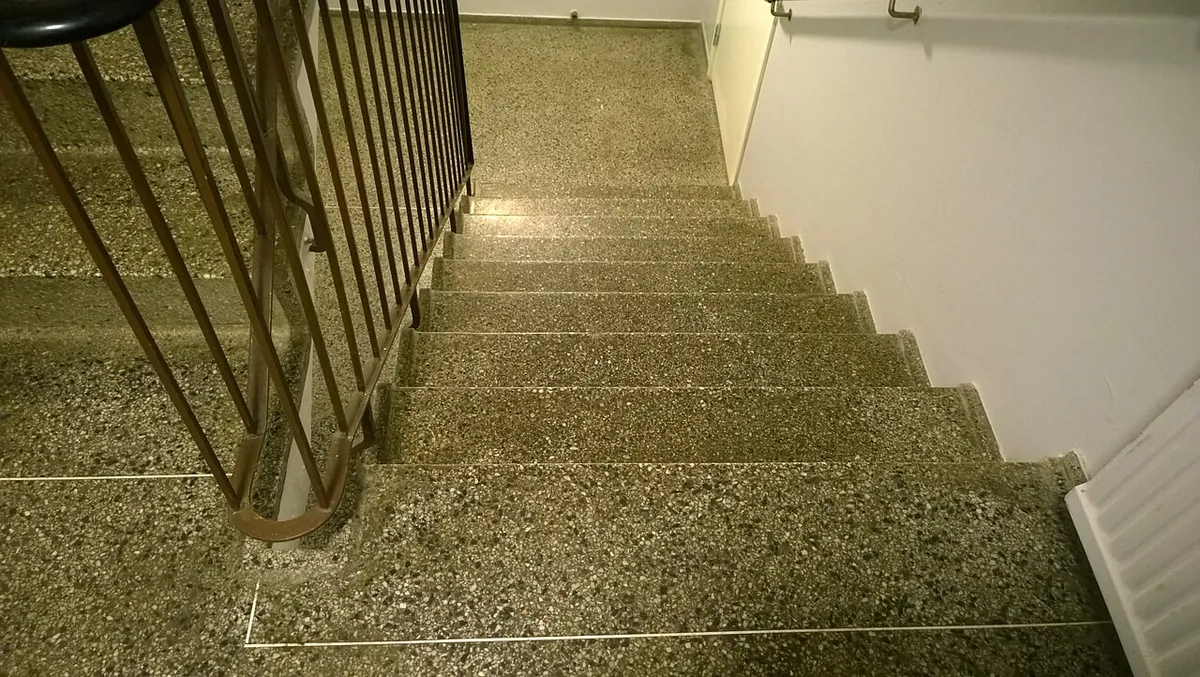
Photo: Ingwik, Wikimedia Commons, CC BY-SA 4.0
The stairwell above uses polished precast concrete stair treads with a speckled aggregate face, a durable, easy-to-clean finish that imitates stone at a lower cost.
Concrete Stair Tread Dimensions and Code
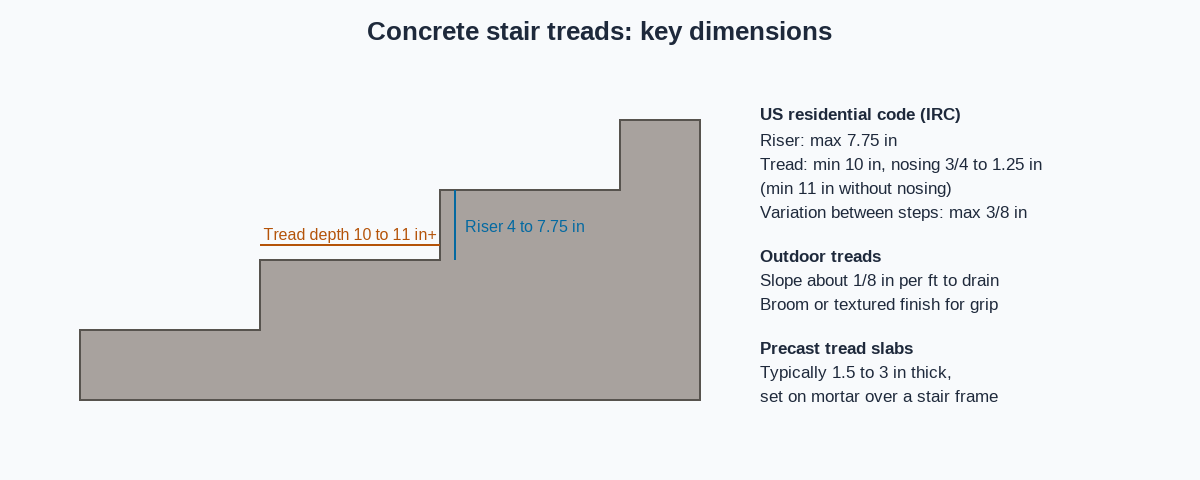
Stair dimensions are regulated for safety. Under the International Residential Code used in most US jurisdictions, risers are limited to 7.75 inches, treads must be at least 10 inches deep measured from nosing to nosing (11 inches if there is no nosing), nosings must project 3/4 to 1-1/4 inches where required, and the difference between the tallest and shortest riser or deepest and shallowest tread in a flight may not exceed 3/8 inch. Commercial and public stairs under the International Building Code generally require risers of 4 to 7 inches and treads of at least 11 inches. Exterior stairs need a slight slope, about 1/8 inch per foot, so water does not pond on the treads, but not so much that they feel tilted. Stairs with four or more risers typically need a handrail, and guards are required where drop-offs exceed 30 inches. Consistency is the most important rule: people trip when one step is a different height, because after the first few steps the body expects every step to match and does not look down. Even a half-inch difference in one riser is a common cause of falls, which is why inspectors measure stairs closely and why any repair or covering on concrete stair treads must keep the risers equal. See handrails for concrete steps and concrete steps cost.
Slip-Resistant Finishes and Nosings
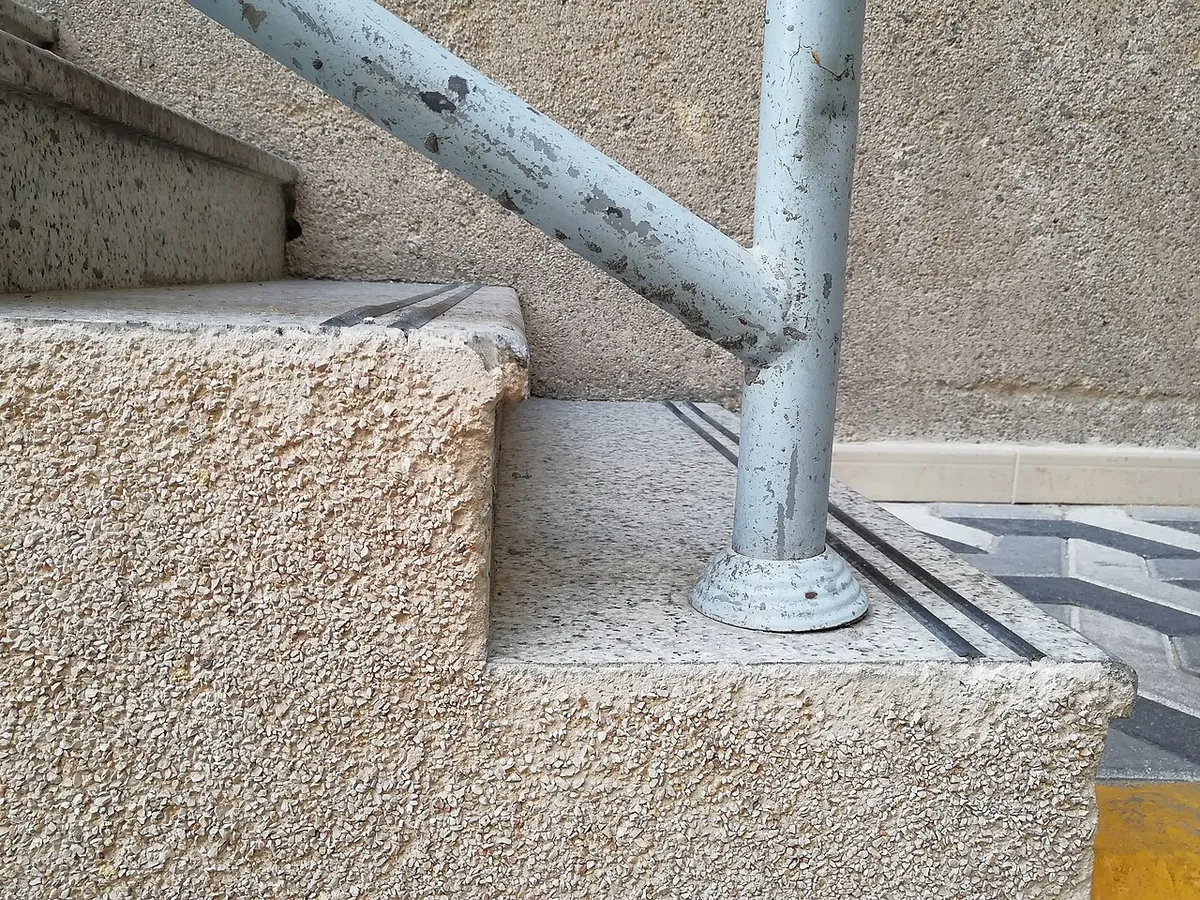
Photo: Ashashyou, Wikimedia Commons, CC0
Concrete stair treads must give secure footing in rain, snow and ice. For new outdoor treads, a broom finish across the tread is the standard, with a smooth troweled edge or tooled nosing. Exposed aggregate and salt finishes also give grip. On existing smooth or polished treads, slip resistance can be improved with anti-slip strips or inserts, like the rubber lines in the photo above, abrasive stair nosings in aluminum or rubber, grit-filled coatings, or acid etching. Contrasting nosings also help people see the edge of each step, which is important for older people and those with poor eyesight. See brushed concrete and exposed aggregate concrete.
Covering Concrete Stair Treads
Plain or worn concrete stair treads can be covered with a new surface. Natural stone treads such as bluestone, granite or limestone are set on a mortar bed over the concrete, often with a slight overhang, for a classic entry look. Porcelain stair tread tiles with bullnose or anti-slip edges are bonded with thinset. Wood or composite treads can be fastened to sleepers or directly to the concrete with adhesive and masonry screws on interior stairs and some porches. Rubber stair treads are glued down in basements, garages and commercial stairs for grip and cushioning. Thin cement-based overlays, stamped or stained, refresh outdoor treads without adding much height. Whatever the covering, keep riser heights equal after adding the new material, which may mean adjusting the top or bottom step. See how to lay tile on concrete and how to resurface concrete.
Repairing Concrete Stair Treads
Chipped nosings, spalled surfaces and cracks are common on concrete stair treads, especially outdoors where freeze-thaw and deicing salt attack the edges. Small chips and spalls are repaired by removing loose concrete, undercutting the edges, applying a bonding agent, and building up a polymer-modified repair mortar, using a board held against the riser as a form to recreate a crisp nosing. Larger broken nosings may need small stainless pins drilled into the tread to anchor the repair. Worn, rough or scaled treads can be resurfaced with a thin overlay. Cracks through a tread may indicate settling of the whole stair, which should be addressed first. See how to fix concrete steps, concrete spalling and concrete patching compound.
Replacing Concrete Stair Treads
Precast concrete stair treads set on stringers or a frame can be replaced individually: remove the old tread, clean the bearing surface, set a new tread on mortar or bearing pads, and fasten it as the original was. Cast-in-place treads cannot be swapped, so badly damaged steps are either rebuilt by cutting off the damaged tread and casting a new one with doweled rebar into the old concrete, covered with stone or precast caps, or replaced entirely with new poured or precast steps. See how to remove concrete.
Precast Concrete Stair Treads in Detail
Precast concrete stair treads are popular in modern homes, apartment buildings, schools, offices and public spaces because they combine the durability of concrete with factory quality and quick installation. Each tread is cast in a mold, usually with steel reinforcement or fibers, cured under controlled conditions, then finished by grinding, polishing, acid etching or sandblasting. Many precast concrete stair treads have cast-in anti-slip inserts, contrasting nosing strips, or textured grooves near the front edge. Terrazzo-style treads, made with colored stone chips in a cement or resin matrix and polished, are a classic choice for stairwells, like the one shown earlier. Treads are typically 1.5 to 3 inches thick for slabs set on a continuous support, and thicker, or reinforced as small beams, when they span between stringers or cantilever from a wall. Cantilevered concrete stair treads, each one anchored into a wall with no visible support at the outer end, are a striking architectural feature but must be engineered and anchored with care.
Installation methods vary. On a stepped concrete or masonry base, precast concrete stair treads are set on a full mortar bed and leveled with the correct slope. On steel stringers, they sit on angle supports or pads and are fastened with bolts or adhesive. On wood stair frames in homes, thinner precast or GFRC treads can be bonded with construction adhesive, though the frame must be strong enough for the extra weight. Joints between treads and risers are filled with mortar or flexible sealant. Because precast treads come with finished edges and surfaces, they give a cleaner result than site-cast steps and can be installed in a day. See precast concrete and glass fiber reinforced concrete.
Concrete Stair Treads for Basements and Interiors
Basement stairs, stairwells in concrete buildings and modern interior stairs often have concrete stair treads. Indoors, the main concerns are appearance, comfort and safety rather than weather. Polished or sealed concrete treads look clean and contemporary and are easy to maintain, but they can be slippery in socks or with wet shoes, so anti-slip strips, textured nosings or a matte sealer are wise. Many homeowners soften basement concrete stairs with carpet runners, rubber treads, or wood or laminate stair caps glued over the concrete. When covering interior concrete stair treads, check that the covering is designed for stairs, with a proper nosing piece, and that the added thickness keeps all risers equal; the top and bottom steps are the ones most often thrown off. Good lighting and a sturdy handrail make any concrete stair safer. See concrete floor coverings and concrete floors in homes.
Outdoor Concrete Stair Treads and Winter
Outdoor concrete stair treads face the harshest conditions: rain, snow, ice, freeze-thaw cycles, deicing salts and the weight of people stamping off snow. The edges, or nosings, take the most abuse and are where chipping and spalling usually begin. To keep outdoor treads in good shape, build them with air-entrained concrete and a proper slope so water drains off, seal them with a penetrating sealer every few years, avoid rock salt and ammonium-based deicers, use sand or a deicer labeled safe for concrete instead, shovel with a plastic blade, and repair small chips before water gets in and freezes. Heated stair treads, with electric cables or hydronic tubing in the concrete, are an option on steep or heavily used entry stairs in snowy climates. Metal or rubber nosings protect edges and add grip. See best ice melt for concrete, does salt damage concrete and heated concrete floor.
Building New Concrete Stair Treads
When building new concrete steps, the quality of the treads depends on careful forming and finishing. Plan the stair so all risers and treads are equal, dividing the total rise by the desired riser height and adjusting to whole steps. Build riser forms with boards set at a slight angle at the bottom so the finisher can trowel the full tread, and brace them securely. Place the concrete starting at the bottom step, consolidate it, and screed each tread to the riser forms with a slight outward slope. Finish each tread with a float, a light trowel pass and a broom, and round the nosings with an edging tool. Strip the riser forms when the concrete can hold its shape and finish the risers. Cure the steps carefully. Reinforcement, footings below frost depth and a proper connection to the house prevent settling and cracking. See how to pour concrete steps and how to build concrete forms.
Common Problems With Concrete Stair Treads
Chipped and broken nosings. From impacts, freeze-thaw, salt and thin, poorly supported edges. Repair with mortar or add protective nosings.
Scaling and pitting. The surface flakes off, usually from salt, freeze-thaw and overworked finishing. Resurface the treads. See concrete pitting and flaking.
Slippery surfaces. Polished, worn or algae-covered treads are dangerous. Clean, etch, or add anti-slip treatments.
Uneven risers. Settlement or added coverings change step heights. Correct them for safety.
Steps pulling away from the house. Usually settlement of the stair base; may need mudjacking, foam lifting or rebuilding. See concrete leveling cost.
Water ponding. Treads sloped toward the house or flat hold water and ice. Resurface with the correct slope, sloping gently outward.
Design Ideas for Concrete Stair Treads
Concrete stair treads can be a design feature rather than just a way up. Floating stairs with thick precast concrete stair treads cantilevered from a wall, or set on a single central steel stringer, give modern homes a sculptural focal point. Wide, deep outdoor treads with low risers turn a garden slope into a series of terraces where people can sit and place planters. Treads with exposed aggregate, salt finish or stamped stone texture blend into landscape paving. Contrasting colors, such as a dark tread with a light riser, make each step easy to see. Treads that overhang the riser slightly cast a shadow line that looks crisp and helps define each step. Integrated LED lights under the nosing or in the riser make outdoor stairs safe and attractive at night. Wood or stone inlays set into concrete stair treads add warmth. In commercial projects, precast concrete stair treads in terrazzo or polished concrete with metal anti-slip inserts combine style with durability. See decorative concrete and concrete walkway ideas.
Concrete Stair Treads in Landscapes and Gardens
Garden and landscape stairs often use concrete stair treads in a more relaxed way than building stairs. On gentle slopes, wide concrete treads with gravel, grass or planting between them create a stepped path. On steeper banks, solid precast step blocks or stacked concrete wall caps form durable steps that can be installed by hand. Treads cast in place with curved edges follow the shape of a path or retaining wall. For outdoor landscape stairs, local codes may be less strict than for building stairs, but the same safety principles apply: keep riser heights consistent, make treads deep enough for a comfortable stride, often 12 to 16 inches outdoors, provide good drainage and a slip-resistant surface, and add a handrail on longer or steeper runs. The long park stairway in the first photo is a good example of simple, durable landscape concrete stair treads. See concrete retaining walls and how to make concrete stepping stones.
Maintaining Concrete Stair Treads
Regular maintenance keeps concrete stair treads safe and good looking. Sweep and wash them periodically to remove grit and algae, which make steps slippery. Clean moss and mildew from shaded outdoor steps with a concrete cleaner. Reseal outdoor treads every two to four years with a penetrating sealer to reduce water absorption and salt damage. Check nosings, anti-slip strips and handrails each spring and fall, and fix loose or worn parts. Repair small chips and cracks promptly before they grow. Inside, clean polished treads with a pH-neutral cleaner and replace worn anti-slip inserts. With good care, concrete stair treads can last for decades. See how to clean moss off concrete and concrete sealer.
DIY or Professional Work on Concrete Stair Treads?
Small jobs on concrete stair treads, such as adding anti-slip strips, sealing, cleaning, patching small chips and installing rubber treads, are well within reach of most homeowners. Rebuilding nosings, resurfacing a whole set of steps, setting stone or tile treads, and installing precast concrete stair treads are moderate DIY projects that require care to keep treads level and risers equal. Pouring new concrete steps, replacing settled stairs, building cantilevered treads and any structural stair work are best left to experienced contractors, because mistakes are hard to correct and stairs must meet code for safety. When hiring, ask to see stairs the contractor has built, confirm that riser heights will be uniform, and ask how they will finish the treads for grip.
Safety Checklist for Concrete Stair Treads
Safe concrete stair treads share a few features. Every riser in a flight is the same height and every tread the same depth, within the small tolerance allowed by code. Treads are deep enough for the whole foot. Surfaces are slip resistant, especially outdoors and where wet shoes are likely. Nosings are visible, with contrast if possible, and in good repair. Water drains off the treads and does not pool or freeze. Handrails are present, sturdy, and at the right height on stairs with four or more risers. Lighting reaches every step, including the top and bottom landings. Treads are free of chips, cracks and loose coverings that could catch a foot. Checking these points once a year prevents most stair accidents.
Choosing Between Precast and Poured Concrete Stair Treads
When planning new stairs, the choice between precast and poured concrete stair treads depends on the project. Poured treads are part of a monolithic stair, so they are strong, seamless and well suited to entry steps, porches and stairs on grade where forms can be built on site. They can be finished in many ways but depend on the skill of the finisher for straight edges and consistent risers. Precast concrete stair treads arrive with finished surfaces and crisp, factory-made edges, so they look sharper and install faster, and they can be polished, terrazzo, colored or fitted with anti-slip inserts in ways that are hard to achieve on site. They need a support structure, such as stringers, a stepped base or wall anchors, and careful setting to keep every tread level. For a modern interior stair or a commercial stairwell, precast treads are often the better choice; for a traditional front stoop or garden steps, poured concrete stair treads are usually simpler and cheaper. Some projects combine both, with a poured stair structure capped by precast or stone treads for a refined finish.
How Long Concrete Stair Treads Last
Well-built concrete stair treads can last 30 to 50 years or more outdoors and much longer indoors. The lifespan depends on concrete quality, air entrainment in freeze-thaw climates, drainage, sealing and how much salt is used in winter. Precast treads made with high-strength, low-permeability concrete often outlast site-cast ones. Even when the surface or nosings wear, concrete stair treads can usually be repaired or resurfaced rather than replaced, extending their life for decades. Rebuilding is generally only needed when the whole stair settles, cracks through, or pulls away from the building.
Measuring for New Concrete Stair Treads
Whether you are ordering precast concrete stair treads or planning a covering, accurate measuring prevents costly mistakes. Measure the total rise from the lower finished surface to the upper finished surface, and the total run available. Divide the rise into equal risers within code limits, then work out tread depths. For replacement or covering projects, measure every existing tread width, depth and riser height, because older steps are rarely uniform, and note where the steps meet walls, railings and door thresholds. Allow for the thickness of mortar beds, adhesives and new coverings so that the finished top step lines up with the door threshold or landing and all risers end up equal. Many suppliers of precast concrete stair treads will review a sketch with dimensions and suggest standard sizes or cut treads to length, which is far easier than trimming heavy concrete on site.
Concrete Stair Treads Cost
Precast concrete stair treads typically cost $50 to $300 each depending on size, finish and whether they include nosings or anti-slip inserts, plus installation. Repairing chipped or spalled treads usually costs $100 to $400 per step, and resurfacing a set of outdoor steps $300 to $1,200. Covering steps with stone treads typically costs $100 to $300 per step installed, tile $80 to $200 per step, and rubber treads $30 to $100 per step. New poured concrete steps typically cost $300 to $700 per step, and precast step units $500 to $2,500 per unit installed. See concrete steps cost.
Frequently Asked Questions
How deep should concrete stair treads be?
At least 10 inches with a nosing, or 11 inches without, under US residential code; 11 inches for most commercial stairs.
How do I make concrete stair treads less slippery?
Add anti-slip strips or nosings, apply a grit coating, or etch the surface. New treads should get a broom finish.
Can I put wood treads over concrete steps?
Yes, on interior stairs and protected porches, using adhesive and masonry screws or sleepers, while keeping riser heights equal.
How do I fix a chipped concrete stair tread?
Remove loose concrete, apply a bonding agent and rebuild the edge with repair mortar against a form board.
What are precast concrete stair treads?
Factory-made tread slabs or blocks set on stringers, frames or stepped bases, often polished or with anti-slip nosings.
Sources
- International Residential Code: stairways, risers, treads and nosings
- International Building Code: stairway requirements
- National Precast Concrete Association: precast stairs
- US Access Board: ADA standards for stairways