
How Thick Should a Concrete Driveway Be? 4, 5 or 6 Inches Explained
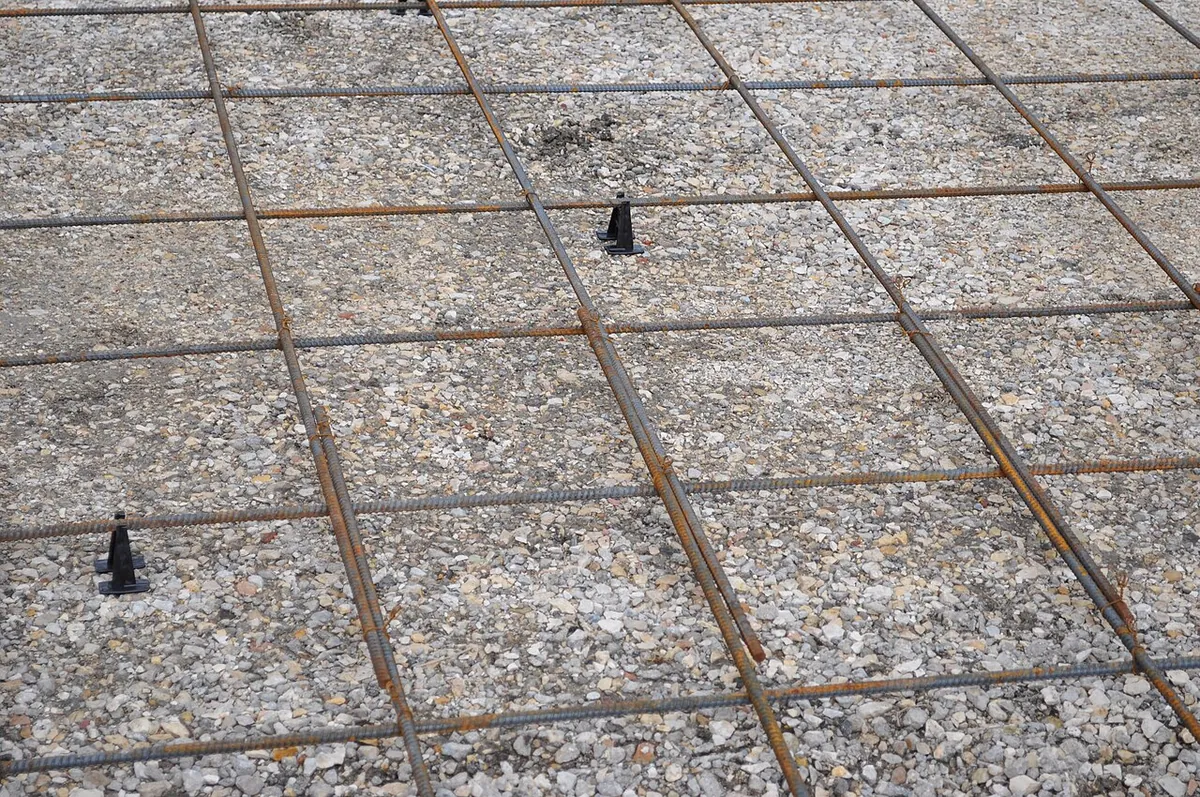
Photo: Dig deeper, Wikimedia Commons, CC BY-SA 4.0
Quick Answer
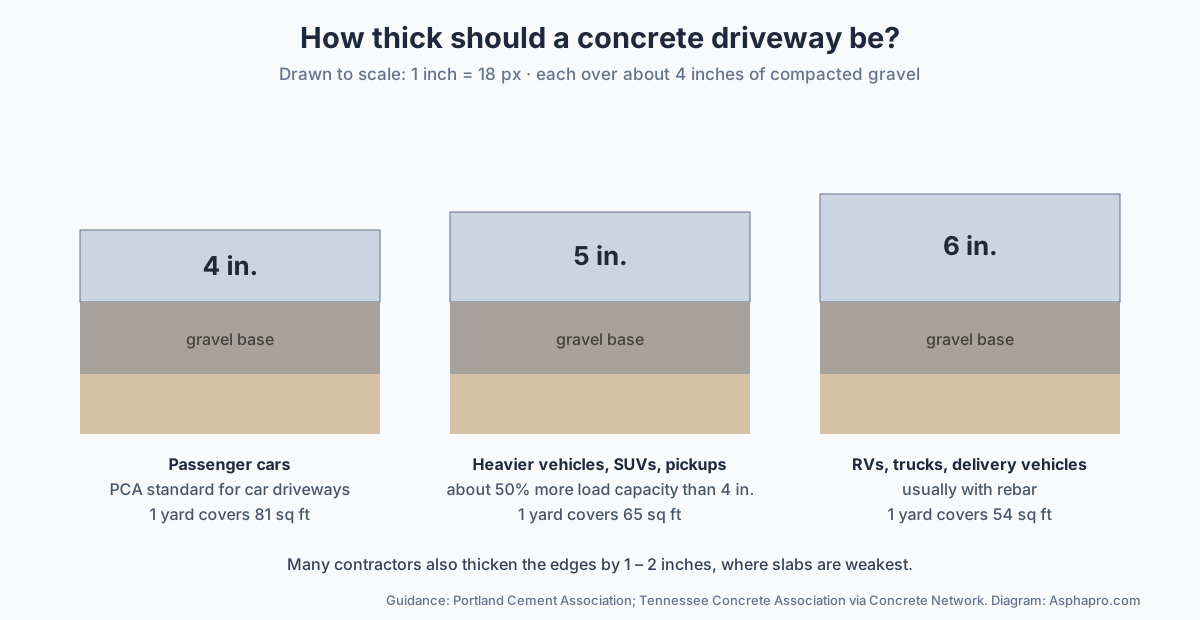
A concrete driveway should be at least 4 inches thick for passenger cars, which the Portland Cement Association treats as the standard for car driveways. Use 5 inches for heavier vehicles such as full-size pickups and SUVs, and 6 inches or more for RVs, boats on trailers, delivery trucks or soft soils. Many contractors also thicken the edges by 1 to 2 inches. Pour it over about 4 inches of compacted gravel. Going from 4 to 5 inches adds roughly 20 to 25 percent more concrete but can raise load capacity by nearly 50 percent.
Concrete driveway thickness is one of the few decisions you cannot change later. Once the concrete is poured, a slab that is too thin for the vehicles on it will crack, settle at the edges, and break up years before it should. Making it thicker than needed costs more but is rarely wasted money. The right answer depends on what you will park on it, your soil, your climate, and how the driveway is built underneath.
This guide explains how thick a concrete driveway should be for each use, why the base and reinforcement matter as much as thickness, how thickness changes the amount of concrete and the cost, and the mistakes that lead to early cracking.
Driveway Concrete Thickness by Use
How thick is driveway concrete on most homes? Walk past a typical suburban driveway and it is almost always 4 inches, sometimes 5 on newer builds. How thick should concrete be for a driveway on your property depends on the heaviest thing that will park on it, not the everyday car. Use this table to match the slab to the load:
| What will use the driveway | Recommended thickness | Reinforcement |
|---|---|---|
| Passenger cars, small SUVs | 4 inches | Wire mesh or fiber (optional), rebar for extra strength |
| Full-size pickups, large SUVs, vans | 5 inches | Rebar or heavy mesh |
| RVs, boats on trailers, box trucks | 6 inches | Rebar |
| Garbage trucks, delivery trucks, equipment | 6 – 8 inches | Rebar; consider an engineer |
| Edges of any driveway | 1 – 2 inches thicker than the slab | Rebar along the edge helps |
| Street apron (public right of way) | set by your city, often 6 inches or more | Per city standard |
The Portland Cement Association describes 4 inches of non-reinforced concrete as standard for passenger car driveways and recommends 5 inches for heavier vehicles. Many contractors now pour 5 inches as their default for all driveways because modern pickups and SUVs are heavy, and the extra inch costs relatively little.
Is 4 Inches Thick Enough for a Concrete Driveway?
For a typical house where only cars and small SUVs park, a 4 inch concrete driveway over a well-compacted gravel base is usually enough, and it is the minimum most codes and contractors accept. The catch is that 4 inches leaves little margin. If the base is poorly compacted, the soil is soft clay, or someone parks a moving truck or a loaded dumpster on it, a 4 inch slab is the first to crack.
Choose 4 inches if:
- Only cars and light SUVs will use the driveway.
- The soil is firm and drains well.
- The base will be at least 4 inches of compacted gravel.
- You will thicken the edges and cut control joints at the right spacing.
When Should a Concrete Driveway Be 5 Inches?
A 5 inch concrete driveway is the most common upgrade and, for many homes, the best value. According to the Tennessee Concrete Association, as cited by Concrete Network, increasing a driveway from 4 to 5 inches can raise its load-carrying capacity by nearly 50 percent while adding only about 20 percent to the cost. Choose 5 inches if:
- You drive or park a full-size pickup, large SUV or van.
- Delivery trucks, landscapers or contractors sometimes use the driveway.
- The soil is clay, sandy or otherwise less stable.
- You live in a freeze-thaw climate where the slab gets extra stress.
- You want extra margin and a longer life for little extra money.
When Do You Need a 6 Inch Concrete Driveway?
A 6 inch concrete driveway is the norm for heavy, frequent loads. That includes RV parking pads, boats on trailers, work trucks, a driveway used as a loading area, or a shared driveway that sees heavy traffic. Six inches is also a good choice where the driveway crosses soft or wet ground, or where the slab will carry point loads such as the jack stands of a camper. For loads beyond that, such as garbage trucks every week, construction equipment or commercial use, 6 to 8 inches with rebar is common, and it is worth having an engineer or an experienced contractor size the slab.
How Thick Should a Concrete Driveway Be at the Edges?
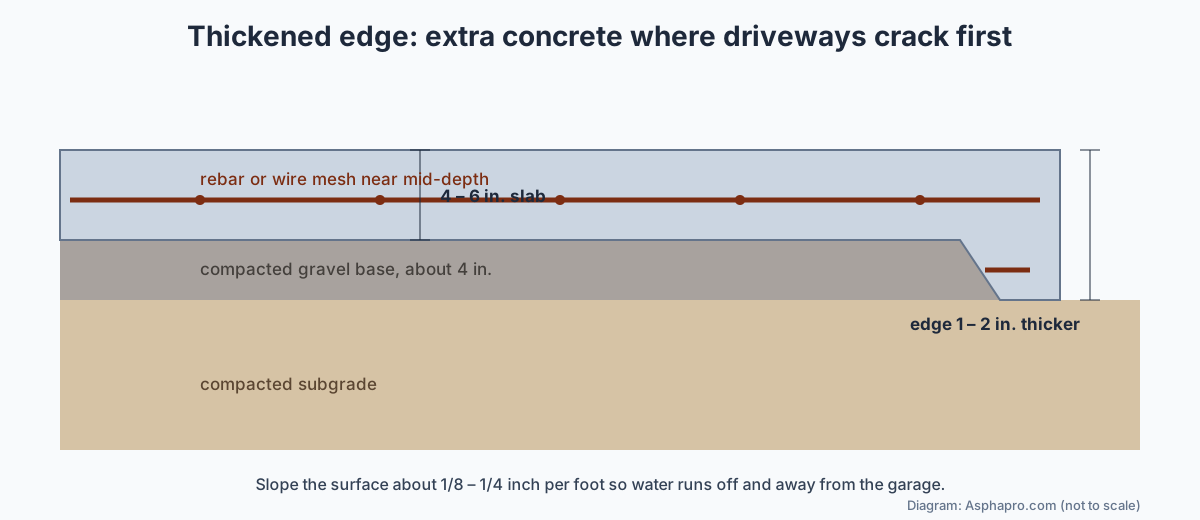
The edges are the weakest part of any driveway, so concrete driveway thickness should not be uniform all the way to the forms. A tire near the edge has no concrete on one side to share the load, and water and frost attack the edges first. That is why many contractors thicken the outer edge by 1 to 2 inches over a width of several inches to about a foot. A 4 inch driveway might be 5 to 6 inches thick at the edges; a 5 inch driveway might be 6 to 7 inches. Thickened edges add only a small amount of concrete but can prevent the most common type of driveway cracking.
Gravel Base: How Thick Should It Be?
The base under the concrete matters as much as the concrete itself. A thick slab on a soft, uneven base will still crack. Most residential driveways use about 4 inches of compacted crushed stone over compacted subgrade. Where soils are soft, wet or clay-rich, contractors often use 6 inches or more, sometimes with a geotextile fabric to keep the stone from mixing into the soil.
- Subgrade: remove topsoil, roots and organic material. Compact the native soil. Do not pour on fresh fill that has not been compacted.
- Base: spread crushed stone or road base in layers and compact each layer with a plate compactor or roller.
- Grade: shape the base so the finished surface slopes about 1/8 to 1/4 inch per foot away from the garage and house.
- Uniform support: the goal is even support everywhere. Soft spots are where slabs crack.
Use the gravel calculator or road base calculator to estimate how much base material you need.
Rebar vs Wire Mesh vs Fiber
Reinforcement does not stop concrete from cracking; it holds the pieces together when cracks happen and keeps them tight. Concrete Network suggests wire mesh for driveways 4 to 5 inches thick and rebar for driveways 5 inches or more. In practice:
| Reinforcement | Best for | Notes |
|---|---|---|
| Synthetic fiber in the mix | Reducing surface shrinkage cracks | Not a replacement for steel on heavy-use driveways |
| Welded wire mesh | 4 – 5 inch car driveways | Must be lifted into the middle of the slab, not left on the ground |
| Rebar grid | 5 inch and thicker, heavy vehicles, soft soils | Often #3 or #4 bars on a grid, set on chairs at mid-depth |
The most common mistake is steel lying on the gravel. Mesh or rebar at the bottom of the slab does almost nothing. It must sit near the middle of the slab on plastic or concrete supports, called chairs.
How Thickness Changes the Amount of Concrete
Every extra inch of thickness adds concrete. Here is how much a 20 × 20 foot (400 square foot) two-car driveway needs at each thickness:
| Thickness | Cubic yards for 400 sq ft | With 5 – 10% extra | Ready-mix at $125 – $200/yd |
|---|---|---|---|
| 4 inches | 4.9 | about 5.2 – 5.4 | about $650 – $1,080 |
| 5 inches | 6.2 | about 6.5 – 6.8 | about $810 – $1,360 |
| 6 inches | 7.4 | about 7.8 – 8.1 | about $975 – $1,620 |
So going from a 4 inch to a 5 inch concrete driveway on 400 square feet adds about 1.3 cubic yards, roughly $160 to $280 in concrete, plus a little labor. On a full installed driveway that typically costs $1,600 to $3,200 or more, that is a small increase for a big gain in strength. See concrete driveway cost for full installed prices and concrete price per yard for ready-mix costs.
Concrete Strength and Mix for Driveways
Concrete driveway thickness and strength work together. A driveway mix is usually stronger than a patio mix, especially in cold climates:
- Strength: many suppliers recommend about 3,500 to 4,000 psi for driveways, and many building codes call for at least 3,500 psi for exterior flatwork in severe weather areas.
- Air entrainment: in freeze-thaw climates, air-entrained concrete is essential. Tiny air bubbles give water room to expand when it freezes, which prevents scaling.
- Water-cement ratio: a lower water content means stronger, more durable concrete. Do not add water at the truck to make it easier to spread.
- Fiber: often added to reduce surface shrinkage cracks.
Tell your ready-mix supplier the concrete is for a driveway and where you live; they will recommend a mix. For more, see types of concrete and what concrete is made of.
Control Joints and Thickness
Control joints are tied to concrete driveway thickness. They are grooves cut or tooled into the slab so it cracks along straight lines instead of randomly. Joint spacing depends on thickness: a common rule is that joints should be no farther apart, in feet, than about 2 to 3 times the slab thickness in inches. For a 4 inch driveway, that means joints about every 8 to 12 feet; for a 5 inch slab, about every 10 to 15 feet. Joints should be at least a quarter of the slab depth, so about 1 inch deep for a 4 inch slab. Panels should be close to square; long, narrow panels crack across the middle.
How Thick Should a Concrete Driveway Be in Cold Climates?
Freeze-thaw cycles and de-icing salt are hard on concrete. In cold climates, a thicker slab helps, but drainage and mix matter more:
- Use at least 4 to 5 inches, and consider 5 inches as the default.
- Use air-entrained concrete with the strength your supplier recommends for your area.
- Make sure water drains off the slab and away from the edges.
- Use a well-draining gravel base so water does not sit under the slab and freeze.
- Do not use de-icing salt on new concrete during its first winter; seal it once it has cured. See does salt damage concrete.
Common Thickness Mistakes
Most problems come from guessing how thick should driveway concrete be from the forms alone. A 2 × 4 form board is only 3.5 inches tall, so a slab struck off flush with it is thinner than 4 inches before you count low spots in the base.
- Assuming the forms set the thickness. A 2 × 4 form is only 3.5 inches tall. If the base is not dug and graded carefully, parts of the slab end up thinner than planned.
- An uneven base. High spots in the gravel make thin spots in the concrete. Check depth across the whole area before the pour.
- Thinning the slab to save money. Cutting from 4 to 3 inches saves little and almost guarantees cracking.
- No thickened edges. Edge cracks are the most common driveway failure.
- Steel on the ground. Mesh or rebar must be at mid-depth to do any good.
- Ignoring the apron. The street apron takes the heaviest loads and often has its own city thickness standard.
How Thick Should a Concrete Driveway Be Compared With Other Slabs?
| Slab | Typical thickness |
|---|---|
| Walkway or sidewalk | 4 inches |
| Patio | 4 inches |
| Shed pad | 4 inches |
| Car driveway | 4 – 5 inches |
| Garage floor | 4 – 6 inches |
| RV or truck pad | 6 inches or more |
| Hot tub pad | 4 – 6 inches |
For more detail on other slabs, see concrete slab thickness and the cost to pour a concrete slab.
Concrete vs Asphalt Driveway Thickness
Asphalt driveways are usually built with about 2 to 3 inches of compacted asphalt over a thicker gravel base, because asphalt is flexible and relies more on the base for support. Concrete is rigid and spreads loads over a wider area, so it can be thinner relative to its strength but must not be too thin or it cracks. If you are comparing the two, see is 2 inches of asphalt enough for a driveway and asphalt vs concrete driveway cost.
Concrete Driveway Thickness by Soil Type
Soil changes how thick a concrete driveway should be because the slab and soil share the load. A slab on firm, well-drained ground needs less thickness than the same slab on soft clay.
| Soil | What it does | Suggested approach |
|---|---|---|
| Sand and gravel | Drains well, firm when compacted | 4 inches for cars over a 4 inch base is usually fine |
| Loam or mixed soil | Moderate support | 4 – 5 inches, compacted base, good drainage |
| Clay | Swells when wet, shrinks when dry | 5 inches or more, thicker base, rebar, careful drainage |
| Fill or disturbed soil | Settles over time | Compact in layers or remove; consider 5 – 6 inches with rebar |
| Wet or high water table | Weak, freezes in winter | Drainage first, thicker base, geotextile fabric, 5 – 6 inches |
If you are not sure what soil you have, dig a test hole or ask your contractor. On problem soils, extra base and drainage often do more good than adding concrete thickness alone.
Apron and Garage Transitions
Two parts of a driveway take more abuse than the rest: the apron at the street and the joint at the garage. The apron carries every vehicle that turns in, plus snowplows and the occasional delivery truck. Many cities require the apron to be thicker than the main driveway, often 6 inches or more, and specify the concrete mix and reinforcement. The section in front of the garage is where vehicles stop, turn their wheels and drip water and salt, so it also benefits from a thicker, well-reinforced slab. At the garage, an isolation joint between the driveway and the garage floor lets each slab move separately. Without it, a settling driveway can crack where it meets the garage.
How to Check Driveway Thickness During Construction
The thickness of a concrete driveway is only as good as the base preparation. If you are hiring a contractor, it is reasonable to check the work before the concrete truck arrives:
- Check the forms. Measure from the top of the forms down to the compacted gravel at several points. That distance is your slab thickness.
- Check the middle. Stretch a string line between forms and measure down to the base across the width. High spots in the base mean thin spots in the slab.
- Check the steel. Mesh or rebar should sit on chairs near the middle of the slab depth.
- Check the edges. If thickened edges were promised, the base should be dug deeper along the forms.
- Check the slope. The forms should fall away from the garage and house.
After the pour, core samples are the only way to measure actual thickness, so it is much better to check before. A good contractor will not mind you looking.
Can You Make a Concrete Driveway Thicker Later?
Not really. You cannot add structural thickness to an existing slab the way you can add an asphalt overlay. Thin concrete overlays and resurfacers can fix the surface, but they do not add meaningful strength. A bonded concrete overlay of 2 inches or more is possible in some cases, but it raises the driveway height at the garage and street and still depends on the old slab. If a driveway is too thin and cracking under loads, replacement is usually the real fix. That is why getting the concrete driveway thickness right the first time matters so much. See concrete overlay cost and can you pour concrete over concrete.
Does Thickness Affect How Long a Driveway Lasts?
Yes, along with base, drainage and mix. A driveway that is thick enough for its loads cracks less, and fewer cracks mean less water getting under the slab. A well-built concrete driveway often lasts about 25 to 40 years or more. A thin slab under heavy vehicles may start cracking within a few years, and once water reaches the base through cracks, settling and further cracking follow. Thicker slabs also resist freeze-thaw damage better because they flex less. See how long concrete lasts.
Installed Cost by Thickness
Concrete driveway thickness raises the installed price mainly through concrete volume. Labor does not rise much from 4 to 5 inches, so the jump in the total is moderate. Here is an example for a 20 × 24 foot (480 square foot) driveway, using about $150 per cubic yard for ready-mix:
| Thickness | Concrete needed (with waste) | Concrete cost at about $150/yd | Difference vs 4 in. |
|---|---|---|---|
| 4 inches | about 6.3 yards | about $950 | — |
| 5 inches | about 7.8 yards | about $1,170 | about +$220 |
| 6 inches | about 9.4 yards | about $1,410 | about +$460 |
Rebar instead of mesh, a deeper gravel base and thickened edges add a bit more. Still, the extra inch is one of the cheapest ways to extend the life of a driveway compared with the full installed price.
Quick Guide: How Thick Should a Concrete Driveway Be for Your Vehicle?
- Compact and midsize cars: a 4 inch concrete driveway is enough on firm soil with a good base.
- Small and midsize SUVs, minivans: 4 inches works, but a 5 inch concrete driveway gives more margin, especially in cold climates.
- Full-size pickups and large SUVs: plan on a 5 inch concrete driveway with rebar or heavy mesh.
- Heavy-duty pickups and work vans: 5 to 6 inches, with rebar and thickened edges.
- RVs, motorhomes and boats on trailers: a 6 inch concrete driveway or RV pad with rebar over a deep, well-compacted base.
- Box trucks, concrete trucks, dumpsters: 6 to 8 inches; if these are regular, have the concrete driveway thickness checked by an engineer.
Think about the heaviest vehicle that will use the driveway regularly, not just your own car. Moving trucks, roll-off dumpsters for a remodel, and ready-mix trucks for a future project all put heavy loads on a slab. If any of those are likely, it is cheaper to pour a thicker slab now than to replace a cracked one later. When in doubt about how thick a concrete driveway should be, go one inch thicker.
Long Rural and Shared Driveways
Long driveways out in the country often see farm equipment, fuel deliveries, propane trucks and well drilling rigs. Shared driveways carry the traffic of two or more homes. For these, 5 to 6 inches with rebar is common, plus a thicker base where the ground is soft. Because long driveways are expensive in concrete, some owners pour concrete near the house and use gravel or asphalt for the long run. Compare options in gravel vs asphalt driveway.
Checklist Before You Pour
- Decide thickness based on the heaviest vehicle that will regularly use the driveway.
- Confirm the gravel base depth and that it will be compacted in layers.
- Measure depth across the base before the pour to avoid thin spots.
- Plan thickened edges and the apron thickness required by your city.
- Choose rebar or mesh and confirm it will be on chairs at mid-depth.
- Order the right strength, with air entrainment in cold climates.
- Plan control joint spacing for the slab thickness.
- Plan the slope so water drains away from the garage.
Frequently Asked Questions
How thick should a concrete driveway be?
At least 4 inches for passenger cars, 5 inches for heavier vehicles such as full-size pickups and SUVs, and 6 inches or more for RVs and trucks, over about 4 inches of compacted gravel.
Is 4 inches of concrete enough for a driveway?
For cars on firm, well-compacted soil, yes. It is the standard minimum. For heavier vehicles, soft soils or extra margin, choose 5 inches.
Is a 5 inch driveway worth it?
Usually yes. Going from 4 to 5 inches can raise load capacity by nearly 50 percent for about 20 percent more cost, according to figures cited by Concrete Network.
How thick should a concrete driveway be for an RV?
About 6 inches with rebar over a well-compacted gravel base. Thicker slabs may be needed for very heavy motorhomes or soft soils.
Do I need rebar in a concrete driveway?
Not always for a 4 inch concrete driveway used by cars, where mesh or fiber is common. For 5 inches and thicker, heavy vehicles or soft soils, rebar is recommended.
What is the minimum concrete driveway thickness?
Four inches is the usual minimum for a residential concrete driveway. Thinner slabs crack easily under vehicle loads and are not recommended.
How thick should a concrete driveway be at the street apron?
Often 6 inches or more, but many cities set their own apron standard. Check your permit or city engineering details before you pour.
How deep should the gravel base be under a concrete driveway?
Usually about 4 inches of compacted crushed stone, and 6 inches or more on soft or wet soils.
Sources
- Portland Cement Association, "Concrete driveways." cement.org
- Concrete Network, "How thick should a concrete driveway be?" (citing the Tennessee Concrete Association). concretenetwork.com
- Angi, "How thick should a concrete driveway be?" angi.com
- HomeGuide and LawnStarter concrete delivery and price-per-yard guides (ready-mix prices). homeguide.com
- Image credits: rebar photo by Dig deeper (CC BY-SA 4.0), via Wikimedia Commons. Diagrams by Asphapro.com.
Checked November 2026. Always follow local codes and your contractor's or engineer's recommendations.
Related Guides
- How to build concrete forms — layout, stakes and slope
- Why does concrete crack? — causes, joints and prevention