
How to Repair Concrete Cracks: Choosing a Crack Sealer, Filler or Caulk
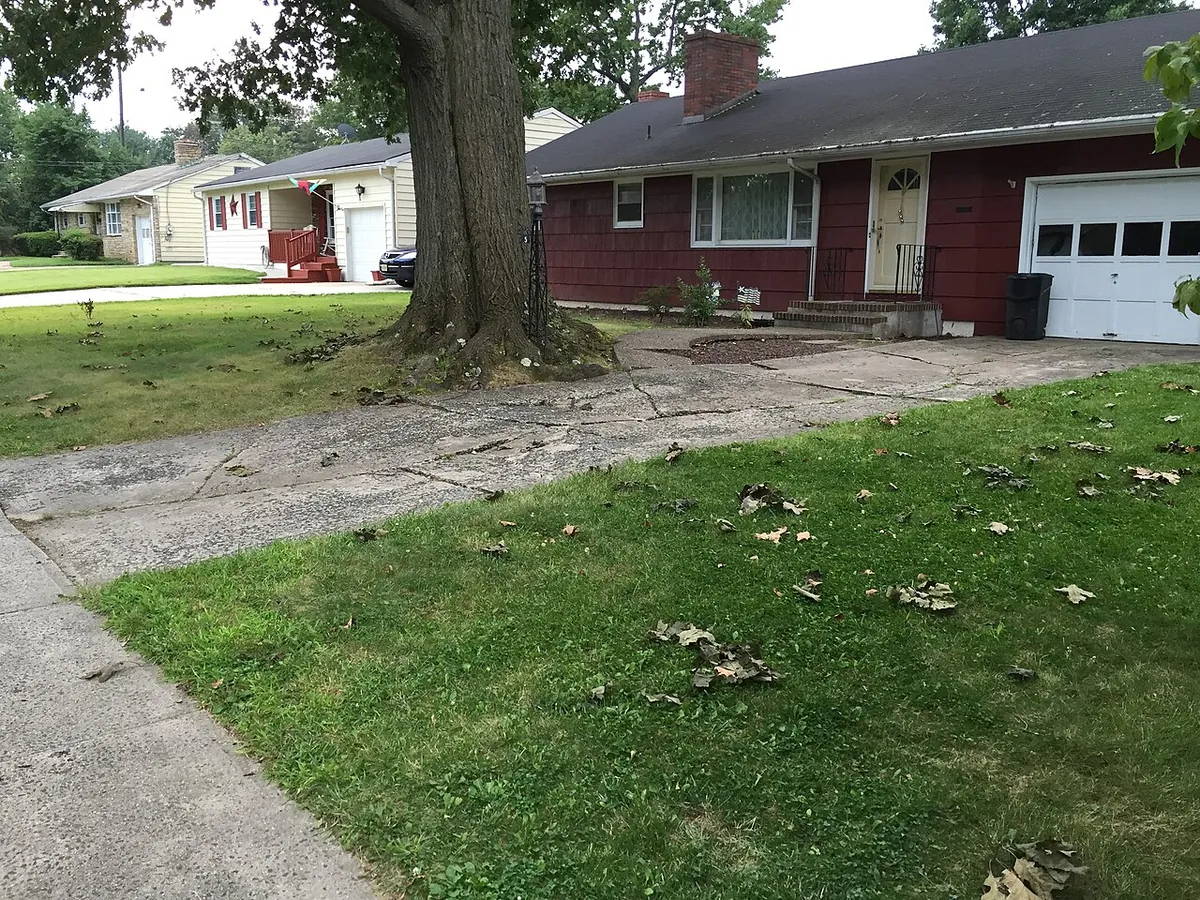
Photo: Famartin, Wikimedia Commons, CC BY-SA 4.0.
Quick Answer
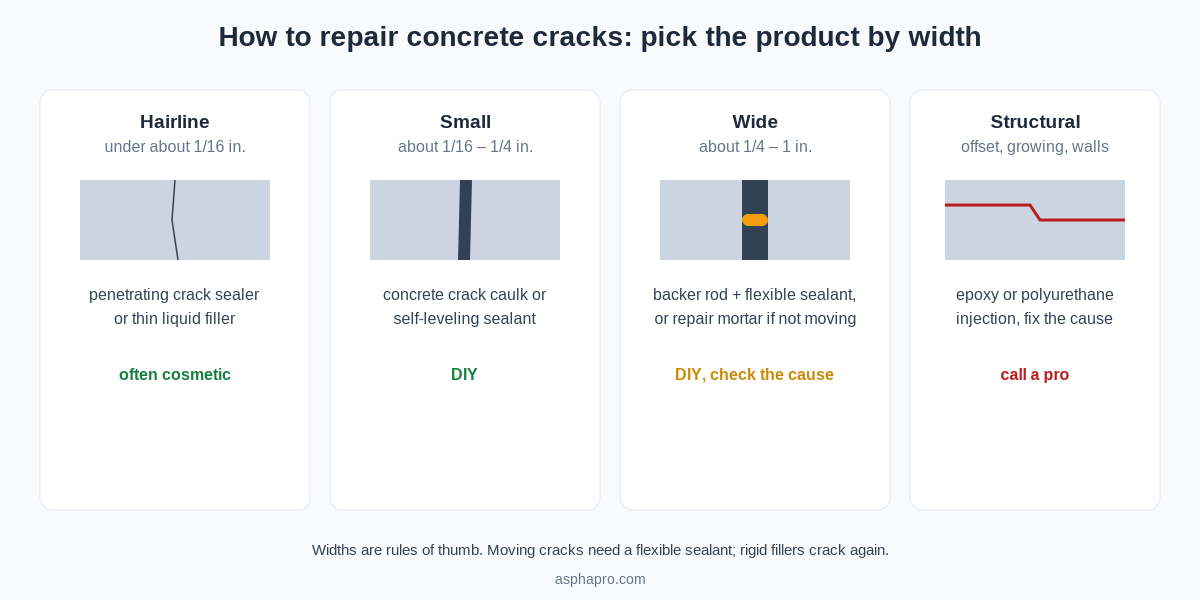
To repair concrete cracks, first clean the crack with a wire brush and vacuum, then choose the product by width: a penetrating concrete crack sealer for hairline cracks, a concrete crack caulk or self-leveling sealant for cracks up to about 1/4 inch, foam backer rod plus sealant for deeper or wider cracks, and a cement-based repair mortar for wide cracks that are no longer moving. Fill the crack slightly below the surface, smooth it, and let it cure before traffic. Cracks that are growing, uneven (one side higher), leaking, or in foundation walls and structural slabs need the cause fixed and often epoxy or polyurethane injection by a pro. DIY materials usually cost $10 to $50 per job.
Almost all concrete cracks sooner or later. Most cracks in driveways, sidewalks, patios, garage floors and basement floors are shrinkage or settling cracks that are not a structural problem, but they let water, ice, weeds and dirt in, and that makes them grow. Knowing how to repair concrete cracks the right way, with the right product, keeps a small crack from becoming a broken slab.
This guide walks through how to fix cracks in concrete step by step: how to tell which cracks matter, which crack filler for concrete or crack sealant to buy, how to fill concrete cracks of different widths, how to deal with cracks in concrete floor slabs, what it costs, and when it is time to call a professional.
Before You Repair Concrete Cracks: Read the Crack
Before fixing a crack in concrete, take a minute to work out what kind of crack it is. That tells you which product to use and whether a DIY repair makes sense at all. Our guide to why concrete cracks explains causes in detail; here is the short version.
- Width. Measure it with a ruler or a coin. Hairline cracks are thinner than a credit card; cracks over 1/4 inch are wide.
- Movement. Is one side higher than the other? Has it grown since last year? Put a pencil mark at each end and check again in a few months. Moving cracks need a flexible sealant, or a structural fix.
- Location. Cracks in driveways, walks, patios and garage floors are usually not structural. Cracks in foundation walls, beams, columns and retaining walls can be.
- Water. A crack that leaks water into a basement needs a waterproofing repair, often polyurethane injection.
- Pattern. A fine web of shallow surface cracks (crazing) is cosmetic. Straight cracks across a slab are often shrinkage cracks where a joint should have been.
Which Product to Use: Concrete Crack Sealer, Filler or Caulk?
Stores sell many products to fix cracks in concrete, and the names overlap. Here is how they group, and what each one is good for.
| Product type | Best for | Notes |
|---|---|---|
| Penetrating concrete crack sealer (thin liquid) | Hairline cracks on floors and slabs | Flows into fine cracks; does not fill wide gaps |
| Concrete crack caulk (acrylic latex or siliconized) | Small cracks, vertical surfaces, indoor work | Easy to use and clean up; less durable outdoors |
| Polyurethane or hybrid concrete sealant for cracks | Outdoor slabs, moving cracks, joints | Flexible and durable; non-sag for walls, self-leveling for flat slabs |
| Self-leveling crack filler | Horizontal cracks in driveways and walks | Pours in and levels itself; not for walls |
| Cement-based repair mortar or patching compound | Wide cracks and broken edges that are not moving | Rigid; matches concrete color better |
| Epoxy crack filler or injection | Structural, dry, stable cracks | Bonds the two sides back together; see epoxy concrete repair |
| Polyurethane injection foam | Leaking cracks in basement walls | Stops water; usually a pro job |
The most important difference is flexible vs rigid. Concrete expands and contracts with temperature, so most cracks in outdoor slabs open and close a little each year. A flexible concrete crack sealant moves with them. A rigid filler, such as mortar or epoxy, works only when the crack has stopped moving; on an active crack it will simply crack again next to the repair.
How to Repair Concrete Cracks: Step by Step
This is the basic method for fixing a crack in concrete on a driveway, sidewalk, patio, garage or basement floor.
Step 1: Clean out the crack
Every product sticks better to clean, dry concrete. Pull weeds, then use a wire brush, a screwdriver or an old chisel to scrape loose bits from the crack. Vacuum it out with a shop vac or blow it out with compressed air. For oily garage floors, scrub with a degreaser first and let it dry. Most concrete crack sealants need the crack dry, so wait a day or two after rain.
Step 2: Widen very fine cracks if needed
Caulks and sealants need some width and depth to grip. If a crack is just wide enough to see but too thin for the product to get in, you can open it slightly with an angle grinder and a diamond crack-chasing blade, or with a cold chisel. Undercutting it into a V or a slight inverted V gives the filler more to hold onto. Wear eye, ear and breathing protection; concrete dust contains silica.
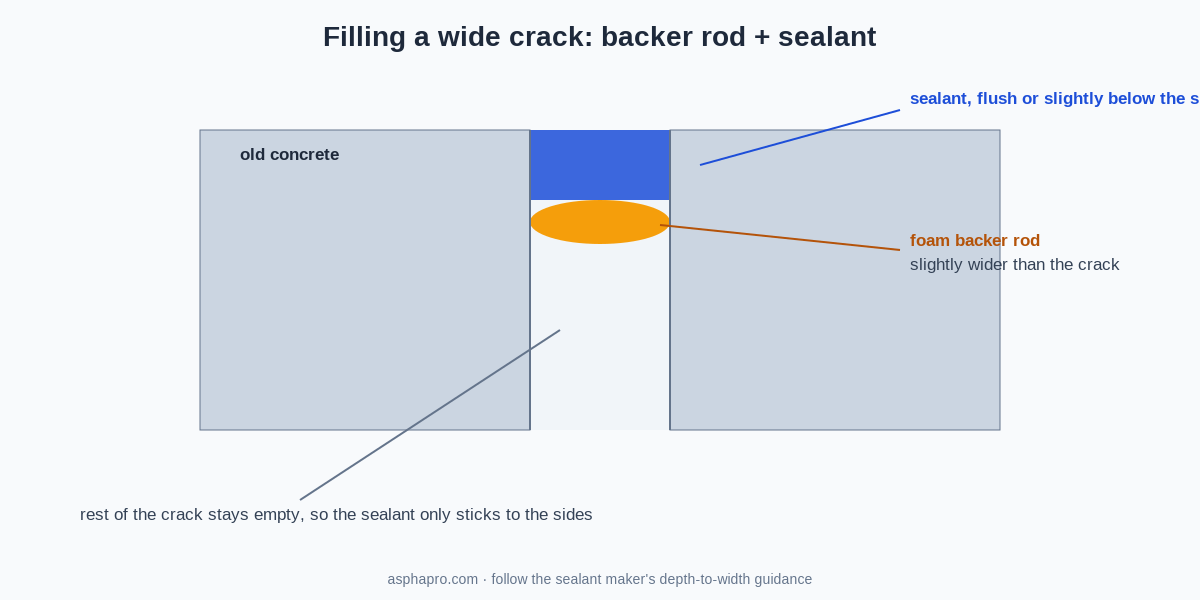
Step 3: Add backer rod to deep cracks
For cracks deeper than about 1/2 inch, push a closed-cell foam backer rod into the crack first. Pick a rod slightly wider than the crack so it stays put, and set it so the sealant on top will be about as deep as the manufacturer recommends (often about half the width, with a minimum depth, but check the label). Backer rod saves sealant and lets the sealant stretch properly, because it sticks only to the two sides of the crack and not to the bottom.
Step 4: Fill the crack
Cut the nozzle of the tube to match the crack width and fill from the bottom up, pushing the product into the crack rather than just laying a bead on top. Self-leveling sealants can be run in and left to level. Non-sag caulks should be tooled with a putty knife or a gloved finger dipped in soapy water. Aim to finish flush or just below the surface, so tires and shovels do not catch the edge.
Step 5: Smooth, cure and protect
Smooth the surface, scrape off any excess before it skins over, and keep foot and vehicle traffic off for the time on the label. Cold weather slows curing. For the best look on gray concrete, some people sprinkle a little sand on fresh sealant so it blends in.
How to Fill Cracks in Concrete by Size
Hairline cracks
How do you fill cracks in concrete that are thinner than a credit card? You mostly seal them rather than fill them. Brush on or pour a low-viscosity penetrating crack sealer. Concrete absorbs it into the crack and it keeps water out. On a garage floor, a clear epoxy crack sealer or the primer coat of a floor coating does the same job. Many hairline shrinkage cracks never grow and can be left alone if they do not bother you.
Small cracks up to about 1/4 inch
This is the most common DIY concrete crack repair. Use a concrete crack caulk or sealant in a caulk gun. On flat outdoor slabs, a self-leveling polyurethane sealant gives the neatest result; on walls and steps, use a non-sag version. A popular budget option at home centers is a latex-based product such as DAP concrete crack filler, which comes in a squeeze bottle and works well on small, stable cracks, especially indoors or under cover. For outdoor cracks that see freeze-thaw and movement, a polyurethane or hybrid sealant usually lasts longer.
Wider cracks from 1/4 to 1 inch
For cracks this wide, clean them, add backer rod if they are deep, and fill with a flexible sealant if the crack moves with the seasons. If the crack has clearly stopped moving, you can instead patch it with a cement-based repair mortar or patching compound, which looks more like concrete. Undercut the edges so the patch locks in, dampen the crack, press the mortar in firmly and finish it flush.
Cracks wider than about 1 inch
Very wide cracks usually mean the slab has broken into pieces that have moved, often because the base under it washed out or settled. Patching the gap does not fix that. Consider lifting the slab with mudjacking or foam leveling, replacing the broken section, or, on driveways, replacing the panel. Our guide to fixing cracks in concrete driveway slabs covers large driveway cracks.
Concrete Crack Caulk: When It Works and When It Doesn't
Caulk is the easiest way to fix cracks in concrete, and the right one works very well. Here is what to know about concrete caulking for cracks:
- Choose a caulk made for concrete. Concrete caulk for cracks is formulated to stick to masonry and to stand up to UV and weather. General-purpose bathroom caulk is not.
- Use self-leveling caulk for cracks in concrete that are horizontal, like driveways and walks. It flows into the crack and leaves a smooth, flat surface.
- Use non-sag caulk for concrete cracks on walls, steps and curbs, so it does not run out.
- Silicone vs polyurethane: 100% silicone is very flexible and long-lasting but cannot be painted and some types do not stick well to damp or dusty concrete. Polyurethane and hybrid polymer sealants stick well, stay flexible and can usually be painted.
- Acrylic latex concrete crack caulk is cheap and easy, cleans up with water, and is fine for small, stable cracks and indoor work, but it usually needs redoing sooner outdoors.
When you caulk cracks in concrete, keep the bead thin enough to cure all the way through. Very deep beads of some sealants stay soft in the middle for a long time, which is another reason to use backer rod.
Concrete Crack Sealer vs Concrete Crack Sealant
The two names get mixed up, but in stores they usually mean different things:
- A concrete crack sealer is usually a thin liquid that penetrates hairline cracks and the surface around them. Use a crack sealer. Concrete with many fine cracks, such as an old patio or garage floor, can be brushed or rolled all over.
- A concrete crack sealant is usually a thicker, elastic product, in a caulk tube or sausage, that fills and bridges a crack. Crack sealant for concrete is what you want for cracks you can fit a coin edge into.
If you are shopping for a sealer for concrete cracks on a large area, also look at a full-surface penetrating sealer once the cracks are filled. See our guide on how to reseal concrete.
Patching Cracks in Concrete With Mortar or Compound
Patching cracks in concrete with a cement-based product is the right choice for wide cracks that are stable, broken edges along a crack, and cracks in steps and walls where you want the repair to look like concrete. Here is how to patch cracks in concrete with a repair mortar:
- Chisel the crack to a slight inverted V, wider at the bottom than the top, so the patch cannot pop out.
- Remove all loose material and dust.
- Dampen the crack so it is damp but without standing water, or apply the bonding agent the product calls for.
- Mix the patching compound to a stiff, workable paste and press it firmly into the crack with a trowel.
- Smooth it flush and match the texture with a brush or sponge.
- Keep it damp or covered while it cures, as the bag directs.
Remember that a rigid patch on a moving crack will crack again. If you are not sure whether a crack moves, use a flexible sealant, or patch it and be ready to seal it again later.
Cracks in Concrete Floor Slabs
Cracks in concrete floor slabs in basements and garages are very common. Most are shrinkage cracks that formed in the first months after the pour and are not structural. To fix a crack in concrete floor slabs:
- For hairline concrete floor cracks, use a penetrating sealer or a thin epoxy crack filler, especially if you plan to coat or paint the floor.
- For wider floor cracks, use a self-leveling polyurethane sealant or an epoxy or polyurea crack filler; the latter is often used before garage floor coatings.
- For cracks with one side higher, the slab has settled or heaved; grinding the edge or lifting the slab may be needed.
- For cracks that let in water, the fix may be a sealant plus better drainage outside, or a waterproofing contractor.
If you are putting tile or flooring over a cracked floor, ask the flooring maker what crack isolation membrane they require. Moving cracks will telegraph through hard flooring otherwise.
Self-Leveling Concrete Crack Filler
For flat outdoor slabs, a self-leveling concrete crack filler is one of the easiest ways to get a neat, long-lasting repair. It comes in caulk tubes or larger sausage packs and flows to a flat surface on its own. Use a self-leveling crack filler. Concrete slabs need to be roughly level for it to work, though; on a sloped driveway, fill in short sections or use a slightly thicker product so it does not run downhill. Do not use self-leveling products on walls, and do not overfill: it shrinks very little, so fill to just below the surface.
How to Seal Cracks in Concrete Before Winter
Fall is the most important time to seal cracks in outdoor concrete. Water that gets into an open crack in November freezes, expands and pries the crack wider every time the temperature crosses freezing. One good concrete crack seal in early fall can save a slab years of damage. Here is how to seal cracks in concrete before the cold arrives:
- Walk the driveway, walks and patio on a dry day and mark every open crack with chalk.
- Clean each crack with a wire brush and vacuum, and pull out any old sealant that has come loose.
- Fill deep cracks with backer rod, then apply a flexible sealant rated for outdoor concrete.
- Seal the joints between slabs at the same time; open joints let water under the slab just like cracks do.
- Finish while daytime temperatures are still comfortably above the product's minimum, so it cures before the first hard freeze.
If you only have time for part of the job, prioritize cracks where water flows across the slab and cracks near the house foundation.
Concrete Crack Fill Products: Tubes, Bottles and Bags
Concrete crack fill products come in a few forms, and the package often tells you what the product is meant for:
- Squeeze bottles hold thin, pourable fillers for hairline and small cracks on flat surfaces. They are quick and easy but cover only a few linear feet each.
- Caulk tubes fit a standard caulk gun and hold most concrete caulks and sealants. One 10-ounce tube fills roughly 15 to 30 linear feet of a 1/4-inch crack, depending on depth.
- Sausage packs and large cartridges are used for long runs of cracks and joints and need a larger gun.
- Tubs and bags hold patching compounds and repair mortars for wide cracks and broken edges.
Measure the total length and rough width of the cracks before you shop, and buy one extra tube. Running out halfway through a repair leaves cracks only partly sealed.
How to Repair Crack in Concrete Steps and Walls
Vertical surfaces need products that do not sag. To repair a crack in concrete steps, clean it, use a non-sag polyurethane sealant for narrow cracks, or rebuild broken edges with a patching mortar held in place by a board. For cracks in basement and foundation walls, small dry shrinkage cracks can be sealed from the inside with a non-sag sealant or an epoxy crack repair kit. Leaking cracks are better handled with polyurethane injection, and wide, horizontal or stair-step cracks should be looked at by a foundation professional before you cover them up. Our guide to fixing broken concrete steps covers step repairs in more detail.
What It Costs to Repair Concrete Cracks
| Repair | Typical cost |
|---|---|
| DIY crack caulk or sealant (tube) | About $8 to $20 per tube |
| Backer rod | A few dollars per roll |
| Repair mortar or patching compound | About $10 to $35 per container |
| Professional crack filling | About $0.50 to $3 per linear foot for minor cracks, plus minimums |
| Professional slab repair | About $3 to $8 per square foot |
| Epoxy or polyurethane injection | About $400 to $1,500 per crack |
Our concrete repair cost guide covers professional prices in more detail, based on published cost guides such as HomeGuide and Angi. For most driveway and patio cracks, doing it yourself costs less than a contractor's trip charge.
Common Mistakes When You Fix Cracks in Concrete
- Skipping the cleaning. Sealant on dust and dirt peels out within a season.
- Sealing a wet crack. Most products need dry concrete; read the label.
- Using rigid filler on a moving crack. It cracks again right beside the repair.
- Overfilling. A raised bead gets torn by tires and shovels.
- Filling a deep crack without backer rod. It wastes product and limits how well the sealant can stretch.
- Ignoring the cause. Downspouts dumping water beside a slab, tree roots and poor drainage keep cracks growing.
- Working in the cold. Most sealants need temperatures above about 40°F; check the label.
When Should You Call a Pro?
You can handle most cracks in flatwork yourself. Call a contractor or engineer when:
- A crack in a foundation wall is wider than about 1/4 inch, is horizontal, or shows one side pushed in.
- A crack keeps growing month by month.
- Doors and windows stick, or floors are noticeably out of level.
- Water comes through a basement crack.
- A crack runs through a beam, column, balcony or retaining wall.
- The slab has sunk or heaved more than about 1/2 inch at the crack.
Structural concrete crack repair often uses epoxy injection, which can restore strength in dry, stable cracks, while polyurethane injection is used to stop leaks in cracks that still move a little. The American Concrete Institute's field guide to epoxy injection describes how pros do it.
How to Keep Cracks From Coming Back
- Keep water away from slabs: extend downspouts and fix low spots.
- Keep joints sealed and clean so slabs can move.
- Seal the whole slab every few years.
- Avoid heavy trucks on residential driveways and keep them off edges.
- Keep tree roots in mind when planting near concrete.
- Inspect and reseal cracks every year or two, before winter.
Cracked Concrete Slab Repair: Matching the Fix to the Crack
Cracked concrete slab repair works best when the repair matches what the crack is doing. Use the guide below for garage floors, patios, basement floors and other slabs on ground.
| Crack type | What it means | Repair |
|---|---|---|
| Hairline, under 1/16 inch, not moving | Normal shrinkage | Penetrating sealer or leave it |
| 1/16 to 1/4 inch, flat on both sides | Shrinkage that opened up | Flexible polyurethane crack sealant or epoxy |
| Over 1/4 inch, flat | Wider shrinkage or temperature crack | Backer rod plus sealant, or a cement patch |
| One side higher than the other | Settlement or soil movement | Lift the slab first (slab leveling), then seal |
| Crack keeps growing | Active movement, drainage or soil problem | Find the cause before any repair |
For a cracked concrete slab repair on a garage or basement floor, clean the crack with a wire brush and vacuum, let it dry, then fill it. Epoxy bonds the two sides together and suits cracks that have stopped moving. Polyurethane stays flexible and suits slabs that move with the seasons. On outdoor slabs, flexible sealant is the safer choice because freeze and thaw cycles keep opening the crack slightly.
A slab with many cracks, large sunken areas or pieces that rock underfoot is often past repair. At that point compare the cost of repair with replacement, and look at what caused the damage, such as poor drainage, tree roots or a weak base. Our guide to why concrete cracks explains the common causes.
Frequently Asked Questions
How do you fill cracks in concrete?
Clean the crack, add backer rod if it is deeper than about 1/2 inch, then fill it with a concrete crack sealant, caulk or self-leveling filler, finishing just below the surface. For wide stable cracks, use a repair mortar.
What is the best crack filler for concrete?
For most outdoor cracks, a flexible polyurethane or hybrid concrete sealant for cracks lasts longest. Acrylic concrete filler for cracks is fine for small, stable cracks indoors. Wide, stable cracks are best patched with a cement-based repair mortar.
Can you use caulk for concrete cracks?
Yes, if it is a caulk made for concrete. Use self-leveling caulk for cracks in concrete that is flat and non-sag caulk for vertical surfaces.
How do you fix a crack in concrete floor slabs?
Seal hairline cracks with a penetrating or epoxy sealer, and fill wider ones with a self-leveling polyurethane sealant or an epoxy or polyurea crack filler. Cracks with one side higher may need grinding or leveling.
Should you fill concrete cracks before sealing?
Yes. Fill and let the crack repair cure first, then seal the whole surface. Sealer alone will not fill a crack wider than a hairline.
How long does concrete crack sealant last?
A good polyurethane or hybrid sealant often lasts many years outdoors, while cheaper acrylic fillers may need redoing after a few seasons. Inspect cracks every year and touch them up as needed.
Can I repair concrete cracks in the winter?
Most sealants and patches need temperatures above about 40°F to 50°F to cure properly. If you must do it in cold weather, use a product rated for low temperatures and follow its instructions.
How to fix concrete crack damage that keeps returning?
A crack that reopens after repair is usually still moving. Use a flexible sealant instead of a rigid filler, and look for the cause, such as water under the slab, tree roots, or missing joints.
Sources
- American Concrete Institute: RAP-1 Structural Crack Repair by Epoxy Injection (field guide)
- U.S. General Services Administration: Types of Cracks in Concrete and Typical Causes
- This Old House: Fixing Cracks in Concrete
- Concrete Network: Crack Injection
- HomeGuide: Cracked Slab Foundation Repair Cost
- Angi: What You Need to Know About Concrete Repair
Related Guides
- How to fix cracks in concrete driveway slabs — small cracks to large cracks and sunken panels
- Epoxy concrete repair — when epoxy is the right fix for cracks
- Concrete patching compound guide — which concrete patch or repair mortar to use
- Concrete pool deck repair — cracks, coping joints and settled slabs
- Tiny red bugs on concrete — clover mites and how to keep them away
- Concrete expansion joint guide — filler, caulk and where joints go
- Control joints in concrete — spacing, depth and when to cut
- Post tension concrete slab guide — how tendons work, cost and drilling safety
- How to kill roots under concrete — tree roots lifting slabs
- Concrete adhesive — epoxy, construction adhesive and bonding agents
- Concrete restoration — repair process, methods and cost
- Concrete wall crack repair — injection, sealants and when cracks are structural