
How to Kill Roots Under Concrete: Cut, Treat, Block and Repair
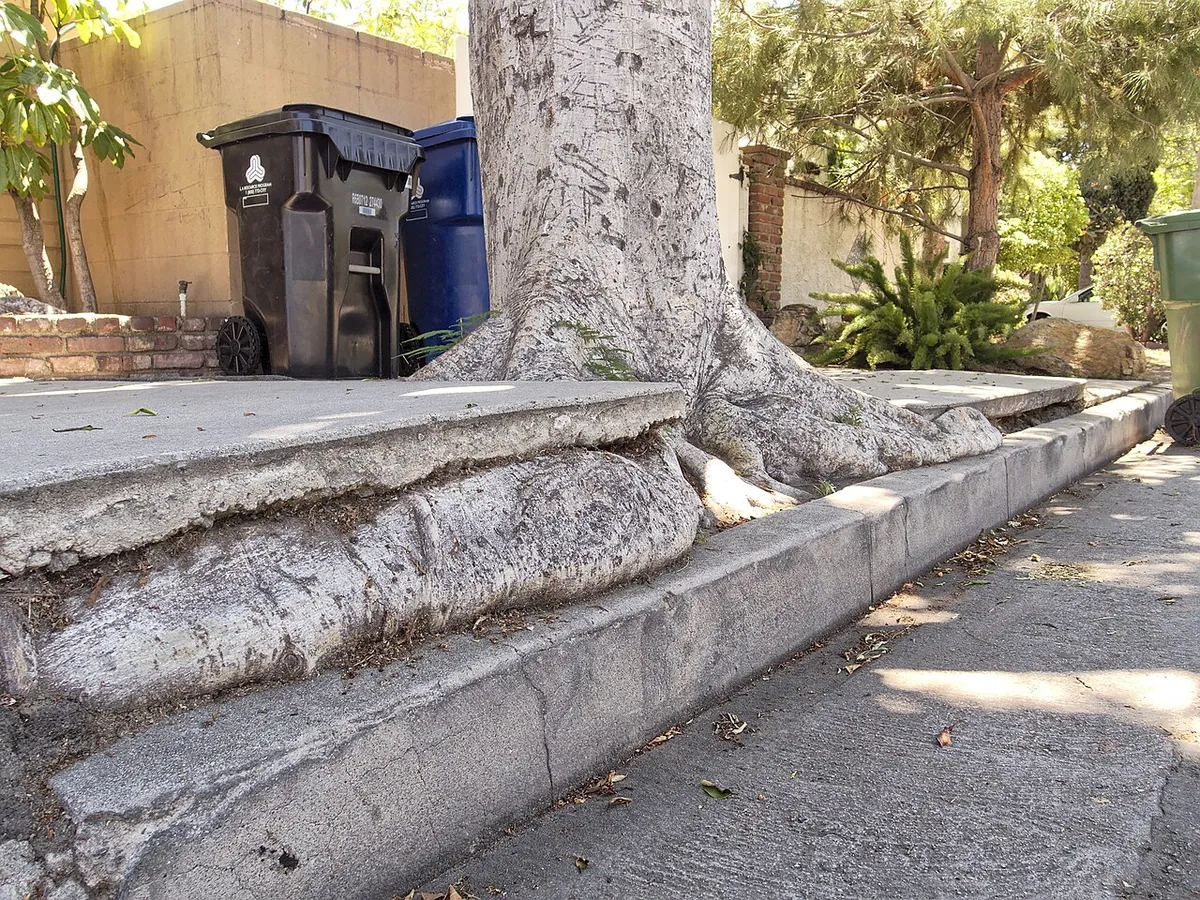
Photo: Junkyardsparkle, Wikimedia Commons, CC0
Quick Answer
How to kill roots under concrete: first decide whether you are keeping the tree. If the tree is being removed, cut it down, grind the stump, and paint the fresh cut right away with a stump killer containing triclopyr or glyphosate, then cut and treat any sprouts that come up. The tree roots under concrete then die and rot on their own. If you want to keep the tree, do not poison it: dig a trench along the slab edge, cut the roots (avoid roots over about 2 inches thick close to the trunk), and install a root barrier 18 to 24 inches deep. Do not use rock salt, bleach, diesel or gasoline, which damage concrete, soil and groundwater. Once the roots are dead or cut, lift, grind or replace the damaged concrete.
Tree roots under concrete are one of the most common reasons sidewalks, driveways and patios crack and lift. Roots grow toward the moist, cool soil under a slab, thicken every year, and slowly push the concrete up, like the sidewalk in the photo above, where the roots of a street tree have lifted a slab several inches and pushed the curb aside. The result is a trip hazard, a cracked driveway, or a patio that holds water.
This guide explains how to kill roots under concrete safely and for good, when killing the roots is the right choice and when it is better to cut and block them, which products work and which ones cause more harm, how to deal with tree roots under concrete from a neighbor's or city tree, and how to repair the concrete once the roots are handled.
Why Tree Roots Grow Under Concrete
Tree roots do not grow toward concrete because they want to break it. They grow where conditions are good: moist, loose, oxygen-rich soil. The soil just under a slab stays moist because the concrete stops evaporation, and condensation forms on the underside of the slab on cool nights. Roots spread sideways near the surface, mostly in the top 12 to 18 inches of soil, and can reach two to three times as far as the branches spread. When tree roots reach the slab, they grow along the underside, where moisture collects. Each year the root thickens. A root 2 inches thick can easily lift a 4 inch slab, because the concrete is heavy but not anchored, and the root grows with steady force. See why concrete cracks and concrete slab thickness.
Some trees are especially bad for tree roots under concrete. Silver maple, Norway maple, sweetgum, willow, poplar, cottonwood, ash, ficus, elm, oak and honey locust all have aggressive shallow roots. Trees planted in narrow strips between sidewalk and curb, like the honey locust below, have nowhere else to go, so their roots spread under paving.
Signs of Tree Roots Under Concrete
Tree roots under concrete usually announce themselves slowly. Look for a slab edge that is higher on the side nearest a tree, a crack that runs toward the trunk, a joint that has opened into a step, a sidewalk panel that rocks underfoot, a patio that now holds a puddle where it used to drain, or roots showing at the edge of the concrete. Suckers and small shoots coming up through cracks are another sign that roots under concrete are alive and active. Measure the lift each spring and fall: if it keeps growing, the tree roots are still thickening, and the problem will get worse until you cut or kill roots at the source. See concrete pitting and flaking.
Step-by-Step Plan for a Typical Yard
Here is how most homeowners handle roots under concrete in practice. Start by tracing the damage back to the tree, which is usually the closest large tree on the side where the concrete is highest. Decide whether the tree stays or goes. If it goes, hire a tree service, ask them to leave the stump fresh, paint the cut with stump killer right away, and grind it a week or two later. If the tree stays, trench along the slab edge, cut the tree roots cleanly, and install a root barrier along the full length of the damaged concrete. Then fix the concrete: grind small lips, reset or replace lifted panels, and remove large roots under concrete before pouring new slabs. Finally, keep an eye on the area for sprouts and new lifting for a year or two. This plan solves the problem for good in most yards and costs far less than repeating repairs every few years.
Should You Kill the Roots or Save the Tree?
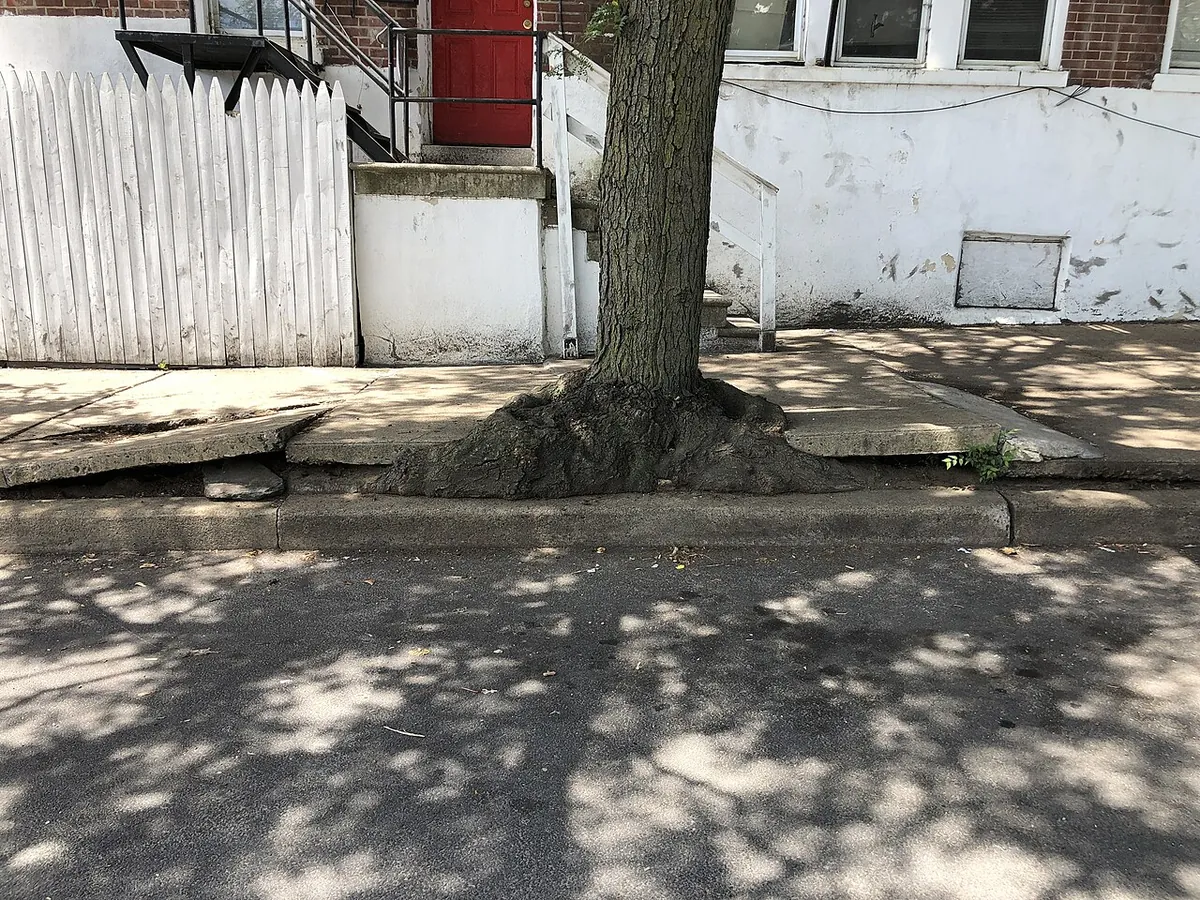
Photo: Famartin, Wikimedia Commons, CC BY-SA 4.0
The key decision is whether the tree stays. Tree roots belong to a living tree, so you cannot kill the roots under concrete without harming the tree. Any chemical that kills roots travels through the tree. If the tree is healthy and valuable, the better approach is to cut the offending roots at the slab edge and block new ones with a root barrier, accepting some risk to the tree. If the tree is dead, dying, in the wrong place, or already scheduled for removal, then killing the roots is the right approach: remove the tree, kill the stump, and let the tree roots under concrete rot. Sometimes the roots belong to a tree already cut down years ago, still pushing up suckers; those roots can be killed directly.
Mature trees add value to a property, shade the house and cool the yard, so think before cutting one down. A certified arborist can tell you whether a tree can survive root cutting, whether the tree is healthy, and what options exist. Many cities and homeowners associations also protect certain trees.
Check the Rules Before You Start
Before you cut or kill roots under concrete, check three things. First, whose tree is it? Street trees in the strip between the sidewalk and curb usually belong to the city, and cutting their roots or killing them without permission can bring fines. Many cities have programs that repair sidewalks lifted by city trees, sometimes for free. Second, if the tree belongs to a neighbor, you generally may cut roots that cross onto your property, but you may be liable if your cutting kills the tree or makes it fall. Talk to your neighbor first and check local law. Third, call 811 before digging a trench, because gas, water, electric and communication lines often run near trees and sidewalks. See concrete sidewalk cost.
Method 1: Remove the Tree and Kill the Stump
If the tree is coming out, this is the most reliable way to kill roots under concrete. The tree roots under concrete die when the tree and its stump are dead, and dead roots slowly rot over several years.
- Cut the tree down. Large trees, trees near houses, and trees near power lines should be removed by a professional tree service.
- Treat the stump right away. Within 15 minutes of the final cut, while the cut surface is fresh, paint or spray the outer ring of the stump (the cambium layer just inside the bark) with a stump killer containing triclopyr or glyphosate concentrate, following the label exactly. The fresh cut absorbs the herbicide and carries it down into the roots. This is called a cut-stump treatment.
- Grind the stump. A stump grinder chews the stump and main surface roots into chips 6 to 12 inches below grade. You can grind after treatment, once the herbicide has had a few days to move into the roots.
- Watch for suckers. Some trees, such as poplar, sumac, tree of heaven, black locust and willow, send up shoots from roots after the trunk is cut. Cut sprouts and treat the cut ends, or spray young leaves with a labeled herbicide, until they stop.
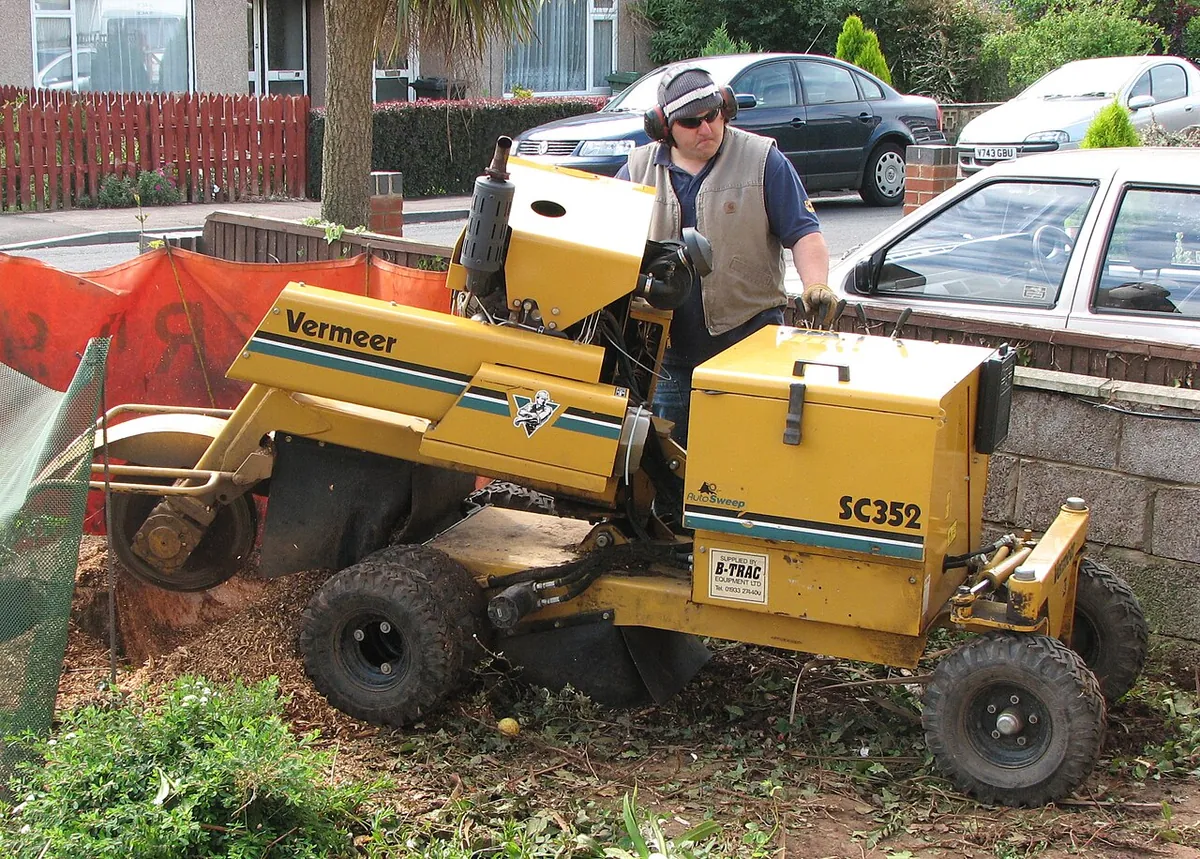
Photo: Adrian Pingstone, Wikimedia Commons, public domain
Stump grinders like the one above can be rented for a day or hired with an operator. Grinding removes the stump and the main root flare near the surface, but the tree roots under concrete farther away stay in the ground and rot. Over the next few years, as large dead roots under concrete decay, they leave voids, and the slab may settle where it was once pushed up. Plan to fill voids and reset the concrete once the roots are gone.
Method 2: Cut the Roots and Install a Root Barrier
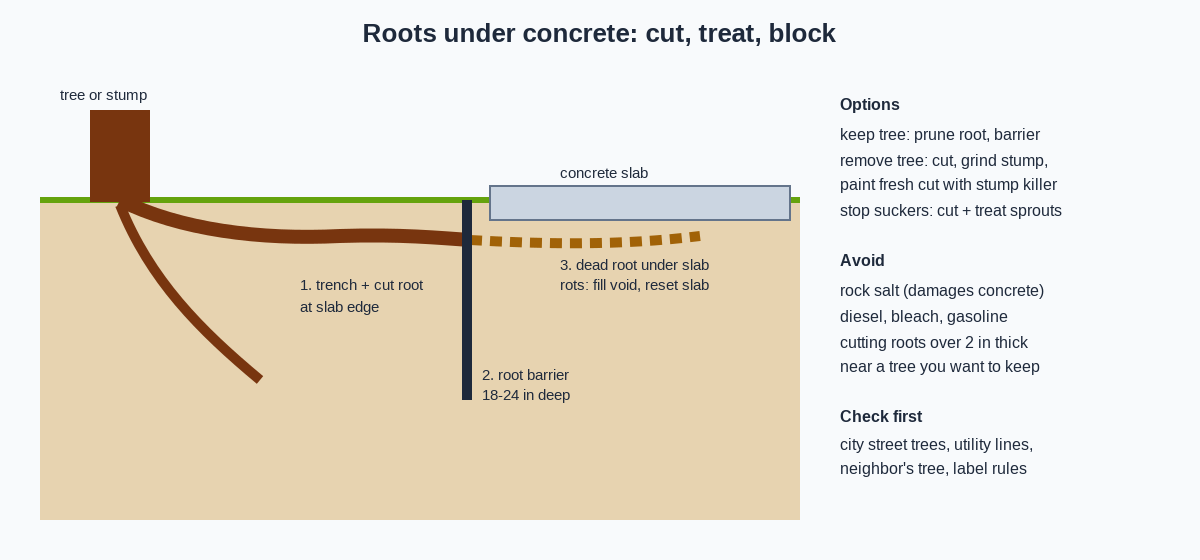
If the tree stays, the best way to deal with roots under concrete is to cut them where they reach the slab and block new growth, as shown in the diagram above. The root section beyond the cut, under the slab, dies once it is cut off from the tree.
- Find the roots. To find tree roots under concrete, dig a narrow trench along the edge of the slab nearest the tree, about 6 to 12 inches wide and 18 to 24 inches deep. A trenching shovel works for short runs; a rented trencher works for long ones.
- Cut the roots cleanly. Use a pruning saw, reciprocating saw with a pruning blade, or loppers. Clean cuts heal better than torn roots. Do not cut roots larger than about 2 inches in diameter within a distance of about 3 to 5 times the trunk diameter from the trunk, because large structural roots hold the tree up. An arborist should decide on large roots.
- Install a root barrier. Place a vertical root barrier panel, made of high-density polyethylene or a ribbed plastic designed for root control, in the trench against the slab edge, with the top just above grade. Barriers are typically 18 to 24 inches deep, and longer runs should extend several feet beyond the area of damage. Some barriers include herbicide-treated fabric that stops roots without killing the tree.
- Backfill. Fill the trench with soil and compact it, keeping the barrier vertical.
The roots under concrete that were cut off die and rot in a few years. New tree roots that grow toward the slab hit the root barrier and turn down or away. Root barriers are widely used by cities when new street trees are planted next to sidewalks, and by homeowners after repairing a driveway or patio. See concrete driveway cost and concrete patio ideas.
Method 3: Kill Roots From a Tree That Is Already Gone
Sometimes the tree was cut down years ago without stump treatment, and roots under concrete keep sending up suckers through cracks and joints. In this case, cut each sprout and treat the cut end with a stump killer, or spray the leaves of young sprouts with a labeled herbicide. Repeat whenever new sprouts appear. Each treatment moves herbicide into the root system, and over a season or two the roots under concrete die. If the original stump is still there, drill holes in the outer ring of the stump about 1 inch deep, a few inches apart, and fill them with a labeled stump killer; or cut a fresh face on the stump and treat it right away. See how to drill into concrete.
Drilling Through the Slab to Treat Roots
A common do-it-yourself suggestion is to drill holes through the concrete into the roots and pour herbicide in. This rarely works well. You cannot easily hit a root through a slab, herbicides move in living plant tissue from leaves and fresh cuts toward roots, not well from a hole into the root sideways, and chemicals poured into soil can move into groundwater, gardens and other plants. Drilling also leaves holes that need patching. If roots must be treated from above, it is usually better to cut a section of concrete out, expose the roots, cut them, and treat the cut ends, then repair the slab. See how to cut concrete and concrete core drilling.
Products That Work and Products to Avoid
Several products are sold to kill roots under concrete, and some common home remedies do more damage than good.
- Triclopyr (in many brush and stump killers) works well on woody plants and stumps when applied to fresh cuts. Follow the label.
- Glyphosate concentrate works on fresh-cut stumps and on sprouts. Use the concentrate listed for cut-stump treatment on the label.
- Imazapyr is very effective but moves in soil and can kill nearby trees and plants whose roots share the area. It is usually best left to professionals.
- Copper sulfate is sold for killing roots in sewer lines. It is not effective on large tree roots under concrete and can harm soil.
- Potassium nitrate stump remover speeds up decay in a stump so it can be removed, but does not kill living roots quickly.
- Rock salt kills plants but also damages concrete, steel reinforcement and soil, and moves to other plants and groundwater. Avoid it. See does salt damage concrete.
- Bleach, diesel, gasoline, motor oil and vinegar are ineffective on roots, harmful to soil and water, and illegal to dump in many places. Never use them.
Whatever you use to kill roots under concrete, read and follow the label for any herbicide. The label is the law, and it tells you which plants it controls, how to apply it, the protective equipment required and how close you can apply it to water. Keep children and pets away from treated areas until dry.
How Long Do Roots Take to Die and Rot?
After a cut-stump treatment, roots under concrete usually stop growing within weeks and die over a few months. Decay takes much longer. Small roots rot in a year or two. Large roots under concrete can take five to ten years to decay completely, depending on the tree species, soil moisture and temperature. Hardwoods like oak decay more slowly than softwoods like willow and poplar. As roots decay, the soil under the slab may settle, and voids may form, which can cause concrete to sink or crack later. For that reason, many contractors remove the main roots when they replace or reset the concrete rather than leaving them to rot. See concrete leveling cost.
Repairing Concrete Damaged by Roots
Once the roots under concrete are cut or dead, the damaged concrete can be repaired. The right fix depends on how far the slab moved and whether it cracked.
- Small lifts under about 1 inch: grind the raised edge to remove the trip hazard. Concrete grinding and saw-cut ramps are common for sidewalk lips. See concrete grinding.
- Lifted slab in one piece: lift or remove the slab, cut out the roots under concrete, regrade and compact the base, install a root barrier, and reset or replace the slab.
- Cracked or broken slab: remove the broken concrete, remove the roots, prepare the base and pour new concrete. Add reinforcement, proper thickness and control joints. See concrete removal cost, control joints in concrete and wire mesh for concrete.
- Settled slab after roots rot: lift the slab with mudjacking or polyurethane foam to fill voids and level it. See concrete leveling cost.
- Small cracks: seal with a flexible crack filler. See how to fix cracks in concrete.
When replacing a sidewalk or driveway near a tree, ask the contractor about thicker slabs, reinforced concrete, flexible pavers, or curving the path around the tree to give roots more room. See how thick a concrete driveway should be and paving stones vs concrete.
Tree Roots Under a Concrete Driveway
Driveways are heavier and thicker than sidewalks, but tree roots under concrete driveways still lift them, usually along the edges and at joints. Look for cracks running from the edge toward the center, a raised edge along a lawn strip, or a slab that rocks. To kill roots under concrete driveways from a tree you are removing, follow the stump treatment method. If you are keeping the tree, trench along the driveway edge, cut the roots, and install a root barrier. When the driveway is replaced, a thicker slab of 5 to 6 inches with reinforcement and a compacted gravel base resists root pressure better. See how to fix cracks in a concrete driveway and concrete driveway resurfacing.
Tree Roots Under Patios and Pool Decks
Patios and pool decks are often thin slabs poured close to trees planted for shade. Roots under concrete patios cause cracks, lifted edges and puddles. Pool decks are especially vulnerable because roots seek the extra moisture near pools, and lifted concrete can damage coping and tile. Cutting roots and installing a root barrier around the patio or pool deck is usually the best long-term fix. If the tree is too close, removal may be the only practical option. See concrete pool deck repair and how to cover an old concrete patio.
Tree Roots Under Foundations and Slabs
Tree roots rarely lift house foundations directly, because foundations are heavy and deep. The bigger risk is moisture. In clay soils, large trees close to a house draw water out of the soil during dry seasons, causing the clay to shrink and the foundation to settle. Tree roots also find and enter leaking sewer and drain lines under slabs. If you suspect tree roots under concrete foundations, have a foundation engineer or plumber inspect before cutting large roots, because removing a large tree from clay soil can also cause the soil to swell. See concrete footings and vapor barrier under concrete.
Preventing Root Damage in New Concrete
The easiest way to deal with roots under concrete is to plan for them before the concrete is poured. Choose the right tree for the space, with small or deep-rooted trees near paving. Give trees enough soil, with wide planting strips or structural soil systems. Install root barriers when pouring new sidewalks, driveways or patios near trees. Pour slabs of proper thickness on compacted gravel. Use reinforcement and control joints. Leave space between the trunk and the slab edge so trunk flare and large roots have room. Water trees deeply rather than often, which encourages deeper roots. See concrete flatwork, rebar in concrete and concrete walkway ideas.
Costs to Kill Roots and Repair Concrete
- Stump killer: about $15 to $40 for a bottle of concentrate.
- Stump grinder rental: about $150 to $400 per day; professional stump grinding about $100 to $400 per stump.
- Tree removal: about $300 to $2,000 or more, depending on size and location.
- Root barrier: about $2 to $6 per linear foot for material; installed, about $10 to $30 per linear foot.
- Root pruning by an arborist: often $200 to $800.
- Sidewalk trip hazard grinding: about $50 to $150 per lip.
- Slab replacement: about $8 to $18 per square foot, including removal of the old concrete and roots. See concrete repair cost and concrete slab cost.
Common Mistakes When Killing Roots Under Concrete
- Killing a tree you meant to save. Herbicide applied to roots or suckers travels through the whole tree.
- Cutting large structural roots. Cutting big roots close to the trunk can make a tree unstable and dangerous in storms.
- Using salt, bleach or fuel. These damage concrete, soil and water and do not work well.
- Treating a stump too late. A cut-stump treatment works best within minutes of cutting, before the cut surface seals.
- Leaving large roots to rot under a new slab. As roots decay, the slab can settle and crack.
- Ignoring the city. Cutting roots of street trees without permission can bring fines.
- Not installing a barrier. Without one, new roots return to the same slab within a few years.
Roots Under Concrete From a Neighbor's Tree
When the tree roots under concrete come from a neighbor's tree, start with a friendly conversation. Explain the damage, show photos, and propose a plan, such as cutting roots along the property line and installing a root barrier. In many places you may cut roots on your own side of the line, but you may be responsible if the cut kills or destabilizes the tree. Get an arborist's opinion before cutting large roots, and keep records. If the tree is protected or the damage is serious, check local ordinances or ask a lawyer. Do not apply herbicide to roots or suckers from a neighbor's tree, since it can kill the tree and make you liable.
When to Call a Professional
Call a certified arborist when you want to keep a tree and need tree roots cut safely, when large roots are involved, or when you are unsure whether a tree is healthy. Call a tree service for removal of large trees. Call a concrete contractor for slab removal, replacement, grinding or leveling. Call a plumber if roots may be in sewer or drain lines under the slab. Many concrete contractors work with tree services and arborists, so one call can cover most of the job. See concrete repair cost.
Frequently Asked Questions
What kills tree roots under concrete?
A stump killer containing triclopyr or glyphosate applied to a freshly cut stump moves into the roots and kills them. Cutting roots at the slab edge also kills the part under the slab.
Will rock salt kill roots under concrete?
Salt can kill roots, but it also damages concrete and soil and moves into other plants and water. It is not recommended.
Can I cut tree roots under my driveway without killing the tree?
Often yes, if the roots are small and far enough from the trunk. Large roots close to the trunk should be assessed by an arborist.
How deep should a root barrier be?
Most root barriers are 18 to 24 inches deep, because most tree roots grow in the top 2 feet of soil.
How long does it take roots to die after killing a tree?
Roots die within a few months after a stump treatment, but large roots can take years to rot completely.
Sources
- Penn State Extension: tree roots, stump treatment and herbicide use
- International Society of Arboriculture: tree care and root pruning
- US EPA: pesticide labels and safe use
- USDA Forest Service: urban trees and sidewalk conflicts
- Call 811: call before you dig