
Concrete Adhesive Guide: Concrete Glue, Epoxy, Construction Adhesive and Bonding Agents
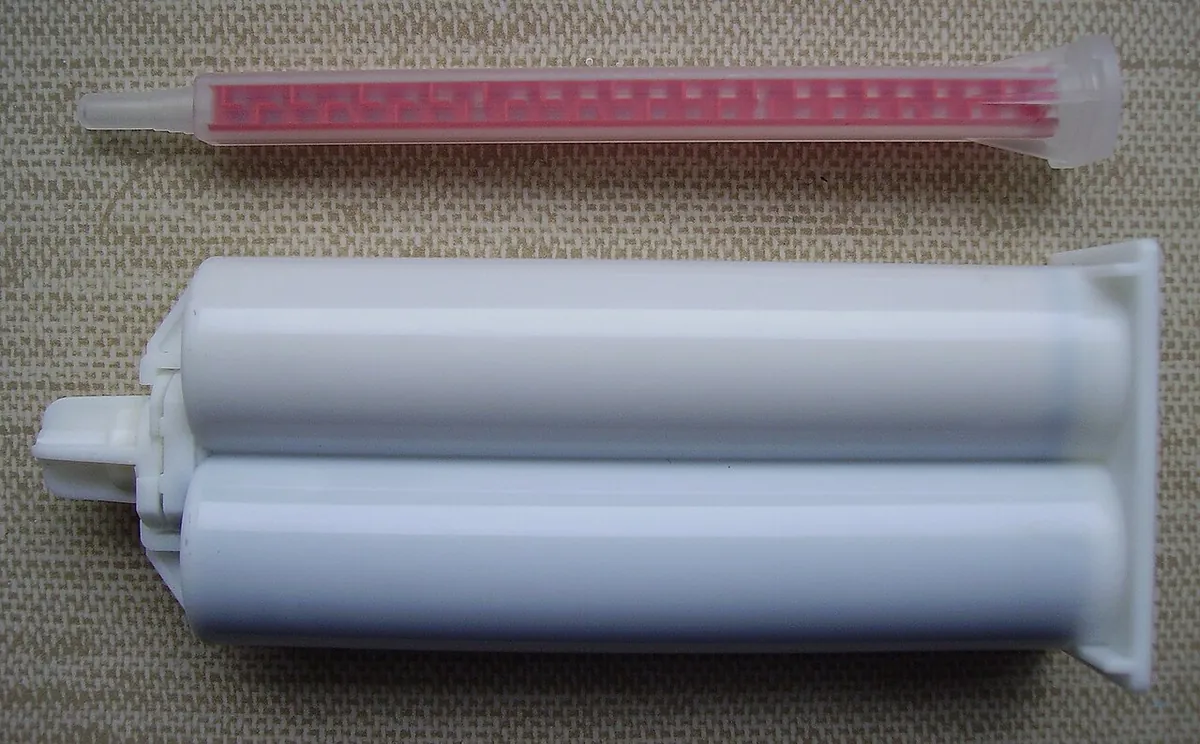
Photo: Cjp24, Wikimedia Commons, CC BY-SA 3.0
Quick Answer
The right concrete adhesive depends on the job. For concrete to concrete repairs, such as a broken step corner, a cracked statue or a loose curb, use a two-part structural epoxy, which is stronger than the concrete itself. For wood to concrete, use a polyurethane construction adhesive that stays slightly flexible. For pouring new concrete or patching over old, use a bonding agent (acrylic or PVA liquid) or a cement slurry. For anchoring rebar and bolts, use an anchoring epoxy. Every concrete glue needs clean, sound, dust-free concrete; most failures come from bad surface prep, not bad adhesive. Tubes cost about $5 to $15 for construction adhesive and $15 to $40 for epoxy.
Gluing to concrete sounds simple, but concrete is porous, dusty, alkaline and often damp, which defeats ordinary glues. Choosing the right adhesive for concrete, and preparing the surface properly, makes the difference between a repair that lasts for decades and one that pops loose after the first winter. The two-part epoxy cartridge above, with its static mixing nozzle, is one of the strongest options. A tube of construction adhesive in a caulk gun is the most common.
This guide explains the main types of concrete adhesive, which one to use for concrete to concrete bonds, wood to concrete, stone, metal and overlays, how bonding agents for concrete work, how to prepare surfaces, cure times and strength, and the mistakes that cause bonds to fail.
Types of Concrete Adhesive
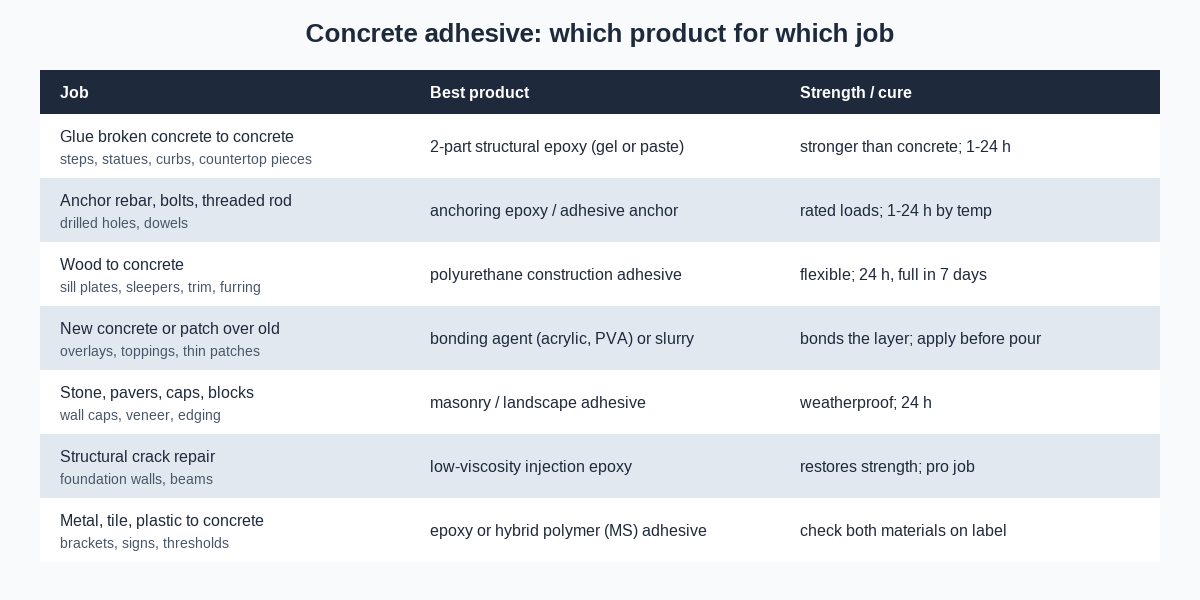
The chart above matches common jobs to the right concrete adhesive. The main families are:
- Epoxy adhesives: two parts, resin and hardener, mixed just before use. Epoxy is the strongest concrete glue for rigid bonds. It sticks to concrete, stone, metal and wood, fills gaps, and cures hard. Gel and paste epoxies are used for broken pieces and vertical work; liquid epoxies are used for crack injection; anchoring epoxies come in large cartridges for rebar and bolts. See epoxy concrete crack repair.
- Polyurethane construction adhesive: one part, in caulk tubes, cures with moisture. Strong, slightly flexible, waterproof, and works on damp surfaces. The usual wood to concrete adhesive and a general concrete glue for stone, block and pavers.
- Hybrid polymer (MS polymer) adhesives: one part, very strong grab, flexible, paintable, and bond to many materials including metal and plastic. Good for mixed-material jobs.
- Masonry and landscape adhesives: construction adhesives formulated for stone, wall caps, pavers and blocks outdoors.
- Bonding agents: liquids, usually acrylic latex or polyvinyl acetate (PVA), brushed or rolled on old concrete before new concrete, mortar or patch is placed, or mixed into the patch. They are not glues for pieces; they help a new cement layer bond to an old one.
- Cement-based adhesives: thinset mortars and cement slurries bond tile, stone and new concrete to old concrete through cement chemistry.
Best Adhesive for Concrete to Concrete
For gluing broken concrete pieces back together, such as a chunk off a step, a cracked concrete statue, a broken curb, a countertop seam or a fallen cap, the best adhesive for concrete to concrete is a two-part structural epoxy in gel or paste form. Properly applied to clean, sound surfaces, epoxy bonds are often stronger than the concrete around them: if stressed, the concrete breaks next to the joint rather than at it. Use a non-sag gel for vertical surfaces and overhead work. For outdoor repairs, choose an epoxy rated for exterior use and wet or damp conditions. Epoxies are temperature-sensitive: most cure slowly below about 50 degrees Fahrenheit and fast in heat, so read the working time and cure time on the label. See how to fix concrete steps and concrete patching compound.
For lighter concrete to concrete jobs, such as gluing pavers, edging, landscape blocks or wall caps, a polyurethane or masonry construction adhesive is easier and strong enough. For structural joints in walls, beams and slabs, a contractor or engineer should specify the epoxy and method, because those repairs carry real loads and must match the design of the structure.
Wood to Concrete Adhesive
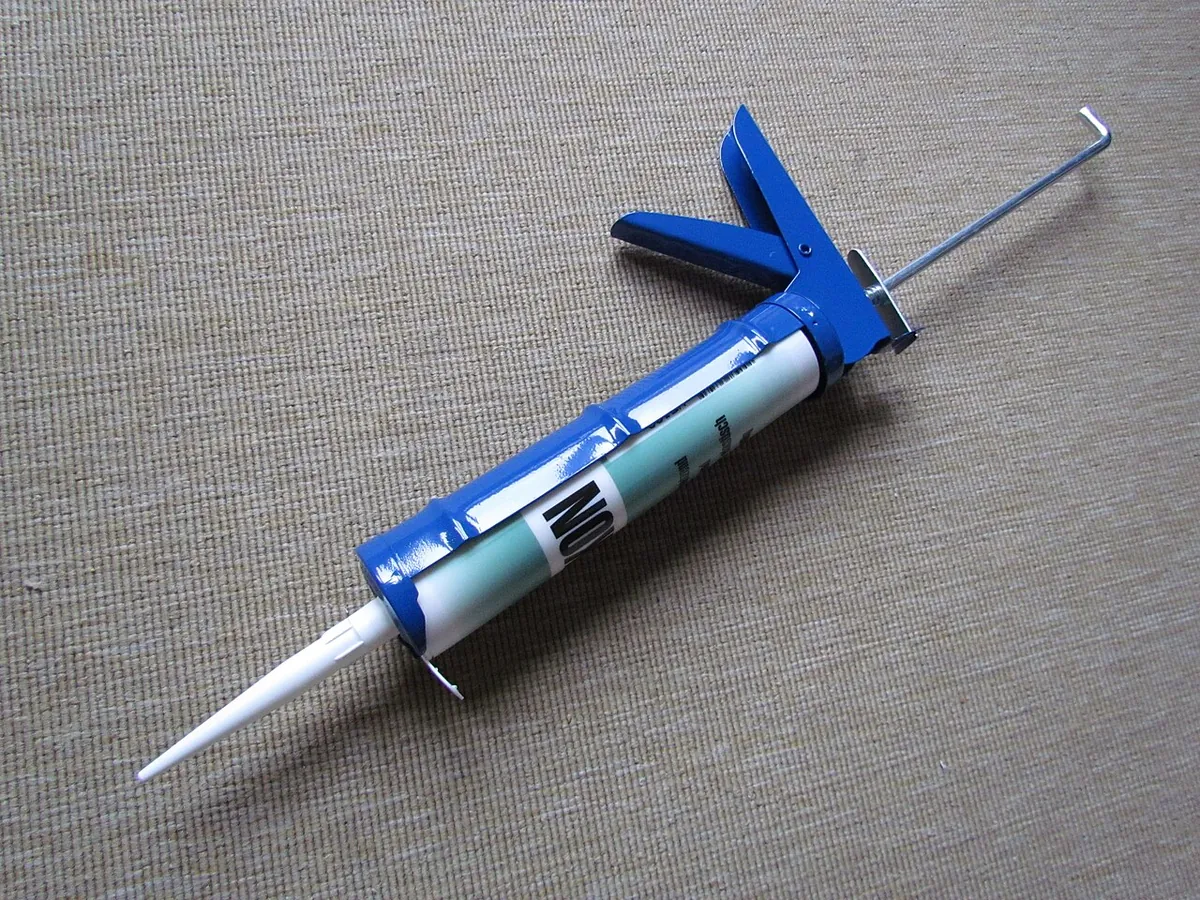
Photo: Frank C. Müller, Wikimedia Commons, CC BY-SA 3.0
Wood and concrete move differently. Wood swells and shrinks with moisture; concrete barely moves. A wood to concrete adhesive must stay slightly flexible, and it must tolerate the moisture and alkalinity that come up through concrete. Polyurethane construction adhesives, applied with a caulk gun like the one above, are the standard adhesive for concrete and wood: sleepers and furring strips on basement floors and walls, sill plates on foundations (along with anchor bolts), stair treads, baseboard and trim on concrete walls, and wood blocks for shelving. Use pressure-treated wood where the wood touches concrete, because concrete can wick moisture. For structural connections, such as sill plates or posts, mechanical fasteners like anchor bolts, concrete screws or post bases are required by code; adhesive adds stiffness and stops squeaks but does not replace the fasteners. See concrete screws, types of concrete anchors and how to anchor a post to concrete.
Concrete Bonding Adhesive and Bonding Agents
When new concrete, mortar, an overlay or a patch is placed on old concrete, it does not naturally bond well. Old concrete is dense, dusty, and often contaminated, and the new layer shrinks as it cures. A concrete bonding adhesive or bonding agent helps. There are three main types:
- Re-emulsifiable PVA bonding agents: white glue-like liquids brushed onto old concrete and allowed to dry. Cheap and easy, but for interior or dry areas only, because PVA softens again in water.
- Acrylic latex bonding agents: brushed on, or mixed into the patch or slurry. Water-resistant, suitable outdoors, and also improve the patch's flexibility and adhesion.
- Epoxy bonding agents: two-part epoxy painted on the old concrete, with the new concrete placed while the epoxy is still tacky. The strongest option, used for structural repairs and bridge decks.
A simple and very effective alternative for many jobs is a cement slurry or bond coat: a thick mix of cement and water, or cement, sand and acrylic, scrubbed into a damp, clean surface just before the new concrete goes on. Many overlay systems use their own primer or bond coat. Whatever bonding agent for concrete you use, the old surface must be sound, rough and clean, and the new layer should be thick enough for the product used. See can you pour concrete over concrete, how to resurface concrete and concrete overlay cost.
Anchoring Adhesives for Rebar and Bolts
Adhesive anchors use epoxy, vinyl ester or hybrid resin injected into a drilled hole, with a threaded rod, bolt or rebar pushed in. Once cured, they carry heavy loads, work close to edges where expansion anchors might split the concrete, and are used for rebar dowels when extending slabs, footings and walls. Anchoring adhesives come in large dual cartridges with mixing nozzles and need a high-thrust dispensing gun. The hole must be cleaned of dust with a brush and blower several times, because dust on the walls of the hole is the main reason adhesive anchors fail. Follow the manufacturer's hole size, depth and cure time tables exactly; cure time can range from under an hour in summer to a day or more in cold weather. See rebar in concrete, how to drill into concrete and how to remove concrete anchors.
Gluing Stone, Pavers and Caps to Concrete
Wall caps, stone veneer, paver borders, stair nosings and landscape blocks are often glued to concrete with masonry or landscape construction adhesive. Apply beads or dabs to clean, dry or slightly damp surfaces, press the stone in place, and support it until the adhesive grabs. Outdoors, use adhesives rated for exterior and freeze-thaw exposure. For full-coverage stone and tile, cement-based thinset mortar is the standard bonding material, not a caulk-type adhesive. For a paver border on a concrete patio, a bed of mortar or a polymer-modified setting bed holds better than spots of adhesive. See can you lay pavers over concrete and concrete blocks.
Gluing Metal, Plastic and Tile to Concrete
Metal brackets, thresholds, signs and plastic parts can be glued to concrete with epoxy or hybrid polymer adhesives. Clean and roughen the metal, remove oil, and make sure the adhesive is listed for both materials. Heavy or safety-critical items, such as handrails, should be fastened mechanically with anchors, not glued alone. Tile is set on concrete with thinset mortar, and the concrete should be flat, clean and free of sealers and curing compounds that stop bonding. See handrails for concrete steps.
Surface Preparation: The Key to a Strong Bond
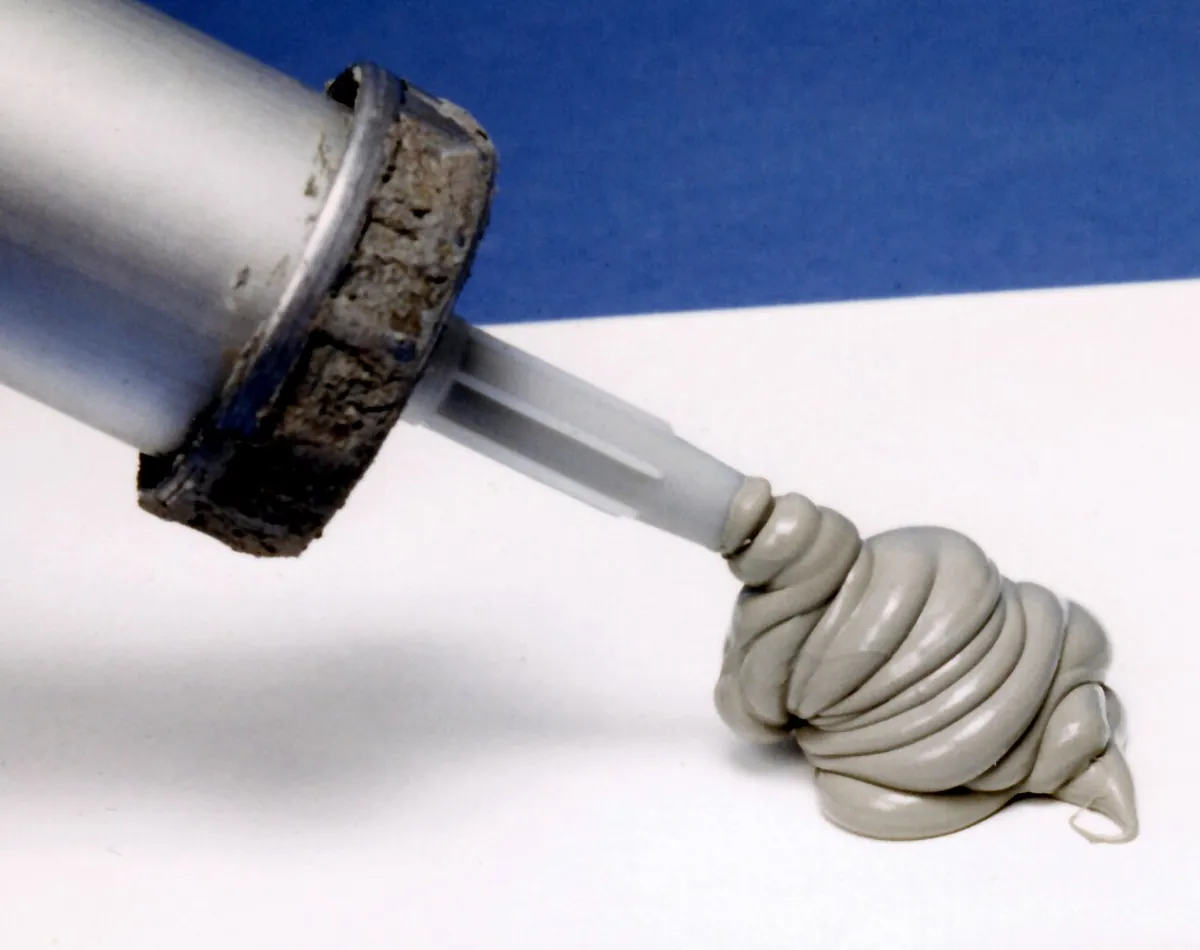
Photo: Achim Hering, Wikimedia Commons, CC BY 3.0
Most concrete adhesive failures are surface failures. The glue holds, but it is stuck to dust, loose paste, paint, sealer, oil or efflorescence that peels off the concrete. To prepare concrete for any adhesive:
- Remove loose material. Chip off loose, crumbling or weak concrete until you reach sound material.
- Roughen smooth surfaces. Wire brush, grind or etch smooth or troweled concrete so the adhesive has something to grip. See concrete grinding and concrete etching.
- Clean. Remove dust with a vacuum or compressed air. Degrease oily areas. Remove paint, sealers and curing compounds from the bonding area. See how to remove oil stains from concrete and how to remove paint from concrete.
- Check moisture. Most epoxies need dry or surface-dry concrete unless labeled for damp surfaces. Polyurethanes tolerate damp. Cement-based bonding needs damp but not wet surfaces.
- Dry-fit. Test the fit of broken pieces before applying glue.
- Check temperature. Most adhesives need surface and air temperatures above about 40 to 50 degrees Fahrenheit.
How to Glue Concrete Step by Step
- Prepare both surfaces as above.
- Mix the epoxy fully, or cut the nozzle of the construction adhesive tube to the right bead size.
- Apply the concrete adhesive to one surface, or both for epoxy, enough to squeeze out slightly when pressed.
- Press the pieces together and hold or clamp them. Use tape, wedges, weights or temporary bracing.
- Wipe off squeeze-out with a rag and the cleaner the label calls for before it cures.
- Let the adhesive cure for the full time before loading. Epoxies may reach handling strength in hours and full strength in a day to a week.
- Fill any gaps or chips with a patching compound and color-match if needed.
How Strong Is Concrete Glue?
Structural epoxies have tensile strengths of several thousand psi, far more than the roughly 300 to 700 psi tensile strength of concrete, so a well-prepared epoxy bond is stronger than the concrete. Construction adhesives are weaker, typically several hundred psi in shear, but strong enough for wood, trim, pavers and caps. Bonding agents improve the bond between old and new concrete from almost nothing to several hundred psi. Strength in practice depends on surface preparation, the bond area, temperature during curing and exposure to water and freeze-thaw. See high-strength concrete and concrete cylinder test.
Epoxy vs Construction Adhesive: How to Choose
Most home jobs come down to a choice between epoxy and construction adhesive. Epoxy is the choice when the joint must be as strong as the concrete, when the pieces are heavy, when the bond is rigid concrete to concrete or metal to concrete, or when the joint carries load, such as a broken step nosing or a dowel. It costs more, has a limited working time, needs exact mixing, and is fussier about temperature and moisture. Construction adhesive is the choice when the materials are different and will move, such as wood to concrete, when you need a gap-filling bead along a long joint, when surfaces may be slightly damp, or when the load is light to moderate, such as trim, caps and pavers. It costs less, comes ready to use, and forgives small mistakes. When in doubt, read the label: good products list the materials they bond, the temperature range, whether they work outdoors and wet, and the cure time.
Hybrid polymer adhesives sit between the two: strong initial grab, flexibility, good weather resistance and adhesion to metals and plastics. They cost more than ordinary construction adhesive but are useful for mixed-material jobs and visible joints because many are paintable and clean-looking.
Concrete Adhesive for Common Home Projects
Basement walls and floors. Furring strips on concrete walls and sleepers on basement floors are usually glued with polyurethane construction adhesive and fastened with concrete screws or powder-actuated pins. Check for moisture first; tape a square of plastic sheet to the concrete for a day and look for condensation under it. If the concrete is damp, solve the water problem and use a vapor barrier before building over it. Glue alone is not enough if the slab is wet, because moisture breaks down many bonds over time.
Broken steps and curbs. A chunk broken off a concrete step can often be glued back with structural epoxy gel. Clean both broken faces, dry-fit them, apply epoxy, press together and brace the piece with boards or tape until the epoxy cures. Fill the crack line with a matching patch. If the piece is gone or crumbled, build the corner back with a repair mortar and a bonding agent instead.
Garden statues, bird baths and planters. Cracked or broken concrete garden pieces are repaired with exterior epoxy. For a bird bath, use the epoxy on the outside and underside if possible, and let it cure fully before refilling with water. See concrete bird bath.
Countertops and furniture. Seams in concrete countertops and the joints between a concrete top and its base are often set with color-matched epoxy or silicone. A concrete coffee table top can be held to its base with construction adhesive dots plus brackets. See concrete coffee table and concrete countertops.
Patio caps, steps and edging. Stone or precast caps on a block wall and paver borders on a concrete patio are glued with exterior masonry adhesive. Use full beads, not dots, so water does not collect under the stone and freeze. See precast concrete steps.
Thresholds and transitions. Metal and wood thresholds on concrete are often set in a bead of construction adhesive plus a few concrete screws, which stops rocking and squeaks.
Safety When Using Concrete Glue
Epoxy hardeners and some construction adhesives can irritate skin, eyes and lungs, and repeated skin contact with epoxy can cause allergic sensitization that lasts for life. Wear nitrile gloves and eye protection, work with good ventilation, and keep adhesives away from children and pets. Read the safety data sheet for large jobs. Grinding concrete to prepare surfaces releases silica dust; use a vacuum shroud and a respirator. Dispose of mixed epoxy only after it has fully hardened, since curing epoxy can get hot in a cup. Store adhesives in a cool, dry place and check expiry dates, because old tubes often fail to cure properly.
Indoor vs Outdoor Use
Outdoors, a concrete adhesive must survive water, freeze-thaw, sun and temperature swings. Choose products labeled for exterior use, waterproof once cured, and UV resistant if exposed. Polyurethanes and exterior epoxies are reliable outdoors. PVA bonding agents and some construction adhesives soften in water and should stay indoors. Indoors, low-odor and low-VOC products matter, and moisture coming up through basement slabs can affect bonds. A vapor barrier under the slab helps; in older basements, test for moisture before gluing flooring or wood. See vapor barrier under concrete and is concrete waterproof.
Using Concrete Adhesive in Cold or Wet Weather
Temperature and moisture are the two conditions that ruin more concrete adhesive jobs than anything else. Most epoxies are formulated for 50 to 90 degrees Fahrenheit. Below that, the reaction slows, the adhesive stays soft for days, and it may never reach full strength. Cold-weather epoxies exist and can cure near freezing, but they cost more. Construction adhesives also slow down in cold weather because they rely on moisture and warmth to cure, and the tubes become stiff and hard to gun. Keep tubes and cartridges indoors overnight before use, warm the surfaces with sun or a heat lamp if needed, and protect the joint from frost until it has set. In hot weather the opposite happens: working time shrinks, so mix small batches and work fast.
Wet concrete is a different problem. Water on the surface blocks most adhesives from reaching the pores of the concrete. Wait for the surface to dry, use a fan or heat gun, or choose a product labeled for damp or wet surfaces. Polyurethane construction adhesives and some epoxy gels are made for damp conditions; standard epoxies are not. Bonding agents and cement slurries are the exception: they want the old concrete saturated but with no standing water, a condition often called saturated surface dry, so the old concrete does not suck water out of the new layer.
How to Test a Bond
On bigger jobs, test before you commit. Glue a small piece of the same material to an out-of-the-way spot on the concrete, using the same preparation and adhesive, and let it cure for the full time. Then try to pry it off. If the adhesive peels cleanly from the concrete, the surface preparation is not good enough. If the concrete itself breaks and comes off with the adhesive, the bond is stronger than the concrete, which is the goal. Contractors use pull-off testers for overlays and coatings, which measure the force needed to pull a disc off the surface; for home work, a pry test tells you most of what you need to know.
Cure Times and Working Times
Working time, also called pot life or open time, is how long you have to place and adjust parts before the adhesive starts to set. Five-minute epoxies give only a few minutes; structural gels give 20 to 60 minutes. Construction adhesives skin over in 10 to 30 minutes but take a day to firm up and up to a week for full strength, longer in cold or thick beads. Bonding agents usually require the new concrete to be placed while the agent is tacky (epoxy) or after it dries (PVA), depending on the product. Cold slows everything; heat speeds it up and shortens working time. Read the label and plan the job to fit it.
Removing Concrete Adhesive
Fresh construction adhesive and uncured epoxy wipe off with mineral spirits or the cleaner listed on the label. Cured adhesive is hard to remove. Scrape off as much as possible, then grind or sand. Heat softens many cured adhesives, but avoid open flames near flammable residues. For old mastic and glue on concrete floors, scraping and grinding are the usual methods. See concrete grinding and concrete dust.
Costs
- Construction adhesive (10 oz tube): about $5 to $12.
- Polyurethane or premium construction adhesive: about $8 to $15 per tube.
- Small epoxy kit (1 to 2 oz): about $8 to $20.
- Structural gel epoxy cartridge: about $20 to $45.
- Anchoring epoxy cartridge: about $25 to $70, plus a dispensing gun.
- Bonding agent (1 gallon): about $20 to $45.
Labor for professional concrete repairs using adhesives varies widely; see concrete repair cost.
Common Mistakes
- Gluing to dust or paint. The bond is only as good as the surface.
- Using the wrong product. PVA bonding agent outdoors, or rigid epoxy between wood and concrete.
- Working in the cold. Adhesives cure slowly or never reach full strength.
- Loading too early. Wait for full cure before stressing the bond.
- Relying on glue for structural or safety connections. Use anchors where codes require them.
- Too little adhesive. Spots instead of full beads leave weak bonds and rocking parts.
Frequently Asked Questions
What is the strongest glue for concrete?
A two-part structural epoxy is the strongest concrete glue for rigid bonds. On clean, sound concrete it is stronger than the concrete itself.
Does Gorilla Glue or super glue work on concrete?
Polyurethane glues stick to concrete for small jobs, and super glue works only for tiny, tight-fitting pieces. For real repairs, use epoxy or construction adhesive made for concrete.
What is the best adhesive for wood to concrete?
A polyurethane construction adhesive, with mechanical fasteners where codes require them.
Do I need a bonding agent to pour new concrete on old?
For thin layers, patches and overlays, yes, or a cement slurry. For thick slabs over old concrete, a bonding agent is often unnecessary if the old slab acts as a base.
How long does concrete adhesive take to cure?
Epoxy reaches handling strength in hours and full strength in about a day to a week; construction adhesive firms in a day and fully cures in about a week.
Sources
- American Concrete Institute: concrete repair and bonding (ACI 546)
- International Concrete Repair Institute: surface preparation guidelines
- Simpson Strong-Tie: adhesive anchors and epoxy products
- Portland Cement Association: concrete properties
Related Guides
- Concrete bolts — expansion, lag and anchor bolt sizes
- Epoxy for concrete — floor coatings, garages and outdoors
- Concrete primer — types, prep and application
- Concrete nailer — powder, gas and battery tools
- How to hang pictures on concrete walls — hooks, plugs and concrete screws