
What Chemicals Do I Need for a Pool? Essential List and Pool Chemical Calculator
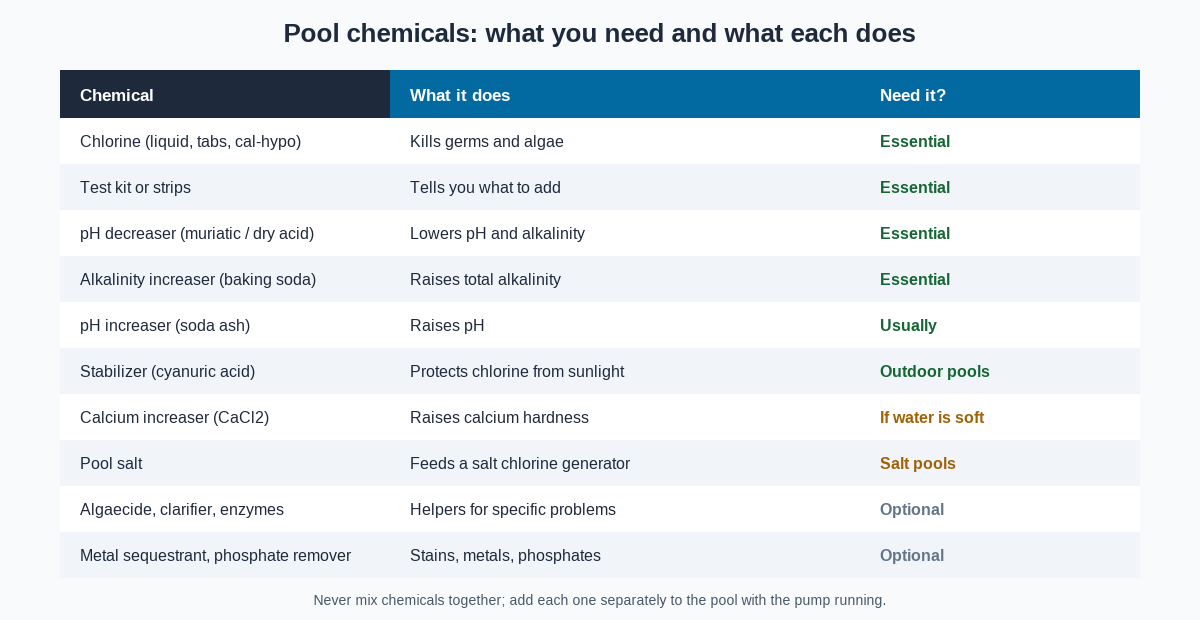
Chart: Asphapro.com
Quick Answer
For most pools, the chemicals you need are: a chlorine source (liquid chlorine, tablets or a salt system), a pH decreaser (muriatic acid or dry acid), an alkalinity increaser (baking soda), a pH increaser (soda ash), stabilizer (cyanuric acid) for outdoor pools, calcium chloride if your water is soft, and a good test kit. Aim for free chlorine at about 7.5% of your stabilizer level, pH 7.4 to 7.6, alkalinity 80 to 120 ppm, calcium 200 to 400 ppm for plaster pools and stabilizer 30 to 50 ppm. Use the pool chemical calculator below to work out how much of each to add.
Pool store shelves are full of bottles and buckets, and it is easy to come home with far more than you need. The truth is that a healthy, clear pool needs only a handful of core chemicals, used in the right amounts, plus regular testing. Extras such as algaecides, clarifiers and enzymes have their place, but they cannot replace good chlorine and balanced water.
This guide answers what chemicals do I need for a pool, what each one does, the target levels, and how much to add with a pool chemical calculator. It also covers starter kit costs and safety. For opening steps, see how to open a pool after winter.
What Pool Chemicals Do I Need? The Essentials
1. Chlorine (Sanitizer)
Chlorine kills bacteria, viruses and algae and breaks down contaminants from swimmers. It is the single most important pool chemical. Common forms are liquid chlorine (sodium hypochlorite), trichlor tablets in a floater or feeder, cal-hypo shock, dichlor granules, and salt chlorine generators that make chlorine from salt. Liquid chlorine is the most flexible choice for daily use, since it adds no stabilizer or calcium. Tablets are convenient but add stabilizer and lower pH. See how much chlorine to add to pool water.
2. A Test Kit
Testing tells you what your pool needs. A drop-based kit that tests free chlorine, combined chlorine, pH, total alkalinity, calcium hardness and cyanuric acid is the best tool. FAS-DPD chlorine tests are the most accurate. Test strips are quick but less precise. Many pool stores also test water for free, which is a useful check on your own kit once or twice a season.
3. pH Decreaser
Most pools drift up in pH, especially salt pools and pools with lots of aeration. Muriatic acid (hydrochloric acid) or dry acid (sodium bisulfate) lowers pH and also lowers alkalinity. See how to lower pH in pool water.
4. Alkalinity Increaser
Sodium bicarbonate, the same as baking soda, raises total alkalinity, which buffers pH and keeps it from swinging. See how to raise alkalinity in pool water.
5. pH Increaser
Sodium carbonate (soda ash) raises pH when it is too low, which can happen after rain, heavy acid use or with trichlor tablets. See how to raise pH in pool water.
6. Stabilizer (Cyanuric Acid)
In outdoor pools, sunlight destroys unprotected chlorine within hours. Cyanuric acid (CYA) shields chlorine from UV light. Keep it at 30 to 50 ppm for chlorine pools and 60 to 80 ppm for salt pools. It does not get used up, so add it only when testing shows it is low. See how to add stabilizer to pool water.
7. Calcium Hardness Increaser
Calcium chloride raises calcium hardness, which protects plaster, grout and equipment in soft-water areas. Many pools in hard-water areas never need it. See how to increase calcium hardness in pool water.
Target Levels for Pool Chemical Calculator Results
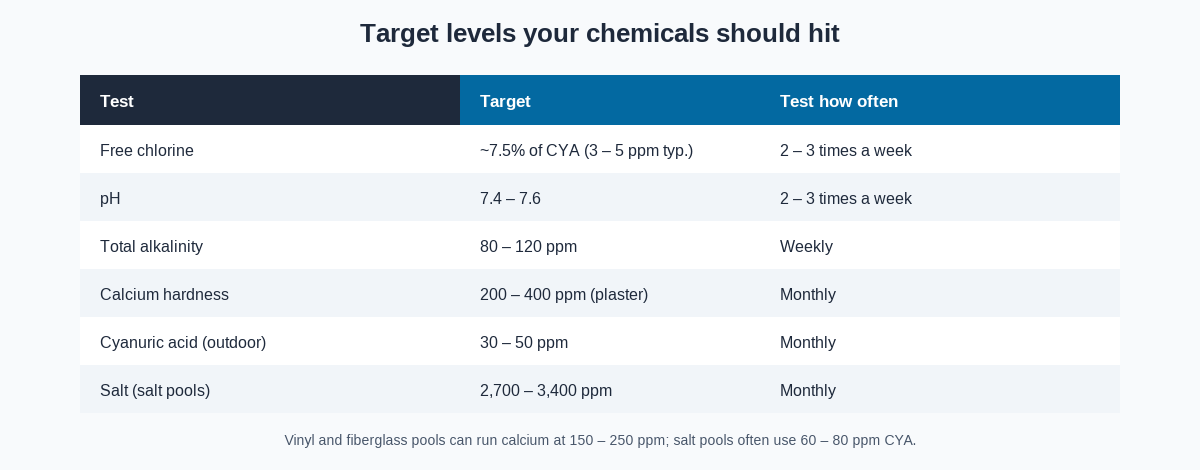
Chart: Asphapro.com
Your chemicals are tools to reach and hold these targets. Test, compare your results with the targets, then add only what you need. The pool chemical calculator below turns your test results into doses.
Pool Chemical Calculator
Enter your pool volume and your current and target levels. This pool calculator chemical tool estimates how much liquid chlorine, acid or soda ash, baking soda, calcium chloride and stabilizer to add. Leave a target equal to your current reading if you do not want to change it.
The pool chemical calculator uses common dosing rules per 10,000 gallons: about 10.2 fl oz of 12.5% liquid chlorine raises free chlorine 1 ppm; 1.4 lb of baking soda raises alkalinity 10 ppm; 1.2 lb of 77% calcium chloride raises hardness 10 ppm; and about 13 oz (0.83 lb) of stabilizer raises CYA 10 ppm. pH changes depend on alkalinity, so pH doses are estimates. Always follow product labels and retest after each addition. If a product's strength differs from the ones listed, such as 10% liquid chlorine or anhydrous calcium chloride, adjust the amount to match the label.
What Pool Chemicals Do I Need to Buy First? Starter Kit and Costs
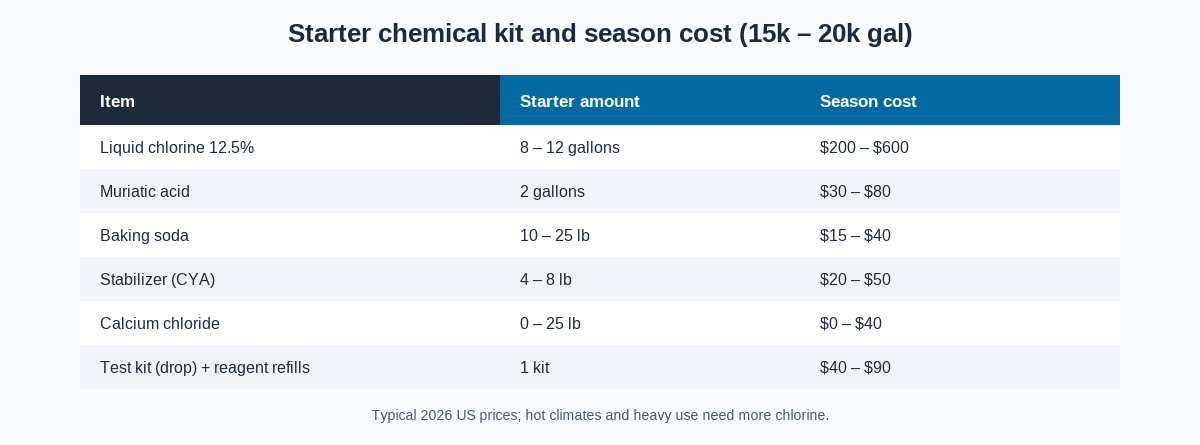
Chart: Asphapro.com
For a typical 15,000 to 20,000-gallon outdoor pool, a basic season of chemicals costs about $300 to $900, with chlorine making up most of the cost. Hot climates, heavy use, algae problems and pools without covers use more. Salt pools spend less on chlorine but more on acid and a replacement cell every few years. Covered pools in mild climates often use less of everything.
How to Add Pool Chemicals Safely
Read every label and follow it. Wear gloves and eye protection. Add chemicals to water, never water to chemicals. Never mix chemicals together, even in a bucket; in particular, keep chlorine and acid apart and never mix different types of chlorine. Add one chemical at a time with the pump running, wait at least an hour or as directed, and retest before adding the next. Pre-dissolve granular products in a bucket of pool water unless the label says otherwise. Store chemicals in a cool, dry, ventilated area, out of reach of children and pets, with acids and chlorine on separate shelves.
Photo: AgrisR, Wikimedia Commons, CC BY-SA 4.0
What Pool Chemicals Do I Need? Choosing a Chlorine Type
The chlorine you choose shapes the rest of your chemical list. Liquid chlorine (sodium hypochlorite, 10 to 12.5%) is the most flexible: it raises chlorine quickly, adds nothing but a little salt, and its slight pH rise is balanced by acid over time. It is heavy to carry and loses strength in heat, so buy it fresh. Trichlor tablets dissolve slowly in a floater or feeder and keep chlorine steady, but they add about 6 ppm of stabilizer for every 10 ppm of chlorine and lower pH and alkalinity, so pools that rely on them often end up with too much stabilizer. Dichlor granules dissolve fast and also add stabilizer. Cal-hypo is a strong granular shock that adds calcium. Salt systems make chlorine from dissolved salt and need acid to control rising pH.
Many owners use a mix: tablets early in the season to build stabilizer, then liquid chlorine once stabilizer reaches the target. When you decide what pool chemicals do I need for daily care, start with the chlorine type, since it determines how much acid, stabilizer and calcium you will use.
What Chemicals Do I Need for an Above Ground Pool?
Above ground pools need the same core chemicals as inground pools, in smaller amounts: a chlorine source, a test kit, acid, baking soda, soda ash and stabilizer. Calcium is less important for vinyl liners, though 150 to 250 ppm still protects metal parts and keeps water from foaming. Use liquid chlorine or a small floater with tablets, and avoid dropping tablets or granular shock directly onto the liner, which can bleach it. Smaller pools respond faster to chemicals, so dose carefully and retest more often. The pool chemical calculator above works for any size; just enter your gallons.
What Chemicals Do I Need for a Salt Pool?
Salt pools still use chlorine, but the cell makes it from salt, so your chemical list changes. You need pool salt to keep levels at about 2,700 to 3,400 ppm, muriatic acid to control pH (which tends to rise in salt pools), stabilizer at 60 to 80 ppm to protect the chlorine the cell makes, baking soda for alkalinity, and calcium chloride if hardness is low. Keep a jug of liquid chlorine on hand for shocking or for days when the cell cannot keep up. Many salt pool owners also use borates to help hold pH steady. See how to maintain a saltwater pool.
What Chemicals Do I Need for a Pool After a Fresh Fill?
A newly filled pool starts with whatever is in your fill water, often low in stabilizer, chlorine and sometimes calcium and alkalinity. Test the water after it has circulated for a few hours, then use the pool chemical calculator to plan. Balance alkalinity first, then pH, then calcium. Add stabilizer next, since it dissolves slowly; put it in a sock in the skimmer basket or a bucket of warm water, and do not backwash for several days. Finally, add chlorine to your target. New plaster pools need special start-up care to avoid dust and scale; follow your plasterer's start-up plan closely rather than a general guide.
What Pool Chemicals Do I Need for Opening and Closing?
When opening, you will usually need a larger dose of chlorine to shock the water, plus acid or baking soda to rebalance after winter. Rain and snowmelt often dilute stabilizer and calcium, so test those too. When closing, balance the water, shock it, and in some climates add a winter algaecide or a slow chlorine floater under the cover. Pool stores sell opening and closing kits, but testing first and buying only what your water needs is usually cheaper and more accurate. See how to winterize a pool.
Optional Chemicals Explained
Algaecide helps prevent algae, especially in pools that struggle to keep chlorine steady or during closing. Polyquat algaecides do not foam or stain. It is a backup, not a replacement for chlorine.
Clarifier clumps tiny particles so the filter can catch them, helping with slightly cloudy water. Flocculant sinks particles to the floor for vacuuming to waste when water is very cloudy.
Enzymes break down oils from sunscreen and skin, reducing scum lines in busy pools.
Metal sequestrants hold iron and copper in solution to prevent stains, useful for well water or pools with copper heaters.
Phosphate removers lower phosphates that feed algae. See how to remove phosphates from pool water.
Borates act as a pH buffer and can make water feel softer, and they help reduce algae growth slightly.
Non-chlorine shock (MPS) oxidizes contaminants without raising chlorine and lets swimmers return quickly, but it does not kill algae.
Pool Chemicals You Can Usually Skip
If your chlorine and balance are right, many pools never need algaecide, clarifier, enzymes or specialty "pool tonics." Avoid buying products to fix problems you do not have. Pool "opening kits" and "maintenance kits" often include more than you need. Products that promise to replace chlorine entirely rarely live up to the promise. When in doubt, ask what chemicals do I need for a pool based on your actual test results, not on what is on sale. The pool chemical calculator above shows what to add for your numbers.
How to Read Test Results Before Using the Pool Chemical Calculator
Compare each test result with the target. If free chlorine is below the minimum for your stabilizer level, add chlorine. If pH is above 7.8, add acid; if below 7.2, add soda ash. If alkalinity is under 80 ppm, add baking soda; if over 120 ppm and pH keeps rising, lower it slowly with acid and aeration. If calcium is low for your pool surface, add calcium chloride. If stabilizer is low, add cyanuric acid; if it is high, partly drain. If combined chlorine is above 0.5 ppm, shock. Use the pool calculator chemical tool for the amounts, and fix one thing at a time, starting with alkalinity, then pH, then the rest.
Worked Examples With the Pool Chemical Calculator
Example 1: weekly top-up. A 15,000-gallon pool tests at free chlorine 2, pH 7.8, alkalinity 90, calcium 250 and stabilizer 40. Targets are free chlorine 5 and pH 7.5. The pool chemical calculator suggests about 46 fl oz of 12.5% liquid chlorine and about 24 fl oz of muriatic acid (add half, retest). Nothing else is needed.
Example 2: new fill. A 20,000-gallon pool filled from city water tests at free chlorine 0, pH 7.4, alkalinity 60, calcium 120 and stabilizer 0. Targets: alkalinity 90, calcium 250, stabilizer 40 and free chlorine 4. The calculator suggests about 8.4 lb of baking soda, 31 lb of calcium chloride, 6.6 lb of stabilizer and about 82 fl oz of liquid chlorine, added over a day or two in that order.
Example 3: low pH after rain. A 12,000-gallon above ground pool tests at pH 7.0 and alkalinity 70 after heavy rain. Raising alkalinity to 90 needs about 3.4 lb of baking soda, which also nudges pH up; the calculator suggests a few ounces of soda ash if pH is still low after retesting.
Common Pool Chemical Mistakes
The most common mistake is adding chemicals without testing, which leads to overcorrecting and chasing pH up and down. Another is using tablets all season, which builds stabilizer until chlorine barely works. Mixing chemicals in a bucket can cause dangerous reactions. Adding several chemicals at once makes it hard to know what worked and can cloud the water. Storing chlorine and acid next to each other risks toxic fumes. Buying large amounts of liquid chlorine and storing it in a hot shed wastes money as it weakens. And relying on algaecide or clarifier to cover up low chlorine leads to recurring problems. Simple testing and the right core chemicals avoid all of these. When something seems wrong, stop adding products, retest carefully, and change one thing at a time until the water is back in balance.
A Simple Weekly Chemical Routine
For most pools, a weekly routine looks like this: test free chlorine and pH two or three times a week and add liquid chlorine and acid as needed; test alkalinity once a week; test calcium and stabilizer once a month; shock after heavy use, rain or if combined chlorine rises; and keep the filter clean. With this routine, most owners find that a short list of core chemicals is all they ever need, and the answer to what chemicals do I need for a pool stays simple: chlorine, acid, baking soda, stabilizer and a good test kit.
How Accurate Is a Pool Chemical Calculator?
A pool chemical calculator is only as accurate as the numbers you enter. The biggest source of error is pool volume; many owners guess, and a guess that is 20% off makes every dose 20% off. Measure your pool and use the formulas earlier in this guide. The next source of error is testing: strips can be off by a wide margin, while a good drop kit is far more reliable. Product strength also matters; liquid chlorine weakens in storage, so an old jug delivers less chlorine than the label says.
pH doses are the hardest to predict, because how much acid or soda ash moves pH depends on alkalinity, borates and other factors. That is why any pool calculator chemical tool, including the one on this page, gives an estimate for pH and suggests adding half, circulating and retesting. Doses for chlorine, alkalinity, calcium and stabilizer are more predictable. Used with care, a pool chemical calculator saves money and prevents the overcorrecting that sends water chemistry up and down.
What Pool Chemicals Do I Need in Different Climates?
Hot, sunny climates burn through chlorine fastest, so owners there need more chlorine, keep stabilizer at the upper end of its range, and often use a cover or a salt system. Pools in hard-water areas rarely need calcium but may need more acid, since hard water often comes with high alkalinity. Soft-water areas may need regular calcium and baking soda. Rainy climates see pH and alkalinity drop after storms and need baking soda more often. Cold climates with short seasons use fewer chemicals overall but need a good opening and closing routine. Knowing your local water and weather helps answer what pool chemicals do I need beyond the basic list.
Using the Pool Chemical Calculator for Weekly Care
The easiest way to use a pool chemical calculator is to make it part of your weekly routine. Test your water, enter the results and your targets, and note the doses. Over a few weeks, you will see patterns: how much chlorine your pool uses per day, how fast pH rises, and how often alkalinity needs a top-up. Many owners keep a simple log on paper or a phone. With that log, the question of what chemicals do I need for a pool each week becomes easy to answer, and you can buy chemicals in the right amounts without waste. Revisit your targets as the seasons change, and use the calculator again whenever you refill, after heavy rain or when you switch chlorine types.
Storing Pool Chemicals
Good storage keeps chemicals safe and effective. Keep chlorine products and acids on separate shelves, ideally in separate cabinets, since acid fumes react with chlorine and can create toxic gas and corrode metal. Store liquids below dry products so a leak cannot drip onto granules. Keep everything in original containers with labels, tightly closed, out of direct sun and heat, and out of reach of children and pets. Buy liquid chlorine in amounts you will use within a few weeks. Dry chemicals like baking soda, calcium chloride and stabilizer keep well if kept dry. Never store pool chemicals near gasoline, fertilizer or lawn chemicals. Keep a list of what you have, so you do not buy more of something you already own.
Pool Chemicals for Hot Tubs and Spas
Hot tubs use the same basic types of chemicals as pools but in much smaller amounts and with a few differences. Many spa owners use bromine instead of chlorine, since it is more stable in hot water. Dichlor granules are a popular chlorine choice for spas, since the water is drained every few months and stabilizer buildup is less of a concern. pH and alkalinity adjusters are the same products as for pools. Hot tubs often benefit from a non-chlorine shock after use and a defoamer if foam appears. Dose carefully: a 400-gallon spa needs only a small fraction of the amounts a pool needs, so use a spa-specific chart or enter the spa's gallons in the pool chemical calculator and measure with a kitchen scale or measuring spoons. See how much does a hot tub cost per month.
What Chemicals Do I Need for a Pool: Key Points
- Essentials: chlorine, a test kit, acid, baking soda, soda ash and stabilizer.
- Add calcium chloride if water is soft, and salt for salt pools.
- Test first and use the pool chemical calculator to dose.
- Add chemicals one at a time, never mixed, with the pump running.
Frequently Asked Questions
What chemicals do I need for a new pool?
Chlorine, stabilizer, baking soda, acid, soda ash, calcium chloride if needed, and a test kit. Test the fill water first and use the pool chemical calculator to work out amounts before you buy.
Do I need shock if I use liquid chlorine?
No separate product is required. Liquid chlorine can be used as shock by adding a larger dose, raising free chlorine to the shock level for your stabilizer and holding it until the water is clear.
Do I need algaecide?
Not if you keep chlorine steady. It can help as a backup during hot spells, when closing for winter, or in pools that struggle with recurring algae.
What chemicals does a salt pool need?
Salt, acid, stabilizer, baking soda and sometimes calcium. The cell makes chlorine, but keep some liquid chlorine on hand for shocking.
How often do I add pool chemicals?
Chlorine every day or two, pH adjusters about weekly, and alkalinity, calcium and stabilizer only when tests show they are off target.
Can I use household bleach in my pool?
Yes, plain unscented bleach is the same chemical as liquid chlorine at lower strength. Avoid scented, splash-less or thickened bleach, which contains additives you do not want in the pool.
Sources
- CDC: Pool chemistry and testing
- CDC: Pool chemical safety
- Trouble Free Pool: Pool water chemistry
- EPA: Pool and spa chemicals