
Concrete Stencils: How Stenciled Concrete Works and How to Stencil a Patio
Quick Answer
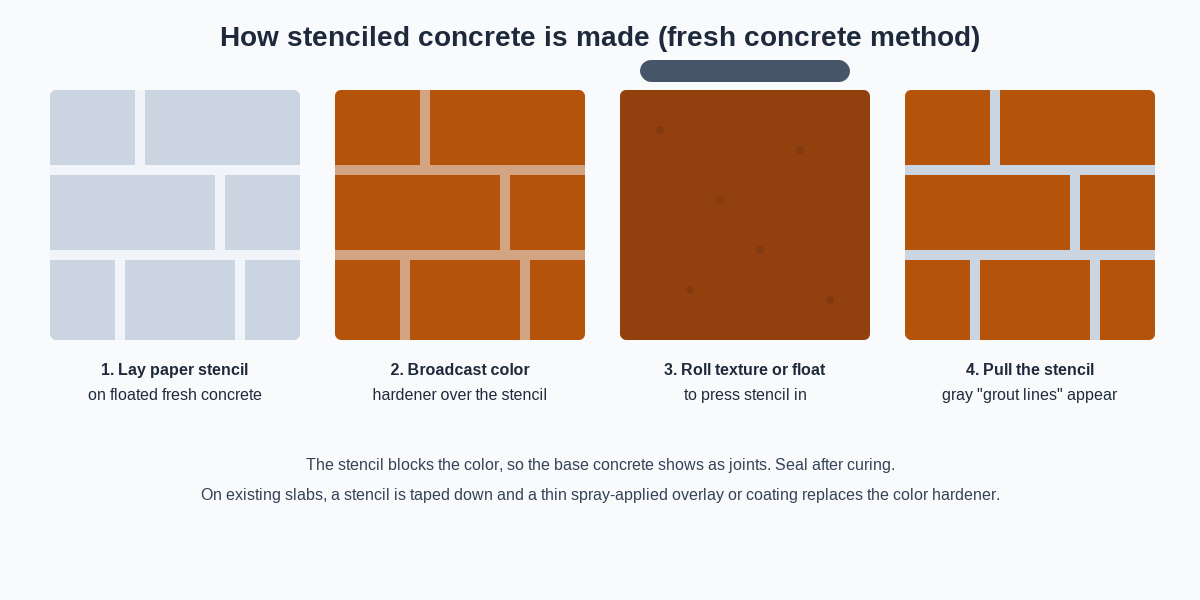
Concrete stencils are paper, plastic or vinyl templates laid on concrete to create the look of brick, tile, flagstone or cobble. On new concrete, a disposable paper concrete stencil is pressed into the floated slab, color hardener is broadcast and worked in, and when the concrete stencil is pulled off, the uncolored base shows through as "grout lines." On existing concrete, a stencil is taped down and a thin spray-applied cement overlay or coating is applied over it, then the concrete stencil is removed. Stenciled concrete is flatter and more even than stamped concrete, easier to walk on and roll over, and often a little cheaper, typically about $8 to $18 per square foot installed. It needs sealing and resealing every two to three years.
Stenciling concrete is one of the most versatile decorative techniques. It gives a slab the look of laid brick, tile or stone with crisp joint lines and color, but keeps the surface smooth enough for wheelchairs, strollers, patio furniture and bare feet. It can be done on a brand-new slab while it is being poured, or applied as a thin overlay to update an existing patio, walkway or pool deck without tearing it out. Simple painted stencils are also used for borders, logos and decorative accents on existing concrete.
This guide explains how concrete stencils work on new and existing concrete, popular stencil patterns, ideas for a stencil concrete patio, how stenciled concrete compares with stamped concrete, costs, DIY options, and how to seal and maintain the finished surface.
What Is Stenciled Concrete?
Stenciled concrete is concrete decorated by masking off a pattern of joint lines and applying color or a thin decorative layer around them. The concrete stencil is essentially the negative of the grout lines: it covers the areas that will look like mortar joints between bricks, tiles or stones. When color or a coating is applied over the whole surface and the concrete stencil is removed, the masked lines appear in the base color, giving the look of individual units set in mortar.
The result is a pattern with clean, uniform joints and a texture that can be smooth, lightly textured, or rolled with a stone-like texture. Unlike stamped concrete, the units are not pressed down into the surface to imitate the height variation of real stones, so the finished surface stays fairly flat. That makes stenciled concrete popular for pool decks, patios used for dining, walkways that need to be accessible, and commercial plazas.
Stenciling Concrete on a New Slab
On fresh concrete, the classic method uses disposable paper stencils in rolls about 2 feet wide. After the concrete is placed, screeded, bull floated and edged, and the bleed water has gone, the crew unrolls the concrete stencil across the slab and presses it into the surface with a roller or float so it sticks and stays flat. Color hardener, a dry powder of cement, fine aggregate and pigment, is then broadcast over the concrete stencil and the exposed concrete, allowed to absorb moisture, and floated or troweled into the surface. A second coat of color hardener is often applied for even color. A texture roller or texture skin can be used to give the surface a stone-like texture.
Once the color has been worked in and the surface has stiffened enough, the concrete stencil is carefully pulled up, revealing the gray base concrete in the shape of the joint lines. The edges of the pattern are touched up, the slab is cured, and later it is sealed. The process requires good timing, like stamping, but the crew does not need a full set of stamp mats, and the pattern is easier to lay out precisely, including curves and borders.
Stenciling Existing Concrete With an Overlay
Concrete stencils are also widely used to update existing slabs. The old concrete is cleaned, repaired and profiled by grinding or shot blasting so new material will bond. A base coat of polymer-modified cement overlay, in the color of the joints, is applied and allowed to cure. Then adhesive-backed vinyl or plastic stencils are laid in the chosen pattern and pressed down firmly. A second, contrasting color of overlay is sprayed over the whole surface with a hopper gun, often to create a knockdown texture, or troweled on, then the concrete stencil is pulled while the topcoat is still soft, revealing the base-coat joint lines. After curing, the surface may be stained for variation and sealed.
This spray-down stencil system is one of the most popular ways to resurface pool decks and patios, because it is thin, adds little height, covers minor surface wear and stains, and gives a cool, slip-resistant texture underfoot. It does require a sound base slab without major cracks or movement. See how to resurface concrete and concrete pool deck resurfacing.
Popular Concrete Stencil Patterns
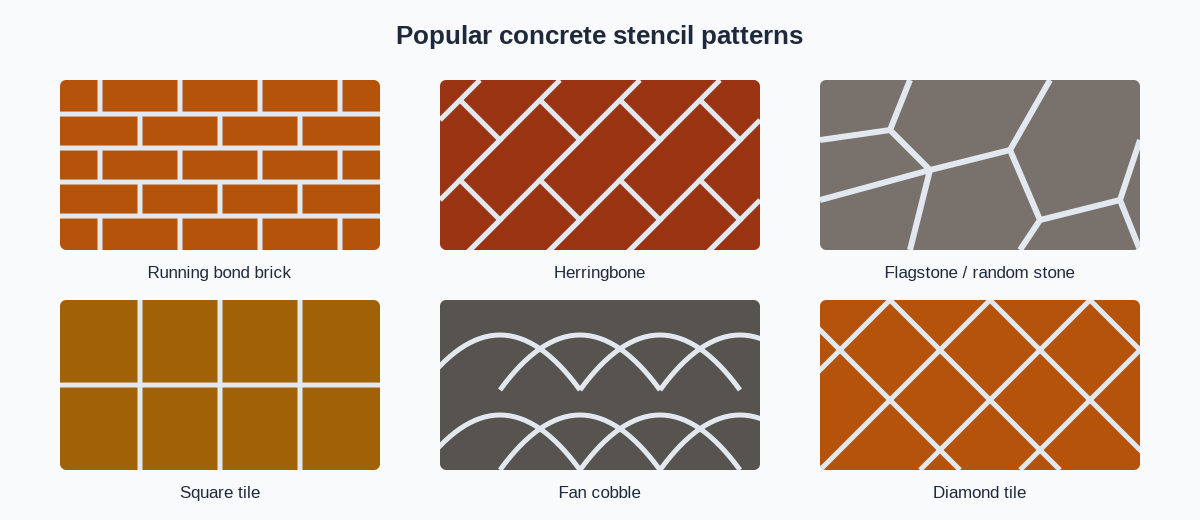
Concrete stencils come in many patterns. Brick patterns, in running bond, herringbone, basket weave and soldier courses, are classic for walkways, borders and driveways. Tile patterns, such as square tile, diamond tile and hexagon, suit patios, porches and indoor floors. Stone patterns, including flagstone, random stone and ashlar, give a natural look to patios and pool decks. Cobble and fan patterns give an old-world feel to walks and courtyards. Borders, bands and medallions such as compass roses add decorative accents. The same concrete stencil can look very different in different colors: a brick stencil in red with gray joints looks like clay brick, while the same stencil in tan with white joints looks like stone tile.
Types of Concrete Stencils
Concrete stencils come in three main materials, each suited to a different method. Paper stencils, sold in rolls about 2 feet wide and many feet long, are used once on fresh concrete; they are pressed into the wet surface, colored over and torn away. Adhesive-backed vinyl or plastic stencils are used on spray-down overlays over existing concrete; they stick to the base coat, stay put while the topcoat is sprayed, and are peeled off and discarded. Reusable rigid plastic stencils, cut from polyethylene or Mylar sheet, are used for painting or staining designs, borders and logos, and can be cleaned and reused many times.
Stencils for concrete are sold in standard patterns by decorative concrete suppliers, and custom stencils can be cut from a drawing or logo by suppliers with plotters. Custom concrete stencils are popular for business logos at entrances, house numbers, sports court markings and themed designs on playgrounds.
Planning and Laying Out a Stenciled Design
Layout makes or breaks a stenciled concrete job. Before any concrete stencil goes down, snap chalk lines to set a straight reference line, usually parallel to the house or the main edge, so the pattern runs true. Plan where borders, bands and medallions go, and how the pattern meets steps, drains, posts and corners. On patios with curves, decide whether the pattern will follow the curve or run straight and be trimmed at the edge. Dry-lay a few sections of stencil before committing to check the look, especially on overlays where the stencil is easy to reposition.
Joint lines should not fight the slab's control joints. On new concrete, plan control joints along stencil lines so cracks follow joint lines. On overlays, existing control joints and cracks must be honored, because they will move and reflect through the overlay; installers often run a stencil line along existing joints or cut new joints through the finished overlay.
Colors for Stenciled Concrete
Color choice drives how realistic and attractive stenciled concrete looks. The joint color is the base, often gray, white or a light neutral like a mortar line. The field color is the main color of the bricks, tiles or stones, applied as color hardener on fresh concrete or as the sprayed topcoat on overlays. Secondary colors can be added with stains, tints or a lightly sprayed accent for variation between units. Brick concrete stencils look best in reds, terracotta and browns with gray joints; tile stencils in sandstone, buff, terracotta or gray with light joints; flagstone stencils in two or three earthy tones. Lighter colors are cooler underfoot, which matters on pool decks and patios in hot climates. Ask the installer for samples on actual boards, and look at them outdoors in daylight. See how to color concrete.
Stencil Cement Patio Overlay, Step by Step
Here is what a typical stencil cement patio overlay job looks like on an existing slab. First, the installer inspects the patio for cracks, settlement and moisture problems; a slab that is moving or badly cracked is not a good base. Next, the surface is cleaned of dirt, oil and old sealers, and ground or shot blasted to open the pores so the overlay will bond. Cracks are repaired and control joints marked. A primer or bonding coat may be applied.
Then a thin base coat of polymer-modified cement in the stenciled concrete joint color is troweled or squeegeed over the slab and allowed to set. The concrete stencils are laid out along chalk lines, smoothed down so they stick firmly with no lifted edges, and trimmed around edges and obstacles. The field color is mixed and sprayed with a hopper gun, often to a knockdown texture flattened lightly with a trowel, or troweled smooth. While the topcoat is still soft, the stencils are pulled up, revealing crisp joint lines in the base color. After curing, the surface can be stained for color variation, then sealed with one or two coats of sealer, often with anti-slip additive.
Most residential stencil concrete patio overlays take two to four days, depending on size, weather and drying times, and the patio can usually handle foot traffic a day or so after sealing.
Concrete Stencils on Pool Decks
Pool decks are one of the best uses for concrete stencils. The spray-down stencil overlay gives a textured, slip-resistant surface that stays cooler under bare feet than many other finishes, especially in light colors, and it can be applied over an old, stained or worn pool deck without demolition. Popular pool deck concrete stencils include large tile, flagstone and brick borders. The overlay must be compatible with pool water, chlorine or salt, so use a system designed for pool decks and keep it sealed. Expansion joints between the deck and the pool coping must remain open and be sealed with a flexible sealant. See concrete pool deck repair.
Stenciled Walkways, Driveways and Indoor Floors
Stenciled concrete works well on walkways, where brick and cobble stencils guide the way and the flat surface is easy for wheelchairs, strollers and wheeled bins. Borders along the edges frame the path neatly. On driveways, fresh-concrete stenciling with color hardener produces a hard-wearing pattern, while overlays on driveways must be rated for vehicle traffic and installed on a sound slab; tire wear and hot tire pickup on sealers are concerns, so choose tough sealers. Indoors, stenciled concrete overlays and stained concrete stencil designs are used on basement floors, sunrooms, retail stores and restaurants, often in tile or custom patterns with polished or sealed finishes.
Hiring a Stenciled Concrete Contractor
Look for a decorative concrete contractor with stenciled concrete projects in their portfolio, ideally some several years old. Ask which method they recommend for your slab, how they will prepare an existing surface, which overlay system and sealer they use, how they handle cracks and joints, what colors and stencil patterns they offer, how long the work takes, and what warranty they provide. Ask to see a sample board in your chosen colors and pattern. Get several written quotes that describe the same scope so you can compare fairly.
Concrete Stencils for Small Decorative Accents
Even if you do not want a full pattern, concrete stencils are useful for small touches. A stenciled border around a plain broom-finished patio adds interest at low cost. A compass rose or medallion stenciled in the center of a patio makes a focal point. A stenciled rug pattern under a dining table defines the space. House numbers stenciled on a driveway apron or step riser help visitors and emergency services. Concrete stencil kits for these accents are widely available and are a good way to try stenciling concrete before tackling a larger project.
Stencil Concrete Patio Ideas
A stencil concrete patio can take on almost any style. For a traditional home, a red or terracotta brick stencil with gray joints, in herringbone or running bond with a soldier-course border, echoes the look of a clay paver patio. For a Mediterranean feel, large square or diamond tile in warm sandstone colors with lighter joints works well. For a natural garden setting, a flagstone stencil in two or three earthy colors with a stone texture looks relaxed and blends with plantings. For a modern house, a large-format tile stencil in gray tones gives a clean, geometric look. Fan cobble suits courtyards and entry areas.
Combining patterns helps define spaces: a brick border around a flagstone field, a tile band marking the dining area, or a medallion under a fire pit. Keep the design simple enough that it reads clearly from a distance; two patterns and two or three colors are usually plenty. Concrete patio stencils are also good for tying a new patio to existing brick on the house, steps or garden walls.
Painted Stencils on Existing Concrete
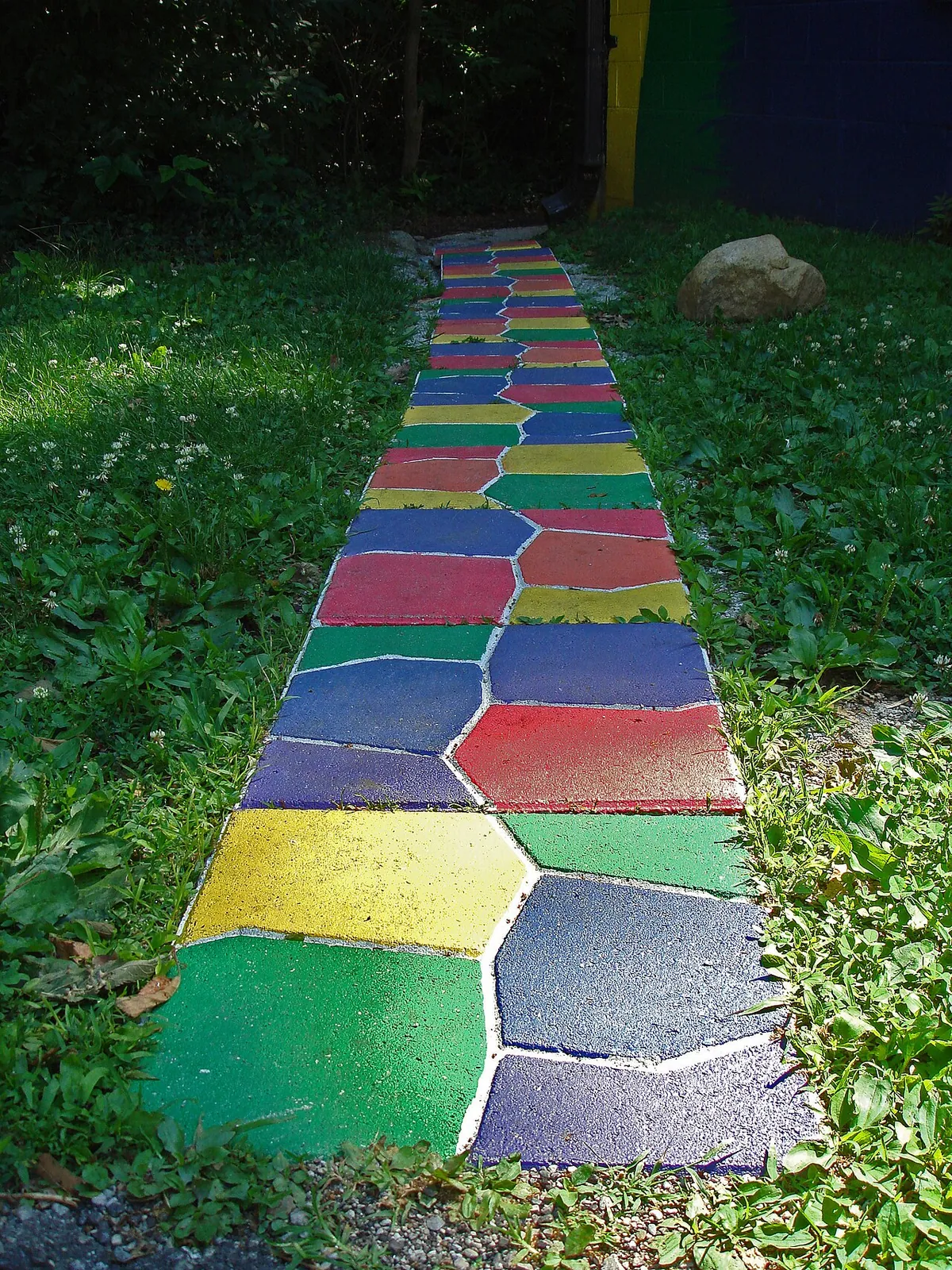
Photo: Allen McGregor, Wikimedia Commons, CC BY 2.0
The simplest form of stenciling concrete uses paint or stain instead of an overlay. A reusable plastic concrete stencil or a pattern of tape is laid on a clean, dry existing slab, and concrete stain or paint is applied with a sprayer, roller or brush. When the concrete stencil is lifted, the pattern remains. This is popular for DIY projects such as decorative borders, rugs painted on a patio, house numbers on a driveway apron, game boards and hopscotch, or a faux tile look on a porch. The path in the photo shows how bold a painted stone pattern on concrete can look; a stencil makes such lines more even and repeatable.
Painted concrete stencils are inexpensive and quick, but paint wears under foot traffic and weather, especially on walkways and driveways, and it can peel if the concrete is damp or not prepared properly. Penetrating stains last longer than film-forming paints because they soak into the concrete. Seal the finished design with a clear concrete sealer to protect it. See concrete paint and concrete staining.
Stenciled vs Stamped Concrete
Stenciled concrete and stamped concrete both create patterns, but they differ in look, feel and cost. Stamped concrete presses mats into fresh concrete, creating deep joints and a strong texture that imitates the height variation of real stone, brick or wood. Stenciled concrete creates the pattern with color and masking, so joints are shallow and the surface is flatter. Stamped concrete looks more three-dimensional and realistic up close; stenciled concrete looks crisp and neat, and is easier to walk on, push carts over, clean and shovel. Stenciling can follow curves and complex layouts easily, and the spray-down stencil systems can be applied over existing slabs, while stamping is usually done on new slabs or thicker overlays. Costs overlap, but stenciling is often slightly cheaper. See stamped concrete patios and stamped concrete patterns.
Stenciled Concrete Cost
Stenciled concrete on a new slab typically costs roughly $8 to $15 per square foot installed in many markets, including the concrete, base and labor, depending on pattern, colors and size. Spray-down stencil overlays on existing concrete commonly run about $5 to $12 per square foot or more, depending on the condition of the old slab, the amount of preparation and repair, and the number of colors. Simple painted stencil designs can cost much less if you do them yourself: a reusable stencil, paint or stain and sealer for a small patio might cost a few hundred dollars. As with other decorative concrete, small jobs cost more per square foot, and multiple colors, borders and medallions add cost. See concrete overlay cost and concrete coating cost.
Stenciling Concrete Yourself
DIY stenciling concrete depends on which method you use. Painting or staining through a stencil on an existing slab is very DIY-friendly. Clean the concrete thoroughly, remove old sealers or paint, let it dry, test for moisture, and fix cracks. Lay out the pattern carefully with chalk lines so it is square to the house. Tape or weigh down the stencil, apply paint or stain in thin coats, lift the stencil while the paint is still slightly wet for crisp edges, move to the next section, and finish with a sealer.
Spray-down stencil overlays require more skill and equipment, including a hopper gun and compressor, surface preparation tools, and experience with overlay mixes; many homeowners hire this out. The fresh-concrete paper stencil method requires coordinating a concrete pour, color hardener and timing, and is best left to experienced decorative concrete crews unless you have helped on several jobs.
Choosing Stencils for Concrete Patios
When choosing stencils for concrete patios, consider scale, style and use. Large tiles and stones look better on large areas; small bricks suit walks and borders. Match the pattern to the house and garden style. For pool decks and areas used barefoot, choose patterns and textures that stay comfortable and slip resistant. Check that the stencil system you choose suits your method: paper stencils for fresh concrete, adhesive vinyl stencils for spray overlays, and reusable plastic stencils for paint and stain. Many suppliers sell cement patio stencils in rolls for fresh concrete and in sheets for overlays and painting, often with matching border and medallion designs.
Sealing and Maintaining Stenciled Concrete
Like other decorative concrete, stenciled concrete should be sealed to protect the color, resist stains and water, and make cleaning easier. Acrylic sealers are common outdoors; on pool decks, choose a sealer compatible with the overlay system and add an anti-slip additive. Reseal every two to three years, or when water no longer beads up. Clean with a broom, hose and mild detergent; avoid harsh acids and high-pressure washing close to the surface, which can damage overlays. In freezing climates, avoid ammonium-based deicers, and use plastic shovels. Small chips in an overlay can be patched and recolored by the installer. See how to seal concrete.
Common Problems With Stenciled Concrete
Problems with stenciled concrete usually come from poor preparation or timing. On fresh concrete, color hardener applied too late may not bond well, and stencils pulled too early or too late can tear edges or leave blurry lines. On overlays, the most common failure is delamination, where the overlay peels from the old slab because the surface was not cleaned and profiled properly, or because moisture or movement in the old slab breaks the bond. Cracks in the old slab reflect through thin overlays. Painted stencils peel when applied to damp or sealed concrete. Choose an experienced installer, insist on proper surface preparation, and keep the surface sealed to avoid these problems.
Whichever method you choose, stenciled concrete rewards careful planning: a straight layout, the right concrete stencil material for the job, good surface preparation, colors tested in daylight, and a quality sealer. With those in place, concrete stencils turn plain gray slabs into patios, walks and pool decks that look like brick, tile or stone for a fraction of the cost.
How Long Stenciled Concrete Lasts
Stenciled concrete on a new slab, with color hardener worked into the surface, lasts as long as the concrete itself when it is sealed and resealed on schedule; the color is part of the surface and wears slowly. Stencil overlays on existing concrete typically last 10 to 15 years or more when well bonded to a sound slab and kept sealed, and they can be recoated to refresh the look. Painted concrete stencils are the shortest-lived, often needing touch-ups every few years on walking surfaces. Choosing the right stenciling concrete method for how the area is used is the best way to get a long life from the design.
Frequently Asked Questions
What is stenciled concrete?
Concrete decorated by masking a pattern of joint lines with a stencil and applying color or an overlay around them to look like brick, tile or stone.
Can you stencil an existing concrete patio?
Yes. A spray-down stencil overlay or painted stencil can be applied to a sound, well-prepared existing slab.
Is stenciled concrete cheaper than stamped concrete?
Often slightly, and it is flatter and easier to walk on, though less three-dimensional than stamped concrete.
How long does stenciled concrete last?
New stenciled slabs last as long as the concrete with resealing; overlays often last 10 to 15 years or more if well bonded and maintained.
Sources
- American Concrete Institute: ACI 310R guide to decorative concrete
- Portland Cement Association: decorative concrete finishes
- American Society of Concrete Contractors, Decorative Concrete Council
- International Concrete Repair Institute: surface preparation for overlays (CSP profiles)
Related Guides
- Stamped concrete patterns — slate, flagstone, brick, cobble and wood
- Stamped concrete patios — designs, colors, cost and pool decks
- Micro cement floor — seamless microcement flooring over tile or concrete
- Concrete patio ideas — layouts, finishes and features
- Concrete walkway ideas — front walks, garden paths and borders
- Decorative concrete — types, finishes and costs