
Concrete Patio Ideas: Designs, Finishes, Layouts and Budget Tips
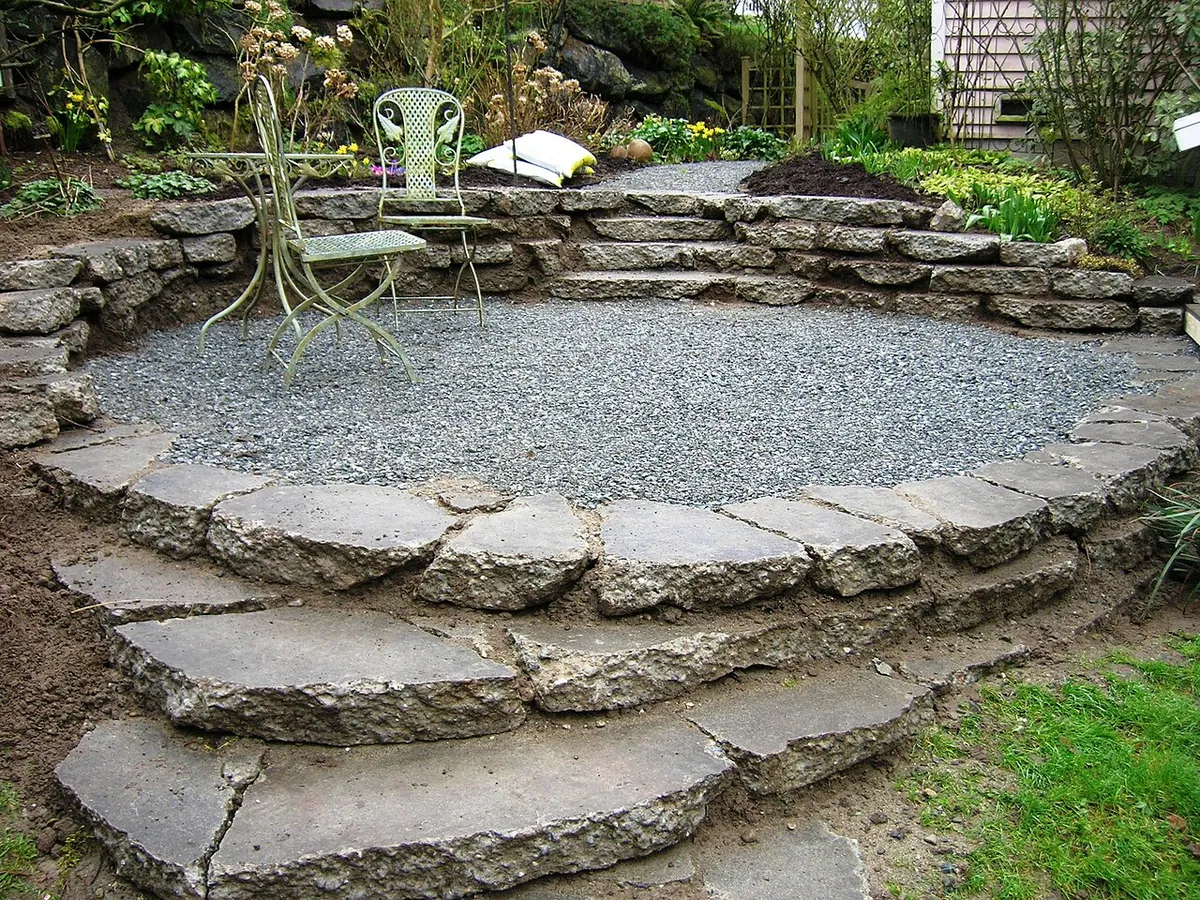
Photo: brewbooks, Wikimedia Commons, CC BY-SA 2.0
Quick Answer
The best concrete patio ideas combine a smart layout (bordered rectangles, curves, separate dining and fire pit zones, multi-level patios on slopes), a finish that suits use and budget (broom, smooth, salt, exposed aggregate, stamped, stained or stenciled), color and borders that tie the patio to the house, and features such as fire pits, seat walls, steps, outdoor kitchens, shade and lighting. Budget cement patio ideas include a plain broom finish with a decorative border, saw-cut tile patterns, poured squares with grass joints, and patios built from recycled broken concrete. Plan size around furniture, slope the patio away from the house, and plan control joints before the pour.
A concrete patio is one of the most versatile outdoor spaces you can build, and good concrete patio ideas make the most of it. Plain concrete is affordable and durable, and with a little design thought it can look anything from crisp and modern to warm and rustic. The difference between an ordinary slab and a patio that feels like an outdoor room usually comes down to a few choices: the shape, the finish, the edges, and the features around it.
This guide collects practical concrete patio ideas in groups: layouts and shapes, finishes and textures, colors and borders, features such as fire pits and kitchens, ideas for small yards and slopes, budget ideas, and tips for planning and building a poured patio that lasts.
Concrete Patio Layout and Shape Ideas
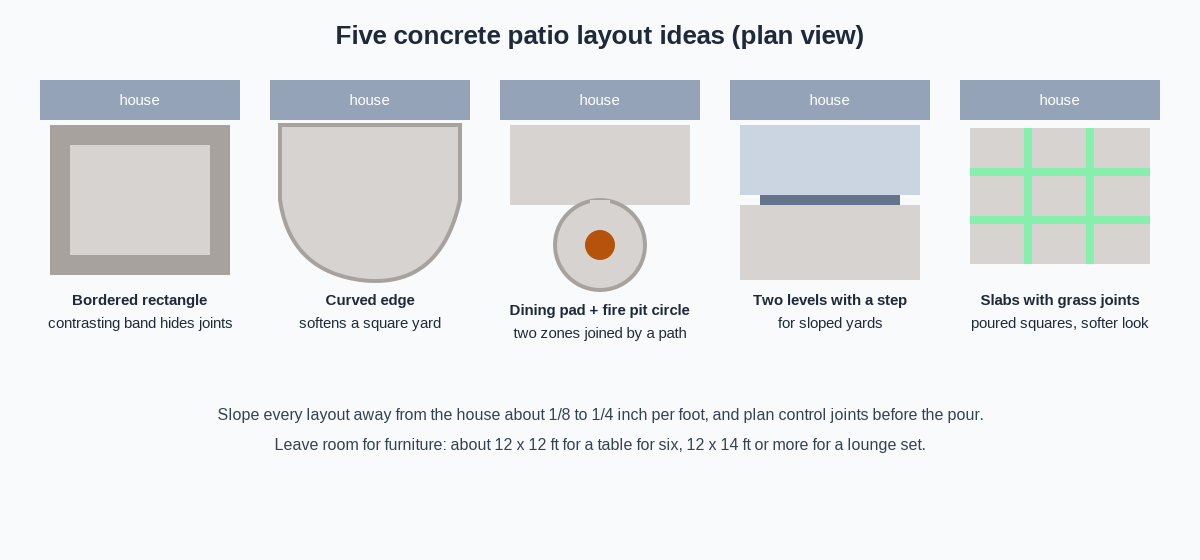
Start your concrete patio ideas with layout, because shape and size shape everything else. A bordered rectangle is the classic choice: a simple slab along the back of the house with a contrasting border band, which looks tidy and hides control joints in the border lines. A curved edge softens a square yard and flows naturally into lawns and planting beds; even one curved side makes a patio feel more designed. Zoned layouts split the patio into a dining pad near the kitchen door and a separate fire pit or lounge area further out, linked by a path. Wraparound patios follow two sides of an L-shaped house. Multi-level patios with steps make the most of sloped yards. Freestanding patios placed out in the garden, under a tree or with a view, create a destination rather than an extension of the house.
Size the patio for how you will use it. A table and six chairs needs about 12 by 12 feet; a sofa, chairs and coffee table about 12 by 14 feet or more; a grill station another 6 by 8 feet. Mark the shape with a garden hose or spray paint and put furniture on the lawn to test it before you build. Many people find their first plan is too small.
Concrete Patio Finish Ideas
Among concrete patio ideas, finish affects look, cost, slip resistance and comfort most. A broom finish is the most affordable and slip-resistant, and a fine broom looks neater than a coarse one. A smooth trowel finish looks modern but is slippery when wet outdoors. A salt finish, made by pressing rock salt into the fresh surface and washing it out, leaves small pits that give a subtle, textured look, popular around pools. A swirl finish, made with a float in arcs, adds texture and character. Exposed aggregate washes away the surface paste to reveal the stones, giving a durable, slip-resistant, natural look. Stamped concrete imitates stone, brick or wood. Stained concrete adds rich, variegated color. Stenciled concrete creates brick or tile patterns on a flatter surface. See types of concrete finishes, stamped concrete patios and stenciled concrete.
Color and Border Ideas
For color-based concrete patio ideas, color can be added to the whole slab with integral pigment from the ready-mix plant, to the surface with color hardener, or after curing with stains and tinted sealers. Earth tones such as tan, buff, sandstone and soft gray suit most homes and hide dirt. Charcoal looks modern but gets hot in the sun. Matching the patio color to the house trim, roof or stone details ties everything together. See how to color concrete.
Borders are one of the most effective concrete design ideas for patios, because they frame the space and add detail at low cost. Try a smooth troweled band around a broom-finished field; a darker colored border around a natural gray center; a stamped brick or cobble border around a plain slab; a border of real pavers, brick or stone set into the concrete; or a saw-cut double line that suggests a border without changing the finish. Borders also give control joints a natural place to hide.
Budget Cement Patio Ideas
Not every patio needs stamping or stain to look good. Some of the best cement patio ideas cost little more than a plain slab. A fine broom finish with a smooth troweled border looks crisp and costs little extra. Saw-cut patterns, such as large squares, diamonds or a tile grid cut into the cured slab, add interest for a few dollars per linear foot. Poured squares with grass or gravel joints, where separate small slabs are poured in a grid with gaps between, look modern and soft and drain well. Integral color in a natural tone costs less than decorative stamping but looks warmer than gray. Recycled broken concrete, often called urbanite, laid like flagstone with gravel or planting joints, makes a rustic patio from free material, like the terrace pictured at the top of this page. See crushed concrete.
Poured Concrete Patio Ideas for Features
Features turn a slab into an outdoor room, and many are easiest to plan before the pour. These poured concrete patio ideas work well with almost any finish.
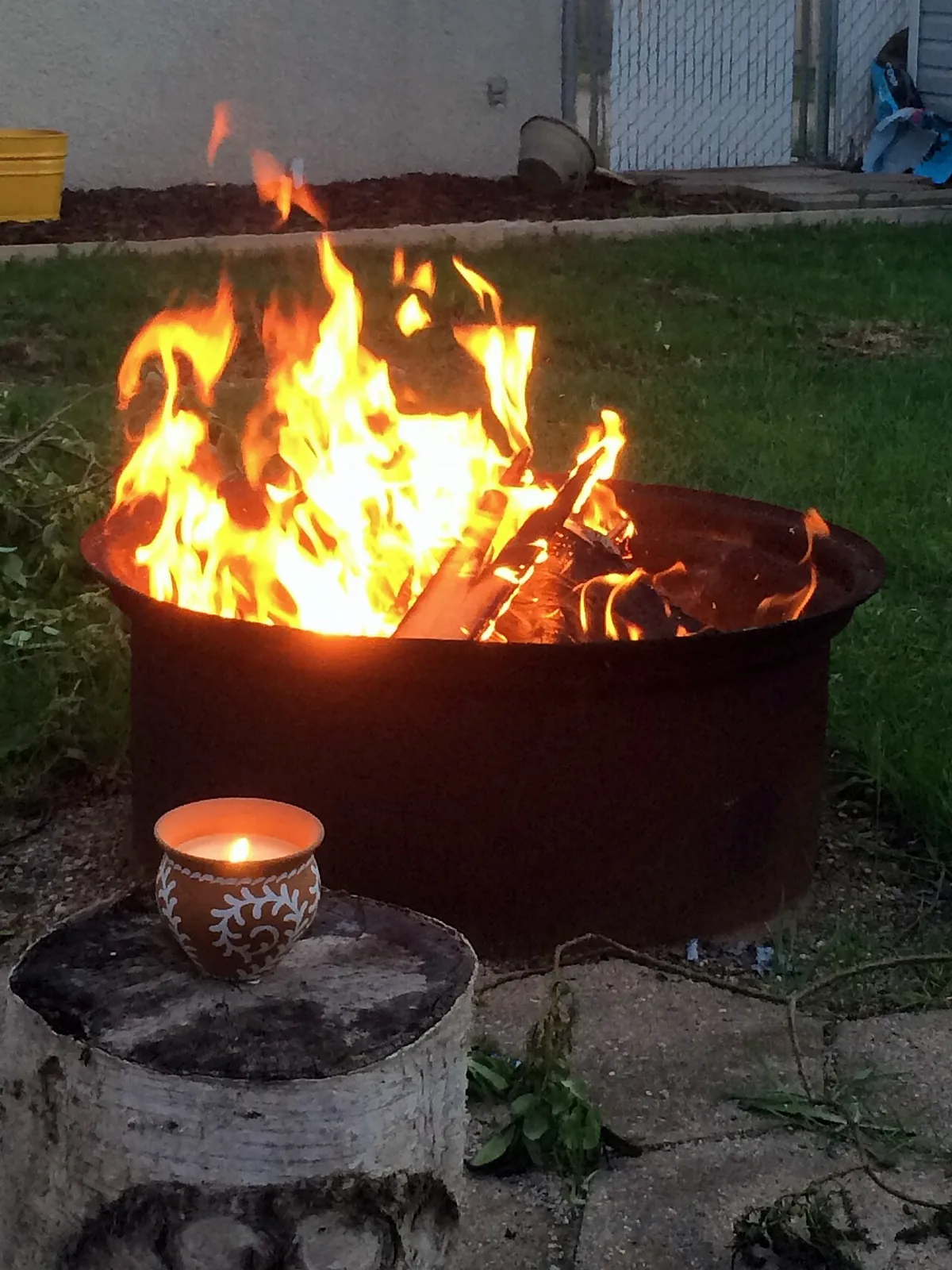
Photo: daryl_mitchell, Wikimedia Commons, CC BY-SA 2.0
A fire pit area is the most requested of all concrete patio ideas. A round pad or a circular section of the patio, sized for chairs at a safe distance around the pit, makes a cozy gathering place. Place fire pits away from the house, overhangs, trees and fences, check local rules, and set wood-burning pits on a heat-resistant base or gravel inset so intense heat does not damage the concrete surface.
Seat walls and planters built from block with a concrete cap, or from poured concrete, give extra seating without furniture and define the patio edge. Outdoor kitchens need a thicker pad under heavy counters and grills, utility lines placed before the pour, and a stain-resistant sealer around cooking areas. Steps and wide landings link the patio to the house or lawn; wide, shallow steps feel generous and safe. Pergolas and shade structures need footings planned in the patio layout so posts land in the right spots. Lighting, such as low-voltage path lights, step lights and conduit run under the slab for future fixtures, extends patio use into the evening. Water features, such as small fountains or a bubbling urn, add sound and cover traffic noise. See how to pour concrete steps and concrete footings.
Backyard Concrete Ideas Beyond the Patio
A patio often works best as part of a connected backyard plan, and backyard concrete ideas extend it. Backyard concrete ideas include a walkway from the driveway or side gate to the patio, stepping-stone paths across the lawn to a garden or shed, a pad for a hot tub on a properly thickened slab, a small pad for trash and recycling bins, a basketball or play area, a garden shed foundation, raised planters and edging around beds, and a pool deck that connects to the patio. Using the same color or border detail across these elements makes the whole yard feel designed. See how to make concrete stepping stones and concrete shed foundation.
Ideas for Concrete Patio Spaces in Small Yards
In small yards, a concrete patio can take up most of the space, so design matters even more. Choose a lighter color to keep the space bright. Use one finish with a simple border rather than several patterns. Built-in seat walls and planters save space compared with furniture. A diagonal saw-cut grid makes a small square feel larger. Leave planting pockets in the slab for small trees or shrubs to soften hard edges. In narrow side yards, a long patio with a bench and planter can become a quiet sitting spot.
Concrete Patio Ideas for Sloped Yards
On slopes, concrete patio ideas can turn the grade into an asset. Build the patio in two or more levels connected by wide steps, with low retaining walls or seat walls holding the grade. A lower patio can feel sheltered and private; an upper deck-like patio can capture a view. Every level needs a compacted base, drainage away from the house and walls, and proper footings for any walls. On steep sites, an engineer or experienced contractor should design retaining walls. See concrete block wall cost.
Patio Concrete Ideas for Comfort and Safety
The best patio concrete ideas consider comfort as well as looks. Light colors stay cooler under bare feet in summer. Textured finishes reduce slipping in rain, and sealers with anti-slip additives help on smooth decorative finishes. Shade from trees, umbrellas, pergolas or shade sails makes a hot patio usable. Slope the patio at least 1/8 inch per foot, and preferably 1/4 inch, away from the house so water drains off. Keep steps even and add lighting at changes in level.
Planning and Building Your Patio
Once you have chosen your concrete patio ideas, a few planning steps make the build go well. Check property lines, setbacks, utility locations and any permit requirements. Decide the finished height, usually an inch or two below door thresholds, and the slope. Plan the base: remove sod and topsoil, add about 4 inches of compacted gravel. Choose thickness, typically 4 inches for patios, more under hot tubs or outdoor kitchens. Choose reinforcement such as wire mesh, rebar or fibers. Plan control joints, about every 8 to 10 feet for a 4 inch slab, placed along borders or pattern lines where possible. Decide who will build it: a simple broom-finished patio is a manageable DIY project for some, while decorative finishes are best left to experienced contractors. See how to pour a concrete patio and concrete slab cost.
Concrete Patio Ideas by Style
Modern concrete patio ideas lean on clean lines and minimal detail: large smooth or lightly broomed panels, crisp saw cuts in a big grid, charcoal or light gray color, built-in concrete benches, linear fire tables, and planting in simple rectangular beds. Poured squares separated by narrow strips of gravel or grass give a gallery-like look.
Rustic and cottage concrete patio ideas favor warm, natural texture: exposed aggregate, flagstone stamping, acid stains in browns and tans, curved edges, recycled concrete laid like stone, and plenty of planting spilling over the edges.
Mediterranean and Spanish-style concrete patio ideas use terracotta and sandstone colors, tile-pattern stencils or stamps, smooth plaster-look seat walls, fountains, and potted citrus and herbs.
Farmhouse concrete patio ideas mix a simple broom-finished slab with wood pergolas, string lights, a large dining table, and a brick or cobble border that echoes porch steps.
Coastal and pool-side concrete patio ideas use light, cool colors, salt finishes or exposed aggregate for grip, and seamless transitions to the pool deck, with shade sails or umbrellas.
Desert and low-water concrete patio ideas pair warm-toned concrete with gravel, boulders and drought-tolerant plants, shaded seating, and a fire feature for cool evenings.
Concrete Patio Ideas by Budget
Budget concrete patio ideas start with a plain 4 inch broom-finished slab, often about $6 to $10 per square foot installed, then add low-cost details: a smooth or colored border, saw cuts, integral color, and good planting and lighting around it. A DIY slab can cost much less in materials if you supply the labor.
Mid-range concrete patio ideas add one decorative upgrade, such as exposed aggregate, a salt finish, staining, or a stamped border, plus a fire pit or seat wall. Expect roughly $10 to $15 per square foot for the patio itself.
High-end concrete patio ideas include full stamping with multiple colors, custom stencils, integrated outdoor kitchens, built-in fire features, pergolas, lighting systems and multi-level layouts, often $15 to $25 per square foot or more for the decorative concrete alone, plus the features. See stamped concrete patios and concrete slab cost.
Concrete Patios: Ideas to Avoid Common Mistakes
Concrete patios. Ideas only work if the slab is built right, so avoid these mistakes. Do not skip the gravel base or pour on soft, unprepared soil. Do not make the patio too small for the furniture you plan to use. Do not slope the patio toward the house. Do not forget control joints, or place them randomly instead of along borders and pattern lines. Do not pour too thin under heavy features like hot tubs. Do not choose a smooth, glossy finish where people walk barefoot or in rain. And do not seal a decorative patio and then forget to reseal it; most decorative finishes need fresh sealer every two to three years. See why concrete cracks and control joints in concrete.
Combining Concrete With Other Materials
Some of the most attractive concrete patio ideas mix concrete with other materials. Concrete slabs with a border of brick or natural stone pavers look high-end but cost less than an all-stone patio. Wood decking next to a concrete patio creates two textures and levels. Gravel paths and joints soften concrete and help drainage. Large-format concrete pavers or poured slabs set in gravel give a modern stepping-stone look. Natural stone caps on block seat walls add a finishing touch. When combining materials, plan heights carefully so edges are flush and safe to walk on. See ideas for paving a patio and paving stones vs concrete.
Using These Ideas for Concrete Patio Planning
Turn ideas for concrete patio projects into a plan by listing what you want to do outdoors, measuring the space, sketching a simple layout with furniture, and choosing one or two finish and color ideas that suit the house. Collect photos of patios you like and share them with contractors when you get quotes. Ask each contractor which of your concrete patio ideas they recommend for your climate and soil, and which add the most value for the money. A clear plan and good communication make the difference between a slab and a backyard space you use every day.
Concrete Patio Ideas for Entertaining
If you host often, concrete patio ideas for entertaining focus on flow and zones. Put the dining area closest to the kitchen door, the grill or outdoor kitchen nearby but downwind, and the lounge or fire pit zone a few steps away so groups can spread out. A wide, continuous slab without steps between zones makes it easy to move chairs and serve food. Built-in counters or a bar ledge on a seat wall give guests a place to set drinks. Plan outdoor outlets and lighting before the pour so cords do not cross the patio. A covered section, under a pergola or roof extension, keeps parties going in light rain or strong sun.
Kid- and Pet-Friendly Concrete Patio Ideas
Families with young children and pets need concrete patio ideas that are safe and easy to clean. Choose slip-resistant finishes such as broom or exposed aggregate, avoid sharp edges by rounding slab edges and wall caps, keep steps shallow with good lighting, and use light colors that stay cooler for paws and bare feet. A section of the patio can double as a chalk-drawing and play area, and a hose bib nearby makes cleanup simple. Fenced or gated zones around fire pits and pools are essential for safety.
Low-Maintenance Concrete Patio Ideas
For the least upkeep, choose concrete patio ideas with durable finishes and simple details. Plain broom finish and exposed aggregate need little more than occasional cleaning and an optional penetrating sealer. Integral color fades more slowly than surface stains. Avoid deep stamped joints that collect leaves and dirt if you want minimal sweeping. Good drainage, a proper base and well-placed control joints prevent most long-term problems. A penetrating sealer applied every few years protects against stains and freeze-thaw damage with little effort. See how to seal concrete.
Lighting and Planting Ideas
Lighting and plants are inexpensive ways to make concrete patio ideas come to life, and they suit poured concrete patio ideas of any style. String lights overhead create a warm canopy; low-voltage step and wall lights improve safety; uplights on trees add drama. Run conduit under the slab before pouring for any lights or outlets you might want later. For planting, leave pockets in the slab for small trees or grasses, use large containers to soften corners, and plant beds along the edges to blur the line between hard and soft surfaces. Vines on a pergola provide shade and green overhead. These cement patio ideas cost little but change how a patio feels more than almost any finish.
Finally, remember that the best concrete patio ideas are the ones that fit how you live. Start with the activities you want, size the space generously, choose a finish that suits your climate and budget, and add a few well-chosen features. A well-built patio will serve your family for decades.
Seasonal Concrete Patio Ideas
Think about every season when choosing concrete patio ideas. In hot summers, shade structures, light colors, misting systems and nearby trees make the patio usable at midday, and a pergola with climbing vines adds cooling shade. In spring and fall, a fire pit or outdoor heater extends the season into chilly evenings, and a sheltered corner against the house blocks wind. In snowy climates, choose finishes and sealers that resist freeze-thaw and deicing salts, avoid low spots where meltwater freezes, and keep furniture that can stay out or be stored easily. Air-entrained concrete, proper curing and a penetrating sealer protect the surface through many winters. See pouring concrete in cold weather and does salt damage concrete.
A patio that works in more seasons gets used more, which is the real return on any of these concrete patio ideas. Plan heat, shade and shelter together with the slab, rather than adding them as an afterthought, and the space will feel comfortable from early spring to late fall.
Getting Quotes for Your Patio Ideas
When you have a plan, ask two or three local contractors for written quotes based on the same drawing and specifications: size and shape, thickness, base, reinforcement, finish, color, borders, joints, steps and features, and sealer. Ask which of your concrete patio ideas they would change for your soil and climate, and why. Look at photos of their finished patios and, if possible, visit one that is a few years old. Clear, comparable quotes make it easy to choose a contractor and keep the project on budget. Ask too how long the work will take, when the patio can be used, and what maintenance the finish needs, so your concrete patio ideas turn into a space you can enjoy without surprises. A little time spent on questions now saves a lot of frustration once the concrete trucks arrive and the crew starts placing and finishing your new patio slab.
Updating an Existing Concrete Patio
If you already have a plain or worn patio, many of these concrete patio ideas can be added without tearing it out. Clean and stain it for new color. Add a saw-cut pattern. Apply a resurfacer or a decorative overlay, such as a stamped or stenciled overlay. Extend it with a new section and a border that ties old and new together. Add seat walls, planters, a fire pit and lighting around it. Cover it with pavers or tile if the slab is sound. See how to cover an old concrete patio and how to resurface concrete.
Frequently Asked Questions
What is the cheapest way to make a concrete patio look nice?
A fine broom finish with a smooth border, saw-cut patterns, integral color, or staining an existing slab, plus planters and lighting.
How thick should a concrete patio be?
Usually 4 inches on a compacted gravel base, thicker under hot tubs, outdoor kitchens or heavy features.
What is the best finish for a concrete patio?
Broom and exposed aggregate are the most slip resistant and durable; stamped and stained finishes are more decorative but need sealing.
Can I add a fire pit to a concrete patio?
Yes, with safe distances from structures and a heat-resistant base under wood-burning pits to protect the concrete.
Sources
- Portland Cement Association: patios and decorative concrete
- American Concrete Institute: ACI 310R guide to decorative concrete
- National Fire Protection Association: outdoor fire pit safety
- National Ready Mixed Concrete Association: CIP 6 joints and CIP 2 scaling
Related Guides
- How to pour a concrete patio — DIY steps, calculator and cost
- Concrete walkway ideas — front walks, garden paths and borders
- Concrete fire pit — block, poured and fire pits on concrete
- How to clean moss from concrete — removing moss and stopping regrowth
- Concrete splash blocks — downspout splash blocks and drainage
- How to kill roots under concrete — tree roots lifting slabs
- Concrete coffee table — DIY, dining, outdoor and picnic concrete tables
- Concrete bird bath — making, sealing and caring for one
- Concrete tile — cement floor tiles, concrete look and outdoor tiles
- Concrete garden statues — painting, sealing and care
- Concrete bench — outdoor benches, DIY and costs
- Concrete pool coping — poured and precast coping, joints and repair
- Concrete curb machine — landscape curbing and edging
- Exposed aggregate concrete — how it's made, sealing and cost
- Concrete trench drain — channel drains, grates, install and cost
- Pool deck concrete — installation, finishes and cost
- How to lay tile on concrete — floors, patios and grouting
- Concrete fountain — tiered fountains, pumps and care
- Concrete raised beds — block, poured and beds on concrete
- Concrete pads — sheds, AC units, hot tubs, carports
- Cinder block outdoor kitchen — building a block grill island
- Concrete decking — concrete decks vs wood
- Rock salt finish concrete — pitted decorative finish for pool decks and patios
- Concrete disposal — concrete dumpster rental, recycling yards, landfill fees and washout
- Concrete flower pots — sizes, weights, prices and extra large planters for outside
- Concrete slide — hillside and playground slides, plus concrete sliders (knee boards)