
Concrete Pool Deck Resurfacing: Coatings, Textures, Overlays and Costs
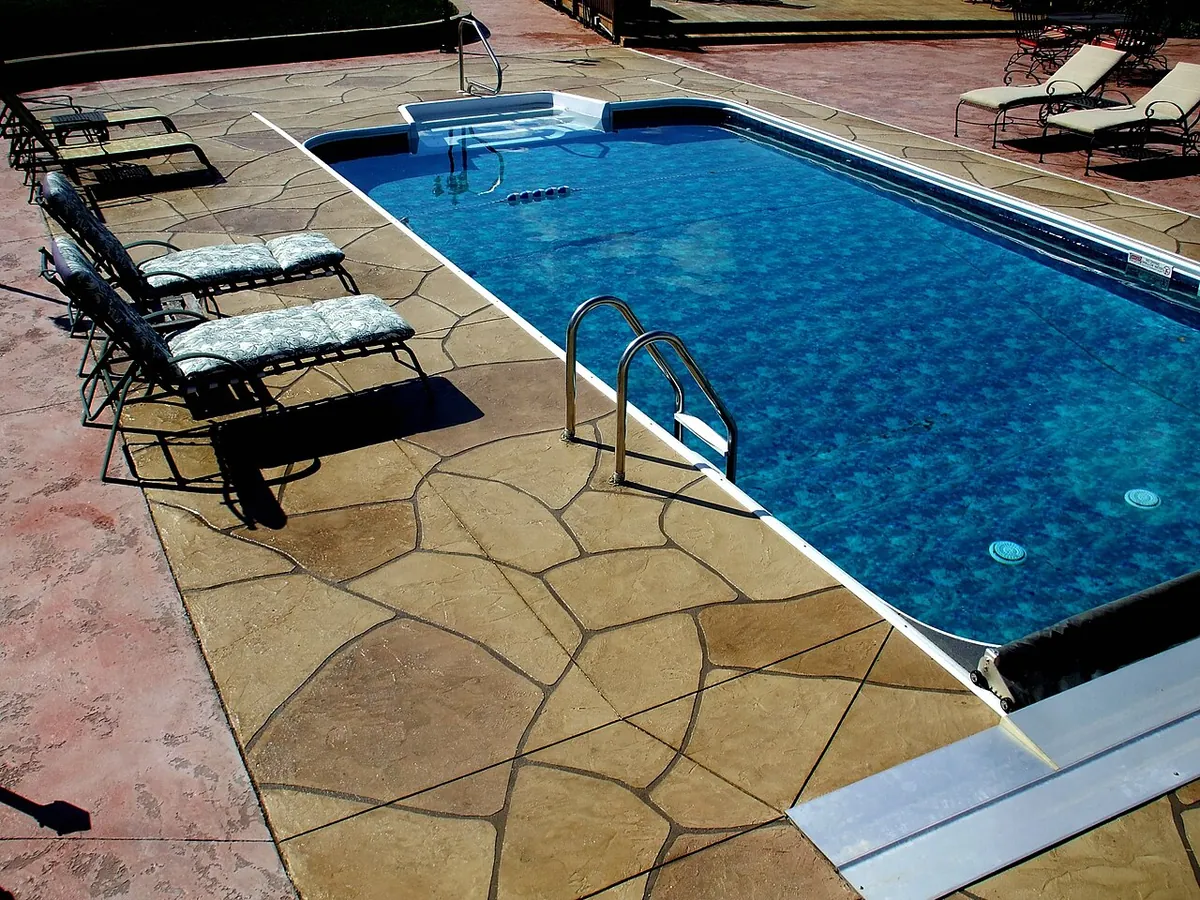
Photo: Decorative Concrete Kingdom, Grand Flagstone Pool Deck, Wikimedia Commons, CC BY 2.0.
Quick Answer
Concrete pool deck resurfacing puts a new surface over an old, sound concrete deck instead of tearing it out. The main options are a cement resurfacer for a fresh plain-concrete look (about $3 to $5 per square foot installed), a spray knockdown texture that stays cooler underfoot, an acrylic pool deck coating to refresh color and grip, and a stamped or stenciled overlay that imitates stone or tile (about $6 to $10 per square foot). Any of them only lasts if the deck is repaired first: settled slabs lifted, cracks and spalls fixed, the coping joint resealed, and the surface cleaned or ground. Resurfacing is not a fix for a deck that is badly broken or still moving.
Pool decks wear out on the surface long before the concrete underneath fails. Sun fades them, chlorine and salt etch them, coatings peel, and repairs leave a patchwork of different colors. Resurfacing concrete pool deck slabs gives them a new, uniform, slip-resistant surface for a fraction of the cost of replacing the deck, and it can change the look completely.
This guide compares the main pool deck coatings for concrete and overlay systems, explains how to resurface a concrete pool deck step by step, what it costs, how long each option lasts, and how to tell whether your deck is a good candidate.
Is Your Deck a Good Candidate for Resurfacing?
Resurfacing works on a deck that is structurally sound but tired-looking. It is a good fit when:
- The slabs are mostly level, without big drops at cracks or joints.
- Cracks are few and stable, or can be repaired first.
- The surface is faded, stained, pitted, lightly scaled, or covered with an old peeling coating.
- The coping is solid and not lifting.
Resurfacing is not a good fit when slabs are broken into many pieces, have heaved or settled badly, sound hollow over large areas, or keep cracking because of water and soil problems. Fix those problems first, or replace the deck. Our guide to concrete pool deck repair covers the repairs that should come before any resurfacing.
Signs Your Pool Deck Needs Resurfacing
- The color has faded unevenly or the topcoat has turned chalky.
- Old coating is peeling, flaking or bubbling in patches.
- The surface is pitted, rough or scaled from chemicals, salt or freeze-thaw.
- Repairs and patches stand out as different colors.
- The texture has worn smooth and feels slippery when wet.
- Stains from leaves, rust or algae no longer come out with cleaning.
If you see several of these signs but the slabs are level and solid, the deck is a good candidate for concrete pool deck resurfacing rather than replacement.
Concrete Pool Deck Resurfacing Options
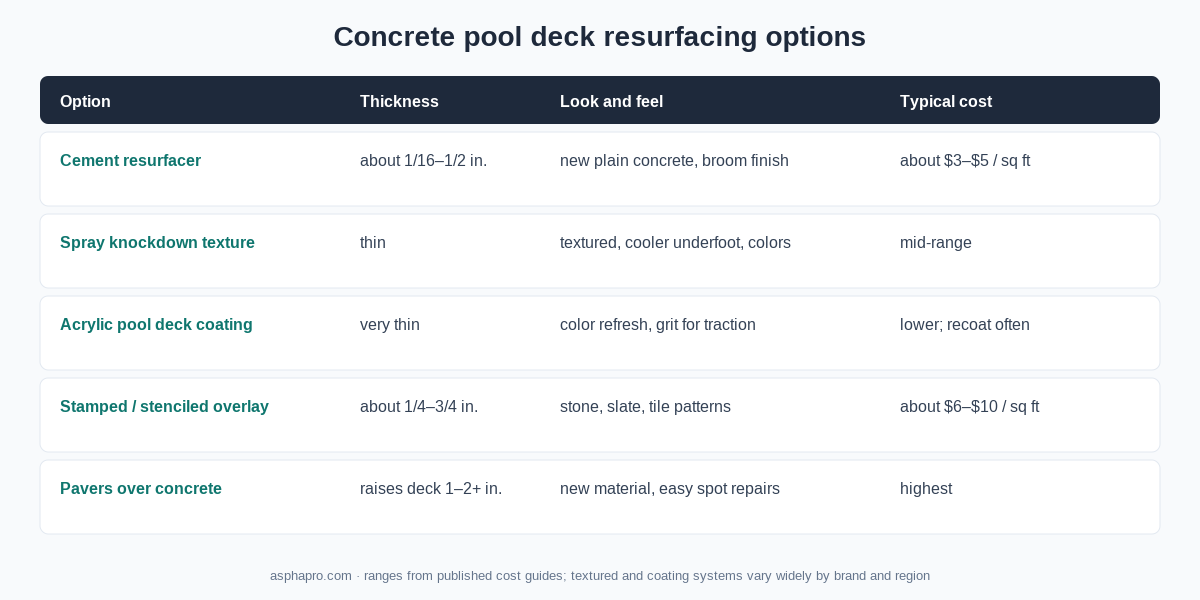
1. Cement resurfacer
A polymer-modified cement resurfacer is spread thin over the clean, damp deck with a squeegee or trowel and finished with a broom or float. It gives the look of new plain concrete and covers stains, light pitting and small repairs. It is the simplest way to resurface pool deck concrete, and it can be colored or sealed afterward. It is a good choice for a plain broom-finished deck. Pros typically charge about $3 to $5 per square foot.
2. Spray knockdown texture
Spray-applied textures are thin acrylic-modified cement coatings that are sprayed on in a splatter pattern, then knocked down with a trowel to flatten the peaks. The result is a textured, slip-resistant surface that many people find cooler and more comfortable barefoot than plain concrete. Some systems are sold under brand names and are often called cool deck coatings. They are very common on pool decks in warm climates. They usually finish with a colored acrylic topcoat that needs refreshing every few years.
3. Acrylic pool deck coatings
Acrylic pool deck coatings for concrete are thin, paint-like coatings made for pool decks, usually with fine grit added for traction. They refresh the color of an existing textured or plain deck and seal the surface. They are the cheapest way to update a deck that is still sound and already textured, but they are a coating, not a resurfacer: they will not fill pits or hide damaged texture, and they need recoating every few years.
4. Stamped and stenciled overlays
A stamped overlay is a thicker cement-based layer, often about 1/4 to 3/4 inch, that is stamped with rubber mats to look like flagstone, slate, brick or wood, then colored and sealed. Stenciled overlays use paper stencils to create grout lines in tile or brick patterns. Both completely change the look of a deck. Decorative overlays typically cost about $6 to $10 per square foot, more for complex designs. See our guide to concrete overlay cost.
5. Epoxy and polyaspartic coatings
Epoxy and polyaspartic flake coatings are common on garage floors and are sometimes used on covered patios. On an open, sunny pool deck, most standard epoxies are a poor choice because they can yellow, get very hot and become slippery when wet. Some polyaspartic systems are UV-stable and can be made slip-resistant with grit, but check that the product is rated for exterior pool decks before choosing one.
6. Pavers or tile over concrete
Laying pavers, travertine or porcelain tile over a sound concrete deck is another way to resurface it, though it raises the deck height and costs more. See can you lay pavers over concrete for the details and limits.
Pool Deck Coatings for Concrete Compared
| Option | Covers damage? | Barefoot comfort | Upkeep |
|---|---|---|---|
| Cement resurfacer | Light pitting, stains, small patches | Like concrete; light colors stay cooler | Seal every few years |
| Spray knockdown texture | Light damage and patches | Good; textured and often cooler | Recoat topcoat every few years |
| Acrylic coating only | Color only, not damage | Depends on the surface below | Recoat every few years |
| Stamped or stenciled overlay | Most surface damage | Good with grit in the sealer | Reseal every few years |
| Epoxy/polyaspartic | Small damage | Can get hot and slippery | Exterior-rated systems only |
How to Resurface a Concrete Pool Deck: Step by Step
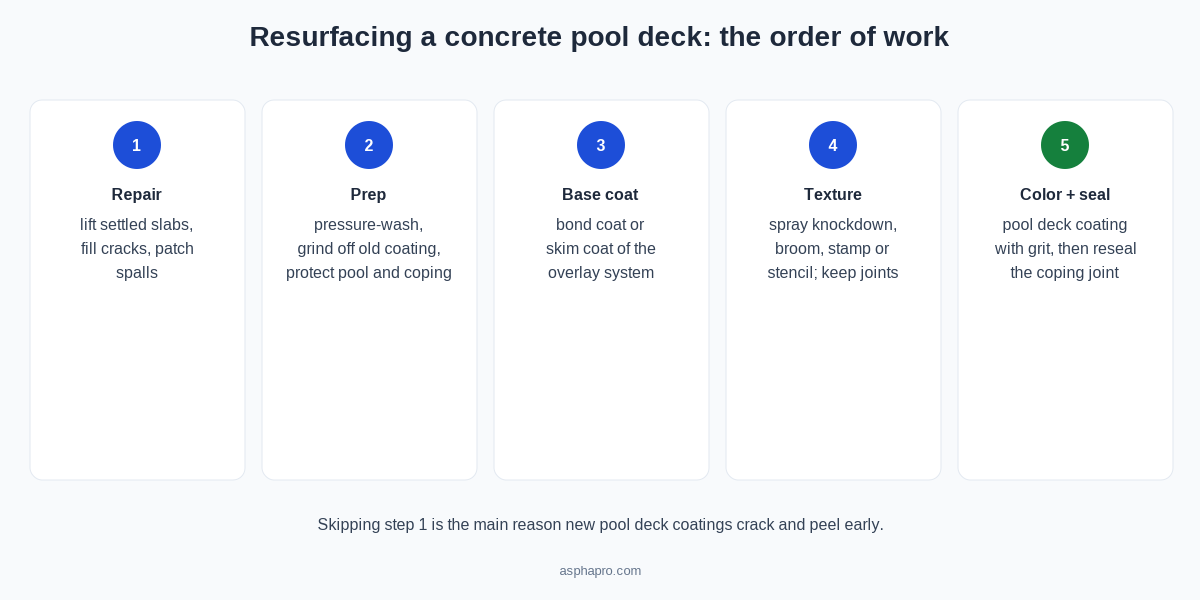
The exact steps depend on the system you choose, and most decorative systems are installed by trained contractors. This is the general order of work for resurfacing concrete pool deck slabs.
Step 1: Repair the deck
Lift settled slabs, grind down trip edges, fill cracks, patch spalls and pop-outs, and cut out and replace the old coping joint sealant. Cracks that move will come back through any new surface, so many installers route cracks and fill them with a flexible filler or use a crack isolation membrane where the system allows.
Step 2: Prepare the surface
Pressure-wash the whole deck with a degreaser. Remove any old peeling coating, usually by grinding or shot-blasting; new coatings will not stick to loose old ones. Many systems require grinding or etching to open the surface for a good bond. Cover the pool, coping and tile line, and protect the pool water from dust and slurry.
Step 3: Mark the joints
Control joints and the coping joint must stay open in the new surface. Tape them or note their locations so they can be kept or re-cut, otherwise the new surface cracks right over them.
Step 4: Apply the base or bond coat
Most overlay systems start with a primer or a thin scratch coat of the overlay mix worked into the damp surface. This is what bonds the new material to the old concrete.
Step 5: Apply the finish layer
For a resurfacer, spread the main coat and broom it. For a spray texture, spray the texture coat and knock it down. For a stamped overlay, place the thicker layer and stamp it at the right time. Work in manageable sections between joints so the material does not set before it is finished.
Step 6: Color, seal and cure
Apply color and the topcoat or sealer the system calls for, with slip-resistant grit where appropriate. Let everything cure for the full time before foot traffic and before the pool is used, and keep pool water, chemicals and salt water off the new surface during that time. Finish by sealing the coping joint again with a flexible pool deck sealant.
What Is in Concrete Pool Deck Coatings?
Concrete pool deck coatings are not all the same thing, even when the cans look alike. Most fall into three groups:
- Acrylic coatings: water-based or solvent-based acrylic resins with pigment and, often, fine grit. They are breathable, UV-stable and easy to recoat, which is why they are the standard topcoat on most textured pool decks.
- Cement pool deck coatings: acrylic- or polymer-modified cement mixes applied as a thin trowel, squeegee or spray coat. They add a little thickness and texture and can hide light damage, then usually get an acrylic topcoat for color.
- Resin systems: epoxy, polyurethane, polyaspartic and polyurea coatings. They are tough and chemical-resistant, but not all of them are suitable for hot, wet, sunny pool decks. Use only products rated for exterior pool decks, with slip-resistant aggregate.
Ask the supplier or contractor for the technical data sheet of the coating for concrete pool decks they propose. It lists the surface preparation, the temperature range, the recoat time and whether the product is approved for pool decks.
Cool Deck Textures Explained
"Cool deck" has become a general name for textured pool deck coatings that stay cooler underfoot than plain concrete. The cooling comes mostly from light colors and from a texture that reduces the area of hot surface touching your feet, along with materials that do not hold heat as strongly as dense dark concrete. In hot, sunny climates this makes a big difference to comfort. These textures are thin, so they follow the slab underneath: if the concrete cracks, the texture cracks with it. Resurfacing an old cool deck usually means repairing cracks, removing loose texture, and applying a fresh texture and topcoat.
How to Resurface Concrete Pool Deck Slabs Yourself With a Resurfacer
If you want to resurface concrete pool deck slabs yourself, a cement resurfacer is the most realistic DIY option. Plan carefully:
- Choose mild weather. Most resurfacers need temperatures above about 50°F and no rain for a day. Avoid hot afternoon sun.
- Repair first. Fill cracks and patch spalls, then let repairs cure.
- Clean thoroughly. Pressure-wash with a degreaser, remove loose old coatings, and rinse the deck so it is damp but has no standing water.
- Protect the pool. Tape plastic over the coping and tile, and lower the risk of slurry getting into the water.
- Work in sections. Mix one batch at a time to the consistency on the bag, pour it on one section between joints, spread it with a long-handled squeegee, then broom it for texture.
- Keep joints open. Do not bridge control joints; re-cut them if needed.
- Cure and seal. Mist or shade the surface as the label directs, then seal it with a slip-resistant pool deck sealer once cured.
Two people make the job far easier: one mixing, one spreading. Color differences between batches are the most common DIY problem, so measure water carefully and mix the same way each time.
Resurfacing vs Replacing a Pool Deck
Replacing a pool deck means breaking out the old concrete near the pool without damaging the coping, plumbing or the pool finish, hauling it away, correcting the base, and pouring new concrete. It typically costs about $6 to $14 per square foot for plain concrete including removal, and more for stamped or decorative concrete. Resurfacing usually costs about half or less, and the pool is out of use for less time.
Replacement is the better choice when the deck has failed: slabs broken into many pieces, deep settlement, heaving that pushes the coping, or drainage that cannot be fixed without changing the slope. It is also worth it when you want to change the shape or size of the deck. Our guides to concrete removal cost and concrete slab cost help with that estimate.
Pool Deck Resurfacing in Hot and Cold Climates
In hot climates, comfort and UV resistance come first: light colors, textured finishes and UV-stable topcoats. Apply products early in the day and keep cement-based layers from drying too fast. In cold climates, freeze-thaw and deicers are the big threats. Choose systems rated for freeze-thaw, make sure the deck drains well, keep the coping joint sealed, and avoid salt on the deck. Overlays in cold climates last longest over decks that were air-entrained and sound to begin with.
A Worked Example: Faded Textured Pool Deck
A 700 square foot textured pool deck around a 15-year-old pool has a faded, chalky topcoat, several hairline cracks, two cracks of about 1/8 inch, and texture peeling near the steps. The slabs are level and the coping joint sealant is cracked.
- Cut out and reseal the coping joint later, after resurfacing.
- Route and fill the larger cracks with a flexible crack filler.
- Pressure-wash and scrape off the peeling texture, and grind the edges smooth.
- Patch the bare areas with the texture base so they match the surrounding deck.
- Apply new spray knockdown texture over the patched areas, or the whole deck for a uniform look.
- Apply two coats of colored acrylic pool deck coating with grit.
- Reseal the coping joint with a flexible sealant over backer rod.
Depending on the scope and local rates, this kind of job often falls in the mid-range between a simple acrylic recoat and a stamped overlay.
Questions to Ask a Pool Deck Resurfacing Contractor
- Which system will you use, and is it rated for pool decks in this climate?
- How will you repair cracks and keep them from showing through?
- Will you remove the old coating or go over it? (Loose coatings should come off.)
- How will you handle the coping joint and control joints?
- What slip resistance will the finish have when wet?
- How long before we can use the pool and the deck?
- What warranty do you offer, and what maintenance does it require?
What Concrete Pool Deck Resurfacing Costs
| Option | Typical installed cost |
|---|---|
| Acrylic recoat of an existing textured deck | Usually the lowest cost per square foot |
| Cement resurfacer with broom finish | About $3 to $5 per square foot |
| Spray knockdown texture system | Usually between a plain resurfacer and a stamped overlay |
| Stamped or stenciled overlay | About $6 to $10 per square foot |
| Repairs before resurfacing | Extra; lifting about $3 to $25 per square foot, joint and crack work often a few hundred dollars |
| Replacing the deck instead | About $6 to $14 per square foot for plain concrete including removal |
For a typical 600 square foot pool deck, a basic resurfacer at $3 to $5 per square foot comes to about $1,800 to $3,000, and a decorative overlay at $6 to $10 per square foot about $3,600 to $6,000, before repairs. These ranges follow published cost guides such as HomeGuide and Concrete Network. Local prices, deck shape, steps and access all change the total.
How Long Does Pool Deck Resurfacing Last?
A well-installed overlay or texture system over a properly repaired deck can last many years, often a decade or more, with resealing or recoating of the topcoat every few years. Acrylic coatings alone need recoating more often. The biggest factors are prep, whether the cracks and joints were handled, drainage, sun exposure, freeze-thaw, and how well the surface is maintained. Overlays fail early when they go over loose old coatings, moving cracks, or wet, settling slabs.
DIY or Professional Pool Deck Resurfacing?
A cement resurfacer or an acrylic recoat is within reach of a handy homeowner on a simple deck, especially with a helper. Spray textures and stamped or stenciled overlays take special equipment and experience to get an even, attractive result, and the timing of stamping is unforgiving. Most homeowners hire a decorative concrete contractor for those. If you DIY, work in mild weather, mix consistently, keep joints open, and do a small test area first to check color and texture.
Choosing Colors and Textures
- Light colors stay cooler in direct sun than dark colors, which matters on a barefoot deck.
- Texture affects grip and comfort. Knockdown textures and light broom finishes give traction without being rough on feet.
- Match the house and pool. Earth tones, grays and sand colors pair well with blue water and most stone coping.
- Ask for samples on a test board, and look at them wet and dry, in sun and shade, because pool deck colors look very different in each.
- Think about dirt. Very light colors show leaf stains and dirt quickly; mid-tones hide them better.
Common Pool Deck Resurfacing Mistakes
- Coating over a failing deck. A new surface over settled, broken or moving slabs cracks and peels within a season or two.
- Leaving old peeling coating in place. The new layer is only as good as the old one beneath it.
- Bridging joints. Covering control joints and the coping joint with rigid material guarantees straight cracks later.
- Skipping surface prep. Pressure washing alone often is not enough; many systems need grinding or etching.
- Applying in bad weather. Heat, wind, cold and rain all weaken thin cement layers and coatings.
- Using the wrong product. Ordinary paints and garage epoxies on a sunny, wet pool deck get hot, slippery and peel.
- Forgetting slip resistance. A smooth, glossy finish is dangerous around a pool.
- Opening the pool too soon. Splashing chlorinated or salt water on a coating before it cures can stain or soften it.
Resurfacing Concrete Pool Deck Edges, Steps and Coping Areas
The edges of a deck need the most care during resurfacing. Steps into the yard and the deck edge along planting beds chip easily, so rebuild broken edges with repair mortar before the new surface goes on, and round them slightly so they are comfortable underfoot. Along the coping, the resurfacing material should stop at the joint, not run over it onto the coping; the joint is then sealed with flexible sealant. Around deck drains, skimmers and lights, keep openings clear and finish neatly around their rims so water still drains properly.
How Resurfacing Changes Deck Height
Thin resurfacers and coatings add very little height, usually a fraction of an inch, so they do not cause problems at doors and the coping. Stamped overlays add more, often around 1/4 to 3/4 inch. Pavers or tile over concrete can add an inch or more. Check door thresholds, the height of the coping relative to the deck, and drainage before choosing a thicker system, because the deck should never end up higher than the coping or slope toward the pool.
Maintaining a Resurfaced Pool Deck
- Reseal or recoat the topcoat on the schedule the installer recommends.
- Keep the coping joint sealed and the deck drains clear.
- Rinse off salt water and pool chemical splash regularly.
- Sweep off sand and grit, which wear the surface.
- Avoid dragging heavy furniture and planters; use pads.
- Clean with a mild detergent and a soft brush or low-pressure rinse; high-pressure wands can damage thin textures and coatings.
- Trim back plants and trees that drop leaves and stain the deck.
- Seal new hairline cracks before they grow, and touch up chips in the coating so water cannot get under it.
Frequently Asked Questions
Can you resurface a concrete pool deck?
Yes, if the deck is structurally sound. Repair cracks, spalls and settled slabs first, then apply a resurfacer, spray texture, coating or overlay.
What is the best coating for concrete pool decks?
For a textured, cool, slip-resistant surface, a spray knockdown system with an acrylic topcoat is popular. For a plain look, a cement resurfacer and sealer. For a new look, a stamped or stenciled overlay. Avoid standard epoxy on sunny pool decks.
How much does concrete pool deck resurfacing cost?
About $3 to $5 per square foot for a basic resurfacer and about $6 to $10 per square foot for a decorative overlay, plus any repairs needed first.
How long does resurfacing concrete pool deck slabs take?
Many residential jobs take a few days including prep and repairs, plus cure time before use. Weather and the system chosen change the schedule.
Will cracks come back after I resurface pool deck concrete?
Cracks that still move often reflect through a thin new surface. Repairing them properly and keeping joints open reduces this.
Can you paint a concrete pool deck?
Use a coating made for pool decks, not ordinary paint. Regular paint tends to peel and can be slippery when wet.
Sources
- HomeGuide: Concrete Resurfacing Cost
- Concrete Network: Concrete Overlay Cost
- HomeAdvisor: Concrete Resurfacing and Overlays Cost
- Bob Vila: Concrete Resurfacing Cost
Related Guides
- How to cover concrete patio slabs — overlays, pavers, tile and other ideas
- Fiber concrete guide — fiber types, dose per yard and cost
- Shotcrete vs gunite — sprayed concrete for pools and walls
- Stamped concrete patios — designs, colors, cost and pool decks
- Stenciled concrete — concrete stencils for patios and pool decks
- Concrete pool — construction, gunite and costs
- Concrete pool coping — poured and precast coping, joints and repair
- Exposed aggregate concrete — how it's made, sealing and cost
- Pool deck concrete — installation, finishes and cost
- Rock salt finish concrete — pitted decorative finish for pool decks and patios