
80 lb Bag of Concrete: Yield, Price, Mixing and How Many Bags You Need
Quick Answer
An 80 lb bag of concrete makes about 0.60 cubic feet of concrete, enough for a 12 x 12 inch area about 7 inches deep or a typical 6-inch post hole 2 feet deep. You need 45 bags of 80 lb concrete per cubic yard, compared with 60 bags of 60 lb concrete. Each 80 lb bag takes roughly 3 quarts of water, standard mixes reach about 4,000 psi in 28 days, and an 80 pound bag of concrete costs about $5 to $8 at home centers in 2026. For jobs larger than about 1 cubic yard, ready-mix delivery is usually cheaper and much less work than bagged concrete.
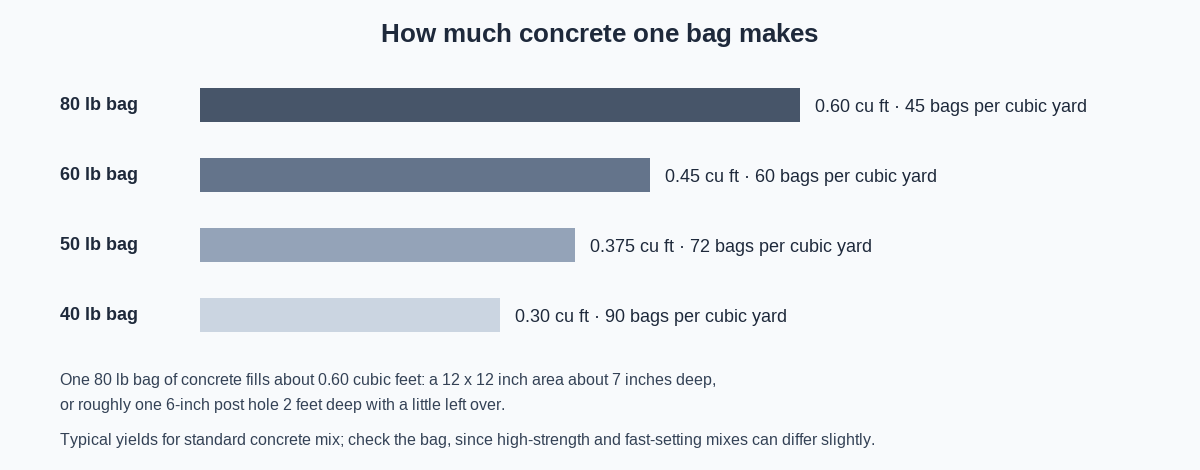
The 80 lb bag of concrete is the workhorse of small concrete projects. Fence posts, mailbox posts, deck footings, small pads, steps, repairs and garden projects are nearly always built with bagged concrete, mixed in a wheelbarrow or a small mixer. The chart above shows how much concrete an 80 lb bag makes compared with smaller bag sizes, which is the first thing to know when planning how many bags to buy.
This guide explains the yield of an 80 lb bag of concrete, how many bags you need for common projects, how to mix it, how the 80 lb compares with a 60 lb bag of concrete, the main types of premix concrete, prices, pallets and handling, and when to switch from bags to a ready-mix truck.
How Much Does an 80 lb Bag of Concrete Make?
A standard 80 lb bag of concrete mix yields about 0.60 cubic feet of mixed concrete. That number is printed on most bags and is the basis for every bag calculation. It works out to:
45 bags per cubic yard (27 cubic feet divided by 0.60).
About 1.8 square feet at 4 inches thick per bag, the usual thickness for walks and small pads.
About 1.2 square feet at 6 inches thick per bag.
One 6-inch round post hole about 3 feet deep per bag, or two shallower holes for small posts.
Smaller bags scale down proportionally: a 60 lb bag of concrete yields about 0.45 cubic feet (60 bags per yard), a 50 lb bag about 0.375 cubic feet (72 per yard), and a 40 lb bag about 0.30 cubic feet (90 per yard). Fast-setting and high-strength mixes yield about the same per pound, but always check the yield on the specific bag. See how many bags of concrete in a yard.
Bagged Concrete Calculator: How Many 80 lb Bags You Need
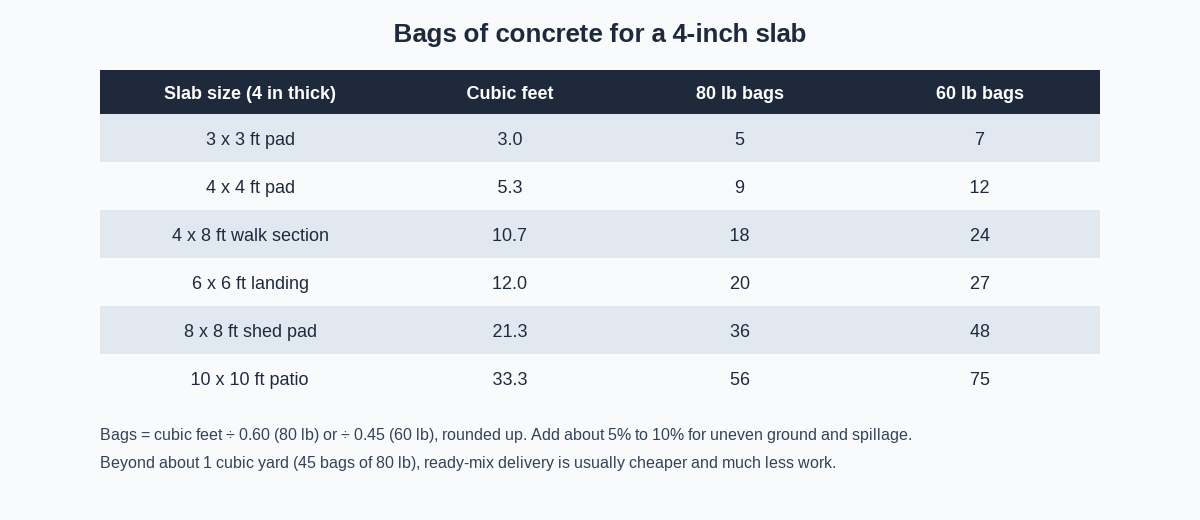
The chart above works as a quick bagged concrete calculator for 4-inch slabs. For any other shape, use this simple method:
1. Find the volume in cubic feet. Multiply length (feet) x width (feet) x thickness (feet). Convert thickness in inches to feet by dividing by 12: 4 inches is 0.333 feet, 6 inches is 0.5 feet.
2. Divide by the bag yield. Divide the cubic feet by 0.60 for 80 lb bags, 0.45 for 60 lb bags, or 0.30 for 40 lb bags.
3. Round up and add extra. Round up to whole bags and add about 5% to 10% for uneven ground, spills and form bulges.
Example. A 5 x 10 foot walk, 4 inches thick: 5 x 10 x 0.333 = 16.7 cubic feet. 16.7 / 0.60 = 27.8, so 28 bags of 80 lb concrete, plus 2 or 3 extra, about 30 bags. With 60 lb bags: 16.7 / 0.45 = 37.1, so 38 bags plus extra.
Post holes. For a round hole, volume in cubic feet = 3.14 x (radius in feet)² x depth in feet. A 10-inch hole (radius 0.417 feet) that is 3 feet deep holds about 1.64 cubic feet, less the volume of the post. A 4x4 post takes up about 0.25 cubic feet over 3 feet, so the hole needs about 1.4 cubic feet: roughly 2.3 bags of 80 lb concrete, so plan on 3. See how to calculate yards of concrete and how to anchor a post to concrete.
80 lb Bag vs. 60 lb Bag of Concrete
Both bag sizes contain the same kind of premix concrete; the only difference is the amount. A 60 lb bag of concrete makes 0.45 cubic feet, three quarters of an 80 lb bag, and costs a little less per bag but usually a little more per cubic foot. Here is how to choose:
Choose 80 lb bags when you are strong enough to handle them, the job needs many bags, and you want the lowest cost per cubic foot. Fewer bags also means fewer trips and less packaging.
Choose a 60 lb concrete bag when lifting 80 pounds repeatedly is too much, when carrying bags a long distance or up stairs, or for small jobs where you need an amount between full 80 lb bags. Many DIYers find 60 lb bags much easier to pour from directly into a mixer or wheelbarrow.
Choose 40 or 50 lb bags for small repairs, a single post or when handling weight is a concern.
Price comparisons change by store and region, so compare the price per cubic foot: divide the bag price by its yield. For example, if an 80 pound bag of concrete costs $6.50 and a concrete 60 lb bag costs $5.25, the 80 lb bag works out to about $10.83 per cubic foot and the 60 lb bag about $11.67.
What Is in an 80 lb Bag of Concrete?
Bagged concrete, also called premix concrete, is a dry blend of Portland cement, sand and gravel (coarse aggregate), proportioned so you only add water. The gravel in standard concrete mix is typically up to about 3/4 inch, which gives strength and reduces shrinkage. That is what separates 80 lb concrete mix from mortar mix or sand mix, which contain sand but no gravel and are meant for masonry and thin toppings. Many products also contain small amounts of admixtures to improve workability or setting. See mortar vs concrete.
Types of 80 lb Concrete Mix
Standard concrete mix. The general-purpose 80 lb concrete mix for slabs, steps, footings and posts, typically rated about 4,000 psi at 28 days.
High-strength or high early strength mix. An 80 lb. concrete mix formulated for about 5,000 psi or for faster strength gain, useful for driveways, structural pads and jobs that must carry loads sooner. See high-strength concrete.
Fast-setting concrete. Usually sold in 50 lb bags, it sets in about 20 to 40 minutes and is designed to be poured dry into post holes and then soaked with water. See dry pour concrete.
Crack-resistant and fiber-reinforced mixes. Contain synthetic fibers that help control shrinkage cracking in thin slabs.
Countertop and specialty mixes. Finer, stronger, often with admixtures for smooth finishes and casting.
How Much Water Does an 80 lb Bag Need?
Most standard 80 lb bags of concrete call for about 3 quarts (0.75 gallon) of water, and 60 lb bags about 2.25 quarts, but the exact amount varies by product and by how dry the mix is. Follow the bag instructions, start with about two thirds of the water, then add the rest slowly until the concrete is workable, like thick oatmeal that holds its shape. Too much water makes concrete easier to place but weaker, more prone to cracking and dusting, and slower to set. A good rule is to add only as much water as you need to place and finish the concrete.
How to Mix 80 lb Bags of Concrete
In a wheelbarrow or mixing tub. Empty one 80 lb bag into a contractor wheelbarrow, make a crater in the middle, add most of the water, and mix with a hoe or shovel, pulling dry material into the water until it is evenly wet with no dry pockets. A wheelbarrow comfortably mixes one 80 lb bag at a time, two at most. See how to mix concrete.
In a portable mixer. A small electric drum mixer can usually handle one or two 80 lb bags per batch; larger mixers take three or more. Add part of the water first, then the dry mix, then more water as needed, and mix for about three to five minutes. A rented mixer is worth it for jobs over about 10 bags. See concrete cement mixers.
Dust and safety. Opening and pouring bags releases cement and silica dust. Wear a dust mask or respirator, eye protection and waterproof gloves, and mix outdoors or in a well-ventilated area. Wet concrete is caustic and can burn skin, so wash it off promptly. See concrete dust.
Price of an 80 lb Bag of Concrete
Typical 2026 retail prices at home centers and lumberyards:
80 lb bag of concrete (standard): about $5 to $8.
80 lb high-strength or crack-resistant mix: about $7 to $11.
60 lb bag of concrete: about $4.50 to $7.
50 lb fast-setting mix: about $8 to $13.
At $6 per 80 lb bag, one cubic yard of bagged concrete (45 bags) costs about $270 in material, compared with roughly $150 to $250 per yard for ready-mix in many areas, before delivery fees. Prices are often lower when you buy a full pallet. See concrete price per yard.
Pallets, Weight and Handling
Bagged concrete is commonly sold by the pallet: about 42 bags of 80 lb concrete (3,360 pounds) or 56 bags of 60 lb concrete, which is the same total weight. A full pallet is far too heavy for a pickup bed in most cases; plan on store delivery or several trips. Each 80 lb bag of concrete is heavy, so lift with your legs, keep the bag close to your body, and use a hand truck or wheelbarrow to move bags around the site. Store bags off the ground and covered with plastic, because moisture causes the cement to harden in the bag. Bags with hard lumps that cannot be broken by hand should be discarded. See how much a yard of concrete weighs.
How Long 80 lb Bag Concrete Takes to Set and Cure
Standard 80 lb bag concrete stiffens within a few hours and can usually be walked on after 24 to 48 hours in mild weather. It reaches roughly 70% of its design strength in about a week and its full rated strength at 28 days, so wait at least a week before driving a car onto a slab and longer for heavy vehicles. Fence posts set in 80 lb bag concrete can usually have rails and boards attached after a day or two, although many builders wait longer for gates and heavy loads. Fast-setting mixes cut those times dramatically, setting in less than an hour, but they cost more and leave less time to work. Keep new concrete moist for the first several days, by misting it or covering it with plastic, so it cures properly instead of drying out. See how long concrete takes to cure.
Buying Concrete Mix 80 lb Bags: What to Check
When you buy concrete mix 80 lb bags, a few quick checks save trouble. First, read the product name, because concrete mix, mortar mix, sand mix and fast-setting mix are often stacked side by side in similar bags. Second, check the stated yield and strength on the bag, since some premium mixes differ slightly. Third, look for damaged or hardened bags: squeeze each bag, and leave behind any that feel lumpy or rock-hard, which means moisture got in. Fourth, buy all the bags for one visible surface at the same time if you can, so color is consistent. Finally, buy a few extra; returning unopened bags is usually easier than stopping halfway through a pour to drive back to the store.
Storing 80 Pound Concrete Bags
Cement reacts with moisture from the air as well as from rain, so 80 pound concrete bags slowly lose quality if stored badly. Keep them indoors or on a pallet off the ground, covered with a tarp or plastic, and away from damp walls. Use opened bags within days and fold the top over tightly. Unopened bags stored dry often stay usable for several months; many manufacturers print a recommended shelf life or a date code. Before mixing, break up any soft lumps by hand. If the bag contains hard chunks that do not crumble, the cement has partly hydrated and the concrete will be weaker, so it is better to discard the bag.
Moving 80 Pound Bags of Concrete Safely
Carrying 80 pound bags of concrete is one of the most common causes of back strain on DIY projects. Bend your knees, keep your back straight, hold the bag close to your body and avoid twisting while lifting. Use a hand truck, dolly or wheelbarrow to move bags from the vehicle to the mixing area, and stage them near the mixer before you start. Many people cut the bag open while it lies in the wheelbarrow and lift the empty paper out, rather than lifting a full bag high to pour it. For projects with dozens of bags, have a helper, take breaks, and consider whether ready-mix delivery or a 60 lb bag of concrete would be easier on your body.
Using a 60 lb Concrete Bag for Small Repairs
For small jobs, a 60 lb concrete bag can be the more practical choice. Setting a single mailbox post, filling a hole in a walk or patching a step corner often needs less than a full 80 lb bag, and a 60 lb bag leaves less waste. A concrete 60 lb bag is also easier to tip into a small mixer and to carry up stairs or across a yard. For repairs thinner than about 2 inches, a sand mix or repair mortar without gravel usually works better than either bag of concrete, because coarse stone does not fit well in thin layers. See concrete patching compound.
Tips for Pouring a Slab with Bagged Concrete
Pouring a small slab from bags is very doable, but planning makes the difference between a smooth day and a rushed one:
Prepare everything first. Build and brace forms, compact the base, place wire mesh or rebar on chairs, and have screed boards, floats and edgers ready before opening the first bag.
Organize the crew. With 30 or more bags, assign one person to feed the mixer, one to move concrete and one to place and screed. Mixing goes fastest with two mixers running.
Pour continuously. Place batches next to each other and work them together, so the slab does not get cold joints between batches.
Keep water consistent. Use a marked bucket to add the same amount of water to every batch, which keeps strength and color even.
Finish at the right time. Screed as you go, then float and edge once the bleed water has gone, and apply a broom finish for outdoor slabs.
See how much a 12x12 concrete slab costs.
Finishing Concrete from an 80 lb Bag
Concrete from an 80 lb bag is finished the same way as ready-mix. After placing, strike it off level with a straight board, then use a wood or magnesium float to push down the gravel and bring up a smooth paste. Wait until the surface water disappears, then float again, run an edging tool along the forms to round the edges, and cut control joints with a groover at spacing of about two to three times the slab thickness in feet, for example every 8 to 10 feet on a 4-inch slab. For outdoor surfaces, drag a broom across the slab for a slip-resistant texture. For indoor surfaces, a steel trowel gives a smooth finish. Small batches of bagged concrete stiffen at different times, so work across the slab in the order you placed it. See control joints in concrete.
Reinforcing Bagged Concrete
Bagged concrete has the same need for reinforcement as any concrete. For small pads and walks on stable, compacted ground, many builders use welded wire mesh or synthetic fibers to control cracking, and rebar for steps, footings and slabs that carry loads. Place mesh or rebar on small supports so it sits in the middle or upper third of the slab, not on the ground. Fiber-reinforced bagged concrete mixes add fibers in the bag, which is convenient for thin slabs but does not replace rebar where the design calls for it. See wire mesh for concrete and rebar in concrete.
Bagged Concrete in Hot and Cold Weather
Bagged concrete behaves like any other concrete in extreme weather. In hot, dry or windy conditions, it stiffens quickly, so mix smaller batches, keep bags and water in the shade, dampen the base and forms before pouring, and cure the surface promptly with plastic or wet burlap. In cold weather, below about 50°F, concrete gains strength slowly, and fresh concrete must not freeze in the first days. Use warm water, a high early strength mix or an accelerator, and cover the work with insulated blankets. Avoid pouring onto frozen ground, and do not use antifreeze or salt in the mix water, which can damage the concrete. If frost is likely in the first two nights, keep blankets on the slab or posts until the concrete has had time to gain strength.
Cleaning Up After Mixing Bagged Concrete
Clean tools, the wheelbarrow and the mixer as soon as the last batch is placed, before concrete hardens on them. Scrape out leftover concrete onto a spot where it can harden and be thrown away with construction debris, then rinse with as little water as possible. Do not wash concrete residue into storm drains, gutters, streams or lawns: the wash water is highly alkaline and harmful to plants and aquatic life. A simple washout area, such as a shallow pit lined with plastic or a plastic tub, lets the solids settle and the water evaporate. Dispose of empty paper bags with household trash or recycling, depending on local rules, and sweep up spilled dry mix before it gets wet and sets on driveways or patios. See concrete washout.
Bagged Concrete vs. Ready-Mix
Bagged concrete makes sense for small jobs, remote spots and work spread over several days. Ready-mix concrete delivered by truck is better for anything over about 1 cubic yard:
Labor. One cubic yard means mixing 45 bags of 80 lb concrete, about 3,600 pounds of material, by hand or with a small mixer, plus placing it before the first batches set.
Consistency. Ready-mix arrives uniform; many small batches can vary in water content and color.
Cost. Even with short-load fees, ready-mix usually costs less per yard than bags at 1.5 yards and above.
Some suppliers also offer mix-on-site trucks or trailer loads for small jobs, which can be a good middle ground. See concrete slab cost.
Common Projects with 80 lb Concrete
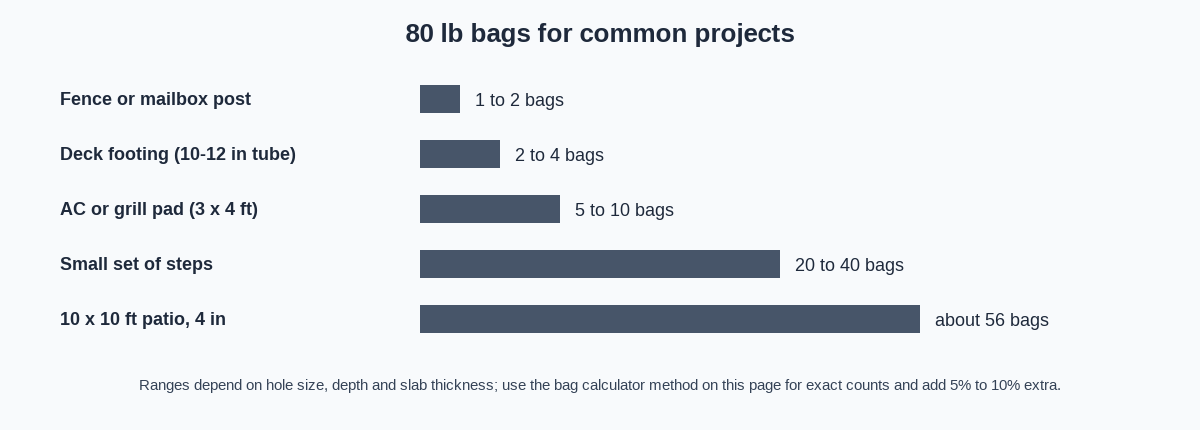
The chart above gives typical bag counts for everyday projects. Use it for a first estimate, then run the numbers for your exact dimensions.
Fence and mailbox posts: one to three 80 lb bags per post depending on hole size.
Deck footings: two to four bags per footing for typical 10- to 12-inch tube forms 3 to 4 feet deep.
Small pads for AC units, trash cans or grills: 5 to 15 bags. See concrete pads.
Steps and landings: often 20 to 60 bags. See how to pour concrete steps.
Walks and patios: small patios can be done with bags, but a 10 x 10 foot patio already needs about 56 bags. See how to pour a concrete patio.
Frequently Asked Questions
How many 80 lb bags of concrete are in a yard?
45 bags, since each 80 lb bag yields about 0.60 cubic feet and a cubic yard is 27 cubic feet.
How much water for an 80 lb bag of concrete?
About 3 quarts for standard mixes; follow the bag directions and add water gradually.
How many 80 lb bags for a fence post?
Usually one to two for a 4x4 post in a 6- to 8-inch hole 2 to 3 feet deep; larger holes need more.
Is 80lbs concrete the same as 80 lb concrete mix?
Yes. "80lbs concrete" and "80lb concrete" both refer to an 80-pound bag of premix concrete.
Is a 60 pound bag of concrete easier to use?
Yes for lifting and pouring, though you need a third more bags for the same volume.
Sources
- Portland Cement Association: concrete basics and proportioning
- ASTM C387: packaged, dry, combined materials for concrete
- OSHA: crystalline silica hazards
- NRMCA: Concrete in Practice series
Related Guides
- Sakrete concrete mix — High Strength, 5000 Plus and Fast Setting compared