
Sakrete Concrete Mix: Products, Yield, Bag Calculator and How to Use It
Quick Answer
Sakrete concrete mix is a line of bagged, ready-to-use concrete sold at home centers and hardware stores. Its general-purpose product, Sakrete High Strength Concrete Mix, reaches about 4,000 psi in 28 days and can take foot traffic after about 24 hours. A Sakrete 60 lb high strength concrete mix bag yields about 0.45 cubic feet and an 80 lb bag about 0.60 cubic feet, so you need 60 or 45 bags per cubic yard. Sakrete 5000 Plus reaches about 5,000 psi and can be walked on in about 12 hours, and Fast Setting Concrete Mix sets in about 20 to 40 minutes for posts. Most Sakrete concrete bags cost about $5 to $12 depending on size and type.
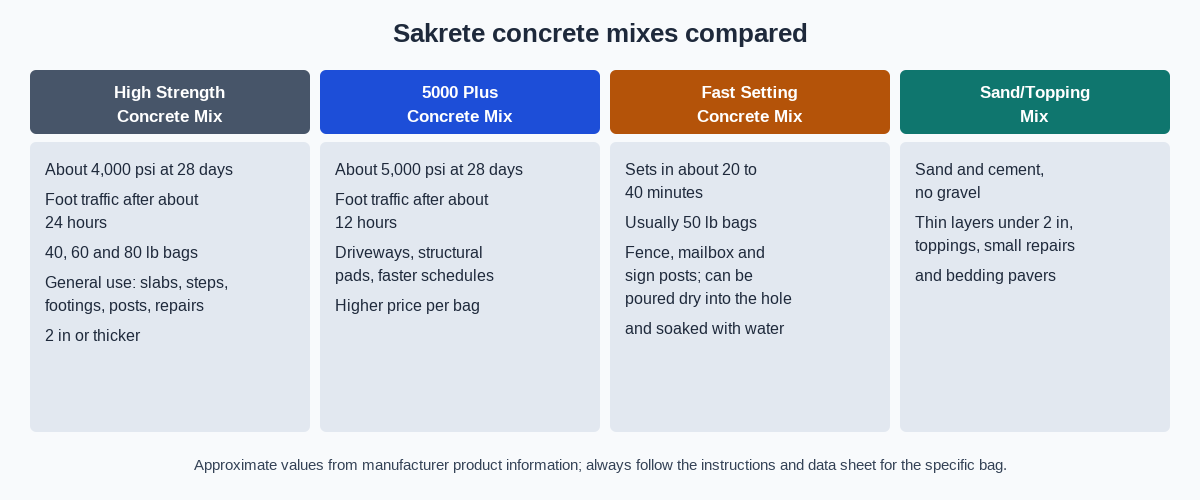
Sakrete is one of the best-known names in bagged concrete in North America. Its bags line the shelves of home centers and lumberyards next to other brands, and contractors and homeowners use Sakrete concrete for posts, footings, steps, pads, small slabs and repairs. The chart above compares the main Sakrete concrete mix products, which is the first decision when you stand in the aisle.
This guide explains the Sakrete concrete lineup, what each mix is for, yields and water amounts, a Sakrete calculator method for concrete slabs and post holes, how to mix high strength concrete by the 60 lb bag, curing, costs, and how Sakrete compares with other bagged concrete.
What Is Sakrete?
Sakrete is a brand of packaged dry concrete, mortar, stucco and repair products that has been sold since the 1930s and is widely credited as one of the first pre-mixed bagged concrete brands. Today it is part of Oldcastle APG, the outdoor living and building products business of CRH, one of the world's largest building materials companies. Sakrete products are made in regional plants and sold through home centers, hardware stores and building supply dealers.
A bag of Sakrete concrete mix contains Portland cement, sand and gravel blended in fixed proportions, so you only need to add water. Like other packaged concrete, it is made to meet ASTM C387, the standard for packaged dry combined materials for concrete. The convenience is the point: no measuring sand, stone and cement separately, and consistent results from bag to bag. See 80 lb bag of concrete.
Sakrete Concrete Mix Products
Sakrete High Strength Concrete Mix. The general-purpose Sakrete concrete mix, often listed simply as Sakrete Concrete Mix. It reaches about 4,000 psi at 28 days and is used for slabs, steps, footings, post setting, curbs and repairs 2 inches thick or more. It is sold in 40, 60 and 80 lb bags in most markets.
Sakrete 5000 Plus Concrete Mix. A higher-strength mix rated about 5,000 psi at 28 days that gains strength faster, with foot traffic in about 12 hours. It suits driveways, garage aprons, structural pads and projects where time matters. It costs more per bag. See high-strength concrete.
Sakrete Fast Setting Concrete Mix. A rapid-setting mix, usually in 50 lb bags, that sets in about 20 to 40 minutes. It is mainly used to set fence, mailbox and sign posts, often by pouring the dry mix into the hole and adding water. See dry pour concrete.
Sakrete Sand/Topping Mix. A blend of sand and cement without gravel, for layers less than 2 inches thick, toppings, small patches and bedding.
Other products. Sakrete also sells mortar mixes, stucco, repair mortars, crack fillers, leveling compounds and concrete repair products, which are designed for different jobs than Sakrete concrete mix.
Sakrete 60 lb High Strength Concrete Mix
The Sakrete 60 lb high strength concrete mix bag is popular because it is easier to lift and pour than an 80 lb bag while still making a useful amount of concrete. Its key numbers are:
Yield: about 0.45 cubic feet per 60 lb bag, so 60 bags make a cubic yard.
Water: about 2.5 to 3 quarts per 60 lb bag; check the bag, and add water gradually.
Strength: about 4,000 psi at 28 days.
Foot traffic: after about 24 hours in normal temperatures.
Minimum thickness: about 2 inches; use a sand/topping mix for thinner work.
An 80 lb bag of the same Sakrete concrete mix yields about 0.60 cubic feet and needs proportionally more water, roughly 3 to 4 quarts. Both bag sizes contain the same concrete; choose the size you can handle comfortably. See how many bags of concrete in a yard.
Sakrete Calculator: How Much Concrete You Need
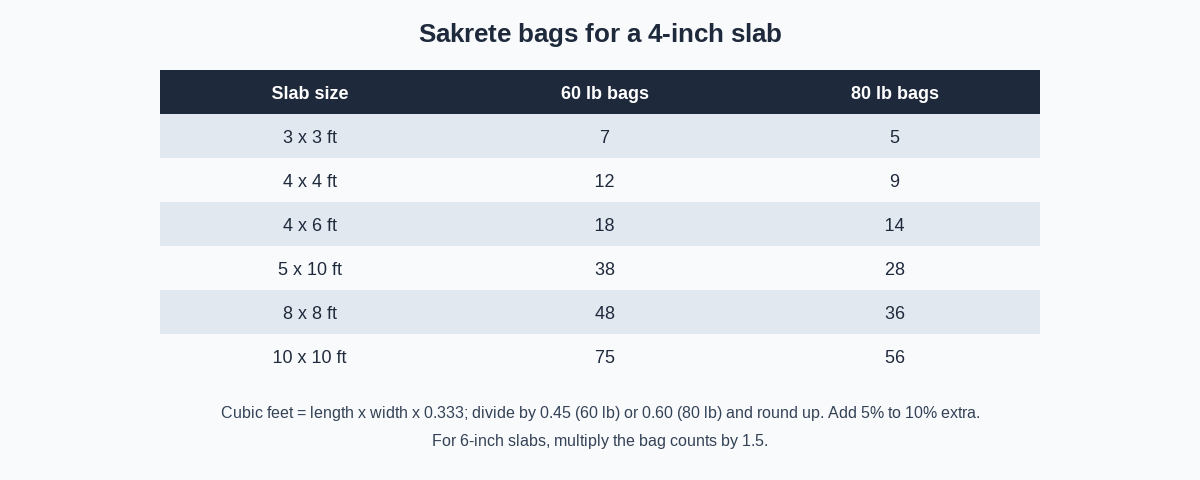
Sakrete publishes online calculators, but the math behind any Sakrete calculator for concrete is simple, and the chart above covers common 4-inch slabs. To work it out yourself:
1. Volume. Multiply length x width x thickness, all in feet. Thickness in inches divided by 12 gives feet: 4 inches = 0.333 feet, 6 inches = 0.5 feet.
2. Bags. Divide the cubic feet by 0.45 for 60 lb bags or 0.60 for 80 lb bags, or by 0.30 for 40 lb bags.
3. Extra. Round up and add 5% to 10% for uneven ground and waste.
Example. Steps that hold 9 cubic feet of concrete need 9 / 0.45 = 20 bags of Sakrete 60 lb high strength concrete mix, plus 1 or 2 extra, or 15 bags of 80 lb.
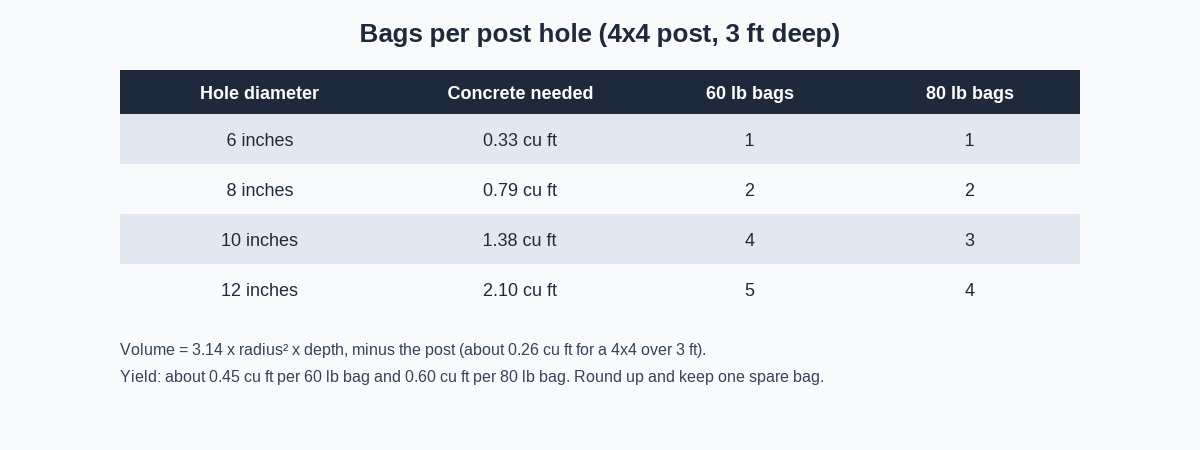
For post holes, the chart above shows typical bag counts for a 4x4 post set 3 feet deep. Larger posts, deeper holes or flared bottoms need more concrete. See how to calculate yards of concrete and concrete fence posts.
How to Mix High Strength Concrete 60 lb Bag by Bag
Here is how to mix high strength concrete 60 lb bag by bag in a wheelbarrow or tub:
1. Measure water. Put about 2 quarts of clean water in a bucket marked for the full amount, so you can keep every batch the same.
2. Add the mix. Empty one 60 lb bag of Sakrete concrete mix into the wheelbarrow and form a crater in the middle.
3. Mix. Pour in most of the water and mix with a hoe, pulling dry material into the wet center. Add the remaining water a little at a time until the mix is uniform and workable, like thick oatmeal, with no dry pockets.
4. Do not over-water. Extra water makes concrete easier to place but weaker and more prone to cracking and surface dusting.
5. Place promptly. Use the batch within about 30 to 60 minutes, sooner in hot weather.
In a portable drum mixer, add about two thirds of the water first, then the bags, then the rest of the water as needed, and mix for three to five minutes. A typical small electric mixer handles two to three 60 lb bags per batch. See how to mix concrete and concrete cement mixers.
Using Sakrete Fast Setting Concrete for Posts
For fence and mailbox posts, Sakrete Fast Setting Concrete Mix is often the easiest option. Dig the hole about three times the post width and deep enough for about one third of the post's height, plus a few inches of gravel in the bottom for drainage. Set and brace the post, fill the hole with water to about one third, then pour in the dry mix until the hole is full, adding more water if dry mix remains on top, following the bag directions. The mix sets in about 20 to 40 minutes, and the post can usually carry rails and boards after a few hours. For gates, heavy signs and structural posts, many builders prefer standard Sakrete concrete mixed with water for full strength. See how to anchor a post to concrete.
Curing Sakrete Concrete
Proper curing makes a big difference in strength and durability. Keep new Sakrete concrete moist for at least three to seven days: mist it with water, cover it with plastic sheeting, or apply a curing compound. Protect it from freezing for the first several days, and from very hot, dry wind, which can cause surface cracking. Sakrete concrete reaches its rated strength at 28 days, so avoid heavy loads, such as vehicles on a new slab, for at least a week, and preferably longer. See how long concrete takes to cure and concrete curing compound.
Using Sakrete Concrete for Deck and Porch Footings
Sakrete concrete mix is a common choice for deck, porch and shed footings, where each footing needs only a few bags. Dig to below the local frost line, as your building department requires, and use cardboard tube forms or a flared footing form for a clean shape. Before pouring, set the post base or anchor bolt template so it can be placed in the wet concrete at the right spot. A 10-inch tube 4 feet deep holds about 2.2 cubic feet, roughly five 60 lb bags or four 80 lb bags of Sakrete concrete mix; a 12-inch tube of the same depth holds about 3.1 cubic feet. Mix one or two bags at a time and fill the tube in lifts, rodding or tapping the sides to remove air pockets, then strike off the top and set the hardware. Check inspection requirements before pouring, since many jurisdictions inspect footing holes first. See concrete footings and Sonotube forms.
Pouring a Small Slab with Sakrete Concrete Mix
Small slabs for air conditioners, trash cans, hot tub steps or walkways are well suited to Sakrete concrete. Excavate and compact 4 inches of gravel base, build forms from 2x4 or 2x6 lumber staked every few feet, and set wire mesh or rebar on small supports in the middle of the slab. Calculate bags with the method above and buy a few extra. Mix Sakrete concrete mix in batches, place each batch against the last, and screed with a straight board across the forms. When the surface water disappears, float the surface, run an edger along the forms and cut control joints. Finish with a broom for outdoor traction. On slabs that need more than about 40 bags of Sakrete 60 lb high strength concrete mix, two mixers and at least three people make the job much easier. See concrete pads and how to pour a concrete patio.
Repairs with Sakrete Concrete
For broken step corners, damaged curbs and holes in slabs 2 inches deep or more, Sakrete concrete mix works well as a repair material. Chip out loose concrete to sound material, undercut the edges slightly so the patch locks in, clean out dust and debris, and dampen the area. Brush on a bonding agent or a slurry of cement and water just before placing the new concrete, then pack and finish the patch to match the surrounding surface. For shallower repairs, use a sand/topping mix or a polymer repair mortar instead, because the gravel in standard Sakrete concrete does not fit in thin layers. See how to fix concrete steps and concrete slurry.
Sakrete Concrete in Hot and Cold Weather
Sakrete recommends placing its concrete products within a moderate temperature range, generally when air and surface temperatures are above about 40°F and will stay above freezing for at least a day or two. In cold weather, use warm water for mixing, keep bags in a heated space before use, protect the new concrete with insulated blankets, and consider Sakrete 5000 Plus, which gains strength faster. In hot weather, store bags and water in the shade, mix smaller batches, dampen forms and base before pouring, and start curing immediately. Wind and low humidity speed evaporation, which increases the risk of surface cracking. See pouring concrete in cold weather.
Storing Sakrete Bags
Bagged concrete absorbs moisture from the air over time. Store Sakrete concrete mix off the ground on a pallet, in a dry place or under a tarp, and use it within the shelf life printed on the bag. Squeeze bags before buying and using them; if the contents have formed hard lumps that do not break up in your hands, the cement has partly set and the bag should not be used for structural work.
Safety When Using Sakrete Concrete
Like all cement-based products, Sakrete concrete contains Portland cement and crystalline silica. Dry dust can irritate the lungs and eyes, and wet concrete is caustic enough to cause chemical burns. Wear a dust mask or respirator when opening and pouring bags, safety glasses, waterproof gloves, long sleeves and waterproof boots. Wash skin that contacts wet concrete promptly with clean water, and flush eyes immediately and thoroughly if splashed. Keep children and pets away from the mixing area and from fresh concrete until it has hardened. Lift bags with your legs, not your back, and use a hand truck to move several bags. See concrete dust.
Common Mistakes with Sakrete Concrete Mix
Adding too much water. The most common mistake. Soupy concrete is easy to pour but weaker, shrinks more and dusts on the surface.
Using concrete mix for thin layers. Below about 2 inches, the gravel causes weak, rough patches. Use a topping mix.
Skipping the base. Pouring on soft or uncompacted soil leads to settling and cracking, whatever the brand of concrete.
Underestimating bags. Running out halfway creates a cold joint. Use a Sakrete calculator concrete estimate, then add 10%.
Not curing. Letting new concrete dry out in the sun reduces its strength and durability.
Mixing batches inconsistently. Different water amounts from batch to batch cause color and strength variations across a slab.
When to Choose Ready-Mix Instead of Sakrete
Sakrete concrete mix is ideal for jobs up to about a cubic yard. Beyond that, ready-mix delivered by truck is usually cheaper, faster and more consistent. One cubic yard equals 60 bags of Sakrete 60 lb high strength concrete mix or 45 bags of 80 lb mix, about 3,600 pounds to lift and mix. Driveways, large patios, garage floors and foundations are almost always poured with ready-mix. For mid-size jobs where a truck cannot reach the site, some suppliers rent concrete trailers or offer mix-on-site trucks, which can bridge the gap between bags and full ready-mix loads. See concrete slab cost.
Reading a Sakrete Concrete Bag
Every bag of Sakrete concrete carries most of the information you need. Look for the product name, the approximate yield in cubic feet, the recommended amount of water, the minimum application thickness, the expected strength and the walk-on or traffic times. The bag also lists safety warnings, the ASTM standard the product meets and a manufacturing code that tells you how fresh it is. Read the directions before you start: mixing water, temperature limits and curing advice can differ between Sakrete concrete mix, 5000 Plus and Fast Setting products, and following them is the simplest way to get the rated strength.
Building Steps with Sakrete Concrete Mix
Small sets of concrete steps are a common Sakrete project. Build sturdy forms for each riser, with the risers usually 7 to 7.75 inches high and treads at least 10 to 11 inches deep, following local code. Fill the inside of large steps with compacted gravel or broken concrete to reduce the number of bags, leaving at least 4 inches of concrete on top and at the front. Place Sakrete concrete mix from the bottom step up, consolidating it against the forms, and finish each tread with a float and a broom for grip. Leave the riser forms in place until the concrete is firm enough to hold its shape, usually several hours, then remove them and rub the faces smooth if needed. A small three-step stoop can easily take 30 to 50 bags of Sakrete 60 lb high strength concrete mix. See how to pour concrete steps.
Finishing Sakrete Concrete
Finishing Sakrete concrete is the same as finishing any concrete. Screed the surface level, then float it with a wood or magnesium float to embed the gravel and bring a smooth paste to the top. Wait until the sheen of bleed water disappears before final finishing; working water back into the surface weakens it. Use an edging tool along the forms for rounded, chip-resistant edges, and a groover to cut control joints that let the concrete crack in straight lines where you want it to. For outdoor surfaces, drag a broom across the slab for traction. For a smoother surface indoors, use a steel trowel once the concrete has stiffened enough to support your weight on knee boards. See concrete finishing tools.
Adding Color or Fibers to Sakrete Concrete
Sakrete concrete is gray, but you can color it by adding a liquid or powdered concrete colorant to the mixing water, following the colorant maker's dosage per bag. Use exactly the same amount of colorant and water in every batch, or the color will vary across the project. Synthetic fibers, sold in small bags, can also be added to reduce plastic shrinkage cracking in thin slabs and pads, though they do not replace rebar or mesh where reinforcement is needed. For a decorative surface without coloring the whole batch, stains and tinted sealers can be applied after the concrete cures. See concrete staining.
Where to Buy Sakrete Concrete Mix
Sakrete concrete mix is sold at large home centers, regional hardware chains, independent hardware stores and building supply dealers, but availability varies by region; in some markets other brands dominate the shelves. Many stores sell full pallets with delivery for larger jobs. Before a big project, call ahead to confirm that the store has enough of the same product, especially Sakrete 5000 Plus or specialty mixes, which may be stocked in smaller quantities. Buying all the bags for one visible surface in a single trip also helps keep the color consistent, since different production runs can vary slightly in shade. Keep receipts in case you need to return unopened bags after the job.
Sakrete Concrete Prices
Prices vary by region and store, but typical 2026 ranges are:
Sakrete 60 lb high strength concrete mix: about $5 to $7 per bag.
Sakrete 80 lb concrete mix: about $6 to $8.50 per bag.
Sakrete 5000 Plus: about $8 to $12 per bag.
Sakrete Fast Setting Concrete Mix, 50 lb: about $8 to $12 per bag.
Buying by the pallet or during seasonal promotions can lower the price per bag. For anything over about a cubic yard, compare the total with ready-mix delivery. See concrete price per yard.
Choosing the Right Sakrete Concrete for Your Project
For most homeowners, the choice between Sakrete concrete products comes down to the job and the schedule. Use Sakrete High Strength Concrete Mix for general work: pads, walks, steps, footings and repairs at least 2 inches thick. Choose Sakrete 5000 Plus when the concrete will carry vehicles, when you want extra strength for a structural pad, or when you need to walk on the work sooner, such as a busy entry. Pick Fast Setting Concrete Mix for posts, where speed matters more than finishing, and where you would rather not haul a mixer or wheelbarrow across the yard to every hole. Use Sand/Topping Mix for thin layers and small surface repairs, such as filling shallow low spots in an old walk. If you are unsure, look at the minimum thickness and strength printed on each bag, and ask the store or the manufacturer's technical service line for help matching a product to your project before you buy a pallet.
Sakrete vs. Other Bagged Concrete
Most major brands of bagged concrete, including Sakrete and its main competitors, make similar standard mixes that meet the same ASTM standard and reach about 4,000 psi. Differences come down to regional availability, bag sizes stocked, specialty products, price and personal preference. Some contractors prefer one brand's fast-setting product or high-strength mix based on how it works and finishes in their climate. In practice, choosing the right type of mix for the job, using the correct water amount and curing properly matter much more than the brand on the bag.
Frequently Asked Questions
How much does a 60 lb bag of Sakrete concrete mix make?
About 0.45 cubic feet. You need 60 bags per cubic yard.
How strong is Sakrete High Strength Concrete Mix?
About 4,000 psi at 28 days. Sakrete 5000 Plus reaches about 5,000 psi.
How much water for a 60 lb bag of Sakrete?
Roughly 2.5 to 3 quarts; follow the bag and add water slowly.
When can I walk on Sakrete concrete?
After about 24 hours for High Strength Concrete Mix and about 12 hours for 5000 Plus, in normal temperatures.
Can Sakrete concrete be used for thin layers?
Not below about 2 inches; use Sakrete Sand/Topping Mix or a repair product for thinner work.
Sources
- Sakrete: product information and technical data sheets
- Oldcastle APG: Sakrete High Strength Concrete Mix 60 lb
- Sakrete 5000 Plus technical data sheet
- ASTM C387: packaged dry combined materials for concrete