
Concrete Pitting, Flaking and Popping Out: Causes and Repair
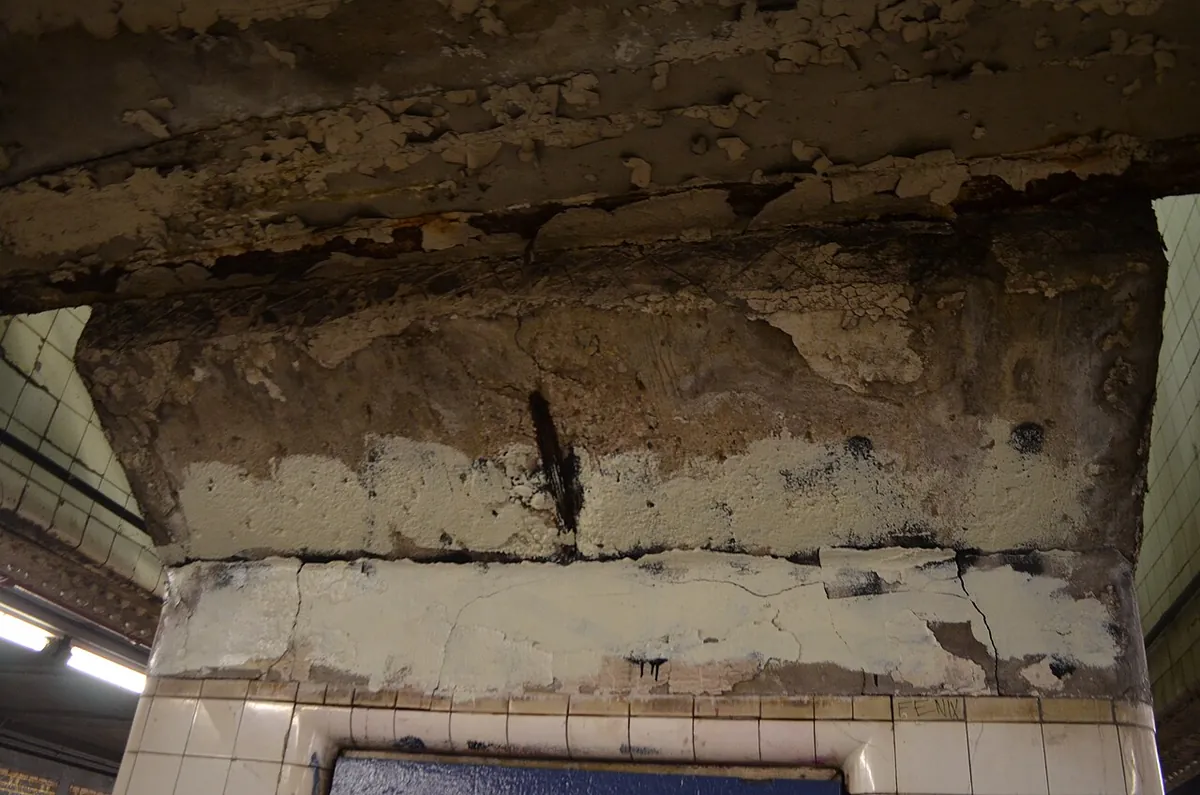
Photo: B137, Concrete surface deterioration, Wikimedia Commons, CC0.
Quick Answer
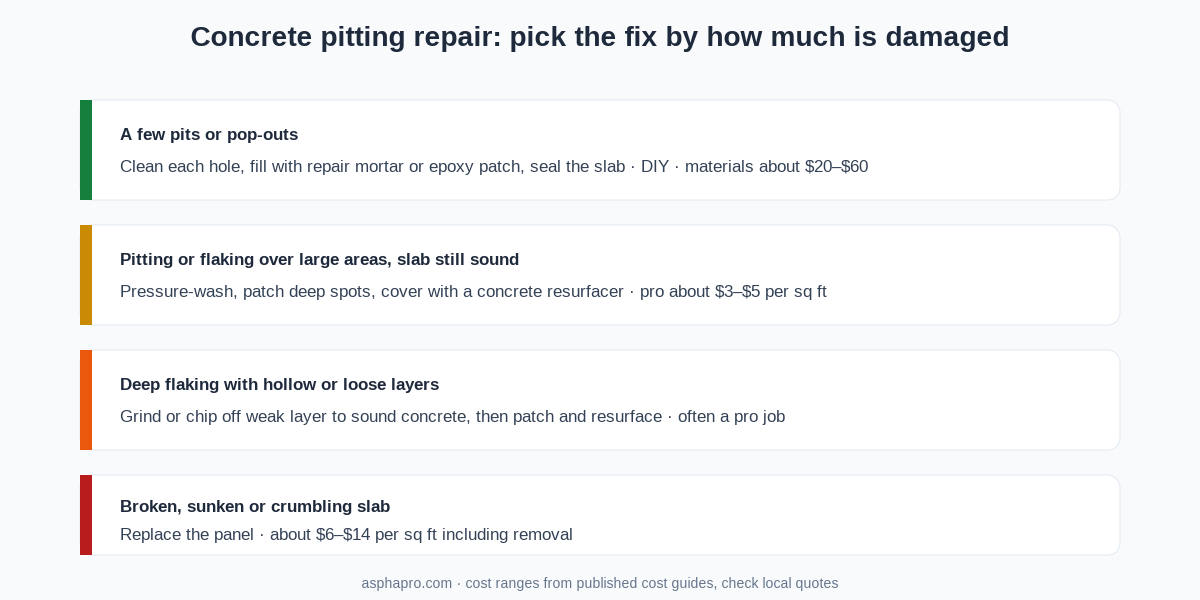
Concrete pitting is a surface full of small holes, usually caused by deicing salt, weak or watered-down surface paste, acids, or freeze-thaw damage. Flaking (also called scaling) is when a thin top layer peels off, and concrete popping out means small cone-shaped pieces break out over a porous stone just under the surface. A few pits or pop-outs can be filled with a repair mortar or epoxy patch. To fix pitted concrete or repair flaking concrete over a large area, pressure-wash it, remove anything loose, patch the deep spots and cover the slab with a polymer-modified concrete resurfacer, which pros charge about $3 to $5 per square foot for. Seal the surface afterward and go easy on deicers to stop the damage from coming back.
Concrete pitting is one of the first signs of aging on driveways, garage floors, sidewalks and patios. It often starts in the second or third winter after a pour, when the top of the slab begins to look rough and sandy, then small holes appear, and some areas start to flake. Left alone, the damage spreads, because every pit holds water that freezes and breaks a little more concrete.
This guide explains the difference between pitting, flaking and popping out, what causes each one, how to fix pitted concrete and how to repair flaking concrete step by step, what concrete pitting repair costs, and how to keep it from coming back.
Concrete Pitting, Flaking and Popping Out: Know Which You Have
These three problems often show up together and are easy to mix up. The cause and the best repair are a little different for each.
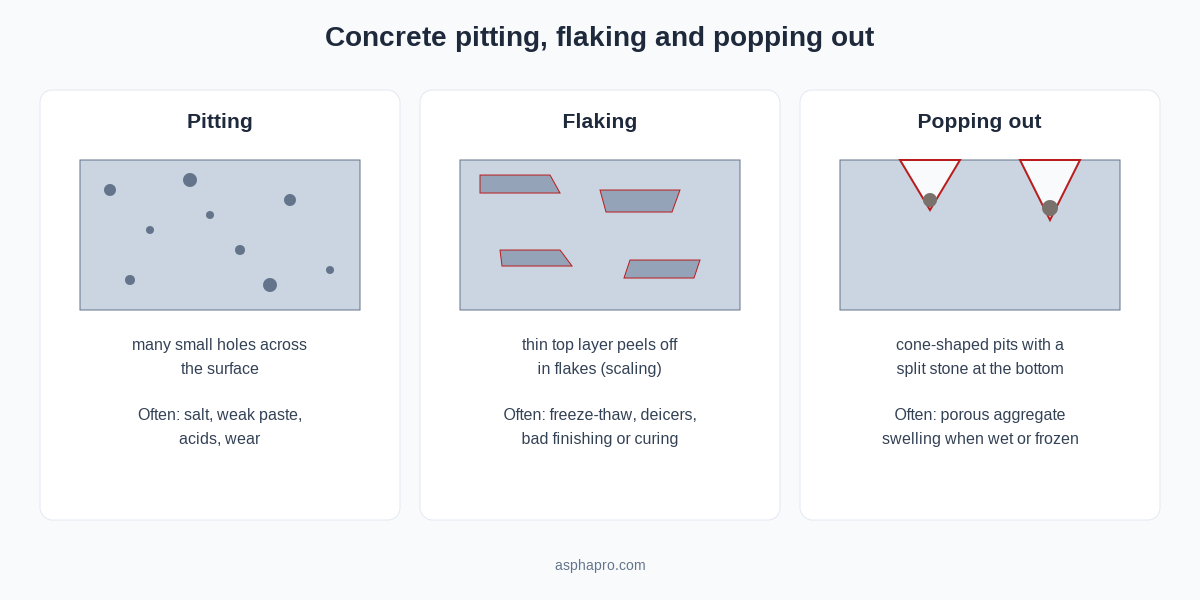
- Concrete pitting: many small holes, from pinhead size to about the size of a pea or a bit larger, spread across the surface. The surface often feels sandy and rough. Pitted concrete usually means the top paste has worn or dissolved away around the sand and small stones.
- Flaking concrete: thin pieces of the top layer, often 1/16 to 3/16 of an inch thick, peel or chip off, exposing the sand and stone below. Engineers call this scaling. Flaking can cover large patches of a slab.
- Concrete popping out: small cone-shaped holes, often from about 1/4 inch to 2 inches across, with a broken piece of stone at the bottom. Pop-outs happen when a porous piece of aggregate near the surface absorbs water and swells or freezes, breaking out the concrete above it.
Deeper, more local damage, where chunks an inch or more deep break off, is spalling. See our guide to spalling concrete for that.
What Causes Concrete Pitting?
Deicing salt
Salt is the number one cause of concrete pitting on driveways and garage floors in cold climates. Rock salt keeps the surface wetter and adds to the number of freeze-thaw cycles, and the brine soaks into the top paste. Some deicers, especially magnesium chloride and ammonium-based products, can also react with the cement paste. Garage floors pit where salty slush drips off cars and sits for days. Our guide to whether salt damages concrete explains which deicers are gentlest.
A weak top layer
Many pitted surfaces were weak from the start. Adding water to the mix to make it easier to place, sprinkling water on the surface during finishing, finishing while bleed water is still on top, or letting the surface dry out in the sun all leave the top 1/8 inch or so weaker than the concrete underneath. That weak skin wears and pits first. Concrete that was never cured properly is especially prone to it.
Freeze-thaw cycles
Water expands when it freezes. Concrete for outdoor use in cold climates should be air-entrained, which means it contains tiny air bubbles that give freezing water room to expand. Non-air-entrained concrete, or a surface that lost its air because it was over-troweled, is likely to flake and pit after a few winters.
Acids and chemicals
Cement paste is alkaline, so acids dissolve it. Acid rain, fertilizers, some cleaning products, leaking battery acid, animal waste and spilled drinks can all etch and pit concrete over time. Muriatic acid used too strong or left too long when cleaning concrete also leaves a pitted, sandy surface.
Wear and abrasion
Heavy foot traffic, steel wheels, studded tires, snowplow blades and dragging equipment slowly wear the surface paste away, leaving the sand and stone exposed. This is more of a polishing and roughening than true pitting, but it often looks the same.
Porous aggregate (pop-outs)
Concrete popping out is caused by the stone, not the paste. Some aggregates, such as certain cherts, shales and lightweight particles, absorb water. When they are near the surface and get wet or freeze, they swell and break off a cone of concrete above them. A reaction between certain stones and the cement (alkali-silica reaction) can also cause pop-outs. Pop-outs usually appear in the first year or two and then slow down once the problem stones near the surface have all popped.
Is Pitted Concrete a Serious Problem?
Usually not structurally. Concrete pitting is mostly a surface problem, and pitted concrete on a driveway or patio is still strong enough to carry cars and furniture. The real problems are:
- It gets worse. Pits hold water and salt, and each winter breaks off a little more concrete.
- It looks worn. A pitted driveway can make a house look neglected and hurt curb appeal.
- It is hard to clean. Dirt, oil and mold settle into the holes.
- It can be a trip hazard where flaking turns into deeper holes or edges.
The exception is pitting with rust stains or exposed steel, which points to corroding reinforcement and deeper damage. That should be handled like spalling.
Concrete Pitting Checklist Before You Start
Run through this short list before you buy any concrete pitting repair products. It helps you match the fix to the damage and avoid paying twice.
- Is it concrete pitting, flaking concrete or concrete popping out? Small holes everywhere, a peeling top layer, and cone-shaped pits with stone at the bottom each point to a different cause.
- How deep are the pits? Pitted concrete with holes under about 1/4 inch can usually be covered by a resurfacer in one coat. Deeper pits need patching first.
- Is any flaking concrete still loose? Tap it. Anything hollow must come off before you repair flaking concrete, or the new layer will flake with it.
- Is there rust or exposed steel? If yes, treat it as spalling, not just concrete pitting.
- Are there cracks? Seal or fill cracks first; a resurfacer will not bridge a moving crack.
- What caused it? Salt, a weak surface, acid or porous stone. Fix pitted concrete without changing the cause, and the pitting usually returns.
- How big is the area? A few pits are a DIY patch job. Concrete pitting over a whole driveway is a resurfacing job, and possibly a contractor job.
How to Fix Pitted Concrete: Step by Step
The right fix depends on how much of the surface is pitted. Here is the general process for a driveway, garage floor or patio.
Step 1: Clean thoroughly
Every concrete pitting repair starts with clean, sound concrete. Pressure-wash the whole area with a surface cleaner if you have one, using a degreaser on oil spots. A pressure washer of about 3,000 psi or more also blasts off weak, loose material that would otherwise come off later and take your repair with it. Let the slab dry, then sweep and check the surface.
Step 2: Remove anything loose
Scrape and wire-brush any flakes that are still attached. Tap the surface with a hammer or drag a chain over it; hollow-sounding areas are delaminated and need to be chipped or ground off. If the weak layer is thick or covers a big area, renting a floor grinder can be faster.
Step 3: Fill the deeper pits and pop-outs
Holes deeper than the resurfacer can fill in one coat (often about 1/4 inch, check the label) need to be patched first. Dampen the concrete, press a polymer-modified repair mortar into each hole, and strike it flush. For a handful of pop-outs on an otherwise good slab, an epoxy patching compound also works well and cures quickly.
Step 4: Resurface the slab
To fix pitted concrete across a whole driveway or floor, apply a concrete resurfacer. Most are mixed with water to a pourable consistency, spread with a squeegee over the damp slab, and given a light broom finish for traction. Work in sections between joints, keep joints open, and do not apply in direct hot sun or below the minimum temperature on the bag. This gives a new, uniform surface that hides the pits and patches.
Step 5: Cure and seal
Cure the resurfacer as the manufacturer directs, often by misting it or keeping it shaded. After it has cured, apply a good penetrating sealer to slow water and salt from getting in again. Our guide to how to reseal concrete covers sealer types and timing.
How to Repair Flaking Concrete
How to repair flaking concrete follows the same steps, with more attention to removing the loose layer. Flaking means the top layer has lost its bond, so anything you apply over it will flake off too unless the weak layer is gone.
- Find the edges of the flaking. Tap around the damaged areas and mark where the surface sounds hollow.
- Remove the weak layer. Pressure-wash, scrape and chip until you reach hard, sound concrete. On large areas, a grinder or scarifier removes a thin layer evenly.
- Patch deep spots. Fill any holes deeper than about 1/4 inch with repair mortar.
- Resurface. Apply a resurfacer over the whole slab, not just the flaked spots, so the color and texture match.
- Seal and protect. Seal after curing, and keep deicing salt off the new surface during its first winter.
To repair flaking concrete on steps, use a resurfacer or patching mortar with a simple board held against the riser to keep edges crisp. See fixing broken concrete steps for details.
How to Repair Concrete Popping Out
When concrete is popping out in a few spots, the fix is simple: remove the loose fragment and the broken stone at the bottom, clean the hole, dampen it, and fill it with repair mortar or epoxy patch. Because pop-outs come from the aggregate, sealing the slab afterward helps by keeping the remaining porous stones drier. If a new slab keeps popping out in many places during its first year or two, contact the contractor; it may point to an aggregate problem, and many contractors will repair pop-outs as part of their warranty.
Concrete Pitting Repair Products
| Product | Use it for | Notes |
|---|---|---|
| Concrete resurfacer | Pitted or flaking slabs over large areas | Thin, polymer-modified cement coating; needs sound, clean concrete |
| Polymer-modified repair mortar | Deep pits, pop-outs and small holes | Fill holes before resurfacing |
| Epoxy patching compound | A few pop-outs or pits, garage floors | Strong and fast; costs more per volume |
| Penetrating sealer (silane/siloxane) | Preventing future pitting | Keeps water and salt out without a film |
| Floor coating (epoxy, polyaspartic) | Garage floors after repair | Covers the patched surface; see coating cost |
Avoid painting over pitted concrete to hide the concrete pitting. Paint does not fill holes and tends to peel on outdoor slabs that get wet and salted.
What Concrete Pitting Repair Costs
| Job | Typical cost |
|---|---|
| DIY: fill a few pits and pop-outs | About $20 to $60 in patch material |
| DIY: resurface a 400 sq ft driveway | Often a few hundred dollars in resurfacer, plus pressure washer rental |
| Professional resurfacing | About $3 to $5 per square foot |
| Decorative overlay | About $6 to $10 per square foot |
| Replace the slab | About $6 to $14 per square foot including removal |
These ranges are in line with our guides to concrete overlay cost and concrete repair cost, which draw on published cost guides such as HomeGuide. On a typical 20 × 20 foot driveway (400 square feet), professional resurfacing at $3 to $5 per square foot comes to about $1,200 to $2,000, compared with roughly $2,400 to $5,600 to replace it.
Fix Pitted Concrete or Replace It?
Resurfacing is the usual answer when the slab is structurally sound: level, without major cracks, not crumbling all the way through. Replace instead when:
- The slab is badly cracked, sunken or heaving.
- The pitting is deep and the concrete crumbles when you scrape it.
- Earlier resurfacing has already failed and peeled.
- You want to change the shape, slope or size anyway.
Our guides on concrete removal cost and concrete driveway cost help you compare.
How to Prevent Concrete Pitting
For new concrete
- Order air-entrained concrete for outdoor slabs in freeze-thaw areas.
- Do not add extra water to the mix or the surface.
- Wait for bleed water to evaporate before finishing, and do not over-trowel outdoor concrete.
- Cure the slab properly for at least the first week. See concrete cure time.
- Do not use deicing salt on concrete during its first winter.
- Seal the slab once it has cured enough for the sealer you choose.
For existing concrete
- Reseal outdoor slabs every few years with a penetrating sealer.
- Shovel early and use sand or a gentler deicer such as calcium magnesium acetate instead of rock salt where you can.
- Rinse salty slush off garage floors and driveways when temperatures allow.
- Keep fertilizer and acidic cleaners off concrete, and rinse spills quickly.
- Fix drainage so water does not stand on the slab.
Pitted Concrete in Specific Places
Garage floors
Garage floors pit in a line where the tires park and where slush melts. After repair, many owners choose a coating. Rubber mats under the car, or simply rinsing the floor in winter, help a lot.
Driveways
Driveways pit most near the street, where salt from plows lands, and in wheel paths. A resurfacer plus sealer is the usual fix. Our driveway cost guide covers replacement if it is too far gone.
Pool decks
Pool chemicals and salt-water pools are hard on concrete. Pitted pool decks are usually resurfaced with a product rated for pool decks and then sealed.
Sidewalks and steps
Sidewalks and steps take the most deicer and foot traffic. Patch and resurface, and switch to sand for traction. See concrete sidewalk cost for replacement prices.
Common Mistakes When You Fix Pitted Concrete
- Skipping the pressure washing, so the resurfacer sticks to dirt and loose paste.
- Applying resurfacer over flaking that has not been removed.
- Putting it on too thin or too thick for the product.
- Working in hot sun or wind, so it dries before it bonds.
- Covering joints, so the new surface cracks along them.
- Salting the fresh repair during its first winter.
A Worked Example: Pitted Two-Car Driveway
A 20 × 24 foot driveway (480 square feet) is pitted over most of its surface after years of rock salt, with flaking near the street and a dozen pop-outs. The slab is level and has only a few hairline cracks.
- Pressure-wash the whole driveway and scrape off loose flakes.
- Tap-test the flaking area near the street, and chip off the hollow layer.
- Fill pop-outs and pits deeper than 1/4 inch with repair mortar.
- Resurface the whole driveway, one joint section at a time, with a broom finish.
- Seal after curing, and switch to a gentler deicer.
A pro would charge roughly $1,450 to $2,400 for this at $3 to $5 per square foot. Doing it yourself costs mainly the resurfacer bags, a pressure washer rental and a weekend.
How Long Does a Concrete Pitting Repair Last?
A well-done concrete pitting repair with a quality resurfacer usually lasts many years on a driveway or patio, and longer on a garage floor or covered porch. How long yours lasts depends on three things: how well the old surface was prepared, how thick and evenly the resurfacer was applied, and what the slab goes through each winter. Resurfaced driveways that are sealed every few years and spared heavy rock salt hold up far better than ones that are salted heavily from the first winter. Pitted concrete that is only patched in spots, without resurfacing, tends to show new pits around the patches within a few seasons because the surrounding surface is still weak.
Watch the edges of the repair and the areas near joints. If you see the new surface lifting or sounding hollow, cut out and patch that section before water gets under it and the damage spreads.
Weather and Timing for Concrete Pitting Repair
Cement-based patches and resurfacers are sensitive to weather. Most products need the air and slab to stay above about 50°F during application and for at least the first day or so; check the bag for the exact limits. Hot sun, wind and low humidity dry the thin layer too fast, which weakens it and can make it crack or flake. The best time to fix pitted concrete is a mild, overcast day in late spring or early fall, with no rain forecast for at least a day.
In hot weather, work early in the morning, keep the slab damp before you start, and mist the finished surface if the instructions allow. In cool weather, plan the work for the warmest part of the day and protect the repair from frost overnight. Never apply concrete pitting repair products on a frozen slab or when freezing temperatures are expected before the product has cured.
Concrete Pitting on Interior Floors
Pitted concrete inside a home, basement or shop is usually caused by wear, old adhesives or chemical spills rather than freeze-thaw. Because it stays dry and warm, it is easier to fix. Clean and degrease the floor, grind off old coatings and adhesives, and fill pits with a patching compound. For a smooth floor under new flooring, use a self-leveling underlayment; see our guide to self-leveling concrete. For an exposed finished floor, a grinder can take the surface down past the pits and prepare it for polishing or a coating. Our guide to polished concrete cost covers that option.
DIY or Hire a Pro to Fix Pitted Concrete?
Filling a handful of pits or pop-outs is an easy weekend job for most homeowners. Resurfacing a whole driveway is harder than it looks: the resurfacer must be mixed consistently, spread quickly before it sets, and finished evenly across every section, often with two people working together. Uneven mixing or overlapping batches can leave visible lines and color differences.
Consider hiring a contractor if the area is large, the flaking is deep or widespread, you need grinding to remove a weak layer, or you want a decorative overlay with color or a stamped pattern. A pro also knows how to deal with cracks and joints so the repair does not crack in a straight line within the first year. Ask for references and pictures of resurfacing jobs that are at least a couple of winters old, and confirm that the quote includes pressure washing, crack repair, joint work and sealing.
Concrete Pitting Repair vs Other Options
Besides resurfacing, a few other approaches are sometimes used on pitted concrete:
- Grinding: grinding off the weak top layer exposes harder concrete and some aggregate. It works best on interior floors and in mild climates.
- Decorative overlay: a thicker overlay with color, stamping or stenciling hides pitting completely and changes the look. It costs more than a plain resurfacer.
- Pavers over concrete: laying pavers over a sound but pitted patio is another way to cover it. See can you lay pavers over concrete.
- Coatings: epoxy or polyaspartic coatings work well on pitted garage floors after the holes are filled.
Whatever you choose, the steps underneath are the same: clean, remove anything loose, fill the pits, and then cover or seal the surface.
Frequently Asked Questions
What causes concrete pitting?
Deicing salt, a weak or watered-down top layer, freeze-thaw cycles in concrete without enough air, acids and chemicals, and wear. Small cone-shaped pits with stone at the bottom are pop-outs caused by porous aggregate.
How do you fix pitted concrete?
Pressure-wash, remove loose material, fill deeper pits with repair mortar, then apply a concrete resurfacer over the whole slab and seal it after curing.
How do you repair flaking concrete?
Remove every loose and hollow piece down to sound concrete, patch deeper holes, resurface the whole area so it matches, and seal it. Anything put over loose flakes will peel too.
Why is my concrete popping out?
Concrete popping out is usually caused by porous stones near the surface that absorb water and swell or freeze, breaking out a cone of concrete. Fill the holes with repair mortar and seal the slab.
How much does concrete pitting repair cost?
A few DIY patches cost about $20 to $60. Professional resurfacing of a pitted slab usually costs about $3 to $5 per square foot.
Can you seal pitted concrete?
Yes, sealing slows further damage, but it does not fill the pits. For a smooth surface, patch and resurface first, then seal.
Will pitted concrete get worse?
Usually, especially outdoors in cold climates. Pits hold water and salt, and each freeze-thaw cycle breaks a little more concrete.
Sources
- U.S. General Services Administration: Types of Cracks in Concrete and Typical Causes
- Iowa State University InTrans: Revisiting Concrete Scaling (MAP Brief)
- Missouri DOT Engineering Policy Guide: Repair of Concrete Surface Failures
- HomeGuide: Concrete Resurfacing Cost
- Portland Cement Association: Cement and Concrete FAQ
Related Guides
- Concrete patching compound guide — which concrete patch or repair mortar to use
- Concrete garage floor repair — cracks, pits, spalls and sunken slabs
- Concrete pool deck resurfacing — coatings, spray textures and overlays
- How to resurface concrete — products, steps and fixing surface cracking
- Concrete driveway resurfacing — cost vs replacement and step-by-step process
- Efflorescence in concrete — what the white powder is and how to remove it
- How to cover concrete patio slabs — overlays, pavers, tile and other ideas
- Precast concrete steps — sizes, cost and mobile home steps
- Concrete aggregate guide — sizes, grading and types of stone
- Concrete admixture guide — air entrained concrete, water reducers and more
- Concrete curing compound — curing compounds vs water curing
- Concrete flatwork — what flatwork is and how it is built
- Concrete dust — silica risks, safe exposure and dusting slabs
- Bull float concrete — when and how to use a concrete bull float
- Is calcium chloride safe for concrete? — choosing the best ice melt
- Concrete restoration — repair process, methods and cost
- Concrete stair treads — precast and poured treads
- Rock salt finish concrete — pitted decorative finish for pool decks and patios
- Temperature to pour concrete — ideal range, minimums and hot or cold precautions