
Concrete Curing Compound vs Water Curing: How to Cure Concrete Right
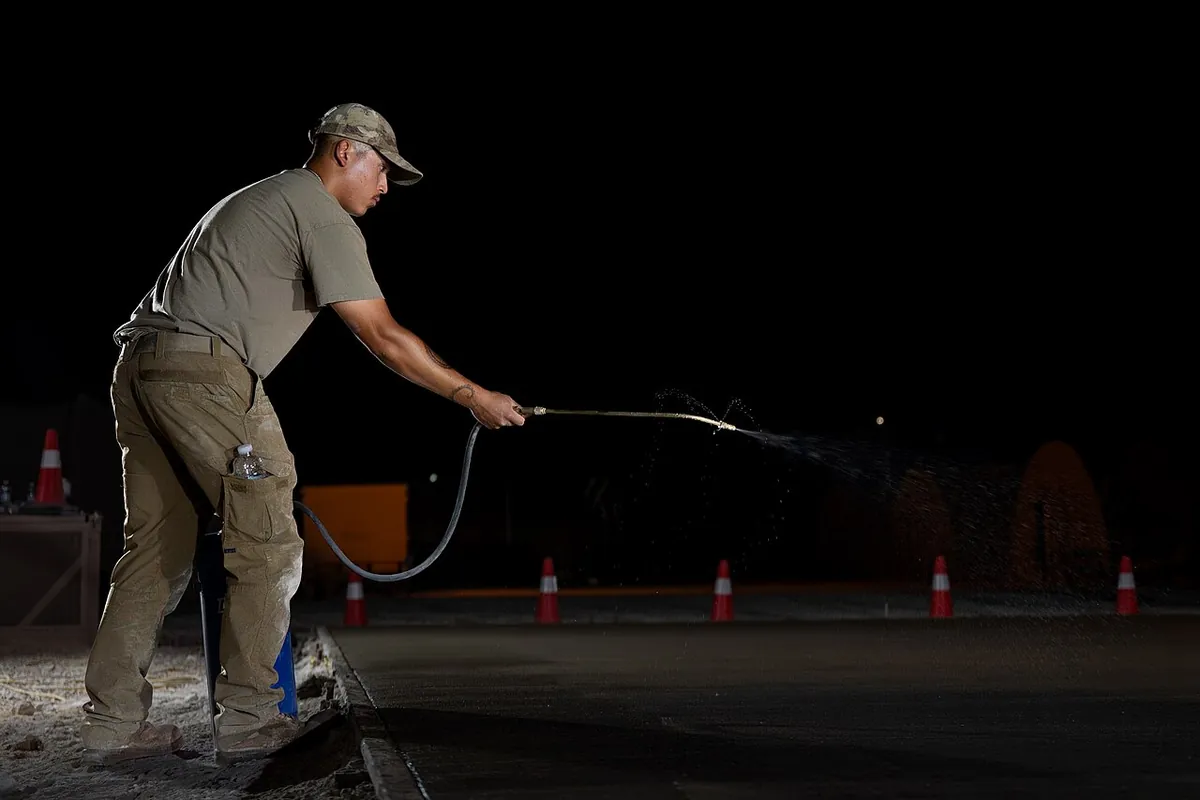
Photo: U.S. Air Force / Erin Dunkleberger, Wikimedia Commons, public domain.
Quick Answer
A concrete curing compound is a liquid sprayed or rolled onto fresh concrete right after finishing that forms a thin film to hold the concrete's water in, so the cement can keep hydrating and gaining strength. It is the easiest way to cure large slabs. The alternatives are water curing concrete (sprinkling, fogging or ponding to keep it wet), wet burlap, and plastic sheeting. Cure and seal products cure the concrete and leave a light sealer. Whichever method you use, start as soon as the surface can take it without marring, and keep the concrete moist for at least 7 days (longer in cool weather). Concrete left to dry out early can end up with roughly half its potential strength and a weak, dusty surface.
Concrete does not dry to harden, which is why concrete curing matters. It hardens because water reacts with cement, and that reaction keeps going for weeks as long as the concrete stays moist and warm enough. Curing is simply keeping that water in, and the temperature reasonable, long enough for the concrete to develop the strength and durability it was designed for. It is the cheapest step in any concrete job and the one most often skipped. A slab that is poured and finished perfectly but left to bake in the sun and wind on day one can crack, dust, scale and wear far sooner than a properly cured slab of the same mix.
This guide answers "how do I cure concrete?" in practice: how a curing compound for concrete works, when to use water curing instead, wet burlap and plastic, cure and seal products, how long concrete curing should last, cold- and hot-weather tips, and the mistakes that waste good concrete.
Why Concrete Curing Matters
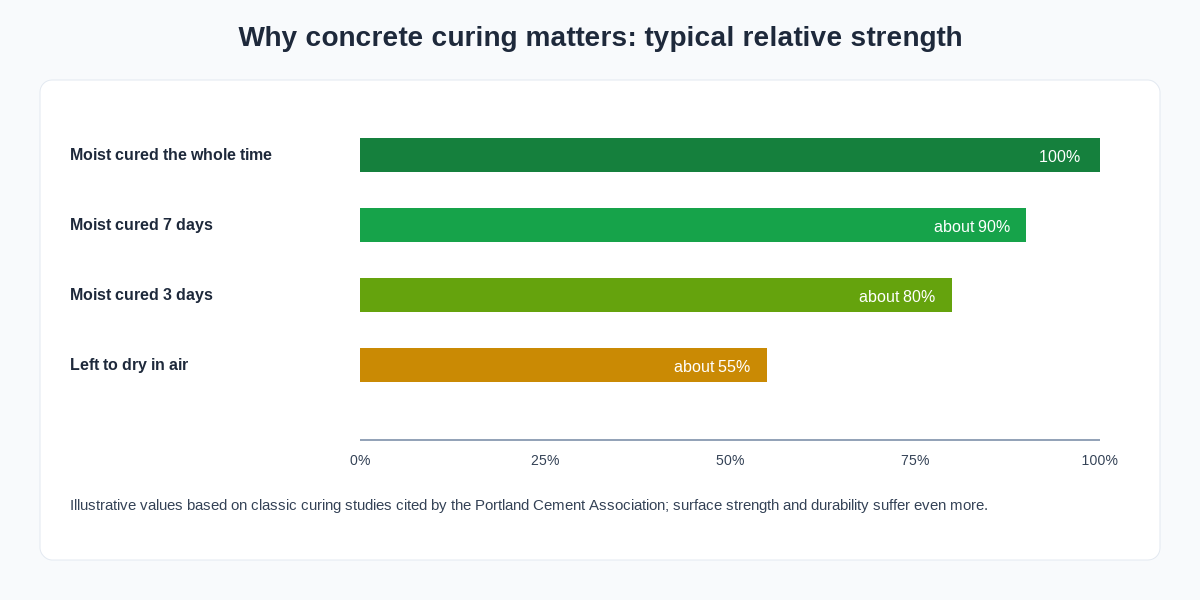
Concrete curing affects almost every property you care about. Strength: classic tests reported by the Portland Cement Association show concrete kept moist continuously reaching its full 28-day strength, concrete moist-cured for only a few days reaching noticeably less, and concrete left to dry in air from the start reaching roughly half. Durability: the top quarter inch of a slab, the part that faces tires, salt and freezing, suffers most from drying, so poorly cured surfaces scale, dust and wear quickly. Cracking: concrete that loses water fast at the surface shrinks while it is still weak, causing plastic shrinkage cracks and crazing. Good concrete curing reduces all of these. See why concrete cracks and concrete pitting and flaking.
What Is a Concrete Curing Compound?
A concrete curing compound, also called a membrane-forming curing compound, is a liquid that forms a thin film on the concrete surface to slow evaporation. Under ASTM C309 (and ASTM C1315 for compounds with sealing properties), the film must limit moisture loss from a test specimen to a set amount over 72 hours. Common types include:
- Wax-based compounds: economical and effective, but leave a residue that must be removed before coatings, paint or adhesives.
- Resin-based compounds: hydrocarbon resins that cure well and wear off or break down over weeks.
- Acrylic compounds: often sold as cure and seal products; they cure the concrete and leave a light protective film.
- Dissipating compounds: designed to break down in sunlight and traffic, so floors can receive coatings or flooring later.
- White-pigmented compounds: reflect sunlight to keep slabs cooler in hot weather, common on highways.
- Clear or fugitive-dye compounds: the dye shows where the compound has been applied and then fades.
How to Apply a Curing Compound for Concrete
- Finish the concrete as usual: screed, float, trowel or broom.
- Apply right after finishing, as soon as the surface sheen of bleed water disappears and the compound will not mar the surface. On hot, windy days, this can be within minutes; do not wait hours.
- Spray evenly with a pump-up garden sprayer or power sprayer, or roll it on, at the coverage rate on the label, often about 200 square feet per gallon. Two light coats at right angles give more even coverage than one heavy coat.
- Cover edges and sides too, once forms are removed.
- Keep traffic off until the film dries, and protect it from damage for the curing period.
Before choosing a curing compound, concrete that will later receive paint, epoxy, tile adhesive, stain or a sealer needs a compound that is compatible with that finish or that dissipates, or else it will have to be ground or stripped first. Check the label and ask the flooring or coating maker. See concrete staining and concrete coating cost.
Water Curing Concrete
Water curing concrete means keeping the surface continuously wet so it never dries out. It is the most effective concrete curing method, because the concrete has all the water it can use, and it cools the concrete in hot weather. Ways to water cure concrete:
- Sprinkling or fogging: lawn sprinklers or misting nozzles keep the surface wet, day and night, without washing away the surface.
- Ponding: building small dikes of sand or soil around a flat slab and flooding it with an inch of water.
- Wet coverings: burlap, cotton mats or curing blankets kept soaked.
- Hosing: rewetting by hand several times a day, which works for small jobs but leaves dry periods in between.
The key with any concrete water cure is that it must be continuous. Alternate wetting and drying causes the surface to shrink and swell and can do more harm than good. If you cannot keep it wet around the clock, use plastic sheeting or a curing compound instead. Do not use water curing when freezing temperatures are expected.
Watering concrete: curing tips
For homeowners, watering concrete curing works best on small slabs, walks and steps. Start once the concrete is hard enough that a gentle spray will not mark it, usually a few hours after finishing in warm weather. Use a fine spray, not a jet. Water early in the morning and evening at minimum, and more often in sun and wind; better yet, cover the slab with wet burlap or old sheets and keep them damp, or put plastic over them. Keep it up for at least 7 days.
Wet Burlap and Curing Blankets
For water curing concrete on walls and decks, burlap or cotton mats soaked in water and laid on the concrete hold moisture against the surface evenly. They are widely used on bridge decks, walls and columns, where sprinklers and ponding are impractical. Pre-soak new burlap to remove sizing that can stain, lay it as soon as the surface can take it without marking, and keep it wet; dry burlap actually wicks water out of concrete. Covering wet burlap with plastic slows drying. In cold weather, insulated curing blankets keep concrete warm as well as moist. See concrete blankets.
Plastic Sheeting
For concrete curing without a curing compound, polyethylene sheeting, usually 4 to 6 mil, laid flat on the concrete and held down at the edges, traps the concrete's own water. It is cheap, easy and effective for footings, posts, small slabs and walls. Lay it as soon as possible after finishing, overlap the seams, and weigh down the edges so wind cannot get underneath. The drawback is cosmetic: where the plastic wrinkles and touches the surface, it can leave darker and lighter blotches, so on colored or exposed decorative concrete, a curing compound or cure and seal is usually preferred. White or clear sheeting is better in sun than black, which absorbs heat.
Concrete Cure and Seal Products
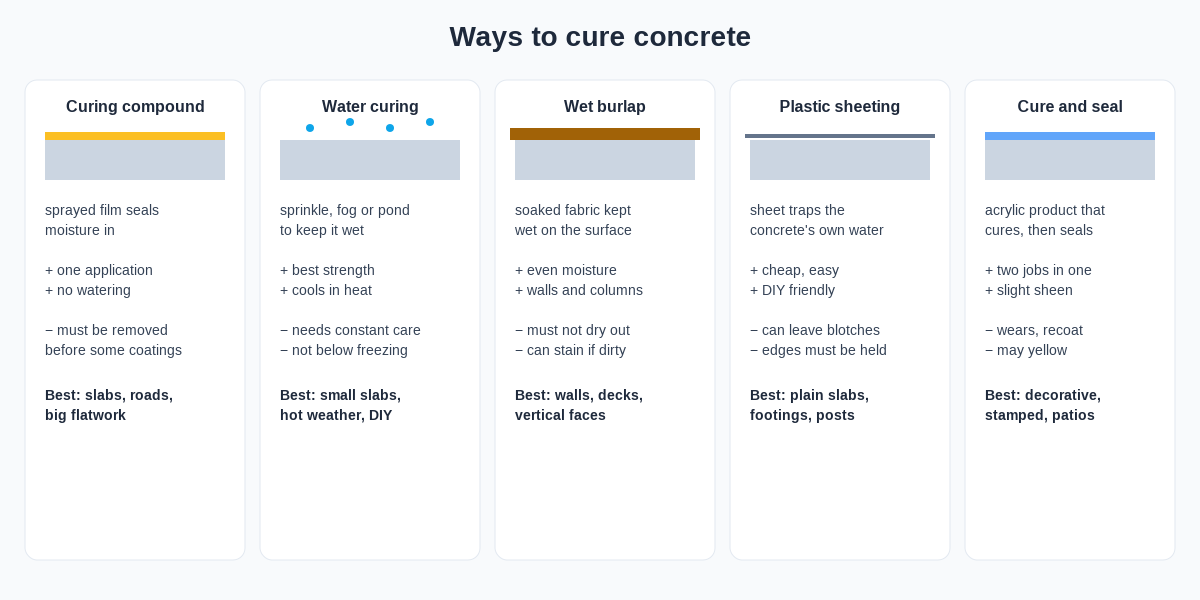
A concrete cure and seal product, usually an acrylic in solvent or water, is applied to fresh concrete like a curing compound but is designed to stay on and protect the surface afterward, leaving a light sheen. It is popular for decorative, stamped and colored concrete, patios and pool decks, because it cures the slab and enhances color in one step. A cure and seal for concrete wears and may need a fresh coat after a year or two, and some solvent-based products can yellow or blush in sun or damp. They meet ASTM C1315 for curing and sealing. For long-term protection, a penetrating or film-forming sealer can be applied later; see how to seal concrete.
How Long Should Concrete Curing Last?
A common minimum is 7 days of moist curing for ordinary portland cement concrete at moderate temperatures, or until it reaches about 70 percent of its specified strength. Concrete with fly ash or slag, which gains strength more slowly, benefits from 10 to 14 days. In cool weather, curing takes longer because hydration slows; in hot weather, curing must start sooner and be more thorough. A curing compound for concrete keeps working for the whole period as long as the film is intact. After curing, concrete continues to gain strength and should be kept from heavy loads until it reaches design strength, typically 28 days. See how long concrete takes to cure.
How Do I Cure Concrete in Hot or Cold Weather?
Hot weather: water evaporates fast and concrete sets quickly. Use an evaporation retarder between finishing passes, apply curing compound immediately after finishing, or start fogging and wet curing as soon as possible. White curing compound or white plastic reflects heat. Pour early in the morning and shade small jobs if you can.
Cold weather: water curing is usually out, because wet concrete can freeze. Use a curing compound or plastic, plus insulated blankets to keep the concrete warm, and keep it above freezing until it reaches about 500 psi. Curing takes longer at low temperatures, so extend the period. See pouring concrete in cold weather.
Comparing Concrete Curing Compounds
Concrete curing compounds are not all the same, and the label tells you a lot. Look first for the standard: ASTM C309 for curing only, ASTM C1315 for products that cure and seal with better durability and resistance to yellowing. Next, look at the base: water-based products have low odor and are easier to clean up, while solvent-based products often penetrate and resist water better but have stronger fumes and stricter rules on volatile organic compounds in some states. Check the coverage rate, since thin application is the most common reason a compound fails to cure properly. Then check compatibility: if you plan to stain, paint, coat, tile or glue flooring to the slab, choose a dissipating product or one the finish maker approves, or plan to remove the film. Finally, for sunny, hot sites, white-pigmented compounds keep the slab cooler. Price differences between concrete curing compounds are small compared with the value of the concrete they protect.
Concrete Curing in Water for Precast and Test Specimens
Curing concrete in water is common outside the field. Test cylinders and cubes are stored in moist rooms or in tanks of lime-saturated water at a controlled temperature until they are tested, following standards such as ASTM C511 and ASTM C31, so that every lab gets comparable results. Some precast plants cure small units by immersion or in steam rooms, where heat and moisture speed up strength gain so molds can be reused the next day. Concrete curing in water this way shows how strong a mix can become under ideal conditions, which is why field concrete, cured less perfectly, often tests a little lower in place than lab cylinders suggest. See concrete cylinder tests.
Water Curing for Small DIY Jobs
For water, concrete curing at home calls for clean water from a hose or watering can and a simple routine. A patio, walk or set of steps can be kept wet by covering it with old sheets, towels or burlap soaked with a hose and topped with plastic to slow evaporation. Rewet the cloth whenever it starts to dry, usually morning and evening, more in heat and wind. For fence posts and small footings, plastic wrapped over the top of the concrete is enough. Avoid hard water jets that wash out the surface, and avoid ice-cold water on hot concrete, which can shock the surface. Stop water curing if a hard frost is forecast; switch to plastic and blankets instead.
Curing Walls, Steps and Columns
Vertical surfaces need concrete curing as much as slabs but are harder to keep wet. Leaving the forms in place for several days is one of the best ways to cure walls and columns, since the forms hold moisture in; loosening them slightly and running water down inside can help in hot weather. Once forms are stripped, wrap the concrete in wet burlap and plastic, or spray a curing compound on the exposed faces. Steps need curing on treads, risers and sides; plastic draped over the whole set and weighted at the edges works well. Do not walk on new steps or set heavy pots on them until curing is complete. See pouring concrete steps.
Internal Curing
Some high-performance and low-water concretes are cured partly from the inside. Pre-wetted lightweight aggregate or special absorbent polymers are added to the mix; as the cement uses up water, these particles release their stored water into the paste. Internal curing helps very low water-cement ratio mixes, such as bridge deck and high strength concrete, avoid self-desiccation and early cracking. It supplements external concrete curing rather than replacing it. See light concrete and high strength concrete mix.
Common Concrete Curing Mistakes
The most common concrete curing mistake is doing nothing: finishing a slab, walking away, and letting the sun and wind dry it out. Others include starting too late, after the surface has already dried and crazed; applying curing compound too thinly or missing spots; spraying water intermittently so the surface dries between wettings; letting burlap dry out; leaving plastic flapping so air circulates underneath; curing for only a day or two; letting fresh concrete freeze; and using a wax-based curing compound on concrete that will later be painted, stained or tiled. Each of these is easy to avoid with a little planning. Buying a gallon of curing compound and a garden sprayer before the pour, or having plastic sheeting and weights ready, costs very little compared with repairing a dusty, scaling or cracked slab later.
Cost of Curing Concrete
Curing is one of the least expensive parts of a concrete job. A 5-gallon pail of curing compound typically costs about $60 to $200 and covers roughly 1,000 square feet; a single gallon for a small patio is often $20 to $50. Cure and seal products cost somewhat more per gallon. Plastic sheeting costs a few cents per square foot, and burlap a little more. Contractors usually include curing compound or cure and seal in their price for slabs and driveways; it is worth asking which product and how it will be applied. Water curing costs only water and time. Compared with the cost of the concrete itself, effective concrete curing adds well under 1 percent to most jobs while protecting the whole investment. See concrete slab cost.
How to Cure Concrete: A Simple Plan for Homeowners
If you are pouring or hiring someone to pour a patio, walk, driveway or shed pad, here is how to cure concrete without overthinking it. Before the pour, decide on the method and have the materials on site: a curing compound and sprayer, or plastic sheeting and weights, or a hose with a soaker or sprinkler and some burlap. Right after the final broom or trowel pass, as soon as the surface sheen is gone, apply the curing compound evenly or lay the plastic, or start a fine mist. For the next seven days, keep the concrete covered, sealed or wet, keep people and pets off it for the first day or two, and keep vehicles off for at least a week. Check plastic edges and wet coverings every day, and fix any spot where the surface has started to turn light and dry. In hot weather, add shade and water more often; in cold weather, add insulated blankets and skip water curing. After about a month, if you want a sealer, apply one that is compatible with any curing compound you used.
Concrete Cure Time vs Curing Time
People often confuse how long concrete takes to cure with how long you need to actively cure it. Concrete cure, in the sense of strength gain, continues for weeks and months: about 70 percent of design strength at 7 days and the full specified strength at 28 days for typical mixes, with slow gains after that. Active concrete curing, keeping the concrete moist and protected, is most critical in the first 3 to 7 days, when the cement paste is forming its structure and the surface is most vulnerable. After that, the concrete still benefits from moisture, but the risk of permanent damage from drying falls sharply. In practice, that means a week of good curing up front, followed by patience before heavy loads.
Signs of Poor Curing
Concrete that skipped a curing compound or water curing often shows it within the first year. Look for a surface that dusts when swept, fine map-like crazing cracks, early scaling or flaking after the first winter, a surface that scratches easily with a key, and plastic shrinkage cracks that appeared within hours of the pour. Color differences can also reveal uneven curing, such as lighter areas where plastic lifted or where curing compound was missed. Many of these problems can be treated with densifiers, sealers or a resurfacer, but none fully restores what good curing would have given. See how to resurface concrete.
Curing Compound or Cure and Seal: Which to Choose?
For a plain gray driveway, sidewalk or shed slab, a standard concrete curing compound is the simplest choice: it does one job well and wears away. For a stamped, colored or exposed aggregate patio, a concrete cure and seal product gives the curing you need plus color enhancement and early protection, and you can recoat it later with the same type of sealer. For an interior floor that will get tile, vinyl, wood or epoxy, choose a dissipating curing compound or plastic sheeting, or plan to grind off the film, because a lasting film can stop adhesives and coatings from bonding. When in doubt, ask whoever will install the final finish which curing compound for concrete they accept.
Curing and the Environment
Good curing is also a sustainability choice. Concrete that reaches its full strength and durability lasts longer, needs fewer repairs and does not have to be replaced early, which avoids the cement, energy and transport that replacement would require. On the product side, water-based curing compounds and cure and seal products release fewer volatile organic compounds than solvent-based ones, and many states and regions now limit VOC content in these products. Water curing uses water, which matters in dry regions; plastic sheeting and curing compounds use far less. Reusable curing blankets and burlap can serve many pours, and a clean pump sprayer used only for concrete curing compound lasts for years. Choosing the right method for the climate and the job keeps both the concrete and the environmental cost in good shape.
Safety With Curing Products
Read the safety data on any curing compound before using it. Solvent-based products are flammable and give off fumes, so use them only with good ventilation and away from flames or pilot lights, and wear a respirator if the label calls for one. Water-based products are milder but still call for eye protection and gloves. Keep sprayers used for a concrete curing compound clean so they do not clog mid-job, and rinse or store them according to the label. Fresh concrete itself is caustic, so wear boots and gloves while laying plastic or burlap on new slabs, and keep children and pets off the curing concrete.
Frequently Asked Questions
How do I cure concrete?
Keep it moist and above freezing for at least 7 days, using a curing compound, continuous water curing, wet burlap or plastic sheeting, starting right after finishing.
Is curing compound better than water curing?
Continuous water curing gives the best results but needs constant attention. A properly applied curing compound is almost as effective and far easier on large slabs.
When should I apply curing compound?
As soon as the surface water sheen is gone and the compound will not mar the finish, usually right after final finishing.
Can I cure concrete with water from a hose?
Yes, if you keep it continuously wet. Intermittent hosing that lets the surface dry between waterings is much less effective.
What is concrete cure and seal?
An acrylic product that acts as a curing compound on fresh concrete and leaves a light protective sealer.
Sources
- ASTM C309: Liquid Membrane-Forming Compounds for Curing Concrete
- ASTM C1315: Liquid Membrane-Forming Compounds Having Special Properties for Curing and Sealing Concrete
- American Concrete Institute: ACI 308R guide to external curing of concrete
- Portland Cement Association: curing concrete
Related Guides
- Concrete blankets — insulated and curing blankets
- Concrete dye and pigment — how to color concrete, white to black
- Concrete pool — construction, gunite and costs
- Concrete densifier — silicate hardeners for floors
- Temperature to pour concrete — ideal range, minimums and hot or cold precautions
- Green concrete — low-carbon mixes with fly ash, slag and Type IL, plus fresh green concrete
- Wet concrete — how liquid concrete works, workability, setting times and safety