
Temperature to Pour Concrete: Ideal Range, Minimums, Maximums and Precautions

Photo: Oregon Department of Transportation, Flickr, CC BY 2.0
Quick Answer
The best temperature to pour concrete is an air temperature between about 50°F and 85°F, with no freezing expected for at least the next few days. You can pour below 40°F or above 90°F, but only with precautions: heated concrete, accelerators and insulated blankets in the cold; early-morning pours, cool water, retarders and evaporation control in the heat. Industry guidance generally aims for a concrete temperature at placement of at least about 50 to 55°F for ordinary slabs and walls and no more than about 90 to 95°F. Fresh concrete must be protected from freezing until it reaches roughly 500 psi, which usually takes about two days at 50°F. Never place concrete on frozen ground.
Concrete hardens through a chemical reaction between cement and water called hydration, and temperature controls how fast that reaction runs, which is why the temperature to pour concrete matters so much for the final result. Too cold, and concrete sets slowly, stays weak and can be damaged if the water inside freezes. Too hot, and it sets too fast, loses water to evaporation, cracks and ends up weaker than it should be. That is why contractors watch the forecast as closely as the schedule. The photo above shows a crew pouring a bridge deck in the early morning on an August day, a standard tactic for keeping the temperature to pour concrete in the comfortable range.
This guide explains what temperature you can pour concrete at, the ideal range, minimum and maximum limits, why concrete temperature matters as much as air temperature, how to handle cold and hot weather, curing temperatures, and common mistakes.
What Temperature Can You Pour Concrete?
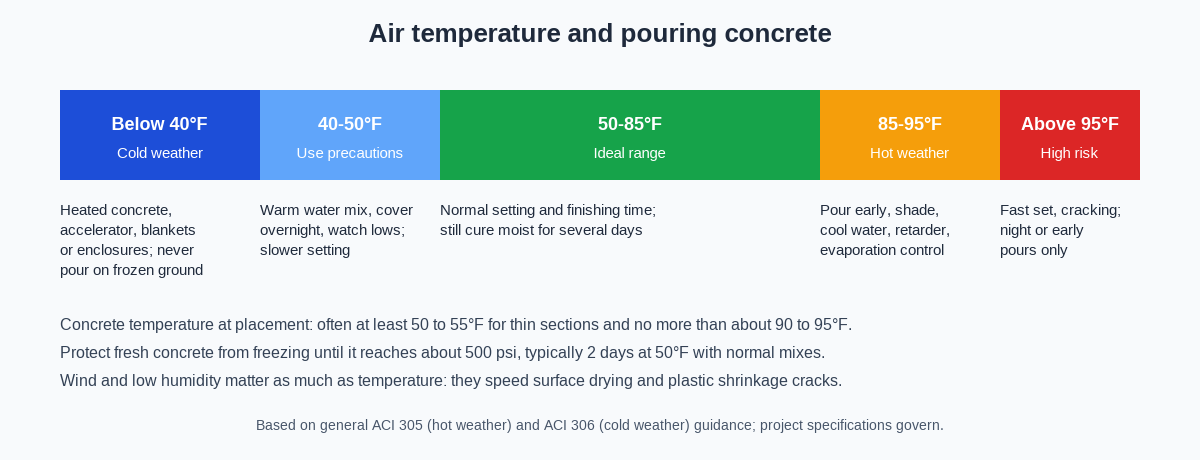
As the chart shows, there is no single magic number. You can pour concrete across a wide range of temperatures, but the further you get from the middle of the range, the more work it takes to get good results:
50°F to 85°F: ideal. This is the best temperature to pour concrete. It sets and gains strength at a normal pace, finishing is predictable and curing is straightforward. Spring and fall are prime concrete seasons in most of the country for this reason, and many contractors book their busiest schedules then.
40°F to 50°F: possible with precautions. You can pour concrete here, but setting and strength gain slow down noticeably as concrete temperature falls. Use warm mixing water or heated ready-mix, consider an accelerator, and cover the concrete overnight, especially if lows will approach freezing.
Below 40°F: cold-weather concreting. The American Concrete Institute's cold-weather guidance applies when air temperature has fallen, or is expected to fall, below 40°F during the protection period. Concrete must be placed warm, kept warm with blankets, heaters or enclosures, and never placed on frozen ground or against frozen forms.
85°F to 95°F: hot-weather precautions. Concrete sets faster and loses moisture quickly. Pour early in the day, keep materials cool, use set retarders and start curing immediately.
Above 95°F: high risk. Many specifications limit concrete temperature at placement to about 90 or 95°F. In very hot weather, many crews pour at night or before sunrise.
Air Temperature vs. Concrete Temperature
When people ask about the temperature for pouring concrete, they usually mean the air temperature. But the concrete temperature, the temperature of the fresh concrete itself as it comes out of the truck, matters just as much. Ready-mix plants can adjust concrete temperature by heating the water and aggregates in winter or cooling them with chilled water or ice in summer. Cold-weather guidance from the American Concrete Institute sets minimum concrete temperatures at placement based on how thick the concrete is: thin sections under about 12 inches, which includes most slabs, walls and footings for houses, need the warmest concrete, about 55°F, while very massive sections can be placed cooler because they hold heat better. In hot weather, many specifications cap concrete temperature at about 90 to 95°F, since hotter concrete sets very quickly and needs more water.
Ground and form temperatures count too. Concrete placed on cold ground or against frozen forms loses heat quickly at the contact surface, and concrete placed on frozen soil can settle and crack when the ground thaws. In summer, hot, dry subgrades and forms pull water out of fresh concrete; dampening them before the pour helps.
How Concrete Temperature Affects Setting and Strength
Setting time. As a rough rule, every 20°F drop in temperature roughly doubles setting time, and every 20°F rise roughly halves it. Concrete that sets in about 4 to 6 hours at 70°F might take 8 hours or more at 50°F and only 2 to 3 hours at 90°F.
Strength gain. Cold concrete gains strength slowly; below about 40°F, it gains very little, and below freezing it essentially stops. Warm concrete gains strength faster early on, but concrete placed and cured very hot often ends up with lower long-term strength than concrete cured at moderate temperatures.
Freezing damage. Fresh concrete contains a lot of free water. If it freezes before the concrete reaches roughly 500 psi, ice crystals can permanently damage the cement paste, reducing strength and durability. Once concrete reaches that strength, a single freeze usually does no lasting harm, although repeated freeze-thaw cycles still require air-entrained concrete.
Cracking. Hot, dry and windy weather causes plastic shrinkage cracks as the surface dries faster than bleed water can rise. Large temperature swings between day and night, or between the inside and outside of thick concrete, can cause thermal cracking.
Cold Weather: How to Pour Concrete Below 40°F
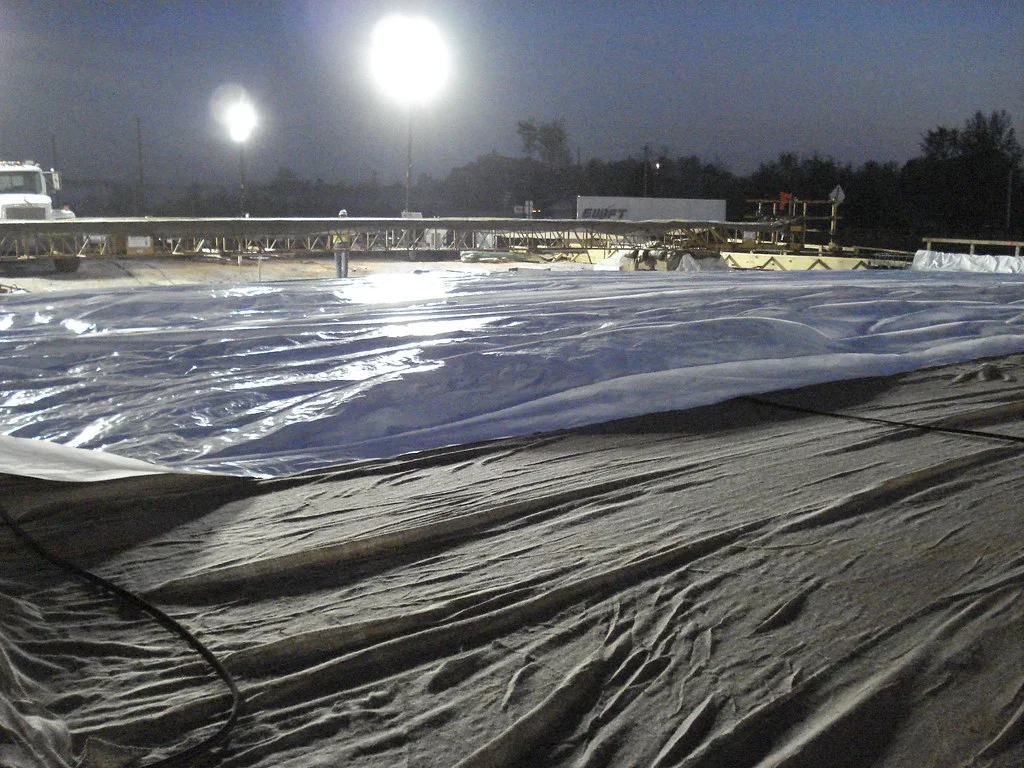
Photo: NCDOT Communications, Flickr, CC BY 2.0
When the air drops below the ideal temperature to pour concrete, the goal is to keep the concrete warm until it is strong enough to resist freezing. The bridge deck above is covered with insulated blankets and heating hoses that circulate warm fluid, a large-scale version of the same idea. Common cold-weather practices include:
Thaw and protect the ground. Use ground heaters or insulated blankets to thaw frost before placing concrete, and keep snow and ice out of forms.
Order heated concrete. Ready-mix plants heat water and aggregates to raise the concrete temperature, so it arrives warm, usually 60 to 70°F in winter.
Use accelerators. Non-chloride accelerating admixtures speed setting and early strength. Calcium chloride is also effective but can corrode reinforcing steel, so it is limited or prohibited in reinforced concrete. See calcium chloride in concrete.
Consider high early strength mixes. More cement, Type III cement or lower water-cement ratios gain strength faster.
Cover and insulate. Insulated concrete blankets trap the heat generated by hydration. Enclosures with heaters are used for walls, columns and large slabs. Avoid unvented fuel heaters inside enclosures, which can cause surface carbonation and dusting, as well as carbon monoxide risks. See concrete blankets.
Keep forms on longer. Forms help hold heat, and concrete gains strength slowly in the cold.
Never use antifreeze or salt. Products sold as concrete antifreeze are usually accelerators; adding salt or automotive antifreeze damages concrete.
See pouring concrete in cold weather for a full guide.
Hot Weather: Keeping Concrete Temperature Down
When you pour concrete in hot weather, the focus is on keeping the concrete temperature down and the surface wet long enough to place, finish and cure it properly:
Pour concrete early or late. Start at dawn, as in the photo at the top of this page, or pour at night when temperatures are lower and wind is calmer.
Cool the materials. Ready-mix plants use chilled water, ice or shaded and sprinkled aggregate piles to keep the concrete temperature below about 90°F.
Use retarders. Set-retarding admixtures slow setting so crews have time to place and finish. See concrete admixtures.
Dampen the base and forms. Wet the subgrade and forms before the pour, without leaving standing water, so they do not pull water out of the concrete.
Control evaporation. Windbreaks, sunshades, fog misting above the surface and evaporation retarders sprayed on fresh concrete reduce surface drying.
Don't add water on site. Adding water to restore slump weakens concrete. Use a water reducer or superplasticizer if more workability is needed.
Cure immediately. Start curing as soon as finishing is done, using wet curing, curing blankets or a curing compound. See concrete curing compound.
How to Measure Concrete Temperature
On commercial jobs, concrete temperature is measured and recorded for every truck. The standard method, ASTM C1064, uses a thermometer inserted at least 3 inches into a sample of fresh concrete, with at least 3 inches of concrete all around the sensor, read after about two minutes or once the reading stabilizes. Testing technicians take the concrete temperature at the same time as slump and air content, and a load that is too hot or too cold for the specification can be rejected. Homeowners and small contractors can use an inexpensive probe thermometer the same way. Knowing the actual concrete temperature, not just the air temperature, tells you how fast the concrete will set and how much protection it needs. Infrared thermometers are handy for checking the surface temperature of forms, subgrade and finished concrete during curing, but they only read the surface.
Temperature to Pour Concrete by Project
Footings and foundation walls. Footings are often poured in cold weather because foundations cannot wait for spring. The key rules are no frozen ground in the excavation, warm concrete, and blankets over footings and wall tops. Walls lose heat through their forms, so insulated forms or blankets on the forms help. The ideal temperature to pour concrete foundations is the same 50 to 85°F, but with protection they can be poured much colder. See concrete foundation.
Driveways and exterior slabs. Exterior flatwork is the most sensitive to temperature, because it is thin, exposed to wind and sun, and later faces freeze-thaw cycles and deicing salts. Avoid pouring driveways when lows will fall below freezing in the first few days, and make sure the concrete is air-entrained and well cured before its first winter. In hot weather, early-morning pours and immediate curing reduce cracking. See concrete driveway cost.
Garage and basement floors. Interior slabs are easier to protect once the building is enclosed. Temporary heat in a closed garage or basement allows winter pours, but ventilate fuel-fired heaters to the outside.
Decorative, stamped and colored concrete. Decorative work needs the most predictable conditions. Cold slows setting so stamping windows shift; heat shortens the window to minutes. Color can also vary with temperature and curing conditions. Many decorative contractors prefer to pour concrete only when the temperature is between about 50 and 80°F. See stamped concrete patterns.
Posts and small DIY pours. Small volumes lose heat quickly, so they are more vulnerable to cold than large pours. Use warm water and cover posts and pads overnight when lows approach freezing.
Best Months to Pour Concrete
In much of the northern US, the most comfortable months to pour concrete are April through June and September through October, when daytime temperatures sit in the ideal range and nights are mild. July and August are workable with hot-weather precautions, and winter pours are routine for professionals with heat and blankets but harder for DIYers. In the South and Southwest, the best months are often October through April, with summer pours scheduled for early morning or night. In mountain and northern states, the window for easy exterior flatwork can be short, and many homeowners plan driveways and patios for late spring or early fall. Whatever the region, the forecast for the week after the pour matters more than the month on the calendar.
What Cold and Hot Weather Precautions Cost
Weather protection adds cost, which is one reason contractors prefer the ideal temperature to pour concrete when schedules allow. Typical extras include winter charges for heated concrete, often about $5 to $15 per cubic yard; non-chloride accelerators, about $4 to $10 per yard; rental or purchase of insulated curing blankets; ground heaters to thaw frost, which can run several hundred dollars a day; and enclosures and fuel for heated tents on larger projects. In summer, ice or chilled water at the plant, retarders and evaporation retarders add smaller amounts, and night or early-morning pours may carry labor premiums. On a small residential job, these extras might add a few hundred dollars; on a large commercial pour, they can be thousands. See concrete price per yard.
Maturity Monitoring and Temperature Sensors
On larger projects, contractors increasingly embed wireless temperature sensors in fresh concrete. Using the maturity method, which relates the temperature history of the concrete to its strength gain, software estimates in-place strength in real time. That tells crews when it is safe to remove blankets, strip forms or apply loads, instead of relying on fixed waiting times. Sensors are especially useful in cold weather, where concrete temperature varies widely across a slab, and in thick sections, where the core can get much hotter than the surface. The data also documents that the concrete was protected properly, which helps with inspections and quality records. See concrete cylinder test.
Temperature Differences in Thick Concrete
Massive concrete, such as thick mat foundations, large footings and dam sections, generates a lot of heat as it hydrates, and the inside can become much hotter than the surface. If the difference between the core and the surface grows too large, commonly limited to about 35°F in specifications, the cooler surface contracts against the warm core and cracks. For mass concrete, engineers control the pouring temperature, use low-heat cement blends with fly ash or slag, insulate surfaces to slow cooling, and sometimes embed cooling pipes. For ordinary house slabs and walls, this is rarely an issue, but it explains why large pours often have their own temperature plans.
Overnight Lows and the Temperature to Pour Concrete
The daytime high is not the only temperature that matters. A sunny 55°F afternoon can be followed by a 28°F night, and fresh concrete poured that day is at its most vulnerable during that first night. Before you pour concrete, check the forecast for the next three to seven days, paying attention to overnight lows. If lows will drop below freezing within the first 48 hours, plan to cover the concrete with insulated blankets or postpone the pour. For hot weather, look at the afternoon high, humidity and wind speed; low humidity and wind can make an 85°F day harder on fresh concrete than a calm, humid 95°F day.
Humidity, Wind and Sun
Air temperature is only part of the weather that affects fresh concrete. Low humidity, wind and direct sun all speed evaporation from the surface, which can cause plastic shrinkage cracks even on a mild day. A 75°F day with 20% humidity and a 15 mph breeze can be harder on fresh concrete than a calm, humid 90°F day. The American Concrete Institute publishes a chart that estimates evaporation rate from air temperature, concrete temperature, relative humidity and wind speed; when the rate climbs above roughly 0.2 pounds per square foot per hour, crews add windbreaks, fog misting and evaporation retarders. Cloudy, calm days are often the easiest days to pour concrete, even when the temperature is at the edge of the ideal range.
The Lowest Temperature to Pour Concrete Without Special Measures
For homeowners without heated concrete or insulated blankets, a practical rule is to pour concrete only when the air temperature is at least 40°F and rising at the time of the pour, and the forecast lows for the next two to three days stay above freezing. Below that temperature, pour concrete only if you can protect it. Even then, small pours lose heat quickly, so a post or small pad needs more protection than a thick slab. Covering fresh concrete with plastic, then a thick layer of blankets, straw or foam board, traps the heat it generates and can keep it above freezing on a light frost night. If a hard freeze is coming, it is safer to wait a few days for milder weather and pour concrete then.
Temperature to Pour Concrete for Posts and Footings
Fence posts, deck footings and sign bases are often set in shoulder seasons. The ground below the frost line stays above freezing even in winter, so concrete at the bottom of a deep hole is relatively protected, but the top few inches near the surface are exposed. Fill holes with warm-water mixes in cool weather, set posts during the warmest part of the day, and cover the tops of footings with insulation overnight. Fast-setting post mixes generate heat quickly and set before most frosts, which makes them a good choice when the temperature to pour concrete is marginal. Do not pour into holes that contain ice or frozen soil at the bottom. See dry pour concrete and concrete footings.
Concrete Temperature During Curing
Concrete needs both moisture and a reasonable temperature to cure. Ideal curing temperatures are roughly 50 to 75°F. Industry guidance calls for keeping concrete above certain minimum temperatures for a protection period, often several days, in cold weather, and for preventing rapid temperature drops when protection is removed, which can cause cracking. In hot weather, keeping the surface wet and shaded during the first days helps prevent cracking and improves long-term strength. See how long concrete takes to cure.
Temperature Tips for Small DIY Pours
Homeowners pouring posts, pads and small slabs can follow a few simple rules:
Pick the right day. The best temperature for pouring concrete at home is a day with highs between 50 and 85°F, no rain, light wind and overnight lows above 40°F for the next few days.
Use the season. Spring and fall usually offer the best temperature for pouring concrete yourself in most climates.
In cool weather, mix with warm tap water, use a high early strength or fast-setting mix, and cover the work with plastic and old blankets or straw overnight.
In hot weather, work in the morning, keep bags and water in the shade, mix small batches and keep the surface damp after finishing.
See can you pour concrete in the rain and 80 lb bag of concrete.
Common Concrete Temperature Mistakes
Trying to pour concrete on frozen ground. The soil thaws and settles later, and the bottom of the concrete may freeze.
Ignoring the overnight low. Fresh concrete poured on a mild day can freeze that night.
Removing protection too soon. Taking blankets off cold concrete on a freezing morning can cause thermal shock and surface damage.
Adding water in the heat. Extra water makes concrete easier to place but weaker and more crack-prone.
Finishing too early. Cold concrete bleeds longer; working water into the surface causes scaling and dusting later.
Frequently Asked Questions
What temperature can you pour concrete at?
Ideally between about 50°F and 85°F. Below 40°F or above about 90°F, use cold- or hot-weather precautions.
What is the minimum temperature to pour concrete?
There is no absolute minimum if you heat and protect the concrete, but without special measures, air temperatures should stay above about 40°F and concrete must not freeze in the first days.
Can you pour concrete at 35 degrees?
Yes, with heated concrete, accelerators, thawed ground and insulated blankets, as contractors do all winter. Without those measures, it is risky.
Is it too hot to pour concrete at 100 degrees?
It is very difficult. Pour at night or early morning, cool the concrete and use retarders and evaporation control.
What is the best temperature to pour concrete for a driveway?
Between about 50°F and 80°F, with no freezing nights for several days. Air-entrained concrete and good curing matter more for driveways than for most other slabs.
Does concrete temperature matter more than air temperature?
Both matter. Concrete temperature controls how fast it sets, while air temperature, wind and sun control how fast it loses heat and moisture. Measure both on cold or hot days.
Can I pour concrete if it will freeze tonight?
Only if you can protect it. Pour concrete early in the day, use a warm mix and cover it with plastic and insulated blankets before the temperature drops. Otherwise, wait for a better forecast.
How cold can concrete get after it is poured?
It should not freeze until it reaches about 500 psi, typically about two days at 50°F for normal mixes.
Sources
- American Concrete Institute: ACI 306R, guide to cold weather concreting
- American Concrete Institute: ACI 305R, guide to hot weather concreting
- Portland Cement Association: cold and hot weather concreting
- NRMCA: Concrete in Practice, cold and hot weather
Related Guides
- Green concrete — low-carbon mixes with fly ash, slag and Type IL, plus fresh green concrete
- Wet concrete — how liquid concrete works, workability, setting times and safety