
Concrete Wire Mesh: Sizes, Placement, Cost and When to Use It
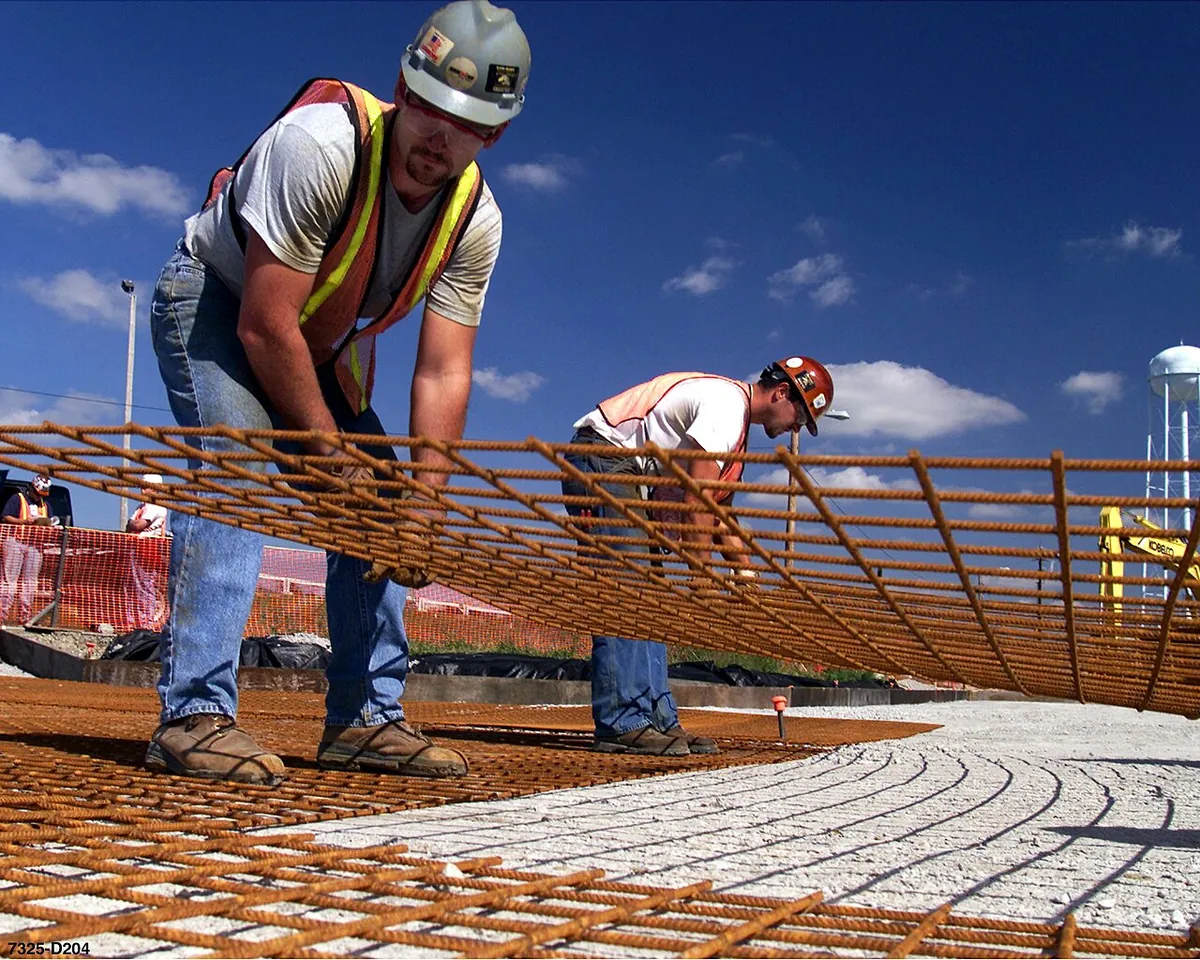
Photo: U.S. Department of Energy, Wikimedia Commons, public domain.
Quick Answer
Concrete wire mesh, also called welded wire mesh or welded wire reinforcement, is a grid of steel wires welded where they cross, laid inside a slab to hold shrinkage cracks tight. The most common wire mesh for concrete slab work at home is 6x6 W1.4xW1.4 (the old "6x6 10/10" gauge) for light patios and walks, and the heavier 6x6 W2.9xW2.9 ("6x6 6/6") for driveways and garage floors. It comes in rolls and flat sheets; sheets are easier to keep flat. Mesh only works if it sits near the middle of the slab on chairs, not on the gravel, and sheets must overlap by at least one full square plus 2 inches. Concrete mesh is cheaper and faster than rebar, but rebar is stronger for heavy loads.
Walk past almost any house being built and you will see flat sheets or rolls of grid-like steel stacked near the driveway forms. That is concrete wire mesh. For decades it has been the default reinforcement for patios, sidewalks, basement floors and many driveways, because it is cheap, light and fast to lay. It is also one of the most misused materials in home concrete, because a mesh lying on the dirt under a slab does almost nothing.
This guide explains what wire mesh for concrete does, how welded wire mesh sizes and gauges are named, which mesh for concrete patios, driveways and floors, how to place and lap it, what concrete mesh costs, and how mesh compares with rebar and fibers.
What Is Concrete Wire Mesh?
Concrete wire mesh is a factory-made grid of cold-drawn steel wires. Long wires run one way, cross wires run the other, and every crossing is electrically welded. The result is a stiff mat with a fixed spacing, usually 6 by 6 inches in residential work, that can be rolled out or laid as sheets over a whole slab in minutes. The industry names are welded wire reinforcement (WWR) and welded wire fabric (WWF); on job sites, people just say wire mesh, concrete mesh wire, remesh or "the mesh".
Welded wire mesh for concrete is made under ASTM A1064, the standard for carbon-steel wire and welded wire reinforcement. The wires can be smooth (W wires) or deformed with small ribs (D wires), which grip the concrete better. Because the cross wires are welded, even smooth wire mesh and concrete lock together well: the welded crossings act as anchors.
What Does Wire Mesh Do in Concrete?
Concrete shrinks as it dries and moves with temperature. Because it is weak in tension, that movement causes cracks. Wire mesh concrete reinforcement does not stop cracks from forming, but it does three useful things:
- Holds cracks tight. Mesh crossing a crack keeps it narrow, so water and dirt stay out and the crack stays a hairline instead of a gap.
- Keeps the pieces together. If a crack forms between joints, the mesh helps keep the two sides from drifting apart.
- Adds some load sharing. Light mesh adds a little stiffness, though much less than rebar.
Mesh is temperature and shrinkage reinforcement. It is not designed to carry heavy structural loads the way concrete rebar does. And it is not a substitute for control joints, a solid base and proper curing; those decide whether the slab cracks randomly, and mesh just keeps the cracks that do form from opening up. For the full list of causes, see why concrete cracks.
Welded Wire Mesh Sizes and Gauges
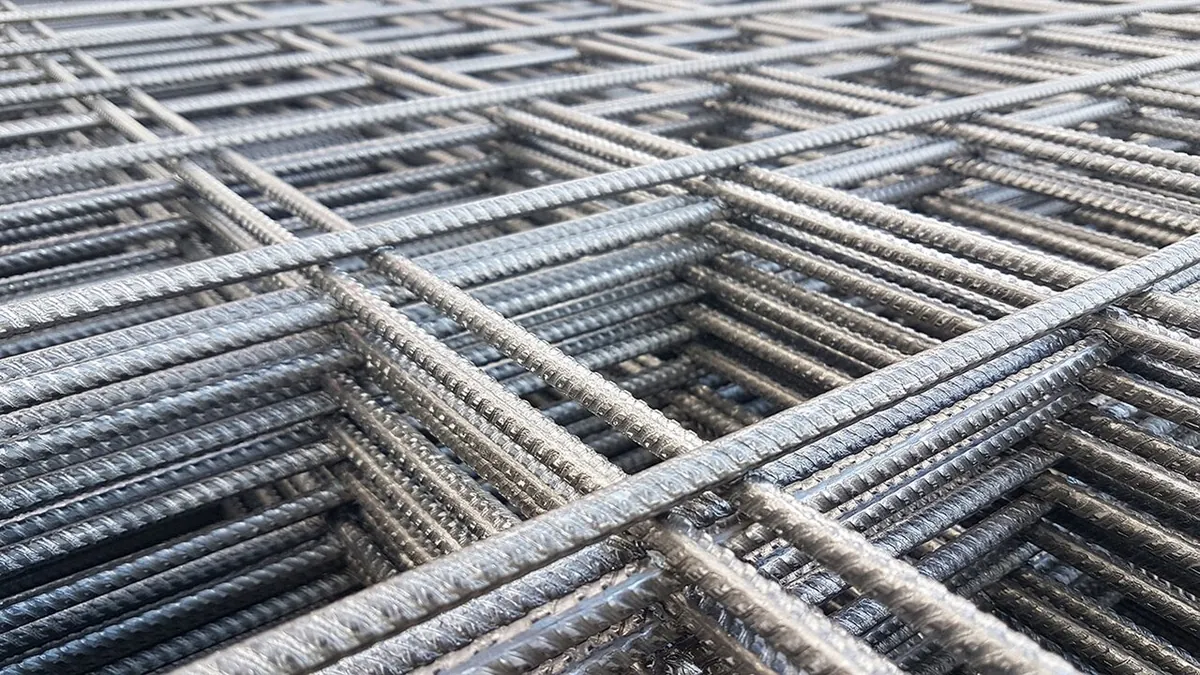
Photo: Lukasz Rzychon, Wikimedia Commons, CC BY-SA 4.0
Welded wire mesh concrete suppliers sell is labeled with the wire spacing first and the wire size second. In a label like 6x6 W1.4xW1.4:
- 6x6 means the wires are 6 inches apart in both directions.
- W means smooth wire (D would mean deformed wire).
- 1.4 is the wire's cross-section area in hundredths of a square inch: 0.014 square inches.
Older labels used steel wire gauge numbers, and you will still see them on store shelves. Lower gauge numbers mean thicker wire.
| Modern label | Old gauge label | Wire diameter | Steel per foot of width | Typical use |
|---|---|---|---|---|
| 6x6 W1.4xW1.4 | 6x6 10/10 | about 0.135 in. | 0.028 sq in. | Patios, walks, light slabs |
| 6x6 W2.1xW2.1 | 6x6 8/8 | about 0.162 in. | 0.042 sq in. | Patios, basement floors |
| 6x6 W2.9xW2.9 | 6x6 6/6 | about 0.192 in. | 0.058 sq in. | Driveways, garage floors |
| 6x6 W4.0xW4.0 | 6x6 4/4 | about 0.226 in. | 0.080 sq in. | Heavier slabs and pads |
Compare that with rebar: #3 bars at 18 inches give about 0.073 square inches of steel per foot, and #4 bars at 18 inches give about 0.133. So light 10-gauge concrete wire mesh carries less than half the steel of a light rebar grid, while 6-gauge mesh is closer to #3 rebar.
Rolls vs Sheets of Wire Mesh for Concrete
Mesh for concrete comes in two forms:
- Rolls. Light 10-gauge mesh is sold in rolls, commonly 5 feet wide by 150 feet long (750 square feet). Rolls are cheap per square foot and easy to haul, but the wire keeps the curve of the roll, so it wants to spring back up or curl down. It must be unrolled, flattened and weighted or tied before it can be set on chairs.
- Sheets. Heavier mesh, and much of the mesh sold at home centers, comes in flat sheets, commonly 5 by 10 feet (50 square feet), and in larger 8 by 15 or 8 by 20 foot sheets from suppliers. Sheets lie flat, stay at the right height on chairs, and are much easier to place correctly.
For most homeowners and small crews, flat sheets are worth the extra cost. A rolled mesh that is still curled when the concrete arrives tends to end up partly on the ground and partly poking out of the surface.
Which Concrete Mesh for Which Slab
These are common starting points for wire mesh for concrete slab work at home. Local code, plans and an engineer's design take priority, and slabs that carry heavy trucks, equipment or structural loads usually need rebar instead.
| Slab | Thickness | Common reinforcement |
|---|---|---|
| Sidewalk, walkway | 4 in. | None, fiber, or 6x6 W1.4 mesh |
| Patio | 4 in. | 6x6 W1.4 or W2.1 mesh, or fiber |
| Shed pad | 4 in. | 6x6 W1.4 or W2.9 mesh |
| Basement floor | 4 in. | 6x6 W1.4 or W2.1 mesh, or none |
| Car driveway | 4–5 in. | 6x6 W2.9 mesh sheets, or #3/#4 rebar |
| Garage floor | 4–6 in. | 6x6 W2.9 mesh sheets, or #4 rebar |
| RV pad, hot tub, heavy loads | 6 in. + | Rebar, sometimes plus mesh |
For thickness by use, see concrete slab thickness and how thick a concrete driveway should be.
Where Wire Mesh Belongs in a Concrete Slab
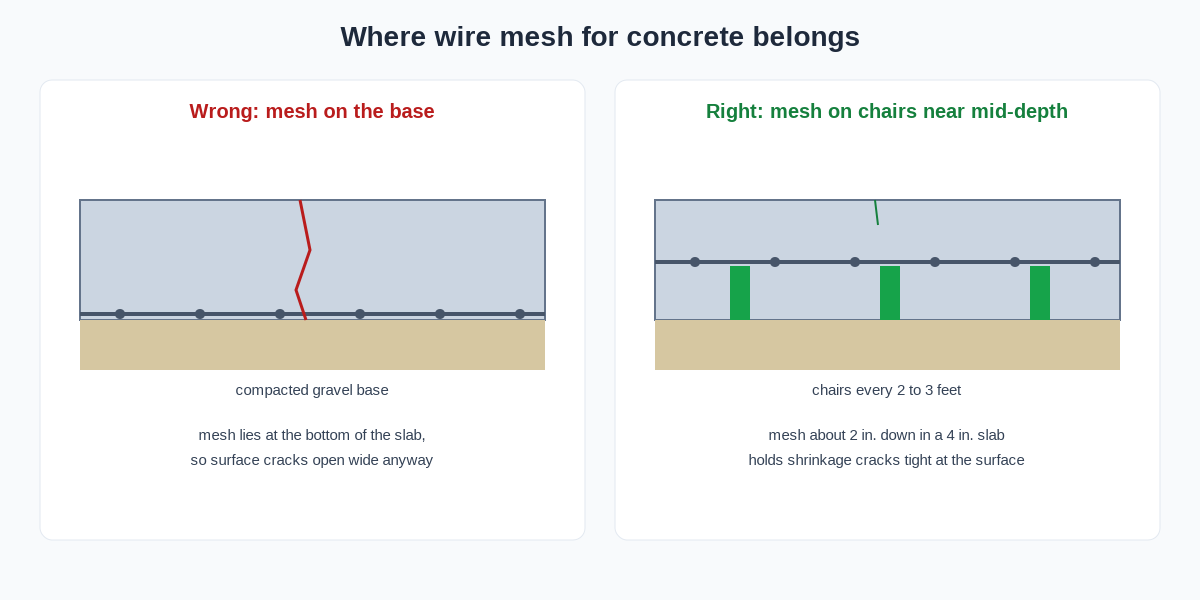
Placement is the whole game with concrete wire mesh. Mesh controls cracks near the top surface, so it has to be inside the slab, near the middle or slightly above it: about 2 inches down in a 4-inch slab. Mesh lying on the gravel at the bottom of the slab is too far from the surface to hold cracks tight, and it is close to the moisture in the ground.
For years, a common practice was to lay the mesh on the ground and have a worker "hook" or "pull" it up into the wet concrete during the pour. The Portland Cement Association and the Wire Reinforcement Institute both warn against this. In practice, the mesh comes up unevenly, falls back down under the weight of concrete and boots, and ends up wherever it lands. Studies of cores cut from slabs poured this way often find the mesh at the very bottom. If the mesh is not supported, many engineers say you might as well leave it out.
How to support mesh for concrete
- Plastic chairs sized for the slab, such as 2-inch chairs for a 4-inch slab, with a wide base or sand plate so they do not sink into the gravel.
- Concrete blocks (dobies), which do not sink and match the concrete.
- Spacing: heavier 6-gauge sheets can be supported about every 3 feet; light 10-gauge mesh sags, so it needs chairs about every 2 feet or less.
Never use bricks, rocks or broken block. They can create weak points and paths for water, and inspectors often reject them. If foot traffic will cross the mesh during the pour, use stiffer sheets or more chairs, and lay walk boards so workers do not trample the mesh flat.
How to Install Wire Mesh for Concrete: Step by Step
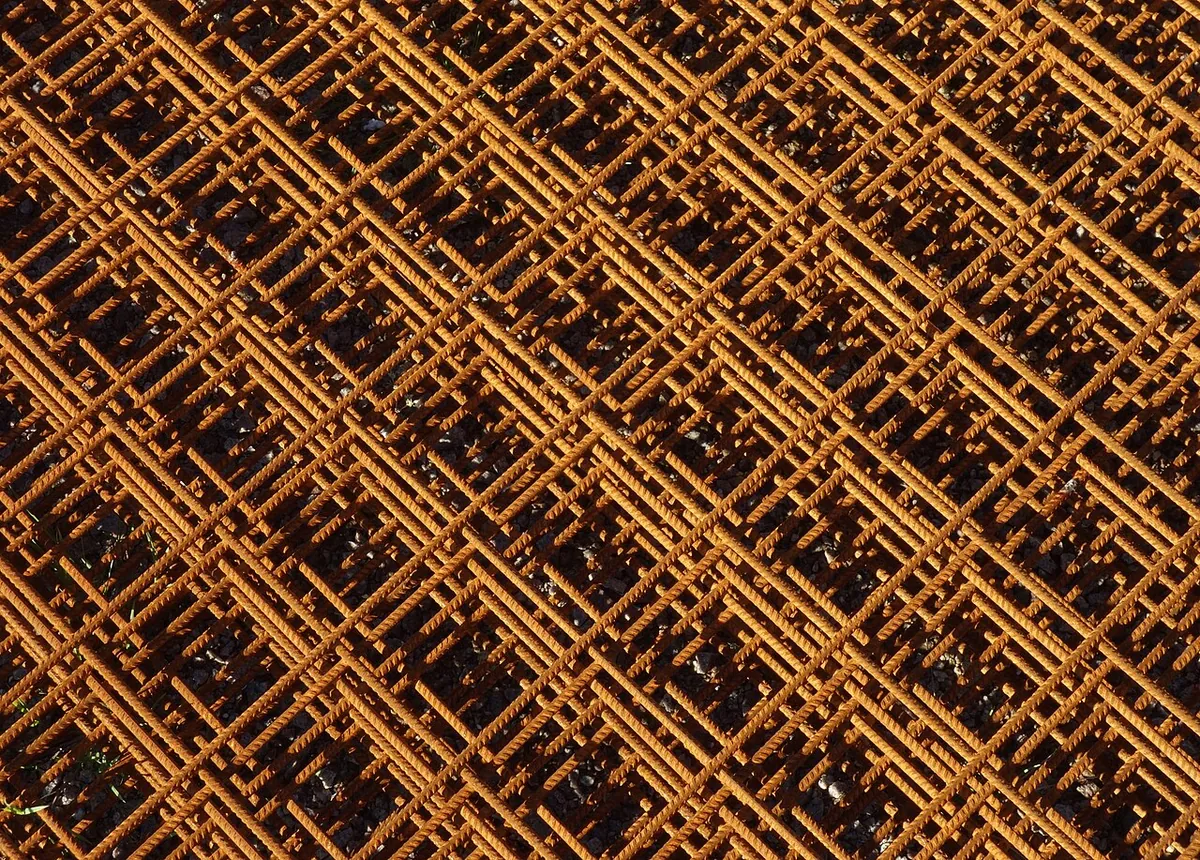
Photo: W.carter, Wikimedia Commons, CC BY-SA 4.0
- Prepare the base. Compact the gravel, set the forms and add a vapor retarder for indoor slabs.
- Cut the concrete mesh to fit with bolt cutters, leaving 2 to 3 inches of clearance from the forms and from walls so the edges have concrete cover.
- Flatten rolled mesh by unrolling it upside down against the curve, and walking or weighting it flat. Sheets skip this step.
- Lay the first sheet in one corner and work across the slab.
- Overlap each sheet as described below and tie the laps with wire every couple of feet.
- Set the chairs under the mesh at the right spacing and height.
- Check clearances at forms, drains and isolation joints. Do not run mesh across an isolation joint at a house, wall or existing slab.
- Pour with care. Use walk boards, and fix any section that gets pushed down before the concrete stiffens.
Lapping Concrete Welded Wire Mesh
Where two pieces of concrete welded wire mesh meet, they must overlap so the steel continues across the slab. A common rule from the Wire Reinforcement Institute and ACI practice for welded wire reinforcement is that the distance between the outermost cross wires of each sheet should be at least one cross-wire spacing plus 2 inches. With 6x6 mesh, that means overlapping at least one full 6-inch square plus 2 inches, or about 8 inches. Tie the lap with tie wire so the sheets do not slide apart during the pour.
Butting sheets edge to edge without a lap leaves a line with no steel across it, and that is often exactly where a crack forms.
Wire for Concrete Ties and Small Jobs
People who search for "concrete wire" or "wire for concrete" are often looking for one of two things: the mesh itself, or tie wire. Tie wire is soft, black annealed steel wire, usually 16 gauge, sold in coils or as precut loop ties. It is used to tie mesh laps, attach mesh to chairs, and tie rebar crossings. A pair of pliers or a tie hook twists each tie; on bigger jobs, a reel holder on the belt speeds things up.
Concrete wire of other kinds you may see includes galvanized or epoxy-coated mesh for slabs near salt or seawater, stucco and lath wire for plaster (not for slabs), and small stucco netting used in thin overlays. For slabs, stick with welded wire reinforcement or rebar.
Concrete Mesh Wire Cost
Prices vary by region and steel market, but typical U.S. ranges are:
- 6x6 W1.4 rolls (5 x 150 ft): about $150 to $300 per roll, or roughly $0.20 to $0.40 per square foot.
- 6x6 W1.4 sheets (5 x 10 ft): about $10 to $18 per sheet.
- 6x6 W2.9 sheets (5 x 10 ft): about $15 to $30 per sheet, or roughly $0.30 to $0.60 per square foot.
- Plastic chairs: about $0.15 to $0.60 each.
- Installed by a contractor: roughly $0.25 to $0.75 per square foot added to the slab price.
How much concrete wire mesh do I need?
Take the slab area, add about 10 to 15 percent for laps and cutting, and divide by the sheet or roll area. For a 20 by 20 foot slab (400 square feet), 400 × 1.15 = 460 square feet. That is 10 sheets of 5 by 10 feet (500 square feet), or one roll of 750 square feet with some left over. With chairs every 2 to 3 feet each way, plan on about 50 to 100 chairs. For a 24 by 24 garage floor (576 square feet), about 576 × 1.15 = 662 square feet, or 14 sheets.
For the full project price, see concrete slab cost, 20x20 concrete slab cost and concrete driveway cost. To order the concrete itself, see how to calculate yards of concrete.
Wire Mesh and Concrete vs Rebar vs Fiber
| Option | Strength | Ease of placing | Cost | Best for |
|---|---|---|---|---|
| Concrete wire mesh | Light to moderate | Fast, but hard to keep at mid-depth | Low | Patios, walks, basement floors, light driveways |
| Rebar | High | Slower; stays where you put it on chairs | Moderate | Driveways, garages, heavy pads, footings |
| Fibers | Controls small early cracks | Mixed into the concrete at the plant | Low to moderate | Patios, walks, any slab at risk of plastic shrinkage |
So which should you choose? For a patio or sidewalk on good soil, properly supported mesh or fibers are usually enough. For a driveway or garage, many contractors prefer rebar because it is stronger and much easier to keep at the right height, or they use heavy 6-gauge mesh sheets on chairs. For anything structural, use what the plans call for. Many crews combine fiber with mesh or rebar: the fiber handles early surface cracking and the steel holds later cracks tight. See our guide to rebar in concrete for bar sizes and spacing.
Is Wire Mesh for Concrete Driveways Enough?
For a 4- to 5-inch car driveway on firm, well-drained soil, heavy 6x6 W2.9 concrete wire mesh held at mid-depth on chairs, with control joints every 8 to 10 feet, has a long track record. The trouble is that many driveways are poured with light 10-gauge rolled mesh dragged along the ground, and those slabs crack and separate like plain concrete. If a driveway will carry delivery trucks, a camper, a boat trailer or heavy equipment, or if the soil is clay or fill, rebar at 18 inches each way is the safer choice. Thickened edges, a compacted gravel base at least 4 inches deep and good drainage do as much for a driveway as any steel. A driveway contractor quoting "wire mesh" should be able to tell you the mesh size, whether it comes in sheets or rolls, and how it will be held up during the pour; if the answer is "we pull it up", ask for chairs or rebar instead.
Wire Mesh for Concrete Slab Floors Indoors
Basement floors, garage floors and slab-on-grade house floors are where wire mesh for concrete slab work is still used the most. Indoors, the slab is protected from freeze-thaw and road salt, so light mesh lasts well, and its main job is to keep shrinkage cracks tight under flooring. A few points matter more indoors:
- Vapor retarder first. Lay the plastic vapor retarder on the base, then set the chairs on top of it. Chairs with a wide base keep from punching through the plastic.
- Keep mesh out of the joints. Interior slabs also need control joints. Some designers stop the mesh or cut every other wire at joints so the joint can open cleanly; follow the plans.
- Watch radiant heat tubing. In heated floors, the tubing is often tied to the mesh, which then sets the tubing depth. Use sheets and chairs so both stay at the right height.
- Plan for flooring. Tile and hard flooring show cracks the most. Tight, well-placed mesh plus well-spaced joints help, but tile installers still use crack isolation membranes over slabs that may move.
Mesh Wire for Concrete Walls, Steps and Small Projects
Mesh wire for concrete is not only for flat slabs. You will also see it used in:
- Concrete steps and landings, often combined with rebar in the risers. See concrete steps cost.
- Tilt-up and precast panels, where heavy deformed mesh replaces hand-tied bars.
- Shotcrete and pool shells, together with rebar.
- Small DIY pieces such as stepping stones, planters and garden benches, where pieces of light wire mesh and concrete give thin castings some strength. Cut the mesh an inch smaller than the mold all around so no wire shows at the edges. See how to make concrete stepping stones and how to make concrete planters.
Thin overlays and resurfacers, usually under 1 inch, do not use welded mesh, because there is not enough thickness to cover it. If an overlay needs extra strength, it uses fibers or a thin bonded overlay system; see how to resurface concrete.
Does Concrete Wire Mesh Rust?
Plain steel mesh starts with a little surface rust from sitting in the yard, and that is normal; light rust does not hurt the bond with the concrete. Once it is buried in good concrete with enough cover, the alkaline cement paste protects the steel and it can last for many decades. Concrete wire mesh rusts inside a slab when:
- It is too close to the surface, so water and salt reach it through small cracks.
- It sticks out at the edges or touches the forms.
- The slab is exposed to deicing salt, seawater or pool chemicals for years.
- The concrete is weak or very porous from too much water in the mix.
Rusting steel expands, cracks the concrete above it and leaves orange stains. For driveways and patios in salt country or near the coast, galvanized or epoxy-coated mesh, more cover, an air-entrained mix and a good sealer all help. See does salt damage concrete and how to seal concrete.
Common Concrete Wire Mesh Mistakes
- Mesh on the ground. The most common and most costly mistake. Use chairs.
- Pulling mesh up during the pour. It does not stay where you pull it.
- No laps or short laps. Overlap at least one square plus 2 inches.
- Mesh touching the forms or sticking out. Edges need concrete cover, or rust stains and spalls will show up along the edges.
- Curled rolled mesh poking out of the finished surface. Flatten rolls well, or buy sheets.
- Mesh across isolation joints. Slabs meant to move separately should not be tied together.
- Skipping control joints because "the mesh will hold it". It won't stop cracking; joints decide where cracks go.
Mesh that ends up too close to the surface can also rust and cause small pop-outs and spalling, and the brown streaks covered in removing rust stains from concrete.
Cutting or Removing Concrete With Wire Mesh
If you later cut a slab that has mesh, a diamond blade cuts the wires along with the concrete; see how to cut concrete. When breaking out an old patio or driveway, the mesh holds the broken pieces together, so plan on bolt cutters to snip the wires as you pry the slab apart. Our guide on how to remove concrete walks through the process.
Frequently Asked Questions
What size wire mesh for concrete patio slabs?
Most 4-inch patios use 6x6 W1.4xW1.4 (6x6 10/10) or 6x6 W2.1xW2.1 mesh, held near mid-depth on chairs. Fiber is a common alternative.
What wire mesh for concrete driveway slabs?
Heavier 6x6 W2.9xW2.9 (6x6 6/6) sheets on chairs, or #3 or #4 rebar. Many contractors prefer rebar for driveways.
Where should concrete wire mesh be placed in a slab?
Near the middle of the slab or slightly above it, about 2 inches down in a 4-inch slab, supported on chairs. Mesh on the gravel does little.
Is wire mesh for concrete necessary?
Not always. Small patios and walks often use fiber or no reinforcement. Mesh helps hold cracks tight, but only if it is placed correctly.
How much should wire mesh overlap?
At least one cross-wire spacing plus 2 inches between the outermost cross wires; with 6x6 mesh, about 8 inches. Tie the laps.
Is concrete mesh better than rebar?
No. Rebar is stronger and easier to keep at the right height. Mesh is cheaper and faster for light slabs.
What does 6x6 10/10 wire mesh mean?
Wires 6 inches apart each way, made of 10-gauge wire. Its modern label is 6x6 W1.4xW1.4.
Can I use chicken wire as mesh for concrete?
No. Chicken wire is thin, twisted and not welded, and it adds almost no strength to a slab. Use welded wire mesh made for concrete, rebar or fibers.
Do you need chairs for wire mesh in concrete?
Yes. Without chairs, mesh ends up at the bottom of the slab where it does little. Use chairs every 2 to 3 feet, closer for light mesh.
Sources
- Wire Reinforcement Institute: welded wire reinforcement sizes, placement and lapping
- ASTM A1064: Carbon-Steel Wire and Welded Wire Reinforcement for Concrete
- Portland Cement Association: concrete slabs on ground and reinforcement
- Concrete Reinforcing Steel Institute: reinforcing steel and bar supports
Related Guides
- Fiber concrete guide — fiber types, dose per yard and cost
- Concrete pad for shed — shed slab size, thickness, cost and pouring
- Concrete moisture barrier guide — vapour barriers under slabs and on floors
- Concrete pads — sheds, AC units, hot tubs, carports
- Metal decking for concrete — composite steel deck floors