
Concrete Mixing Ratio: Cement, Sand, Gravel and Water Proportions
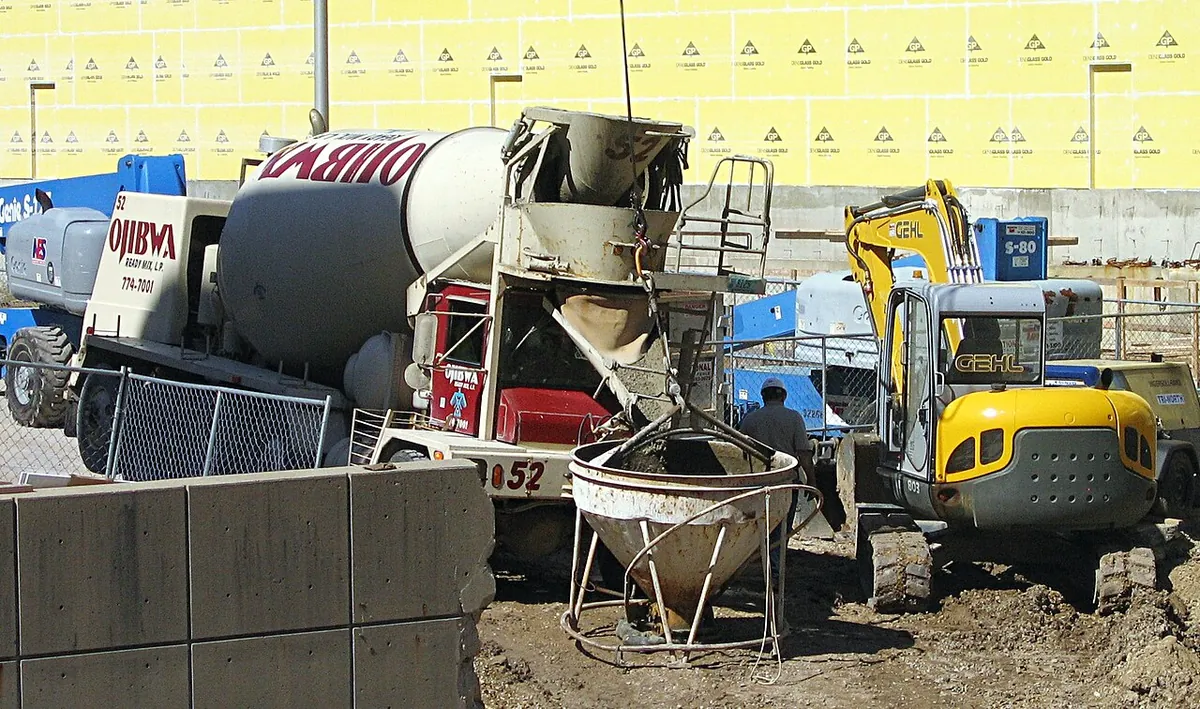
Photo: Michael Pereckas, Wikimedia Commons, CC BY-SA 2.0
Quick Answer
The most common concrete mixing ratio for home projects is 1:2:3 by volume: 1 part portland cement, 2 parts sand and 3 parts gravel, with just enough water to make a workable mix. That gives roughly 3,000 psi concrete for slabs, patios and posts. A stronger 1:1.5:3 mix suits driveways and steps, and a leaner 1:2:4 or 1:3:6 mix suits footings and fill. The water-cement ratio matters as much as the dry ratio: about 0.45 to 0.55 pounds of water per pound of cement, roughly 5 to 6 gallons per 94-pound bag. The concrete calculator formula for a slab is length × width × thickness in feet, divided by 27, for cubic yards.
Concrete is simple in principle: cement, sand, gravel and water. In practice, the concrete mixture proportion decides whether you get a strong, durable slab or a weak, dusty, cracked one. Too much water, too little cement or too much sand all show up later as cracks, scaling and crumbling edges. The good news is that a few standard ratios cover nearly every home project, and the math to figure quantities is straightforward.
This guide explains the common concrete mixing ratios and what each is for, how the water-cement ratio controls strength, how ratios by volume compare with mixture proportions by weight, how much cement, sand, gravel and water go into a cubic yard, the concrete calculator formula for slabs, footings and holes, and how to mix a batch by hand or in a mixer.
What Does a Concrete Mixing Ratio Mean?
A concrete mixing ratio lists the parts of cement, sand and coarse aggregate in that order. In a 1:2:3 mix, for every bucket of cement you add two buckets of sand and three buckets of gravel. The ratio is usually by loose volume for hand mixing and by weight for ready-mix plants. Water is listed separately, either as a water-cement ratio or as gallons per bag of cement.
The concrete cement mix ratio sets how much paste is available to coat the aggregates and fill the spaces between them. More cement per part of aggregate gives stronger, denser concrete, up to a point, but also costs more and can shrink more. Less cement saves money but weakens the concrete and makes it more porous. The aggregate proportions affect how the mix handles: more sand makes it creamy and easy to finish; more gravel makes it stiffer, stronger for the same cement and less prone to shrinkage.
Common Concrete Mixing Ratios and Their Uses
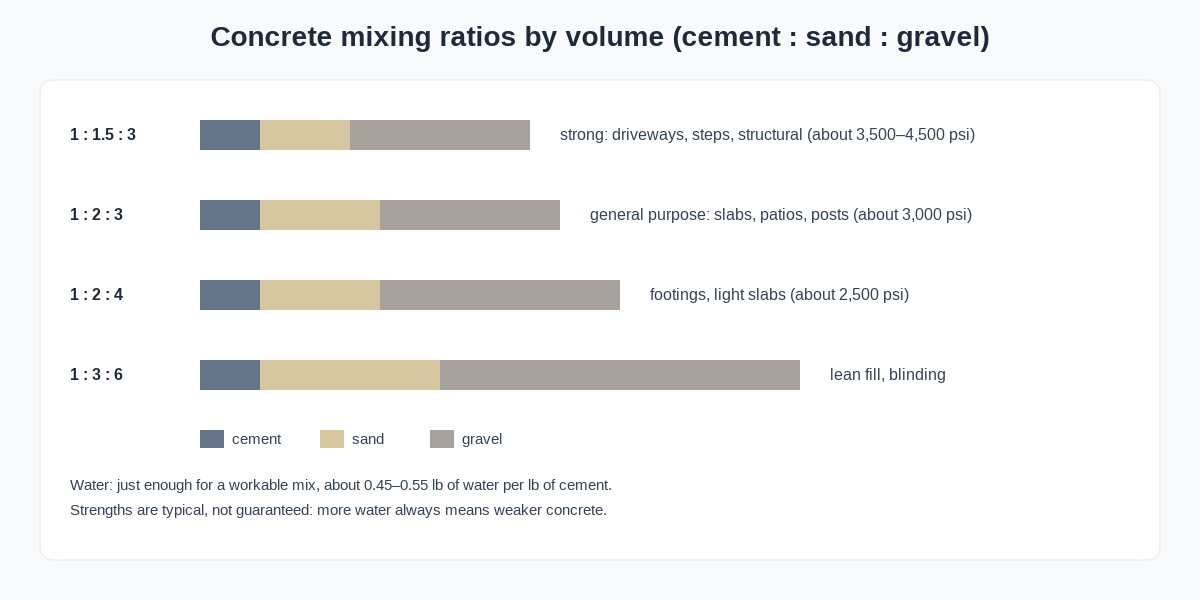
| Ratio (cement : sand : gravel) | Approx. strength | Typical uses |
|---|---|---|
| 1 : 1 : 2 | 4,500+ psi | High-strength structural work, thin sections |
| 1 : 1.5 : 3 | 3,500–4,500 psi | Driveways, steps, garage floors, beams and columns |
| 1 : 2 : 3 | About 3,000 psi | Slabs, patios, sidewalks, fence posts, general use |
| 1 : 2 : 4 | About 2,500 psi | Footings, foundations, light slabs |
| 1 : 3 : 6 | About 1,500 psi | Lean concrete, blinding under footings, fill |
Strengths are approximate and assume clean materials, a reasonable water-cement ratio and proper curing. In practice, the water you add changes the result more than the difference between 1:2:3 and 1:2:4.
Nominal mixes used internationally
Engineers in India and some other countries name standard nominal mixes by grade. Under the Indian standard IS 456, M10 is about 1:3:6, M15 is 1:2:4, M20 is 1:1.5:3 and M25 is about 1:1:2, where the number is the target strength in megapascals (M20 is about 2,900 psi). Higher grades are designed mixes proportioned by weight. The same ratios appear in many DIY guides around the world.
Water-Cement Ratio: The Most Important Number
Within any concrete mixing ratio, the water-cement ratio is the weight of water divided by the weight of cement. Cement needs only about 0.25 to 0.3 pounds of water per pound to hydrate fully; the extra water makes concrete workable but leaves tiny pores when it evaporates. The more water, the more pores, and the weaker and more permeable the concrete becomes. Roughly, raising the water-cement ratio from 0.45 to 0.65 can cut 28-day strength by about a third or more.
- 0.40 to 0.45: strong, durable concrete for driveways, freeze-thaw exposure and deicing salts.
- 0.45 to 0.55: typical for slabs, footings and general work.
- Above 0.60: weak, porous concrete that shrinks and dusts; avoid.
In gallons, a 94-pound bag of portland cement at a 0.5 water-cement ratio needs about 47 pounds of water, or about 5.6 gallons, including any water already in damp sand. For bagged concrete mix, most 80-pound bags call for about 3 quarts of water, sometimes up to about 3.5; add it gradually. The American Concrete Institute's durability rules limit the water-cement ratio to 0.45 for concrete exposed to freezing, thawing and deicing chemicals.
Concrete Mixture Proportion by Weight
The concrete mixture proportion at a ready-mix plant is set by weight, because weights are precise and do not change with how loosely sand is packed. A typical mixture proportion of concrete for one cubic yard of 4,000 psi air-entrained concrete might look like this:
| Material | Weight per cubic yard |
|---|---|
| Portland cement (or cement plus fly ash or slag) | About 520–600 lb (5.5 to 6.5 "sacks") |
| Water | About 250–280 lb (30 to 34 gallons) |
| Fine aggregate (sand) | About 1,200–1,400 lb |
| Coarse aggregate (3/4–1 in. stone) | About 1,700–1,900 lb |
| Air content | About 5–7% by volume |
| Admixtures | Ounces per 100 lb of cement |
Mix designers start from the required strength and exposure, choose the maximum aggregate size and water-cement ratio, then calculate the water, cement and aggregate weights using methods such as ACI 211. Those weights are adjusted daily for moisture in the sand and stone. A concrete ratio mix from a plant is therefore much more consistent than one batched by shovel. See concrete aggregate and concrete sand.
Concrete Calculator Formula
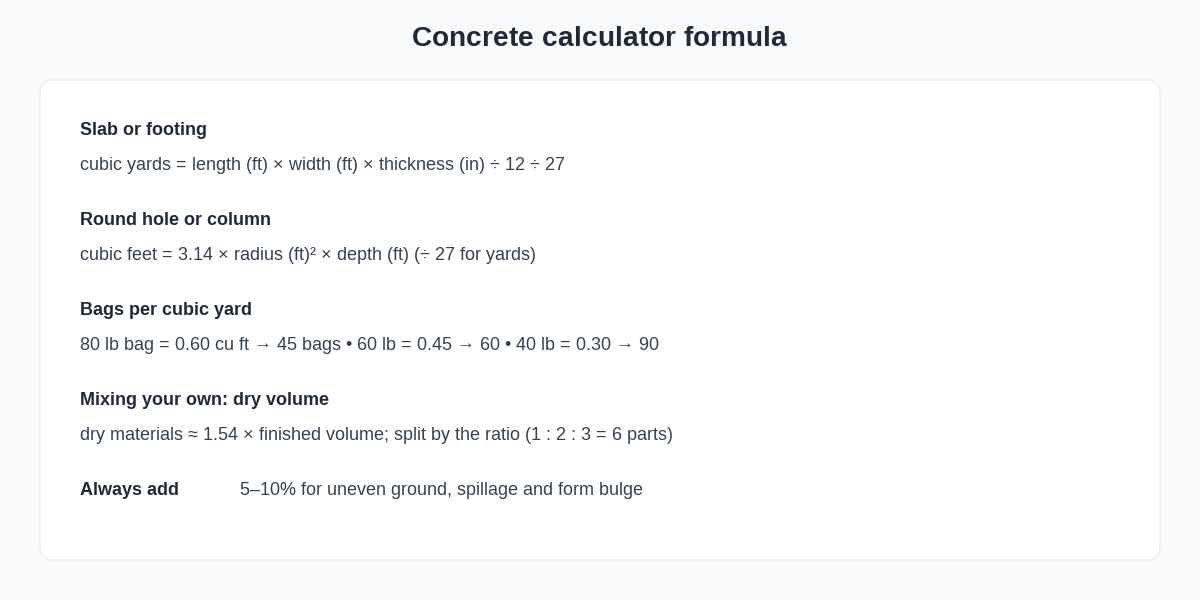
Before you can apply a concrete mixing ratio, you need the volume. The basic concrete calculator formula is:
- Slab, pad or footing: cubic yards = length (ft) × width (ft) × thickness (in) ÷ 12 ÷ 27.
- Round hole, pier or column: cubic feet = 3.14 × radius (ft)² × height (ft); divide by 27 for yards.
- Steps: treat them as stacked layers; see pouring concrete steps.
Example: a 10 × 12 foot patio, 4 inches thick: 10 × 12 × 4 ÷ 12 ÷ 27 = 1.48 cubic yards. Add 5 to 10 percent, so order about 1.6 yards. That concrete formula is the same one every online concrete calculator uses. For more shapes, see how to calculate yards of concrete.
Turning volume into materials
Because dry materials shrink when water is added and the sand fills gaps in the gravel, you need about 1.5 times the finished volume in dry materials. For a 1:2:3 concrete mixing ratio, the total is 6 parts. For one cubic yard (27 cubic feet) of finished concrete: dry volume ≈ 27 × 1.54 ≈ 41.6 cubic feet; one part ≈ 6.9 cubic feet. So you need about 6.9 cubic feet of cement (about 7 bags of 94 pounds), 13.9 cubic feet of sand and 20.8 cubic feet of gravel, plus about 35 to 40 gallons of water depending on sand moisture.
For bagged concrete mix, simply divide: an 80-pound bag yields about 0.6 cubic feet, so a cubic yard takes about 45 bags; 60-pound bags yield 0.45 (60 bags per yard); 40-pound bags yield 0.3 (90 bags). See how many bags of concrete in a yard.
Bagged Concrete Mix to Cement Ratio
People sometimes ask about the concrete mix to cement ratio in bagged products: how much cement is in a bag of premixed concrete. Manufacturers do not always publish exact recipes, but a standard 80-pound bag of concrete mix typically contains roughly 10 to 13 pounds of cement, with the rest sand and gravel, which works out close to a 1:2:3 or 1:2.5:3.5 mix. High-strength bags contain more cement. Adding extra portland cement to bagged mix is generally unnecessary and can make it shrink and crack more; if you need stronger concrete, buy a high-strength mix or order ready-mix with a specified strength.
Concrete Ratio: Mixture by Volume vs by Weight
A volume-based concrete mixing ratio is easy to use on a small job: one bucket, one shovel, count the scoops. But loose sand bulks up when damp, a shovel holds different amounts of sand and gravel, and cement settles in the bag, so volume batching can vary by 10 percent or more from batch to batch. A weight ratio removes most of that error, which is why every ready-mix plant, precast plant and lab uses weights. For home batches, the most practical compromise is to measure every material with the same bucket, filled level, and to use sand from the same part of the pile throughout. If you want to convert a weight-based mix design to buckets, you need the bulk density of each material: roughly 94 pounds per cubic foot for loose cement, 90 to 105 for damp sand and 95 to 105 for gravel.
Whatever the mixture, concrete ratio errors are easiest to fix before the water goes in. Once a batch is wet, adding more cement or sand rarely blends evenly and often makes things worse.
Choosing a Concrete Mixing Ratio for Your Project
Driveways and garage floors. Use the stronger 1:1.5:3 ratio by hand, or better, order 4,000 psi air-entrained ready-mix with a maximum water-cement ratio of 0.45. Driveways see traffic, freeze-thaw cycles and salt, so strength and low permeability matter. See how thick a concrete driveway should be.
Patios, sidewalks and shed pads. A 1:2:3 concrete mixing ratio is the standard choice, with 3,000 to 3,500 psi ready-mix as the truck equivalent. In cold climates, use air-entrained concrete outdoors.
Footings and foundations. 1:2:4 or 1:2:3 by hand, or 2,500 to 3,000 psi ready-mix, as your code requires. See concrete footings.
Fence posts. Fast-setting post mix or a 1:2:3 batch. See concrete fence posts.
Countertops and thin castings. Richer mixes with small aggregate, often 1:1.5:2 with 3/8-inch stone, or a dedicated countertop mix. See concrete countertops.
Repairs and toppings. Sand mix or repair mortar, roughly 1 part cement to 2.5 to 3 parts sand, with a bonding agent. See concrete patching compound.
Admixtures: Fine-Tuning the Mix
Ready-mix concrete almost always includes small amounts of chemical admixtures that change how the mix behaves without changing the basic concrete mixture proportion. Air-entraining agents create billions of tiny bubbles that give water room to expand when it freezes, which is essential for outdoor concrete in cold climates. Water reducers and superplasticizers make concrete flow with less water, so you get workability without raising the water-cement ratio. Accelerators speed setting in cold weather; retarders slow it in hot weather or for long hauls. Supplementary materials such as fly ash and slag replace part of the cement, improving long-term strength and durability and lowering cost and carbon. Homeowners rarely add admixtures to small batches, but when ordering ready-mix, ask the plant for their standard exterior flatwork mix for your climate.
Ratios for Mortar, Grout and Sand Mix
Concrete is not the only cement-based mix around the house, and each has its own typical ratio. Mortar for bricks and blocks is usually 1 part cement to about 3 parts sand by volume, often with lime added, as in Type N and Type S mortar. Grout for filling block cores is a fluid mix of cement, sand and sometimes pea gravel, roughly 1 part cement to 2 or 3 parts aggregate, with enough water to flow. Sand mix for toppings is about 1 part cement to 2.5 to 3 parts sand. Stucco scratch and brown coats run around 1 part cement to 3 to 4 parts sand with lime. None of these replaces concrete with gravel for slabs, footings or posts. See mortar vs concrete and cement vs concrete.
Troubleshooting a Bad Batch
If a batch is too stiff to place, the temptation is to change the concrete ratio mix by adding water, but every extra gallon per cubic yard costs strength. For hand batches, add water in small amounts while mixing, and if a batch is badly overwatered, add a proportional amount of cement, sand and gravel to bring it back rather than just more cement. If the mix is sticky and hard to finish, it may have too much sand or too fine a sand. If it is rocky and harsh, with stones poking through, it needs a little more sand. If water and cement bleed heavily to the surface, there may be too much water or too little fine material. If concrete stays soft for days, the cement may have been old and lumpy, the water may have been contaminated, or the weather too cold. Most of these problems disappear when you measure consistently and keep the water under control. For cracking and weak surfaces after the fact, see why concrete cracks and concrete pitting and flaking.
Strength Gain and Curing
The concrete mixing ratio sets the potential strength, but curing decides how much of it you actually get. Concrete reaches roughly 70 percent of its 28-day strength in about 7 days under good conditions, and keeps gaining strength slowly for months as long as moisture is present. Concrete that dries out too fast in the first few days, especially on hot, windy days, can lose a large share of its potential strength and develop a weak, dusty surface. Keep new concrete damp with plastic sheeting, wet burlap or a curing compound for at least 5 to 7 days, and longer in cool weather, when strength gain is slower and the concrete mixing ratio alone cannot make up for poor curing. See how long concrete takes to cure.
Worked Example: Patio Slab From Start to Finish
Say you are pouring a 10 × 10 foot patio, 4 inches thick, and want to mix it yourself with a 1:2:3 concrete mixing ratio. Start with the concrete calculator formula: 10 × 10 × 4 ÷ 12 = 33.3 cubic feet, or 1.23 cubic yards. Add about 8 percent for waste and you need about 36 cubic feet of finished concrete. Multiply by 1.54 for dry volume: about 55 cubic feet of dry materials. Divide by 6 parts: each part is about 9.2 cubic feet. So you need about 9 bags of 94-pound portland cement, 18.5 cubic feet of concrete sand (about 0.7 cubic yard, roughly 1 ton) and 27.5 cubic feet of gravel (about 1 cubic yard, roughly 1.4 tons). At a water-cement ratio near 0.5, the water is about 9 × 47 = 420 pounds, roughly 50 gallons in total, less whatever the damp sand already carries.
The same patio from bagged concrete mix would take about 36 ÷ 0.6 = 60 bags of 80-pound mix. From a ready-mix truck it is a 1.25-yard order, often subject to a short-load fee. Comparing the three options on price, time and labor usually makes the choice obvious: for a slab this size, many homeowners pick the truck. Mixing 60 bags by hand is a long, heavy day for two people, and the last batches are often placed against concrete that has already started to stiffen, which risks cold joints and an uneven finish. See concrete price per yard and how much a bag of concrete costs.
Concrete Mixing Ratio Myths
"More cement is always stronger." Up to a point. Very rich mixes shrink and crack more, generate more heat and cost more. A sensible concrete cement mix ratio with a low water-cement ratio beats a cement-heavy mix with too much water.
"Wetter concrete is easier, so it is fine." Easier to place, yes. But each extra gallon of water per cubic yard can reduce strength by a few hundred psi and increase shrinkage and surface dusting. Use a water reducer or a slightly richer mix instead.
"Any sand and gravel will do." Dirty sand, play sand or road base can ruin a good ratio. Use washed concrete sand and clean stone; see concrete sand and concrete aggregate.
"The ratio is all that matters." Mixing time, consolidation, finishing and curing all affect the final strength. A perfect mixture concrete ratio can still give weak concrete if it dries out on day one.
Batch Sizes and Measuring on Site
A typical 3- to 4-cubic-foot portable drum mixer handles about 2 to 2.5 cubic feet of concrete per batch, which with a 1:2:3 concrete mixing ratio is roughly one third of a 94-pound bag of cement, two thirds of a cubic foot of sand and one cubic foot of gravel. Many people find it easier to batch around whole or half bags: half a bag of cement, about 1 cubic foot of sand and 1.5 cubic feet of gravel makes about 2 cubic feet of concrete. Mark a 5-gallon bucket at the 0.5 and 0.67 cubic foot levels (a 5-gallon bucket holds about 0.67 cubic feet when full) so every scoop is the same. Write the recipe in large letters on a board next to the mixer, including the water per batch, so helpers stay consistent. Keep a stopwatch or phone timer to mix each batch for the same time, and place each batch before you start mixing the next one.
Concrete Formula for Walls, Columns and Curbs
The same volume concrete formula extends to other shapes. A wall or curb is length × height × thickness in feet. A square column is width × depth × height. A round column or sonotube is 3.14 × radius² × height. For a curb and gutter or an irregular shape, break it into rectangles and triangles, calculate each, and add them up. Then apply the concrete mixing ratio to the total, adding waste. For example, a 20-foot garden wall footing 16 inches wide and 8 inches deep is 20 × 1.33 × 0.67 = 17.8 cubic feet, or 0.66 cubic yard, which is about 30 bags of 80-pound mix or a small mixer job at 1:2:4.
How to Mix Concrete by Hand or in a Mixer
- Measure with the same bucket for every material. Use damp, not soaked, sand and gravel.
- In a mixer: add about half the water and the gravel first, then cement, then sand, then the remaining water a little at a time until the mix is workable. Mix about 3 to 5 minutes.
- By hand: spread the sand and cement in a wheelbarrow or tub and mix dry until the color is even, add the gravel and mix again, make a crater and add water gradually, folding the dry mix in with a hoe.
- Check consistency. The mix should hold its shape like thick oatmeal and slump slightly when you cut a groove with the hoe. If water pools on top, it is too wet.
- Place within about 30 to 60 minutes, and do not add water to a stiffening batch.
For mixer types and tips, see concrete cement mixers.
Frequently Asked Questions
What is the best concrete mixing ratio?
For most home projects, 1:2:3 (cement, sand, gravel) with a water-cement ratio around 0.5. Use 1:1.5:3 for driveways and steps.
What is the concrete calculator formula?
Cubic yards = length × width × thickness in feet ÷ 27. Convert inches to feet by dividing by 12, and add 5 to 10 percent extra.
How much water per bag of cement?
About 5 to 6 gallons per 94-pound bag of portland cement for typical concrete, less if the sand is wet. For 80-pound bags of concrete mix, about 3 quarts.
What is the mix of concrete ratio for footings?
1:2:4 is common for footings, or 1:2:3 for extra strength. Many codes call for at least 2,500 psi concrete.
Is concrete mixing ratio by weight or volume?
DIY ratios are usually by volume. Ready-mix plants batch by weight for accuracy.
Sources
- Portland Cement Association: design and control of concrete mixtures
- American Concrete Institute: ACI 211.1 proportioning and ACI 318 durability limits
- Bureau of Indian Standards: IS 456 plain and reinforced concrete
- National Ready Mixed Concrete Association: concrete in practice
Related Guides
- Concrete fence posts — concrete per post, best mix and cold weather
- Cement vs concrete — the difference explained
- Concrete sand guide — sand for concrete, pavers and sanding concrete
- Concrete aggregate guide — sizes, grading and types of stone
- How to make concrete — mixing in a bucket, wheelbarrow or mixer
- High strength concrete mix — psi classes, ingredients and cost
- Concrete admixture guide — air entrained concrete, water reducers and more
- Concrete slump test — what slump means and how to test it
- Concrete cylinder tests — strength testing and cylinder calculator
- Dry pour concrete — when pouring dry mix works and when it fails
- Sugar in concrete — how sugar delays or stops setting
- Concrete batching plant — how ready-mix is made
- Density of concrete — unit weight and modulus of elasticity
- 80 lb bags of concrete — yield, price and how many bags you need
- Sakrete concrete mix — High Strength, 5000 Plus and Fast Setting compared
- Wet concrete — how liquid concrete works, workability, setting times and safety
- Concrete canoe — how a concrete boat floats and the ASCE competition