
Concrete Release Agent: Types, Choosing the Right One, and How to Apply It

Photo: Stalform Engineering, Wikimedia Commons, CC BY-SA 3.0 (cropped)
Quick Answer
A concrete release agent is a coating applied to formwork, molds and stamping tools so that fresh concrete does not stick to them. There are two main types: barrier release agents, such as form oil and waxes, which form a physical film, and chemically reactive release agents, which react with lime in the concrete to form a thin soap layer and give cleaner surfaces with less residue. Use a thin, even coat, applied with a low-pressure sprayer, roller or rag, just before setting forms or pouring. For stamped concrete, colored release powders and liquid release agents keep stamp mats from sticking and add accent color. Release agents typically cost $10 to $40 per gallon and cover 500 to 1,500 square feet per gallon.
Concrete bonds tenaciously to almost anything it touches while it hardens: wood, steel, aluminum, plastic, even rubber. Without a barrier, forms stick, stripping them tears the surface of the concrete, and forms are damaged or ruined. A concrete release agent solves the problem. It lets forms come off cleanly, protects and extends the life of the forms, and gives a better concrete surface. The photo above shows a smooth concrete ceiling after steel coffer forms were stripped away, the kind of clean result a good release agent makes possible.
This guide explains how concrete release agents work, the main types, how to choose a release agent for different forms and molds, release agents for stamped concrete, how to apply them, common problems, safety and costs.
How a Concrete Release Agent Works
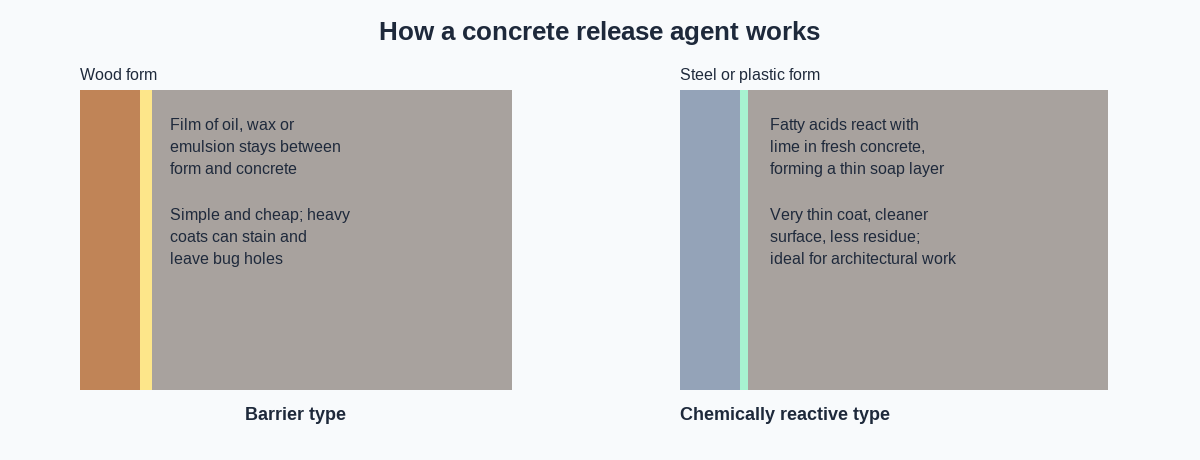
As the diagram shows, release agents work in one of two ways. Barrier release agents put a physical layer between the form and the concrete. Traditional form oils, diesel and used motor oil (now discouraged or banned), waxes and some emulsions are barrier types. They are simple and inexpensive, but if applied too heavily they can transfer to the concrete, leaving stains, a dusty or soft surface, and more surface voids called bug holes, and they can interfere with paints, sealers and coatings applied later.
Chemically reactive release agents contain fatty acids or similar compounds that react with free lime (calcium hydroxide) in the fresh concrete at the form face. The reaction forms a thin, water-insoluble metallic soap layer that prevents the concrete from bonding to the form. Because the reaction uses up the agent, very little residue is left on the concrete, and only a thin film is needed. Reactive agents generally give cleaner, more uniform architectural surfaces and are the preferred choice for exposed concrete, steel forms and reusable systems. Many modern products combine reactive chemistry with a light barrier oil, and many are water based or low in volatile organic compounds (VOCs) to meet air quality rules.
Types of Concrete Release Agents
Petroleum form oils. Mineral-oil-based barrier products, inexpensive and widely used on wood and steel forms for general construction. Some regions restrict them because of VOCs and environmental concerns.
Vegetable and bio-based release agents. Made from plant oils and esters, biodegradable and low in VOCs, increasingly popular for environmentally sensitive sites and precast plants.
Water-based emulsions. Oil or wax emulsified in water, low VOC, easy to clean up, and good for many forms; they must not freeze and need time to dry.
Chemically reactive agents. Fatty-acid based, solvent or water based, used for architectural concrete, steel and aluminum forms and precast molds.
Waxes and polymers. Used on fiberglass, plastic and rubber molds, decorative products and countertops, where a very smooth release is needed.
Form liners and coatings. Some plywood forms have factory-applied overlays such as medium density or high density overlay that release well with minimal agent and can be reused many times. See how to build concrete forms.
Choosing a Release Agent for Different Forms
Wood and plywood forms. Raw wood absorbs release agent, so the first application on new forms may need two coats. Barrier oils and water-based products are common. Seal new plywood or use overlaid plywood for better surfaces and more reuses.
Steel forms. Reactive release agents prevent bonding and help protect steel from rust between uses. Keep steel forms clean of concrete buildup.
Aluminum forms. Aluminum can react with alkaline concrete; use release agents specifically labeled for aluminum, often with corrosion inhibitors.
Plastic, fiberglass and rubber molds. Used for precast products, statues, planters and countertops; use release agents recommended by the mold maker, often wax, silicone-free polymers or light reactive agents, to avoid damaging the mold or leaving residue. See how to make concrete planters.
Cardboard tube forms. Spiral cardboard forms such as sonotubes usually have a release coating inside and need no extra agent. See sonotube.
Release Agents for Stamped Concrete
Stamped concrete uses release agents in a special way. Before stamping mats are pressed into fresh concrete, the surface is coated with a release so the mats lift off cleanly without pulling up paste. Powdered release agents, colored pigments mixed with a hydrophobic powder, are broadcast onto the surface; after the concrete cures, most of the powder is washed off, but some remains in the low spots and texture, creating an antiqued, two-tone look. Liquid release agents, sprayed onto the surface and the mats, leave little residue and keep the base color of the concrete; they are often combined with tinted sealers or stains for accent color. The choice affects the final appearance as much as the color hardener or integral color does. See stamped concrete patterns, stamped concrete patio and how to color concrete.
How to Apply a Concrete Release Agent

Photo: MTA Capital Construction, Wikimedia Commons, CC BY 2.0
1. Clean the forms. Remove old concrete, dirt and rust. Release agents cannot work properly over buildup, and old concrete will imprint on the new surface.
2. Choose the method. Use a low-pressure pump sprayer with a fine fan tip for most forms, or a roller, brush, mop or lint-free rag for small forms and molds.
3. Apply a thin, even coat. The goal is the thinnest continuous film that covers the whole surface. Excess release agent runs, puddles at the bottom of forms, and causes stains, soft surfaces and bug holes. Wipe off excess and puddles.
4. Avoid the rebar. Apply release agent before placing reinforcement where possible, or take care not to coat rebar, which reduces bond between steel and concrete.
5. Respect timing. Follow the maker's instructions for drying time before pouring; some water-based products must dry first, and many agents should not sit for weeks before the pour, collecting dust and rain.
6. Strip and clean. After stripping, clean and recoat forms promptly for the next use. Proper release extends the life of forms considerably. See how long does concrete take to cure.
Concrete Release Agent for Precast and Countertops
In precast plants and countertop shops, the concrete release agent is part of the product finish, not just a way to free the mold. Precast producers cast the same mold many times a day, so they use reactive or bio-based release agents applied by spray systems in thin, consistent films, which keep molds clean, reduce surface defects and give uniform color from piece to piece. Architectural precast with smooth, exposed faces often uses premium reactive agents that leave almost no residue, so stains, sealers and coatings bond well later. Countertop and furniture makers working with melamine, silicone and fiberglass molds often use a light wax, a specialty mold release, or even a thin coat of paste wax on melamine, buffed to a near-invisible film, because any excess concrete release agent can leave blotches, pinholes or a slippery surface that rejects sealer. Many makers test a new concrete release agent on a sample piece first, then finish and seal the sample to confirm that the surface and sealer perform as expected. See precast concrete, concrete countertops and concrete sink.
Release Agents for DIY Concrete Projects
Homeowners casting stepping stones, planters, garden statues, pavers and small slabs need a concrete release agent too, but on a small scale. For plastic molds, a commercial concrete release agent made for molds gives the best results, but light vegetable oil, cooking spray or a thin coat of petroleum jelly wiped on with a rag works for occasional crafts. Apply very little and wipe off the excess, because puddles of oil leave dark spots and bubbles on the finished piece. For wood forms on a patio or walkway, a dedicated form oil or water-based release, or simply wetting the boards and using a thin coat of release, makes stripping easier and protects the lumber for reuse. Avoid motor oil and diesel, which stain concrete and harm soil and water. Silicone sprays can work on some molds but may leave residue that prevents paint and sealer from sticking later. See how to make concrete stepping stones and concrete statues.
Release Agents and Architectural Concrete Finishes
On exposed, architectural concrete such as board-formed walls, smooth cast-in-place facades and precast panels, the choice and application of the concrete release agent strongly affects the finished appearance. Too much barrier oil leads to dark streaks, color variation between pours and more bug holes. Inconsistent application between form panels can show as a patchwork of light and dark areas. Reactive release agents applied in a very thin, uniform film give the most consistent color and the fewest surface defects. On board-formed concrete, where the wood grain is meant to imprint on the surface, release agents are chosen to let the texture transfer cleanly without the boards sticking or shedding fibers. Architects and contractors often build a mockup panel to test the concrete release agent, form material, mix and vibration together before the real work begins, and the approved mockup becomes the standard for the project. See decorative concrete and types of concrete finishes.
Storing and Handling Release Agents
Store any concrete release agent according to its label. Water-based products must be protected from freezing, which can break the emulsion and ruin the product. Solvent-based products should be kept in closed containers away from heat and flames. Stir or shake products that separate before use. Keep sprayers clean, flushing them after each use so tips do not clog. Label containers clearly on jobsites so release agent is not mistaken for curing compound or sealer, which serve very different purposes. Use the oldest stock first and check shelf life, since some products lose effectiveness over time.
Applying Release Agents in Hot and Cold Weather
Weather changes how a concrete release agent behaves. In hot, dry, windy conditions, water-based release agents can dry too fast, and solvent carriers flash off before the film levels, so crews apply in the cooler part of the day, keep forms shaded when possible and avoid spraying onto forms that are too hot to touch. Steel forms sitting in direct sun can reach temperatures that bake the film and reduce its effect, so a light mist of water to cool the steel before spraying helps. In cold weather, water-based products can freeze on the form or in the sprayer, and oils thicken so they spray unevenly and build up too heavy a coat. Many manufacturers make winter grades of form release agent with a lower pour point for cold work. Never apply any release agent to frost, ice or snow on the form, because the film will not bond and the ice melts into the fresh concrete surface. Check the product data sheet for the minimum and maximum application temperatures and the time window between spraying and placing concrete, since some reactive release agents need a short drying time while others can be poured over almost immediately. See pouring concrete in cold weather and temperature to pour concrete.
Release Agents, Coatings and Sealers
Anything left on the concrete surface after stripping can affect what goes on it later. Heavy barrier oils and some waxes leave a film that interferes with paint, epoxy, sealer, plaster, tile adhesive and waterproofing membranes. If a wall or slab will be coated, choose a concrete release agent that the manufacturer states is compatible with later finishes, apply it thinly, and test adhesion before coating large areas. A simple water drop test shows whether a residue is present: if water beads on the surface instead of darkening the concrete, a film is likely still there. Residue can be removed with a degreaser and scrubbing, pressure washing or light mechanical abrasion such as grinding or shot blasting, though it is easier and cheaper to avoid it in the first place. Reactive release agents generally leave the least residue because most of the product reacts with the cement paste and is used up at the surface. See concrete primer, concrete sealer and how to paint cinder blocks.
Release Agents Compared with Curing Compounds and Bond Breakers
Several spray-on products used in concrete work look similar but do different jobs. A concrete release agent goes on the form before the pour and keeps the concrete from bonding to it. A curing compound goes on the exposed concrete surface after finishing and holds moisture in so the concrete cures properly. A bond breaker is sprayed on a hardened concrete surface, such as a slab used as a casting bed for tilt-up wall panels, so that new concrete poured on top can be lifted off later. Some tilt-up bond breakers also act as a curing compound for the casting slab. A stamping release, used with decorative stamp mats, keeps the mats from sticking to fresh concrete and often adds an antiquing color. Using the wrong product can cause stuck forms, poor curing, or coatings that fail to bond, so read labels and keep products separated on site. See concrete curing compound.
Cleaning Forms Before Applying Release Agent
A concrete release agent works best on a clean form. Old concrete, cement paste, rust and dirt left on forms transfer to the next pour as rough patches and stains, and they stop the release film from forming evenly. After each stripping, scrape off remaining concrete with plastic or wooden scrapers on plywood and with steel scrapers or wire brushes on steel forms, then sweep or blow off dust. Some contractors use form cleaners, which are mildly acidic or chemical products that loosen cement buildup. Check plywood for damaged faces, delamination and holes, and patch or replace panels as needed, since damaged areas absorb release agent and stick. New wood forms often need a heavier first coat because the dry wood absorbs more product, while plastic-coated and overlaid plywood needs much less. Steel forms should be kept lightly oiled between uses to prevent rust, which otherwise shows as orange stains on the concrete.
How Much Release Agent to Use
The right amount of concrete release agent is less than most people expect. Coverage rates depend on the product and the form surface, but typical values run from roughly 600 to 1,500 square feet per gallon for reactive agents on smooth steel or overlaid plywood, and around 300 to 800 square feet per gallon on raw wood. The goal is a thin, even film with no runs, puddles or dry spots. A good check is to wipe a finger across the form after spraying: it should feel slightly slick but should not pick up a visible drip. On vertical forms, excess release agent runs down and collects at the bottom, where it causes dark staining and bug holes in the concrete, so remove puddles with a rag or a squeegee. Low-pressure pump sprayers with fan tips give better control than brushes or rollers, though rollers and rags work for small areas and molds.
Environmental and Safety Points
Modern concrete release agents are designed to be safer than the diesel and used motor oil once common on jobsites. Many regions now limit volatile organic compound content, so water-based and low-VOC products are the standard. Bio-based release agents made from vegetable oils are biodegradable and reduce the risk to soil and water if overspray or runoff occurs. Still, wear gloves and eye protection when spraying, avoid breathing mist, and follow the safety data sheet. Keep release agent off rebar and embedded items, because the film can reduce the bond between steel and concrete. Do not let overspray land on existing concrete joints or surfaces where new concrete must bond. Dispose of leftover product and containers according to local rules, and never pour release agent into storm drains.
Choosing a Release Agent by Form Material and Finish
A simple way to pick a concrete release agent is to start with the form material and the finish you need. For raw plywood and dimensional lumber on footings, foundation walls and slab edges where the surface will be buried or covered, an economical barrier form oil or a general water-based release agent is enough. For high density overlay and medium density overlay plywood on walls that will stay exposed, a reactive chemical release agent applied thinly gives a smoother, more even face and extends panel life. For steel and aluminum forms used many times, choose a reactive product with rust protection, and keep the forms lightly coated between pours. For fiberglass, plastic, rubber and silicone molds in precast and decorative work, use a release agent the mold maker approves, since some oils swell rubber or soften plastics. For stamped and textured flatwork, use a liquid or powder stamping release made for stamp mats. When the concrete will be painted, sealed or tiled later, choose a low-residue concrete release agent and confirm compatibility with the coating supplier. Whatever product you choose, apply it thinly, keep forms clean and test it on a small area first. Keep a record of which product and coverage rate worked on each form type, so the next crew can repeat the same result without guessing, and reorder the same concrete release agent instead of switching brands mid-project, because a change in product can show as a change in surface color on exposed walls. See concrete formwork for form types, ties and stripping times.
Common Problems and How to Avoid Them
Staining and discoloration. Usually from too much release agent or mixing products. Apply thin, uniform coats and use the same product throughout.
Bug holes and surface voids. Excess barrier oil traps air bubbles at the form face. Use thin coats, reactive agents, and proper vibration. See concrete vibrator.
Dusting or soft surfaces. Over-application or incompatible agents can weaken the surface paste.
Sticking. Areas missed during application, worn forms, or agents that evaporated too long before the pour.
Coating adhesion problems. Residual barrier oils can prevent paint, sealers and coatings from bonding. Use compatible reactive agents or clean the surface before coating. See concrete paint and concrete sealer.
Safety and Environmental Notes
Read the safety data sheet. Solvent-based release agents can be flammable and produce vapors; use them with ventilation and away from flames. Wear gloves and eye protection, and avoid breathing spray mist. Never use diesel, used motor oil or other improvised products as release agents: they stain concrete, contaminate soil and water, and are prohibited in many places. Water-based and bio-based release agents reduce VOC emissions and are safer around waterways and sensitive sites. Dispose of leftover product and containers as directed.
Concrete Release Agent Cost
Basic petroleum form oils typically cost about $10 to $20 per gallon in bulk, water-based and bio-based release agents about $15 to $35 per gallon, and premium chemically reactive agents about $20 to $40 per gallon or more. Coverage is usually 500 to 1,500 square feet per gallon depending on the product and form surface, so release agent typically adds only a few cents per square foot of form contact area. Stamped concrete release powders cost about $40 to $80 per 25 to 30 pound pail, covering roughly 600 to 1,000 square feet, and liquid stamping release about $20 to $50 per gallon. See stamped concrete driveway.
Frequently Asked Questions
What is a concrete release agent?
A coating applied to forms, molds or stamping tools so fresh concrete does not stick to them.
Can I use cooking oil as a concrete release agent?
For small DIY crafts, light vegetable oil can work, but commercial release agents give more consistent results and fewer stains.
What is the difference between form oil and reactive release?
Form oil is a barrier film; reactive agents react with lime in the concrete to form a thin soap layer, giving cleaner surfaces with less residue.
How much release agent should I use?
The thinnest continuous coat that covers the form. Excess causes stains and bug holes.
Do I need release agent on sonotubes?
Usually not; most cardboard tube forms have a built-in release coating.
Sources
- American Concrete Institute: ACI 347 guide to formwork for concrete
- ACI 303R guide to cast-in-place architectural concrete practice
- Portland Cement Association: formwork and release agents
- US EPA: VOC rules for architectural and industrial coatings
Related Guides
- Concrete formwork — form types, materials, form pressure, ties and stripping times