
Stamped Concrete Driveway: Cost, Patterns, Construction and Care
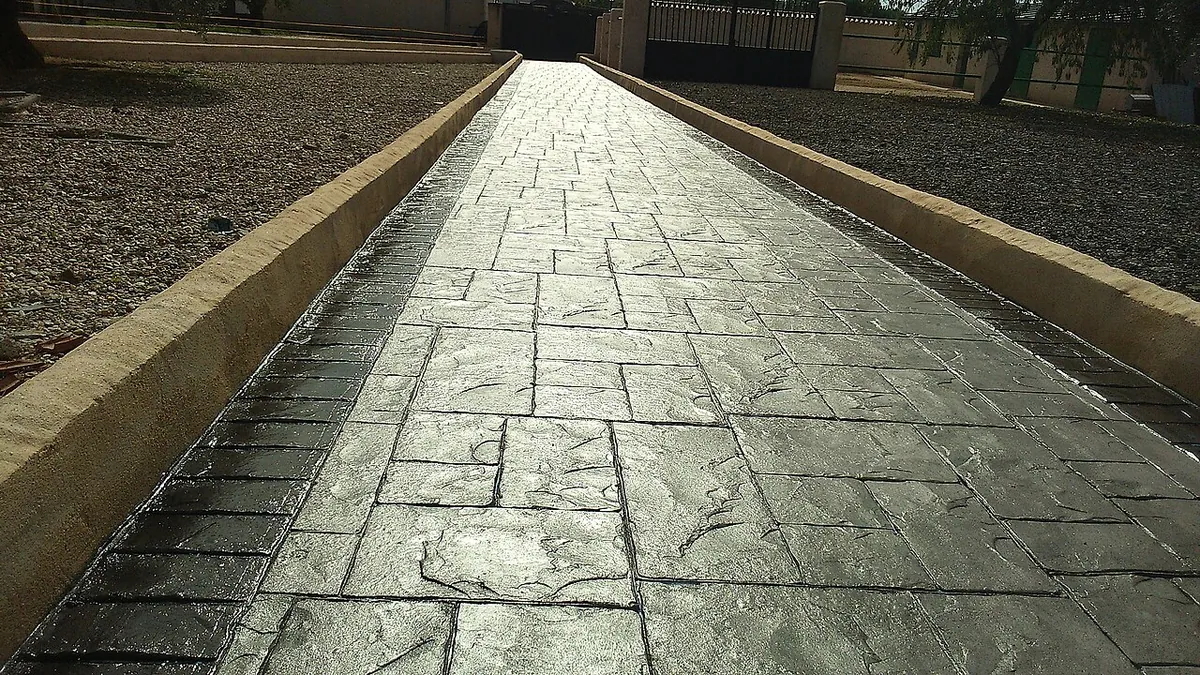
Photo: Sorin1980, Wikimedia Commons, CC BY-SA 4.0
Quick Answer
A stamped concrete driveway is a concrete driveway pressed with patterned mats and colored to look like stone, brick or cobblestone. It typically costs about $12 to $20 or more per square foot installed, roughly $8,000 to $16,000 for a typical two-car driveway, compared with about $6 to $12 for plain concrete. It should be built at least 4 to 5 inches thick, 5 to 6 inches for heavier vehicles, on a compacted gravel base with reinforcement, air-entrained concrete in cold climates, and control joints cut along pattern lines. Good driveway concrete stamps are cobblestone, European fan, brick and ashlar slate. A stamped driveway needs a sealer that resists hot tires and salt, resealed every two to three years. Well built, it can last 25 years or more.
The driveway is often the largest paved area at a house and one of the first things visitors see. A plain gray slab does the job, but a stamped concrete driveway can look like a cobblestone lane, a slate court or a brick drive, adding a lot of curb appeal for less than natural stone or many paver systems. It is also one of the most demanding places to use stamped concrete, because it has to carry vehicles, resist tire marks, oil and salt, and handle freeze-thaw cycles in cold climates.
This guide explains what a stamped concrete driveway costs, which patterns and colors work best, how it must be built to carry cars and trucks, how to seal and maintain it, the pros and cons, and how stamped concrete driveways compare with pavers, asphalt and plain concrete.
Stamped Concrete Driveway Cost
In many U.S. markets, a stamped concrete driveway costs roughly $12 to $20 per square foot installed, and complex designs with multiple colors, borders and hand detailing can exceed $25. A plain broom-finish concrete driveway typically costs about $6 to $12 per square foot, so stamping and coloring roughly double the price. For a 20 by 24 foot two-car driveway, about 480 square feet, a stamped concrete driveway might cost about $6,000 to $10,000; for a longer 600 to 800 square foot driveway, around $8,000 to $16,000. Removal of an old driveway, often $2 to $6 per square foot, grading, extra thickness, rebar, aprons, and city permits for the curb cut add to the total. See concrete driveway cost and driveway cost per square foot.
Several things drive the price: driveway size, because large driveways cost less per square foot; the number of colors and whether color hardener, integral color or both are used; the pattern and borders; thickness and reinforcement; site access and slope; and local labor rates. A popular way to save is a plain broom-finish center with stamped borders, or stamping only the visible front section and apron.
Best Driveway Concrete Stamps
Not every stamped pattern suits a driveway. The best driveway concrete stamps have many joint lines and moderate texture. Cobblestone and European fan patterns, like many old European streets, hide tire marks and small cracks well and look right on a drive. Brick in running bond or herringbone is classic and also handles traffic well. Ashlar slate, like the driveway pictured above, gives a cleaner look and is popular on modern homes. Very deep flagstone joints can trap water, dirt and ice, and very smooth seamless textures can be slippery and show tire marks, so use them carefully on driveways.
Borders are common on stamped concrete driveways: a band of brick, a smooth strip, or a contrasting color along the edges and at the street frames the drive and hides joints. The photo above shows dark gray borders along both sides of a lighter slate field.
Colors for Stamped Concrete Driveways
Color choice matters more on a stamped concrete driveway than on a patio, because tires, oil, dirt and salt all show on the surface. Medium tones such as gray, charcoal blends, sandstone and brown hide tire marks and dirt better than very light colors, while very dark colors show salt residue and fade more visibly in the sun. Many stamped concrete driveways use a medium base color with a darker accent in the joints, which hides dirt in the grooves naturally. Coordinate the color with the house, roof and landscaping rather than choosing it alone from a chip. Color hardener gives the strongest, most wear-resistant surface color, which helps on a driveway; integral color colors the full depth, so chips and wear show less. Many contractors use both.
How a Stamped Concrete Driveway Should Be Built
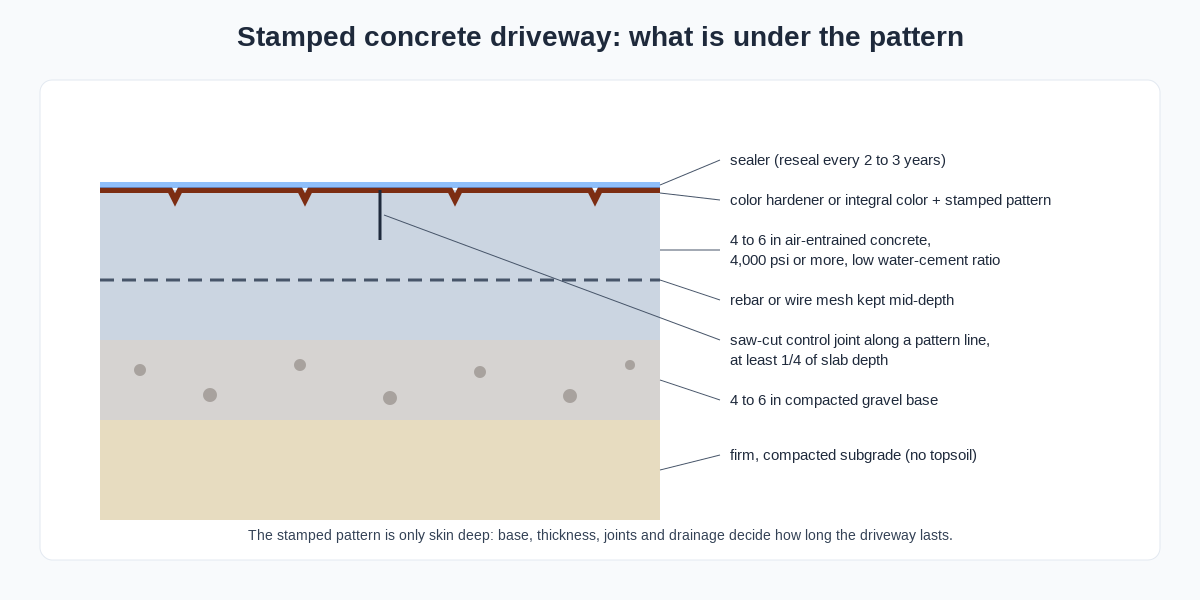
On a stamped concrete driveway, the pattern is only skin deep. What decides whether a stamped concrete driveway lasts is the structure underneath, which should be built to the same standard as any good concrete driveway, or better.
Start with the subgrade. Topsoil and organic material are removed, soft spots dug out and replaced, and the subgrade compacted. A base of 4 to 6 inches of compacted crushed stone goes on top, wider than the slab so the edges are supported. Forms are set with a slope for drainage, usually at least 1 percent away from the garage and toward the street or a drain.
Thickness matters. A stamped concrete driveway for cars should be at least 4 inches thick, and many contractors pour 5 inches as standard; for trucks, RVs, delivery vehicles or soft soils, 6 inches is safer. Thicken the edges and the apron at the street where loads are highest. See how thick a concrete driveway should be.
Reinforcement such as rebar, welded wire mesh or fibers helps hold cracks tight. It must sit in the middle of the slab on chairs, not on the ground. The photo below shows wire mesh laid over a compacted base, ready for a stamped slab. See rebar in concrete and wire mesh for concrete.
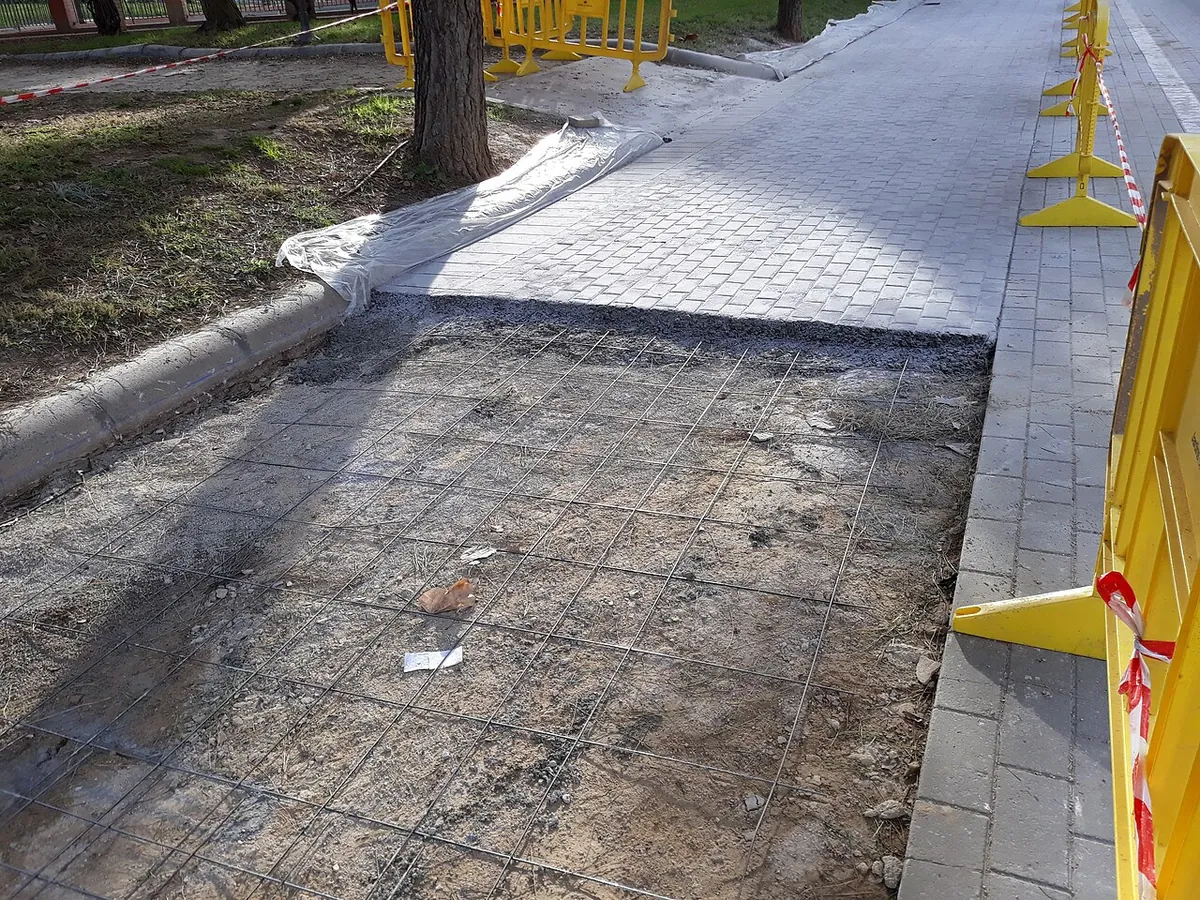
Photo: Pacopac, Wikimedia Commons, CC BY-SA 4.0
The concrete mix should be at least 4,000 psi for a stamped concrete driveway, with a low water-cement ratio, and air-entrained at about 5 to 7 percent air in freeze-thaw climates. Stamping crews like a workable mix, but adding water at the truck weakens the surface that has to resist tires and salt.
Control joints are cut along pattern lines, usually every 10 to 12 feet for a 5 inch slab, at least a quarter of the slab depth, so that cracks happen where they are hidden in the grout lines. Isolation joints separate the driveway from the garage slab, walks and the street curb. See control joints in concrete.
Finally, curing and sealing protect the surface. The slab is cured with a curing compound or covered, then sealed once the concrete is ready, and kept free of vehicles for about a week, longer in cool weather.
Planning a Stamped Concrete Driveway
Good planning saves money and problems later on a stamped concrete driveway. Start with the layout: a single-car driveway is usually 10 to 12 feet wide, a two-car driveway 18 to 24 feet, with extra width or a parking pad where people get in and out of cars. Curves and flared aprons at the street look good with stamped patterns but add forming and stamping time. Check local rules for the curb cut and the apron in the public right of way; many cities require a permit and may restrict decorative finishes or colors in the sidewalk and apron area. Plan drainage so water runs away from the garage and the house, and does not collect at low spots where ice can form in winter.
Think about how the stamped concrete driveway connects with the front walk, porch steps and patio. Using the same pattern or color family throughout ties the property together, while a border pattern can carry from the driveway into the walk. If the budget is limited, consider stamping only the most visible parts, such as the front apron, a border and the walk, with a plain or lightly textured center.
Stamped Concrete Driveway Design Ideas
Popular stamped concrete driveway designs include a cobblestone field with a smooth gray border; ashlar slate with a darker running bond brick band along each edge; a European fan pattern with a circular medallion in a turnaround; a plain broom-finish center with stamped borders and apron, a budget-friendly look; and two-tone designs where the parking pad and the drive use different colors of the same pattern. Circular drives and turnarounds are ideal for fan and radial patterns, which follow curves naturally. On sloped driveways, choose patterns with good texture and a coarser sealer grit for traction.
Installation Day for a Stamped Driveway
A stamped concrete driveway is usually poured and stamped in one day, often starting at first light, because a driveway is a large area and stamping must be finished before the concrete sets. A typical crew includes several finishers and stampers. Ready-mix trucks discharge directly into the forms where possible, or a pump is used. The concrete is placed, screeded and floated, color hardener broadcast and floated in if used, release agent applied, and then stamping starts at one end, with the crew laying mats in rows across the width. Large driveways may be poured in sections on different days, with joints between sections planned along pattern lines.
The next day, the crew washes off excess release, cuts control joints along the pattern, and inspects the surface. Sealing follows once the concrete has cured enough for the chosen sealer. Keep cars off for at least about a week, and heavy trucks off for a month if possible. Foot traffic is usually fine after a day or two.
Climate Considerations
In cold climates, stamped concrete driveways face freeze-thaw cycles, plowing and deicing salts, so air entrainment, a low water-cement ratio, proper curing, a thicker slab and a good sealer are essential. Avoid pouring late in the fall when the concrete will not have time to dry before the first freezes and salt applications. In hot climates, the main challenges are fast setting during installation and UV fading afterward; crews pour early in the morning, and UV-resistant sealers protect the color. In areas with expansive clay soils, a thicker, well-reinforced slab on a deep base reduces cracking. See pouring concrete in cold weather.
Stamped Concrete Driveway Cost Examples
Rough stamped concrete driveway examples help with budgeting. A single-car stamped concrete driveway, 12 by 40 feet or 480 square feet, might cost about $6,000 to $9,600 at $12 to $20 per square foot. A two-car driveway, 24 by 30 feet or 720 square feet, might cost about $8,600 to $14,400. A long or circular driveway of 1,200 square feet might cost $14,000 to $24,000. Adding removal of an old driveway, a thicker slab, extra rebar, multiple colors, borders or a medallion pushes costs higher; choosing one pattern and color, or stamping only borders, brings them down. Always compare quotes based on the same thickness, base, reinforcement, pattern, colors and sealer.
Hiring a Stamped Concrete Driveway Contractor
Look for a decorative concrete contractor with plenty of stamped concrete driveways in their portfolio, ideally some that are several years old so you can see how they have held up. Ask how thick the slab will be, what base and reinforcement they use, the concrete strength and air content, which pattern mats they own, how they will place joints, which sealer they use and whether it is rated for vehicle traffic and hot tire pickup, and what warranty they offer. Get references, proof of insurance and a written contract with all specifications. Avoid quotes that are much cheaper than others without a clear reason; savings often come from a thin slab, poor base or skipped reinforcement.
Repairing a Stamped Concrete Driveway
Even well-built stamped concrete driveways can develop problems over time. Hairline cracks can be filled with a color-matched flexible sealant or a repair compound. Small spalls and chips can be patched with color-matched repair mortar, and a small stamp skin can recreate the texture. Faded or worn color can be refreshed with a tinted sealer or a stain before resealing. Sealer problems such as whitening or peeling can often be fixed by stripping or re-wetting the sealer with solvent and resealing. Severely cracked, settled or scaled sections may need to be cut out and replaced, which is hard to match perfectly, so many owners replace a whole panel between joints. See concrete repair cost.
Does a Stamped Concrete Driveway Add Value?
A well-maintained stamped concrete driveway improves curb appeal and can make a home more attractive to buyers, especially when it matches the walk and patio. It is a durable upgrade that buyers see immediately. How much value it adds depends on the local market and the condition of the driveway at sale time; a worn, faded or cracked stamped driveway can look worse than a clean plain one, so keep up with sealing and repairs if resale is a goal.
Sealing a Stamped Concrete Driveway
Sealer is not optional on a stamped concrete driveway. It protects the color from UV fading, keeps oil, antifreeze and road grime from soaking in, reduces water absorption that leads to freeze-thaw damage and scaling, and gives the surface its rich, wet look. Driveways need tougher sealers than patios. Ordinary acrylic sealers can soften under hot tires and leave "hot tire pickup" marks where the sealer lifts. Many contractors use high-solids solvent-based acrylics, or polyurethane or polyaspartic systems on driveways, sometimes with an anti-slip grit, especially on sloped drives. Reseal about every two to three years, or when water stops beading. See how to seal concrete and concrete sealer.
Maintaining Stamped Concrete Driveways
Regular care keeps stamped concrete driveways looking good. Sweep and rinse the surface regularly, and wash it with a mild detergent and a low-pressure washer a couple of times a year. Clean oil and fluid drips quickly with a degreaser before they soak through worn sealer; see how to remove oil stains from concrete. In winter, use plastic snow shovels or a snowblower set high to avoid scratching the sealer, and avoid deicers with ammonium nitrate or ammonium sulfate, which attack concrete; calcium magnesium acetate or sand are gentler. Do not use rock salt on a new driveway in its first winter. Keep gutters and downspouts from dumping water onto the edges, which can erode the base. See does salt damage concrete.
Pros and Cons of a Stamped Concrete Driveway
The advantages are clear: the look of stone, brick or cobble at a lower price than the real materials or many paver systems; a solid, continuous surface with no joints for weeds or ants; fast installation, often a day or two for the pour; and a long service life when well built and maintained. A stamped concrete driveway also adds curb appeal that buyers notice.
The disadvantages are worth weighing too. Stamped concrete costs more than plain concrete or asphalt. It needs resealing every few years, which is an ongoing cost. Cracks can still happen, and repairs are harder to blend because color and pattern must be matched. Sealers can be slippery when wet, especially on slopes. In very cold climates with heavy salt use, poor installation or skipped sealing can lead to scaling. And unlike pavers, individual pieces cannot be lifted and replaced.
Stamped Concrete Driveway vs Pavers, Asphalt and Plain Concrete
Compared with plain concrete, a stamped concrete driveway costs more and needs sealing, but looks far more decorative. Compared with asphalt, it costs considerably more up front, but lasts longer, stays cooler and does not need sealcoating as often; see asphalt vs concrete driveway cost. Compared with interlocking pavers, stamped concrete usually costs less and has no joints for weeds, while pavers cost more but can be lifted and relaid, handle frost heave well, and show less from cracks because each paver moves independently. In areas with heavy frost or moving soils, pavers are often the more forgiving choice; elsewhere, a well-built stamped concrete driveway performs very well. See stamped concrete vs pavers.
Can You Stamp an Existing Concrete Driveway?
You cannot press a pattern into hardened concrete, but you can stamp concrete driveway overlays. A stamped overlay is a thin layer of polymer-modified cement, applied over a sound existing driveway, colored and stamped with thin mats. It works only if the old driveway is structurally sound, without major settlement, heaving or wide cracks, and properly prepared. Overlays on driveways must be rated for vehicle traffic. They cost less than replacement but are thinner and depend on the old slab beneath. Another option is saw-cutting a pattern and staining an existing driveway, which adds a tile or stone look without an overlay. See concrete driveway resurfacing and concrete overlay cost.
Is a Stamped Concrete Driveway Right for You?
A stamped concrete driveway is a good fit if you want a decorative, durable drive at a moderate price, are willing to reseal every few years, and live where a well-built slab performs well. It is less suitable if you want zero maintenance, if your soil moves a lot, or if you expect heavy trucks regularly and cannot afford a thicker slab. For many homes, a stamped concrete driveway with a matching walk and patio is one of the most effective curb appeal upgrades available.
Questions to Settle Before You Stamp Concrete Driveway Slabs
Before committing, settle a few decisions with your contractor: the pattern and how it will run relative to the garage and street; the base and accent colors, seen on sample boards in daylight; borders and where they go; the slab thickness and reinforcement; the joint layout and how it fits the pattern; the sealer type and how often it should be reapplied; and the schedule, including when cars can use the drive. Agreeing on these points in writing avoids disappointment later and helps the crew stamp concrete driveway sections consistently from one end to the other. A stamped concrete driveway is a big investment, and clear decisions up front are what turn it into a long-lasting one.
Living With a New Stamped Driveway
The first weeks after a stamped concrete driveway is installed matter. Keep vehicles off until the contractor says the slab is ready, usually about a week, and keep heavy trucks off for longer. Do not let anyone park on the edges or drive over the lawn next to the new slab, where the base is less supported. Avoid turning car wheels sharply while stationary on fresh sealer, which can scuff it. Water the edges of new sod or plants carefully so runoff does not undermine the base. In the first winter, skip rock salt entirely and use sand for traction. After the first year, walk the driveway with a critical eye: note any cracks, worn sealer or low spots, and fix them early. A stamped concrete driveway rewards a little attention in its first year with many years of good looks and service.
For any stamped concrete driveway, keep a record of the pattern name, the color names and the sealer product used. If you ever need a repair, a patch, or a resealing by a different contractor, those details make it much easier to match the original finish closely.
Common Stamped Driveway Problems
The most common problems with stamped concrete driveways are cracks that do not follow pattern lines, often from joints placed too far apart, a weak base or a thin slab; hot tire pickup where soft sealer lifts under tires; faded or patchy color from worn sealer; white, cloudy sealer from trapped moisture; and scaling or flaking from salt, poor curing or finishing problems. Most of these can be prevented by good construction and timely resealing, and many can be repaired: cracks filled with tinted sealant, sealer stripped and reapplied, and scaled areas resurfaced. See concrete pitting and flaking and how to fix cracks in a concrete driveway.
Frequently Asked Questions
How much does a stamped concrete driveway cost?
Usually about $12 to $20 or more per square foot installed, or roughly $6,000 to $16,000 for typical residential driveways.
How long does a stamped concrete driveway last?
Often 25 years or more when built on a good base, jointed properly and resealed every two to three years.
Is stamped concrete good for driveways?
Yes, if built thick enough with reinforcement, air-entrained concrete in cold climates, and a tough sealer.
Is a stamped concrete driveway slippery?
It can be when wet or icy, especially with glossy sealer. Choose textured patterns and add anti-slip grit to the sealer.
Sources
- American Concrete Institute: ACI 330R guide for concrete parking lots and site paving; ACI 310R decorative concrete
- Portland Cement Association: concrete driveways and decorative concrete
- National Ready Mixed Concrete Association: CIP 2 (scaling) and CIP 6 (joints)
- American Society of Concrete Contractors, Decorative Concrete Council
Related Guides
- Stamped concrete patterns — slate, flagstone, brick, cobble and wood
- Concrete driveway apron — street and garage aprons, thickness and cost
- Cleaning concrete driveway — pressure washers, cleaners and stains
- Is calcium chloride safe for concrete? — choosing the best ice melt
- Decorative concrete — types, finishes and costs
- Concrete trench drain — channel drains, grates, install and cost
- Concrete release agents — form oil and reactive release for forms and molds
- Stamped concrete floors — indoor patterns, overlays vs new slabs, sealers and cost